
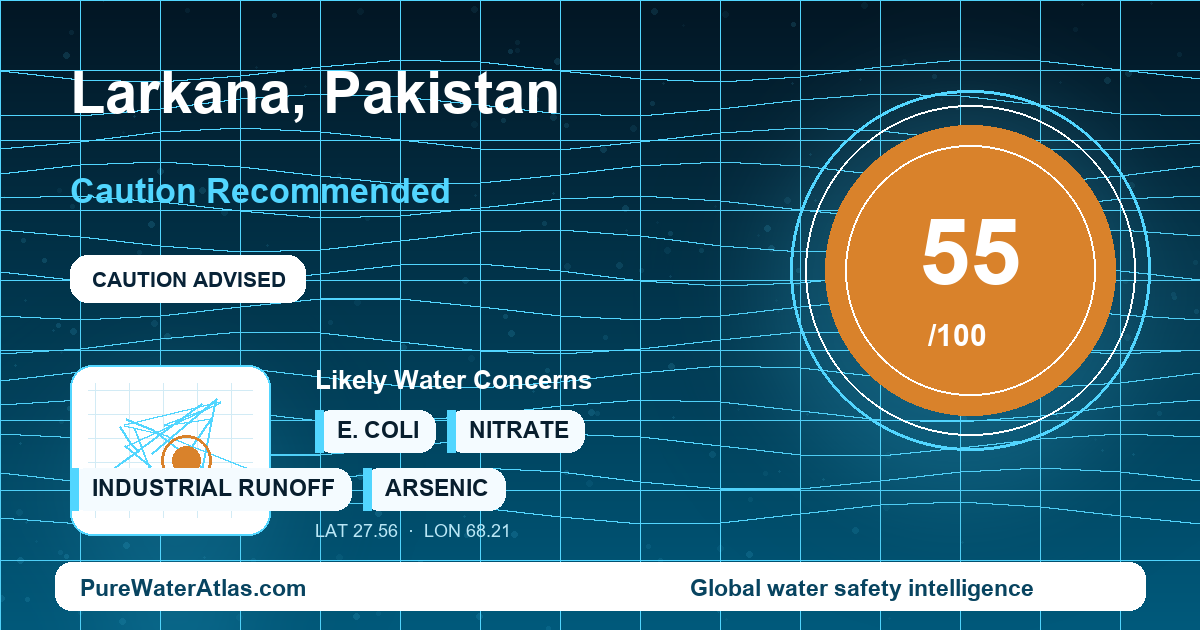
Larkana, Pakistan: canal-influenced municipal water, intermittent distribution, household storage, and bore-water uncertainty mean caution is recommended before drinking from the tap.
Quick Answer
| Overall safety status | Caution recommended. Larkana’s municipal tap water should not be assumed reliably potable without point-of-use treatment. |
|---|---|
| Water safety score | 55 / 100 — risk level: Caution Recommended. |
| For travelers | Do not drink untreated tap water. Use sealed bottled water from reputable brands, boiled water, or water treated by a reliable purifier. |
| For residents | Treat municipal water as a source that may be usable after household controls: clean storage tanks, use suitable treatment, and test the actual drinking tap. |
| Main water source context | Indus River-fed canal water associated with the Sukkur Barrage right-bank canal system, especially the Rice Canal area, plus private boreholes, hand pumps, tankers, and stored water in some households. |
| Responsible institutions | Local and provincial responsibility involving Larkana Municipal Corporation, Sindh Local Government, Sindh Public Health Engineering Department, and historically North Sindh Urban Services Corporation under Sindh urban improvement programs. |
| Filter recommendation | For municipal water, use sediment prefiltration plus disinfection such as boiling, UV with clear water, or chlorination. Consider reverse osmosis only when TDS, salinity, arsenic, nitrate, or dissolved contaminants are confirmed or suspected. |
Confidence level: Medium-low. Recent, ward-level, consumer-facing Larkana tap-water compliance data is limited, so this profile focuses on documented infrastructure context, national and provincial water-quality concerns, and practical risk pathways specific to Larkana.
Why Larkana Is Different
Larkana is an upper Sindh city west of the Indus River, located in a hot, irrigated agricultural belt. Its drinking-water risk profile is shaped by the Indus canal network, seasonal flows, irrigation demand, monsoon rainfall, flood risk, and the realities of urban water distribution in a city where many buildings rely on storage tanks or supplementary sources.
The key issue is not that every tap in Larkana has the same confirmed contaminant problem. It is that water safety can change depending on the exact source being used that day: canal-supplied municipal tap water, household tank water, a private bore, a tanker supply, a mosque or market filtration point, or bottled water. Asking whether a building has tap water is not enough. The safer question is whether the water used for drinking has been boiled, filtered, disinfected, and stored in a clean covered container.
Larkana has also been part of broader northern Sindh urban infrastructure improvement discussions and projects, reflecting long-running concerns about water supply, sanitation, drainage, and municipal-service capacity. This matters for drinking water because a treated source can still become unsafe before it reaches the glass if pipes leak, pressure is intermittent, storage tanks are dirty, or sewerage and drainage systems interact with damaged water lines.
Where Does Larkana’s Tap Water Come From?
Larkana sits on the Indus alluvial plain. The city’s urban water supply is generally associated with Indus River-fed canal water from the Sukkur Barrage right-bank canal system, especially the Rice Canal area. Municipal water-supply works may include pumping, storage, settling or filtration infrastructure where functioning and maintained, overhead or ground-level reservoirs, and distribution mains that carry water to homes and businesses.
Historically, water use in the district has been tied to the Indus irrigation network and shallow groundwater in an agricultural region known for rice cultivation. Canal water and local groundwater have both been used. However, groundwater quality in Sindh can vary sharply because of salinity, arsenic risk in parts of the province, and contamination linked to sanitation conditions. For that reason, private boreholes, hand pumps, and tanker sources should not be treated as automatically safer than municipal water.
The main local infrastructure risk pathway is the combination of canal-source surface water, intermittent pressure, old or leaking distribution pipes, nearby drainage and sewerage lines, and household storage tanks. Even if water is treated at a municipal works, quality can deteriorate in the distribution network or inside a building. Rooftop and underground tanks are especially important in Larkana because stored water can be recontaminated by dust, insects, biofilm, unclean covers, hoses, or poor tank maintenance.
Seasonal factors also matter. Monsoon rainfall can increase runoff, turbidity, drain overflows, and microbial contamination risk. Flooding in Sindh, including the 2022 Pakistan floods, showed how vulnerable water and sanitation systems in the region can be. Canal closures or desilting periods in the Sukkur Barrage canal system can reduce raw-water availability and increase reliance on stored water, tankers, or alternate supplies. Summer heat raises water demand and can worsen quality in household tanks when water is stored for long periods. Power outages can interrupt pumping and reduce system pressure, increasing intrusion risk in leaky networks.
Who Manages Drinking Water in Larkana?
Larkana does not appear to have a single highly transparent city utility publishing routine consumer-facing annual water-quality reports comparable to a United States Consumer Confidence Report. Urban water-service responsibility is local and provincial. Relevant institutions include Larkana Municipal Corporation under the Sindh Local Government framework, the Government of Sindh Public Health Engineering Department for water-supply schemes, and historically the North Sindh Urban Services Corporation under the Sindh Cities Improvement Investment Program for selected northern Sindh urban services including Larkana.
Pakistan’s benchmark for drinking-water quality is the National Standards for Drinking Water Quality, with provincial and local implementation. Sindh Environmental Protection Agency has environmental oversight relevant to water pollution and wastewater, while the Pakistan Council of Research in Water Resources is a high-authority national body that publishes drinking-water quality monitoring and research. For household decision-making in Larkana, the lack of recent public tap-by-tap or ward-level results means residents should rely on actual testing of the water they drink, not assumptions based only on the source name.
Main Local Water Concerns
The most important concern in Larkana is microbial contamination risk. Intermittent pressure, leaking pipes, sewer intrusion, and unsafe storage can allow contamination to enter water after it leaves the source or treatment works. This is why water that looks clear may still be unsafe, especially for children, visitors, pregnant people, older adults, and immunocompromised people.
Turbidity and sediment are also relevant because Larkana’s raw-water context is canal-influenced. Canal disturbance, heavy rain, poor settling, or filtration problems can increase suspended particles. Turbid water can reduce the effectiveness of disinfection and may signal operational problems, although visible particles alone do not prove the water is unsafe or safe.
Chlorine residual is another practical concern. If municipal water is disinfected but residual chlorine is inconsistent or unverifiable at the household tap, water can become vulnerable to recontamination in pipes and tanks. A chlorine smell is not a reliable safety certificate; residual levels and microbial testing are more useful.
For private groundwater, the concern shifts toward salinity, high TDS, arsenic, nitrate, and basic chemistry, along with microbial indicators. Sindh has regional groundwater-quality variation, including arsenic concerns in parts of the province, but arsenic should not be assumed present or absent at a specific Larkana address without testing. Nitrate is relevant where shallow groundwater may be affected by sewage, septic systems, animal waste, or agricultural inputs.
For Travelers
Can travelers drink Larkana tap water? For most travelers, the answer is no. Do not drink untreated tap water in Larkana unless it has been boiled, disinfected, or passed through a well-maintained purifier suitable for microbial risks and local water chemistry. Short-term visitors should not rely on taste, clarity, or hotel assurances unless the premises can clearly show a maintained filtration or boiling system.
Use sealed bottled water from reputable brands, and prefer bottles opened in front of you. Avoid unsealed water containers in guest houses, bus stands, markets, and small restaurants. In hot weather, carry oral rehydration salts because dehydration can become a practical risk if you avoid drinking enough fluid.
For brushing teeth, use bottled, boiled, or properly filtered water if you are a short-term visitor, have a sensitive stomach, are pregnant, immunocompromised, or traveling with children. Avoid ice unless you know it was made from treated water. In small eateries and roadside drink stalls, assume ice may be made from untreated tap or bulk water.
In hotels and restaurants, ask whether drinking water is sealed bottled water, boiled water, or filtered water from a maintained system. Hot tea or coffee made with fully boiled water is generally a safer choice than cold drinks mixed with uncertain water or ice. Cooked foods served hot are preferable to items rinsed or diluted with untreated water.
If using a portable purifier, choose one designed for bacteria and protozoa, and add boiling or disinfection where viruses are a concern. For practical background, see PureWaterAtlas guides on boiling water purification and water purification methods.
For Residents
For Larkana residents, a home filter is often advisable, but the right setup depends on the source. For municipal canal-supplied water, a practical approach is sediment prefiltration plus disinfection. Boiling, UV treatment with clear prefiltered water, or chlorination can reduce microbial risk when used correctly. Reverse osmosis may be useful where TDS, salinity, arsenic, nitrate, or other dissolved contaminants are confirmed or suspected, but it should not be chosen blindly for every home without testing.
Private boreholes and hand pumps should be tested before long-term drinking use. Do not assume groundwater is safer simply because it is private or clear. At minimum, test the actual drinking tap for E. coli or thermotolerant coliforms, total coliforms, turbidity, pH, electrical conductivity, TDS, residual chlorine if using municipal water, hardness, nitrate, arsenic, iron, and manganese. For private boreholes, include arsenic, nitrate, fluoride where available, salinity/TDS, and microbial indicators.
Retest after flooding, major pipe repairs, sewer overflows, changes in taste or color, long storage, or installation of a new borehole. Use an accredited laboratory where possible, such as a government, university, PCRWR-linked, or recognized private laboratory, and keep results so changes can be compared over time.
Older buildings in Larkana may have corroded internal plumbing, illegal cross-connections, leaking service lines, or stagnant roof-tank plumbing. Pakistan is not typically dominated by lead service-line history in the same way as some older Western systems, but lead can still occur from brass fittings, solder, old fixtures, and contaminated plumbing materials. Testing is the only reliable way to know.
Storage tanks are a major household control point. Keep underground and rooftop tanks covered, clean and disinfect them on a schedule, prevent bird and insect entry, avoid dipping cups or hoses into stored water, and flush tanks after floodwater contact or sewage backflow. A well-maintained purifier cannot fully compensate for a dirty tank that keeps recontaminating water.
Relevant Contaminants and Water-Quality Issues
The most relevant issue for Larkana’s intermittent supply, sanitation, and household storage conditions is E. coli, which indicates fecal contamination and possible disease-causing microbes. Related microbial risks are explained in the PureWaterAtlas Water Microbiology guide.
Turbidity and sediment are important because Larkana’s supply is influenced by canal-source water, monsoon runoff, pipe disturbance, and storage. High turbidity can interfere with disinfection and may point to filtration or distribution issues.
Chlorine matters because residual disinfection helps protect water in distribution, but inconsistent or unknown chlorine residual at the household tap leaves uncertainty. For private boreholes and groundwater, arsenic and nitrate should be tested rather than guessed. PureWaterAtlas also has focused guides on arsenic testing and detection and nitrate testing and detection.
How to Verify Your Water Quality
The best way to verify drinking-water safety in Larkana is to test the water actually used for drinking, not only the canal source, borehead, or storage tank. Contamination can enter through municipal pipes, internal plumbing, rooftop tanks, underground storage, tanker transfers, or household handling.
Start with microbial testing and basic field indicators, then add chemical testing based on the source. Municipal users should check E. coli or thermotolerant coliforms, total coliforms, turbidity, pH, TDS or electrical conductivity, and residual chlorine. Bore-water users should add arsenic, nitrate, fluoride where available, salinity/TDS, iron, manganese, hardness, and microbial indicators.
For a broader testing framework, use the PureWaterAtlas complete guide to water testing and analysis. If you receive lab results and need to understand the parameters, use the Contaminants Search Engine. Travelers comparing destinations can use the Global Water Quality Checker, and broader country and city context is available in Global Water Quality. For general decision-making, see Drinking Water Safety.
Official and Technical Sources
- Asian Development Bank, Sindh Cities Improvement Investment Program — urban infrastructure improvement context for northern Sindh cities, including water, sanitation, and municipal-service issues relevant to Larkana.
- Pakistan Council of Research in Water Resources, Water Quality Reports — national authority for Pakistan drinking-water quality monitoring and research.
- National Standards for Drinking Water Quality, Pakistan — reference point for Pakistan drinking-water parameters and standards framework.
- Sindh Environmental Protection Agency — provincial environmental regulator relevant to water pollution, wastewater, and environmental compliance in Sindh.
- Local Government Department, Government of Sindh — provincial local-government authority relevant to municipal service responsibility.
- Public Health Engineering Department, Government of Sindh — provincial department associated with water-supply and drainage schemes in Sindh.
- WHO emergency information on Pakistan floods — public-health context for flood-related water, sanitation, and disease risks in Pakistan, including Sindh.
- UNICEF Pakistan Water, Sanitation and Hygiene — WASH context on Pakistan safe-water, sanitation, and child-health challenges.
Data limitation: Recent, routine, publicly accessible Larkana ward-by-ward tap-water test results were not found in a form that supports precise neighborhood safety claims. Conditions can differ by street, building plumbing, storage tank, private bore, and season.
Bottom Line
Larkana tap water should be treated with caution. The city depends on an Indus canal-influenced urban water context, with risks shaped by intermittent supply, aging or leaking distribution lines, drainage and sewerage proximity, household storage tanks, seasonal turbidity, heat, flooding, and source switching between municipal water, private bores, tankers, and bottled water. Visitors should use sealed bottled, boiled, or reliably purified water and avoid untreated tap water and uncertain ice. Residents should test the actual drinking tap, keep storage tanks clean and covered, and match treatment to the source: sediment plus disinfection for municipal water, and laboratory-guided treatment for bore water, especially where TDS, salinity, arsenic, nitrate, or microbial contamination may be present.
Read the full guide: Global Water Quality Guide
Explore more in this category: Global Water Quality Articles