
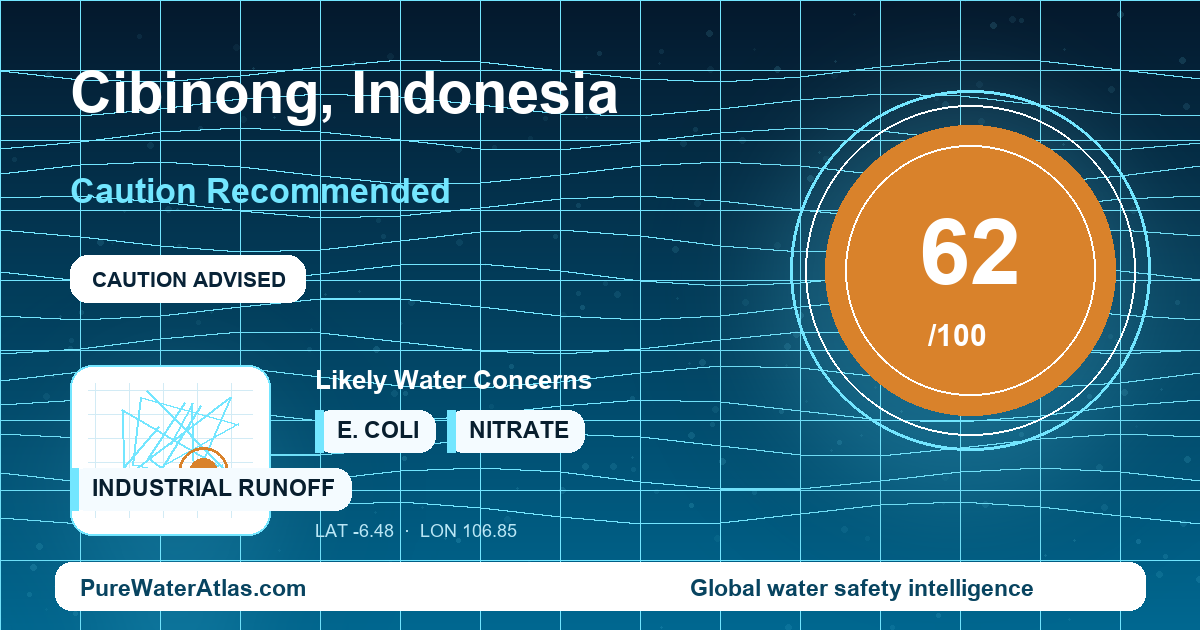
Cibinong, Indonesia: tap water safety score 62/100 — caution recommended, especially for travelers, private-well users, and homes with storage tanks or uncertain plumbing.
Quick Answer
| Overall status | Caution recommended. Do not assume untreated tap water in Cibinong is safe to drink directly. |
|---|---|
| Water safety score | 62/100 |
| Traveler advice | Use sealed bottled water, properly boiled water, or water treated by a reliable purifier. Be cautious with ice and informal refill water. |
| Resident advice | Manage household risks: clean tanks, monitor turbidity and pressure interruptions, and use boiling, UV, or filtration for drinking water. |
| Main water context | Treated local/regional surface water within the Ciliwung-Cisadane basin, plus mixed household sources such as private wells, tanks, refill depots, and bottled water. |
| Local water authority | Perumda Air Minum Tirta Kahuripan Kabupaten Bogor serves Bogor Regency, including Cibinong service areas. |
| Filter recommendation | A home treatment barrier is recommended for drinking water. For utility water, boiling or UV with sediment filtration can reduce common microbial and turbidity risks when maintained correctly. Private wells should be tested before choosing treatment. |
For short-term visitors, the safest practical answer is: do not drink Cibinong tap water straight from the tap. For residents, the answer depends heavily on whether the household uses PDAM utility water, a private well, roof or ground storage tanks, refill water, or a combination. Public, routinely updated, Cibinong-specific water-quality reports are limited, so this guidance is based on the verified utility identity, the Ciliwung-Cisadane watershed setting, national Indonesian drinking-water rules, and practical household risk factors.
Why Cibinong Is Different
Cibinong is inland in Bogor Regency, south of Jakarta, and sits within the humid tropical Ciliwung-Cisadane watershed. Because it is not a coastal city, salinity intrusion is not the primary drinking-water concern here. The more relevant Cibinong issues are surface-water turbidity, microbial contamination risk, drainage impacts, private wells, household storage, and what happens to water after it leaves the public utility system.
The city’s practical water-safety profile is shaped by mixed water use. Many households in Indonesian urban areas do not rely on one source only. In Cibinong, a household may use Perumda Air Minum Tirta Kahuripan piped water, a private well, a roof tank, a ground tank, bottled water, or refill depot water. This mixed-source pattern matters because treated utility water and privately managed water can have very different risk profiles, even within the same neighborhood.
The most important city-specific distinction is therefore not simply “tap water versus bottled water.” It is the difference between water treated and distributed by the Bogor Regency utility and water affected by household tanks, building plumbing, stagnant pipes, shallow wells, flood exposure, septic systems, or informal handling. A home with steady utility pressure, a clean sealed storage tank, and a maintained purifier can have much lower drinking-water risk than a nearby home using a shallow well beside drains or septic tanks.
Where Does Cibinong’s Tap Water Come From?
Cibinong is part of the Bogor Regency water-supply area served by Perumda Air Minum Tirta Kahuripan Kabupaten Bogor. The safest verified description of the local raw-water setting is treated local and regional surface water within the Ciliwung-Cisadane river-basin context, with additional spring or groundwater sources used elsewhere in the wider Bogor Regency service area. Public sources do not provide a single continuously updated city-level source-water statement for every Cibinong distribution zone.
The Ciliwung-Cisadane basin is managed in the national water-resources context by the Indonesian public works river-basin authority, including Balai Besar Wilayah Sungai Ciliwung Cisadane. This watershed context is important because wet-season runoff, river turbidity, drainage conditions, and urban pressure can affect raw-water quality before treatment.
Cibinong also has an older and continuing household water identity. As the administrative center of Bogor Regency, it developed in an area where many households historically used shallow wells, local groundwater, or refill water in addition to piped service. That pattern has not disappeared. In areas not fully served by reliable piped water, or in homes where residents supplement utility water, the water at the point of drinking may come from non-piped sources that require separate testing and treatment.
Key infrastructure affecting drinking water in Cibinong includes the regency-owned utility system, local Cibinong distribution networks, surface-water treatment infrastructure in the Bogor Regency system, household tanks, private wells, refill-water depots, and building plumbing. For safety at the glass, the last three are often as important as the treatment plant.
Who Manages Drinking Water in Cibinong?
The local public drinking-water company for Bogor Regency, including Cibinong service areas, is Perumda Air Minum Tirta Kahuripan Kabupaten Bogor. It is the relevant utility identity for piped drinking-water service in the regency system.
National drinking-water health requirements in Indonesia are set by the Ministry of Health. The key regulatory context in this dataset is Permenkes No. 2 Tahun 2023, which sets environmental health quality standards, including drinking-water-related parameters. River-basin water resources are overseen through the Ministry of Public Works’ Ciliwung-Cisadane basin organization.
The main limitation for Cibinong consumers is transparency at the neighborhood level. Publicly accessible, regularly updated, Cibinong-specific consumer confidence style reports were not found in the available high-authority sources. That means this profile should not be read as a claim that every tap in Cibinong either passes or fails specific laboratory limits. Conditions can differ by service zone, building plumbing, pressure history, household storage, and whether the home uses PDAM water, a private well, refill water, or bottled water.
Main Local Water Concerns
- Microbial contamination: The leading practical concern is microbial risk from private wells, poorly cleaned storage tanks, cross-connections, loss of pipe pressure, or water affected by flooding and drainage. Learn more about E. coli in drinking water.
- Rainy-season turbidity: The wet season can increase runoff, river turbidity, drain overflows, and microbial loading. Cloudy water or sudden sediment can reduce confidence in water safety and may interfere with some treatment devices. See turbidity.
- Sediment and discoloration: Pipe repairs, local distribution work, stagnant household plumbing, and tank accumulation can produce particles or brownish water. See sediment in water.
- Chlorine taste or odor variation: Chlorine taste may indicate disinfection is present, but taste alone does not prove the water is safe at the household tap. See chlorine in drinking water.
- Nitrate in shallow wells: Wells near septic tanks, dense settlement drainage, agriculture, or animal waste should be tested for nitrate. See nitrate.
- Iron and manganese in groundwater: Private wells may have metallic taste, staining, brown particles, or black particles associated with iron or manganese. See iron in water.
- Building-specific lead risk: Lead is not documented as a citywide Cibinong issue in this dataset, but older plumbing, brass fittings, solder, or unknown materials can create exposure in individual buildings. See lead in drinking water.
Seasonality matters. After heavy rain, flooding, or ponded water, shallow-well users should be especially cautious and should boil or disinfect water until testing confirms safety. During dry periods, source availability and pressure conditions may change, and some households may rely more heavily on alternative sources.
For Travelers
Travelers should treat Cibinong tap water as not safe to drink directly unless it has been properly boiled, filtered with a reliable purifier, or supplied as sealed bottled water. This is especially important for short-term visitors, people prone to stomach illness, pregnant travelers, immunocompromised people, and families with young children.
For brushing teeth, use bottled or boiled water if you are visiting temporarily or if your health risk is higher. Long-term residents may feel adapted to local water conditions, but adaptation is not the same as verified safety.
Ice requires judgment. Ice in major hotels, established restaurants, and chains is more likely to be made from treated water, but this is not guaranteed. Avoid ice from street stalls or informal vendors if the source and handling are unclear. Also be cautious with drinks diluted with unknown water, unsealed refill containers, and raw foods rinsed in untreated water if you are sensitive.
In hotels and restaurants, ask whether drinking water is bottled, boiled, or filtered. Many properties provide bottled water or dispenser water. Do not assume bathroom tap water is drinking water unless the property specifically states that it is treated for drinking. Hot drinks made with water that reached a rolling boil are generally a safer choice for microbial risk. For practical background, see PureWaterAtlas on boiling water purification.
For Residents
Cibinong residents should think in terms of a household water-safety chain: source, distribution, storage, plumbing, and final treatment. If you are connected to Perumda Air Minum Tirta Kahuripan, you should still manage risks inside the home. Clean storage tanks, monitor for pressure interruptions, flush after stagnant periods, and use a maintained treatment barrier for drinking water.
For utility water, boiling or UV plus sediment filtration can address common microbial and turbidity concerns when the system is installed and maintained correctly. UV works best when water is clear enough for light to penetrate; if water is cloudy, pretreatment is important. See UV water purification and the PureWaterAtlas guide to choosing water treatment systems.
If you use a private well, do not choose treatment based only on taste or appearance. Test at least annually for E. coli and total coliform, and retest after flooding, septic leaks, unusual odor, or nearby construction. Test nitrate if your well is shallow or near septic tanks, agriculture, animal waste, or dense settlement drainage. Check turbidity, pH, TDS, iron, and manganese if water is cloudy, metallic, staining fixtures, or visibly particulate. For nitrate-specific testing guidance, see nitrate contamination testing and detection.
Older buildings need extra caution. Unknown plumbing materials, brass fittings, solder, or aging pipes can contribute metals or sediment even when incoming utility water is treated. Flush stagnant water, avoid first-draw hot water for cooking or infant formula, and consider first-draw and flushed lead testing if plumbing materials are unknown. See lead testing and detection methods.
Storage tanks are a major Cibinong-style practical risk. Roof tanks and ground tanks should be sealed, screened against insects and animals, cleaned periodically, and protected from floodwater. If slime, sediment, mosquito larvae, odor, or discoloration appears, do not drink the water untreated. If you test water, sample after the tank as well as from the source tap because tanks and internal plumbing can introduce contamination.
Relevant Contaminants and Water-Quality Issues
The most relevant Cibinong water-quality issues are not based on a single published citywide contaminant table; they follow from the local utility context, mixed water use, tropical wet-season conditions, private wells, and household storage. The key issue for illness prevention is microbial safety, especially E. coli and total coliform testing in wells and stored water.
For cloudy water after rain, network disturbance, or tank accumulation, review turbidity and sediment. For taste and disinfection questions in utility water, review chlorine. For shallow wells near septic systems or dense drainage, review nitrate. For groundwater staining or metallic taste, review iron. For older or uncertain building plumbing, review lead.
How to Verify Your Water Quality
Because public Cibinong-specific, routinely updated water-quality reporting is limited, the best way to verify your own water is to test the water you actually drink. For residents, that usually means sampling after household storage tanks and at the kitchen tap, not only at the incoming line. If you use a well, include microbial indicators, nitrate, turbidity, pH, TDS, iron, and manganese; add lead testing where building plumbing is old or unknown.
Use PureWaterAtlas resources to plan testing and treatment decisions: start with the guide to drinking-water testing, review the broader drinking water safety guide, and consult water microbiology for bacteria, viruses, and microbial risk. You can also use the Global Water Quality Checker and the Contaminants Search Engine to compare issues and treatment approaches.
For additional PureWaterAtlas context, see the Drinking Water Safety, Global Water Quality, Water Microbiology, and Water Testing sections.
Official and Technical Sources
- Perumda Air Minum Tirta Kahuripan Kabupaten Bogor — local drinking-water utility for Bogor Regency, including Cibinong service areas.
- Balai Besar Wilayah Sungai Ciliwung Cisadane — official Ciliwung-Cisadane river-basin management context.
- Permenkes No. 2 Tahun 2023 — Indonesian Ministry of Health regulation on environmental health quality standards.
- Badan Pusat Statistik Kabupaten Bogor — official Bogor Regency statistical source for local demographic and infrastructure context when available.
- WHO/UNICEF Joint Monitoring Programme Indonesia household WASH data — national context on drinking-water and sanitation service levels.
- CDC Travelers’ Health: Indonesia — traveler health guidance supporting caution with local water, food, and hygiene practices.
- Indonesia Ministry of Environment and Forestry water quality information portal — national environmental and water-quality program context.
Bottom Line
Cibinong tap water should be approached with caution, not treated as automatically drinkable from the tap. The city is served within the Bogor Regency system by Perumda Air Minum Tirta Kahuripan, but public Cibinong-specific water-quality reports are limited, and household conditions vary. Travelers should use sealed bottled water, boiled water, or a reliable purifier, and should be careful with ice and informal refill water. Residents should focus on the water they actually consume: clean storage tanks, watch for turbidity or pressure interruptions, test private wells for microbes and nitrate, and use appropriate treatment for drinking. The biggest practical risks are microbial contamination, wet-season turbidity, shallow-well vulnerability, tank hygiene, and building-specific plumbing issues.
Read the full guide: Global Water Quality Guide
Explore more in this category: Global Water Quality Articles