
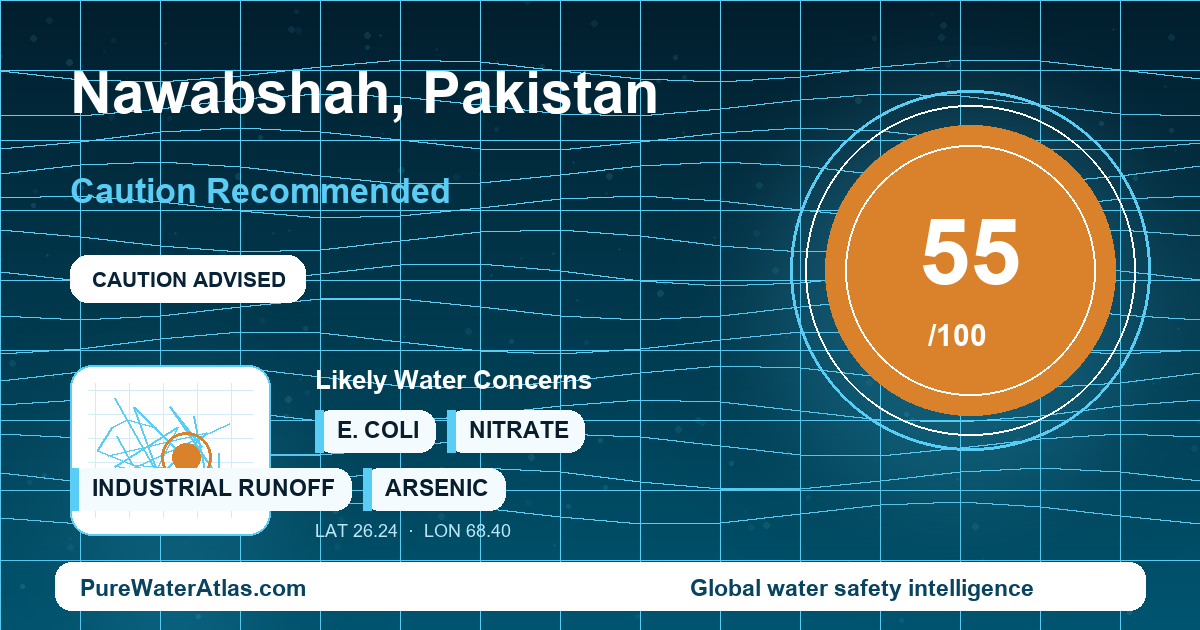
Nawabshah, Sindh: canal-fed municipal water, intermittent distribution, household storage, and variable bore-water quality make untreated tap water a caution-level choice.
Quick Answer
| Water safety score | 55 / 100 |
|---|---|
| Risk level | Caution Recommended |
| Can tourists drink the tap water? | No, not as a default. Visitors should avoid untreated tap water in Nawabshah and use sealed bottled water, boiled water, or water treated by a trustworthy maintained system. |
| Resident advice | Treat municipal, bore, tanker, and stored water as variable. Test the water actually used for drinking, then choose sediment filtration, disinfection, UV, or RO according to results. |
| Main water source | Primarily Indus irrigation-canal surface water through the regional canal network, commonly associated with the Rohri Canal and local distributaries; some homes also use private boreholes, hand pumps, tanker water, or mixed sources. |
| Water authority context | Urban water supply is mainly a local-government responsibility through the Nawabshah municipal administration, with support from the Public Health Engineering Department, Government of Sindh. No widely documented independent WASA-style utility is identified for Nawabshah. |
| Filter recommendation | For piped water: sediment pre-filtration plus reliable disinfection or UV where water is clear enough. For bore, tanker, salty, or high-TDS water: lab testing first; RO may be needed for dissolved contaminants. |
Editorial verdict: Caution is recommended. Nawabshah is not a city where untreated tap water should be assumed safe for visitors or high-risk residents. The concern is the combined risk profile: canal-fed surface water, intermittent distribution, household tanks, variable disinfection, possible sewage intrusion, and mineralized groundwater use. Current public, tap-by-tap compliance data for Nawabshah are limited, so this page gives a risk-based safety verdict rather than claiming that every tap passes or fails today.
Why Nawabshah Is Different
Nawabshah, officially in Shaheed Benazirabad District, sits in central Sindh on the hot, low-rainfall Indus alluvial plain. This geography matters for drinking water. Reliable freshwater in this part of Sindh is closely tied to the Indus irrigation network, while local groundwater in much of central Sindh can be saline or otherwise mineralized. As a result, canal-fed municipal water and stored surface water have historically been important for drinking-water schemes where available.
The city also has a practical water-quality challenge that is not captured by looking only at the raw-water source. Many households store water in underground or rooftop tanks, use booster or suction pumps, buy tanker water during shortages, or blend piped water with private bore water. In Nawabshah, the quality at the glass can therefore differ sharply from the quality entering a municipal reservoir or distribution main.
Water-quality references may appear under either Nawabshah or Shaheed Benazirabad, which makes city-specific research harder. This also increases the risk of missing district-level findings when looking for Nawabshah-specific water data. Because there is no easily accessible routine public dashboard showing current tap-level microbiology, residual chlorine, turbidity, TDS, arsenic, nitrate, and metals by neighborhood, household testing remains important.
Where Does Nawabshah’s Tap Water Come From?
Nawabshah’s urban public supply is understood to rely mainly on Indus irrigation-canal surface water conveyed through the regional canal system, commonly associated with the Rohri Canal and local distributaries. This raw water is typically moved to municipal storage ponds or reservoirs that buffer canal supply and allow some settling before water is filtered, pumped, and distributed.
Key infrastructure affecting water quality includes canal intake and conveyance, raw-water storage ponds, settling and filtration arrangements, pumping facilities, distribution mains, local service lines, and household storage tanks. The final step is especially important in Nawabshah: underground tanks, rooftop tanks, suction pumps, small filters, private boreholes, and bottled-water purchases often determine the water that residents actually drink.
The practical risk increases where supply is intermittent rather than continuously pressurized. When pipes lose pressure, leaks, cross-connections, or nearby wastewater can allow contaminated water to enter the distribution system. Stored water can also lose residual disinfectant, collect sediment, support algae or bacterial regrowth, or become re-contaminated if tanks are uncovered, poorly cleaned, or exposed to insects and dirty containers.
Season also matters. Very hot weather increases water demand and storage time. Monsoon rainfall can raise turbidity and microbial risk in surface-water and drainage systems. Canal closure, desilting, or low-flow periods can reduce supply reliability and increase dependence on stored water, tankers, or private boreholes. Flooding in Sindh can contaminate water sources and sanitation infrastructure, and diarrheal-disease risk can persist even after floodwater recedes.
Who Manages Drinking Water in Nawabshah?
Urban water supply in Nawabshah is primarily a local-government responsibility through the Nawabshah municipal administration. Planning, construction, rehabilitation, and public-health engineering support commonly involve the Public Health Engineering Department, Government of Sindh. The Local Government Department, Government of Sindh is relevant to municipal service delivery, including local councils that operate or oversee water-supply services.
Nawabshah does not have a widely documented independent WASA-style water utility comparable to Karachi Water and Sewerage Corporation or Lahore WASA. Drinking-water quality is generally benchmarked against Pakistan’s National Standards for Drinking Water Quality and WHO guideline principles. Relevant institutions include the Pakistan Council of Research in Water Resources for national water-quality monitoring, the Sindh Environmental Protection Agency for environmental regulation, and Sindh irrigation institutions for the canal system supplying raw water.
The important limitation is transparency at tap level. Some information exists through local infrastructure references, provincial institutions, and broader Pakistan monitoring, but recent public neighborhood-by-neighborhood Nawabshah tap results are limited. A resident’s risk can vary by supply zone, storage condition, bore depth, tanker source, plumbing, and season.
Main Local Water Concerns
- Microbial contamination: Nawabshah’s most practical concern is microbial risk from intermittent supply, household storage, sewer leakage, inadequate residual chlorination, and possible intrusion when lines are depressurized. E. coli or thermotolerant coliform detection would indicate fecal contamination and unsafe drinking water.
- Turbidity and sediment: Canal-derived surface water can experience turbidity and sediment episodes, especially during seasonal flow changes, canal maintenance, or monsoon runoff. High turbidity can reduce the effectiveness of chlorination and UV treatment, while sediment can accumulate in tanks and filters.
- High TDS, salinity, hardness, taste, and scaling: These are concerns where households use private groundwater, hand pumps, tanker water, or mixed supplies. A TDS pen can signal mineralization, but it cannot prove microbiological safety or identify arsenic and nitrate.
- Potential arsenic in groundwater: Parts of the Indus alluvial aquifer system have arsenic concerns. This should be tested for any individual Nawabshah well rather than assumed from appearance, smell, or taste. See PureWaterAtlas guidance on arsenic and arsenic testing methods.
- Nitrate and shallow-well risk: Shallow or poorly protected boreholes near drains, septic systems, animal waste, or agricultural activity can face nitrate and microbial contamination. Learn more about nitrate and nitrate testing.
- Residual chlorine loss: Where chlorinated water is supplied, a measurable chlorine residual helps indicate ongoing disinfection. Water that sits in household storage may lose residual protection before it reaches the drinking glass.
For Travelers
Tourists should not drink untreated tap water in Nawabshah. Use sealed bottled water from busy, reputable shops; check that the cap seal is intact; and avoid refilled bottles. Boiled water and hot tea are safer options when properly prepared. The U.S. Centers for Disease Control and Prevention Pakistan traveler health advice supports conservative food and water precautions for visitors.
For brushing teeth, use bottled, boiled, or properly filtered water if you are a short-term visitor, immunocompromised, pregnant, traveling with young children, or prone to stomach illness. Avoid ice unless a reputable hotel or restaurant can confirm it is made from purified water. Street-vendor ice should be treated as unsafe.
Better hotels and restaurants may use RO-treated, UV-treated, boiled, or bottled water, but do not assume this. Ask specifically how drinking water and ice are prepared. Carry oral rehydration salts in hot weather. If staying more than a few days, a travel purifier that combines fine filtration with disinfection can help reduce microbial risk, but it will not reliably remove dissolved salts or arsenic unless it includes appropriate RO or certified media and performance is verified.
For emergency microbial control, see Boiling Water Purification: Complete Guide.
For Residents
For Nawabshah residents, a home treatment system is often advisable, but the right system depends on the actual water source. For municipal piped water that is visually clear, a sediment pre-filter followed by UV or another reliable disinfecting step can be a practical baseline for microbial control. See UV Water Purification: Complete Guide and Water Treatment Systems.
If your household uses bore water, tanker water, salty-tasting water, or mixed sources, test first. RO may be needed where results show high TDS, salinity, arsenic, nitrate, fluoride, or other dissolved contaminants. RO systems must be maintained, and remineralization or blending may be appropriate depending on the water and household needs. Do not rely only on taste, color, or a low-cost TDS pen.
Test stored drinking water, not just the municipal or bore source. At minimum, consider E. coli or thermotolerant coliforms, total coliforms, turbidity, pH, electrical conductivity, TDS, residual chlorine where chlorinated water is supplied, hardness, chloride, nitrate, arsenic, iron, manganese, and fluoride where groundwater is used. After pipe repairs, flooding, sewage backflow, tank cleaning, or long interruptions, re-test microbiology before drinking untreated water.
Older buildings can add risk through corroded metal pipes, stagnant rooftop lines, illegal cross-connections, and suction pumps drawing contaminated water into weak mains. Lead service lines are not well documented for Nawabshah, so a citywide lead problem should not be claimed; however, older fixtures and soldered plumbing can be tested if the building is old or water has a metallic taste. PureWaterAtlas has a practical guide to lead testing and detection methods.
Storage tanks are a major control point. Keep underground and rooftop tanks covered, insect-proof, and protected from sewage seepage. Clean and disinfect them periodically, avoid dipping containers into tanks, and do not connect untreated bore water into the same tank as treated drinking water unless the mixed water is tested and treated.
Relevant Contaminants and Water-Quality Issues
The most relevant Nawabshah water-quality topics are microbial safety, turbidity, sediment, dissolved minerals, and groundwater-specific chemicals. Start with E. coli because intermittent supply, storage tanks, and sewage intrusion risk make fecal contamination the primary health concern. Review turbidity and sediment because canal water, monsoon runoff, tank deposits, and dirty filters can interfere with treatment.
For private bores or mixed supplies, include arsenic and nitrate in the test plan. These cannot be ruled out by clear water, normal taste, or absence of odor. Where chlorinated supply is available, chlorine residual testing helps show whether disinfection protection remains after distribution and storage.
How to Verify Your Water Quality
The safest Nawabshah-specific approach is to test the water you actually drink: after your tank, plumbing, filter, or RO system. Use an accredited laboratory, PCRWR-linked testing service where accessible, university laboratory, or recognized public health laboratory. For a step-by-step framework, see How to Test Drinking Water: Complete Guide to Water Testing and Analysis.
If you receive lab results and need to identify a parameter, use the PureWaterAtlas Contaminants Search Engine. For broader safety decision-making, review Drinking Water Safety, Water Microbiology, and Water Purification Methods. Travelers comparing destinations can also use the Global Water Quality Checker.
Official and Technical Sources
- Pakistan Council of Research in Water Resources water-quality reports and monitoring resources — national drinking-water monitoring context for microbial contamination, arsenic, salinity, and other parameters.
- National Standards for Drinking Water Quality, Pakistan — official benchmark context for interpreting microbiological, chemical, and aesthetic results.
- Public Health Engineering Department, Government of Sindh — provincial water-supply and drainage scheme context.
- Local Government Department, Government of Sindh — municipal service delivery context in Sindh.
- Sindh Environmental Protection Agency — provincial environmental regulation and water-pollution oversight.
- Sindh Irrigation and Drainage Authority — institutional context for the canal system central to raw-water availability.
- WHO Guidelines for Drinking-water Quality — global reference for microbial and chemical drinking-water risk assessment.
- CDC Pakistan traveler health advice — food and water precautions for visitors.
- UNICEF Pakistan: Water, sanitation and hygiene — public-health context for Pakistan WASH challenges.
- Pakistan Meteorological Department — heat, monsoon, and flood context affecting water safety in Sindh.
Bottom Line
Nawabshah tap water should be treated with caution. The city’s drinking-water risk is shaped by canal-fed surface supply, intermittent distribution, household tanks, possible sewage intrusion, variable disinfection, and the use of private bore or tanker water during shortages. Tourists should avoid untreated tap water, ice from uncertain sources, and brushing teeth with tap water unless it is boiled, bottled, or reliably treated. Residents should test the water they actually drink, including stored tank water, and choose treatment based on results: sediment filtration and disinfection or UV for microbial risk, and RO where testing confirms high TDS, salinity, arsenic, nitrate, fluoride, or other dissolved contaminants. Because current public tap-level data for Nawabshah are limited, local testing is essential.
Read the full guide: Global Water Quality Guide
Explore more in this category: Global Water Quality Articles