Chengdu municipal tap water is treated under China’s national drinking-water standards, but direct drinking should be judged at the building and tap level, especially in high-rise or older properties with secondary water-supply systems.
Quick Answer
| City | Chengdu, China |
|---|---|
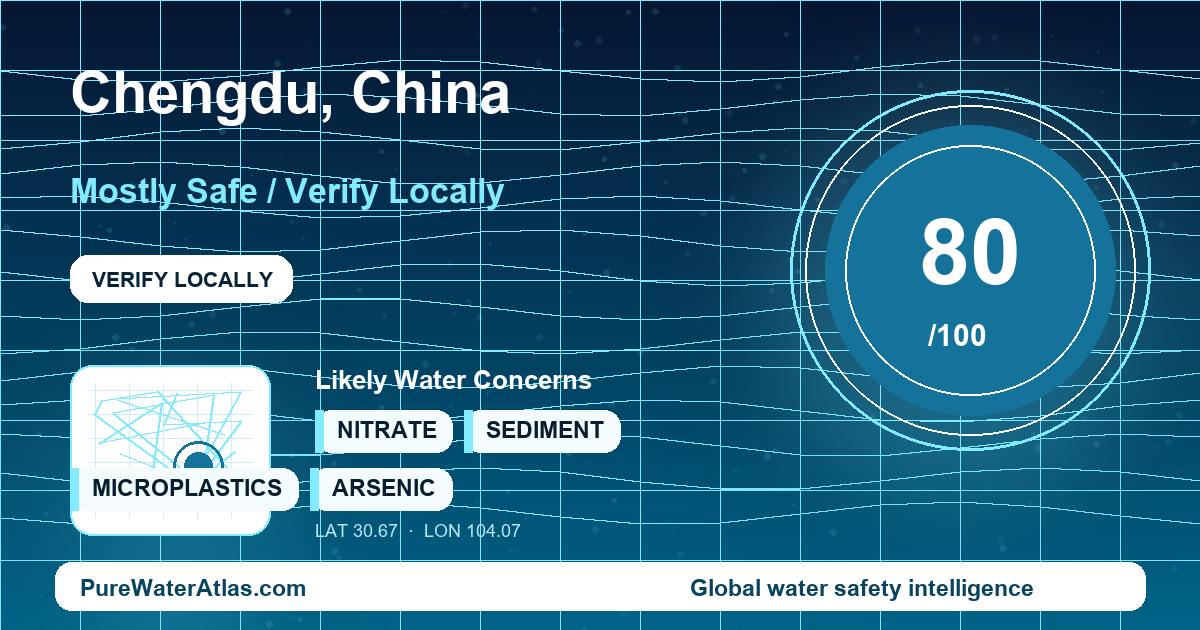
| Water safety score | 80 / 100 |
| Risk level | Mostly Safe / Verify Locally |
| Overall status | Chengdu’s municipal tap water is treated and regulated under China national drinking-water standards. The main urban supply is generally suitable for domestic use after treatment, but direct drinking is best approached cautiously unless current building-level conditions are known. |
| Traveler advice | Use bottled water, boiled water, hotel-provided drinking water, or a reliable purifier for drinking. Tap water is usually acceptable for brushing teeth in modern hotels if clear and odor-free, but sensitive travelers may prefer bottled water. |
| Resident advice | Municipal supply is not the only issue. Check internal pipes, rooftop or basement tanks, booster systems, and old building plumbing. Boiling, maintained filtration, and periodic testing are sensible in older apartments or buildings with tanks. |
| Main raw-water context | Minjiang River and Dujiangyan-linked water-conservancy system serving the Chengdu Plain, followed by municipal treatment and distribution. |
| Water authority | Chengdu Water Group Co., Ltd. and affiliated municipal water-supply operators, with oversight involving Chengdu water, health, housing, and ecological-environment authorities. |
| Filter recommendation | A filter is not automatically required for every connected home, but activated carbon can improve chlorine taste and odor. Reverse osmosis is a stronger option where residents want added protection against dissolved contaminants or metals. Maintenance is essential. |
Why Chengdu Is Different
Chengdu’s drinking-water context is shaped by its inland position on the Chengdu Plain in the Sichuan Basin. Unlike coastal cities, Chengdu does not face meaningful municipal-supply risks from seawater intrusion or coastal salinity. Its water story is instead tied to mountain-fed water, the Minjiang River system, the Dujiangyan water-conservancy network, rainy-season turbidity, and the condition of urban distribution and building-level infrastructure.
The Dujiangyan Irrigation System is more than a landmark near Chengdu. It is a historically important water-management system that helped shape water availability across the Chengdu Plain. Modern drinking water does not come from untreated canal water; it depends on engineered intakes, municipal treatment plants, protected source-water zones, and distribution systems. Still, the Minjiang-Dujiangyan hydrologic setting remains essential for understanding why Chengdu has the raw-water supply pattern it does.
The practical difference for households and visitors is that the municipal treatment stage is only part of the safety picture. After treated water leaves the municipal network, it may pass through internal building pipes, booster pumps, rooftop tanks, basement tanks, or secondary pressurization systems. In Chengdu, as in much of urban China, many people boil tap water before drinking. That habit does not prove the water is unsafe at the treatment plant; it reflects taste preferences, residual disinfectant odor, long-standing custom, and caution about pipes, tanks, and distribution endpoints.
Where Does Chengdu’s Tap Water Come From?
Publicly available local materials identify the Minjiang River and Dujiangyan-linked raw-water system as the key water-supply context for Chengdu’s urban area. Chengdu sits downstream of mountain-fed Minjiang water managed through the Dujiangyan system, which diverts water toward the Chengdu Plain. This regional system is central to raw-water availability, but drinking water delivered to users is treated at municipal waterworks before entering urban transmission and distribution mains.
Important infrastructure in Chengdu includes Minjiang upper-basin and Dujiangyan-linked raw-water facilities, municipal treatment plants operated by the local urban water utility system, transmission mains, distribution mains, and secondary water-supply facilities in some high-rise residential and commercial buildings. Those secondary facilities can include pumps, tanks, and internal pipework that are outside the simple “treatment plant compliance” picture.
For users, this means source-water identity is reasonably clear at a city level, but the exact condition at an apartment tap, hotel tap, restaurant tap, or old compound tap is not automatically proven by citywide statements. This is the key data limitation for Chengdu: official and utility-level information can describe the municipal system, but it rarely verifies every building’s tank hygiene, pipe materials, stagnation conditions, or endpoint water quality.
Who Manages Drinking Water in Chengdu?
Urban tap-water service in Chengdu is provided by Chengdu Water Group Co., Ltd. and affiliated municipal water-supply operators. Local governance and oversight involve agencies including the Chengdu Water Affairs Bureau, Chengdu health authorities, housing and urban-rural development authorities, and ecological-environment agencies. The Chengdu Municipal People’s Government provides broader municipal context for public services and local administration.
Chengdu drinking water is regulated under China’s national drinking-water framework, especially GB 5749 Standards for Drinking Water Quality. Public-health context is also connected to the National Health Commission of the People’s Republic of China. Environmental oversight and surface-water context fall partly under provincial ecological-environment systems, including the Sichuan Provincial Department of Ecology and Environment.
These agencies and standards matter, but they do not remove the need for local verification. National standards apply to treated drinking water, yet individual tap quality can change after water travels through distribution lines, building plumbing, storage tanks, or pressure-boosting equipment.
Main Local Water Concerns
The main Chengdu concerns are not dominated by seawater intrusion or coastal salinity. The more relevant issues are seasonal runoff, turbidity, distribution disturbances, disinfectant taste, older internal plumbing, and secondary water-supply systems.
- Turbidity and sediment: Heavy rain, flood-control operations, pipe flushing, construction, and repairs can temporarily increase cloudy water, particles, or sediment complaints.
- Chlorine taste and odor: Treated water may have noticeable disinfectant taste or smell, especially after traveling through long distribution lines or building tanks.
- Old pipes and rust: Older internal plumbing may contribute rust-colored water, metallic taste, iron, sediment, or other premise-level concerns after stagnation or pressure changes.
- Secondary water supply: High-rise buildings, hotels, offices, and older compounds may use rooftop, basement, or intermediate storage tanks and booster systems. If tanks are not cleaned, sealed, and maintained, they can create microbial or turbidity problems.
- Watershed pressure: Chengdu’s source-water pressures are more related to basin urbanization, upstream land use, storm runoff, agricultural inputs in the wider watershed, and rainy-season treatment burden than to salinity.
Season also matters. The Sichuan Basin summer rainy season can increase raw-water turbidity and runoff-related treatment challenges. Hot, humid periods can make poorly maintained tanks and internal plumbing more important. After holidays, vacancies, or shutdowns, first-draw water may be stale and should be flushed before use.
For Travelers
Short-term visitors should not rely on untreated Chengdu tap water as their main drinking water. The safer default is bottled water, boiled water, hotel-provided drinking water, or water from a reliable purifier. Many hotels provide bottled water or electric kettles because boiling water is standard practice locally.
For brushing teeth, tap water is usually acceptable in modern hotels and serviced apartments if it runs clear and has no unusual odor. However, travelers who are immunocompromised, traveling with infants, or prone to stomach sensitivity may prefer bottled water for brushing as well.
Ice requires judgment. Ice in higher-end hotels, international restaurants, and major chains is more likely to be made from treated or purified water. Avoid ice from street stalls or venues that cannot explain their water source. In restaurants, hot tea, boiled water, sealed bottled drinks, and commercially bottled beverages are the lowest-risk choices.
If tap water is cloudy, rusty, contains particles, or has a strong unusual odor, do not drink it. Let the tap run briefly, notify the hotel or host, and switch to bottled or boiled water. For travel water-hygiene context, see the World Health Organization travel and health guidance. For boiling-specific safety practices, PureWaterAtlas also provides a Boiling Water Purification: Complete Guide.
For Residents
Residents connected to Chengdu’s municipal system should focus on what happens after water enters the building. A home filter is not automatically required for every household, but it is often practical. A certified activated-carbon filter can improve chlorine taste and odor. An under-sink reverse-osmosis system is a stronger option for residents who want added protection against metals, nitrate, or other dissolved contaminants. Any filter must be maintained on schedule; neglected filters can worsen water quality.
Testing is especially sensible if you live in an older apartment, a building with unknown pipe materials, a high-rise using tanks or booster pumps, or a unit where water is frequently discolored. Test both first-draw and flushed water where possible. Priority parameters include lead, iron, manganese, turbidity, residual chlorine, total coliform or E. coli indicators, pH, conductivity, and nitrate where broader screening is desired.
If your building uses rooftop, basement, or intermediate storage tanks, ask property management for tank-cleaning records. Poorly sealed or poorly cleaned tanks can undermine otherwise well-treated municipal water, particularly for microbial quality, turbidity, taste, and odor. After pipe repairs, pressure loss, flooding, or long stagnation, flush taps and consider testing if sediment, taste, or odor problems persist.
Relevant Contaminants and Water-Quality Issues
For Chengdu, the most relevant water-quality topics are connected to treatment byproducts, distribution conditions, and building infrastructure rather than a single citywide contaminant claim. Chlorine is relevant because treated municipal water can have disinfectant taste or odor. Turbidity and sediment matter during rainy-season runoff, main flushing, construction, pressure changes, or old-pipe disturbances.
Lead is a premise-plumbing concern in older buildings or buildings with uncertain internal materials. It should not be assumed from citywide source-water information alone, but it is worth testing where plumbing risk is plausible. E. coli is relevant when evaluating microbial safety in buildings with storage tanks or poor maintenance. Nitrate can be included in broader chemical screening where residents want to understand possible watershed-runoff or dissolved-contaminant conditions.
How to Verify Your Water Quality
The most reliable way to know whether a specific Chengdu tap is suitable for direct drinking is to test that tap under realistic conditions. Use an accredited local laboratory or official testing channel where possible, especially for health-critical decisions. Color-change strips can be useful for basic screening, but they should not be the only evidence for microbial safety, lead risk, or other serious concerns.
For a structured approach, start with PureWaterAtlas guides on Water Testing and Drinking Water Safety. If you are comparing Chengdu with other destinations, use the Global Water Quality Checker and the broader Global Water Quality guide. To research individual substances, use the Contaminants Search Engine.
Residents considering treatment options can review Water Purification, the UV Water Purification: Complete Guide for point-of-use microbial treatment, and Lead in Drinking Water: Testing and Detection Methods for older-building risk. For broader chemical screening, see Nitrate Contamination in Drinking Water: Testing and Detection Methods.
Official and Technical Sources
- Chengdu Water Affairs Bureau — local water-management authority context, municipal water governance, public notices, and water-affairs oversight.
- Chengdu Water Group Co., Ltd. — urban water-supply operator identity, service information, and utility-level context.
- Chengdu Municipal People’s Government — official municipal context for infrastructure, public services, and local agencies.
- Sichuan Provincial Department of Ecology and Environment — provincial environmental monitoring context and surface-water quality oversight.
- UNESCO World Heritage Centre: Mount Qingcheng and the Dujiangyan Irrigation System — verification of the Dujiangyan water-management system and its importance to the Chengdu Plain.
- China National Standard GB 5749 Standards for Drinking Water Quality — national drinking-water standards framework applicable to treated municipal water.
- National Health Commission of the People’s Republic of China — public-health regulatory context for drinking-water hygiene and national health standards.
- World Health Organization: Travel and Health — general traveler water-safety and hygiene framing.
Bottom Line
Chengdu’s municipal tap water is treated and regulated, with the city’s raw-water context closely tied to the Minjiang River and Dujiangyan-linked system serving the Chengdu Plain. For domestic use, the main urban supply is generally considered suitable after treatment. For direct drinking, the safer practical advice is more cautious: travelers should use bottled, boiled, hotel-provided, or properly filtered water, while residents should pay close attention to building plumbing, storage tanks, and booster systems. The biggest unknown is often not the municipal treatment plant but the final path through pipes, tanks, stagnation, and fixtures. If water is rusty, cloudy, particle-filled, or unusually odorous, do not drink it untreated; flush, report it, and verify locally.
Read the full guide: Global Water Quality Guide
Explore more in this category: Global Water Quality Articles