
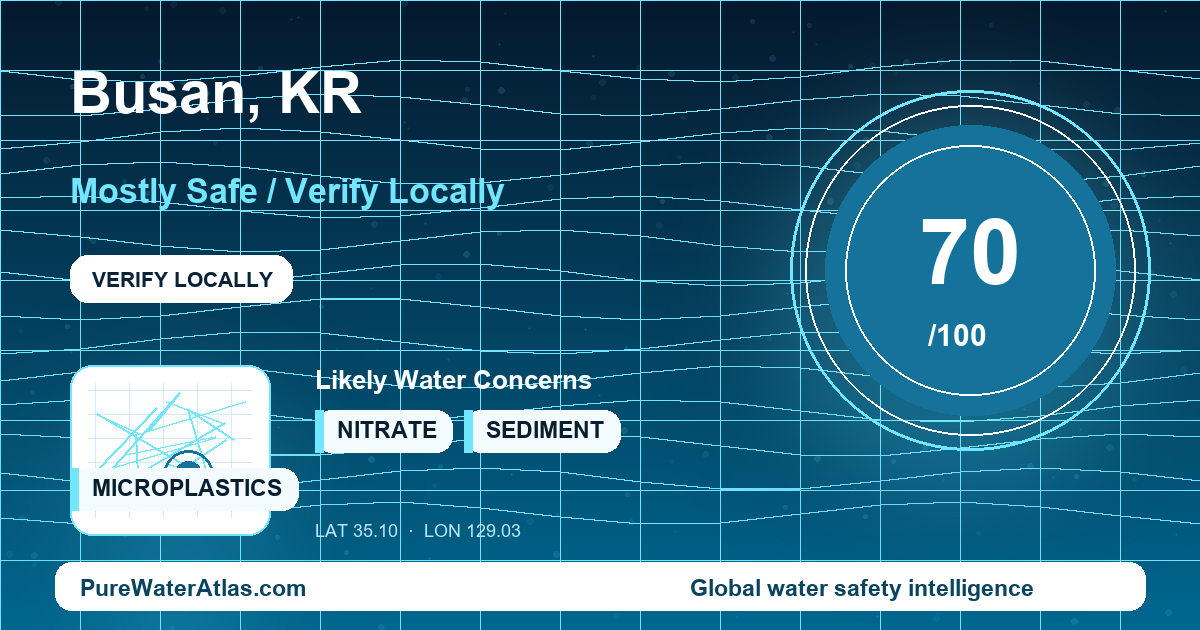
Busan tap water is professionally treated, but its safety profile depends on the lower Nakdong River source system, seasonal river conditions, and the plumbing or storage tanks inside the specific building where you drink it.
Quick Answer
| PureWaterAtlas safety score | 70 / 100 |
|---|---|
| Risk level | Mostly Safe / Verify Locally |
| Can you drink the tap water? | Usually yes in modern, well-maintained hotels, restaurants, and residences, but verify locally if the building is old, the water is discolored, or storage-tank maintenance is unclear. |
| Main water source | The Nakdong River system, especially lower Nakdong River raw-water intakes commonly associated with the Mulgeum and Maeri intake areas. Hoedong Reservoir and other local-source infrastructure are part of Busan’s historical and supplementary water context. |
| Water authority | Busan Metropolitan City Waterworks Headquarters. |
| Traveler advice | Most healthy travelers can use tap water for drinking, brushing teeth, and hot drinks in modern accommodations. Bottled or filtered water is a reasonable precaution for infants, sensitive stomachs, immunocompromised travelers, pregnancy, or older buildings. |
| Resident advice | Treat the municipal supply as professionally managed, but check building pipes, tank-cleaning records, taste, odor, discoloration, and current Busan Waterworks notices. |
| Filter recommendation | A filter is not automatically required for every household. A certified point-of-use carbon filter can reduce chlorine taste and odor; testing is recommended before choosing treatment for metals, bacteria, PFAS, or other specific concerns. |
Why Busan Is Different
Busan is not a city whose drinking-water risk can be judged only by the fact that South Korea has a modern municipal water system. Busan is a coastal port city at the southeastern end of the Korean Peninsula, near the mouth of the Nakdong River. That geography matters. The city’s drinking-water story is closely tied to a large upstream river basin rather than only to a small protected mountain catchment.
The lower Nakdong River receives the influence of upstream cities, industrial activity, agricultural land, reservoirs, storm runoff, and seasonal river conditions before water reaches the Busan area. This does not mean that Busan tap water is unsafe after treatment. It does mean the system requires continuous source-water monitoring, treatment management, algal-bloom response, and public communication. PureWaterAtlas therefore rates Busan as “Mostly Safe / Verify Locally,” not as a universally low-risk tap-water destination.
The other city-specific issue is the last part of the system: the building. In Busan’s dense urban environment, many users receive water after it has passed through neighborhood mains, pumps, service reservoirs, and then private plumbing or rooftop or underground storage tanks. A modern hotel in Haeundae and an older small building with a neglected tank can deliver different tap-water experiences even when both are connected to the same municipal supply.
Where Does Busan’s Tap Water Come From?
Busan’s dominant drinking-water source is the Nakdong River system. Official and local waterworks materials commonly reference raw-water intakes on the lower Nakdong River, including the Mulgeum and Maeri intake areas upstream of Busan. Treated water is produced through major municipal water-treatment infrastructure serving the metropolitan area.
Key infrastructure in Busan’s water system includes Nakdong River raw-water intakes, major water-treatment plants identified in Busan waterworks materials such as the Hwamyeong, Deoksan, and Myeongjang systems, and a large urban distribution network with service reservoirs, pumping stations, neighborhood mains, and building-level storage tanks. Hoedong Reservoir and associated local-source infrastructure also remain part of Busan’s historical water-supply context.
Busan historically relied more heavily on local reservoirs and smaller source systems, including Hoedong Reservoir. Rapid urban growth pushed the city toward large-scale use of the Nakdong River. That history still matters today because older districts and buildings may have aging internal plumbing or storage-tank arrangements even where the treated municipal water leaving the plant is properly managed.
Who Manages Drinking Water in Busan?
Busan’s municipal drinking-water supply is operated by Busan Metropolitan City Waterworks Headquarters, the local water utility responsible for tap-water production, distribution, customer service, and local water-quality information. The broader municipal context is provided by Busan Metropolitan City.
Drinking water in Busan is regulated under South Korea’s national drinking-water and waterworks framework, overseen by the Ministry of Environment, Republic of Korea. The national framework sets drinking-water standards and monitoring obligations, while Busan Waterworks operates the local system and publishes local information. For river-basin context, the Nakdong River Basin Environmental Office is relevant to the upstream environmental pressures that affect the Nakdong River system.
Users should not rely only on general assumptions about South Korean tap water. Current Busan Waterworks notices, building-level conditions, and visible changes at the tap are important. Publicly available information may be Korean-language, periodically updated, and not always easy to map to a specific apartment tower, guesthouse, or neighborhood tap.
Main Local Water Concerns
The main Busan-specific concern is dependence on the Nakdong River, a downstream source exposed to multiple upstream pressures. These include municipal wastewater, industrial activity, agriculture, storm runoff, and reservoir operations. Treatment is designed to manage raw-water quality, but a large river basin creates more variable source-water conditions than a small protected watershed.
Seasonal algal blooms and taste-and-odor episodes in the Nakdong River basin can increase treatment complexity and public concern during warm periods. Summer heat can intensify algal-bloom pressure, while monsoon rain and typhoons can raise turbidity and increase runoff from urban, industrial, and agricultural areas. Drought or low-flow periods can concentrate source-water pollutants and may worsen estuary-related salinity management concerns in the lower river system.
At the tap, users may notice short-term cloudy, yellow, or brown water after heavy rain, typhoons, construction, main flushing, pipe repairs, or building-tank cleaning. These events are not unique to Busan, but they are highly relevant in a dense coastal city with a large distribution network and many building-level storage systems.
Residual chlorine taste or odor is also common in disinfected urban water systems and may be more noticeable to travelers. In older buildings, premise plumbing can contribute corrosion products, metals, sediment release, or stagnant-water taste. In apartment towers, villas, guesthouses, schools, and commercial buildings, rooftop or underground storage tanks can affect water quality after water has already entered private premises.
Emerging-contaminant concern in the broader Nakdong River basin, including PFAS and industrial chemicals, is relevant, but PureWaterAtlas does not make a current neighborhood-level PFAS claim for Busan taps without current testing or an official table for the specific location.
For Travelers
Most healthy travelers staying in modern Busan hotels or eating at well-maintained restaurants can usually use tap water for drinking, brushing teeth, and hot beverages. The better practical rule is to judge the specific setting. A modern hotel with maintained plumbing is generally lower concern than an old guesthouse or small building where storage-tank cleaning records are unknown.
Use bottled or properly filtered water if the tap water is brown, sandy, oily, unusually cloudy, or has a sewage-like odor. Also use bottled water after a water outage, after obvious pipe work, or if hotel staff advise against drinking from the tap. Sensitive travelers, infants, pregnant travelers, and immunocompromised people should be more cautious, especially in older buildings.
Brushing teeth with municipal tap water is generally acceptable in normal hotels and restaurants. Ice from reputable hotels, cafes, and restaurants is usually low concern if it is made from treated water and handled hygienically. Avoid ice from unknown street sources or places where general food hygiene appears poor.
A simple habit helps in older accommodations: let the tap run briefly in the morning or after returning to the room. Boiling can reduce microbial risk, but it does not remove metals, PFAS, nitrate, or many industrial chemicals. For taste, a portable carbon filter bottle may reduce chlorine flavor, but it should not be treated as proof that all contaminants have been removed. For general travel comparisons, use the Global Water Quality Checker.
For Residents
Busan residents should treat the municipal supply as professionally managed but verify household-level risks. The most important questions are practical: How old is the building? Are there metal pipes or older fixtures? Are rooftop or underground storage tanks cleaned and inspected? Does the water show recurring discoloration, odor, sediment, or metallic taste? Are there current notices from Busan Waterworks for the supply area?
A home filter is not automatically required for every Busan household. Many residents may still prefer a certified point-of-use carbon filter for chlorine taste, odor, and some sediment reduction. If the concern is old plumbing, infant formula, pregnancy, immunocompromised household members, persistent discoloration, bacteria, PFAS, pesticides, solvents, or industrial chemicals, choose treatment only after identifying the specific risk. A filter selected for taste is not the same as a system certified for metals or microbial reduction.
Old Busan buildings deserve special attention. Internal plumbing can contribute metals, rust particles, or stagnant-water taste even when municipal water leaving the treatment plant is properly treated. First-draw water after overnight stagnation can be higher risk than flushed water. Do not use first-draw water for infant formula unless household testing supports it.
Storage tanks are another major resident issue. In apartment towers, villas, guesthouses, schools, and commercial buildings, rooftop or underground tanks can affect water quality if they are not cleaned and maintained. Ask the building manager for tank cleaning records and inspection dates. If the water has odor, slime, visible debris, or recurring cloudiness, consider bacterial testing and contact the building manager or Busan Waterworks if flushing does not resolve the issue.
Relevant Contaminants and Water-Quality Issues
Several water-quality topics are especially relevant to Busan because of the Nakdong River source system, seasonal runoff, disinfection, and building-level plumbing.
- Chlorine in drinking water: Busan’s treated municipal water is disinfected, and travelers may notice chlorine taste or odor.
- Turbidity in drinking water: Heavy rain, typhoons, storm runoff, pipe disturbance, and tank cleaning can produce cloudy or discolored water events.
- Lead in drinking water: The main relevance is old building plumbing and stagnant first-draw water, not a citywide source-water claim.
- E. coli in drinking water: Relevant for storage-tank hygiene, plumbing failures, and deciding when microbial risk requires stronger precautions.
- PFAS in drinking water: Relevant because of broader Nakdong River basin emerging-contaminant concern, but current Busan tap-level conclusions require testing.
For wider background on how contamination can enter source water, treatment systems, distribution mains, and private premises, see Water Contamination and Drinking Water Safety.
How to Verify Your Water Quality
The best verification method in Busan is to combine official information with building-level checks. Start with Busan Waterworks notices and local water-quality information for your area. Then inspect the premise-level factors that official citywide data cannot prove: building age, storage-tank maintenance, recent pipe repairs, stagnation, visible sediment, color, odor, and taste changes.
If your building is old, recently renovated, or shows metallic taste, blue-green staining, or recurring discoloration, test first-draw and flushed water for lead and other metals. PureWaterAtlas provides a detailed guide to lead testing and detection methods. If you are concerned about PFAS, pesticides, solvents, or industrial chemicals, use an accredited laboratory; simple home strips are not reliable for most emerging contaminants. See PFAS testing and detection methods.
If water is cloudy or brown after construction, main repair, or tank cleaning, flush taps and ask the building manager whether tank work or pipe work occurred. Contact Busan Waterworks if the problem does not clear. For microbial concerns, boiling can help, but it has limits. Review Boiling Water Purification to understand when boiling helps and when it does not.
For a structured approach to sampling and interpretation, use the PureWaterAtlas Water Testing guide. To research individual substances, use the Contaminants Search Engine. For choosing treatment without overbuying, see Water Treatment Systems.
Official and Technical Sources
- Busan Metropolitan City Waterworks Headquarters official website — municipal utility responsible for Busan tap-water production, distribution, customer service, and local water-quality information.
- Busan Metropolitan City official website — official municipal context and city-service information.
- Ministry of Environment, Republic of Korea — national authority for environmental and drinking-water policy, standards, and oversight.
- Nakdong River Basin Environmental Office — official river-basin authority relevant to source-water pressures affecting Busan.
- K-water official English website — national water-resources context, including dams, reservoirs, and basin-scale water management.
- Water Environment Information System — government water-environment monitoring data system relevant to major Korean river basins such as the Nakdong.
- World Health Organization Guidelines for Drinking-water Quality — international reference for drinking-water risk concepts, microbial hazards, chemical contaminants, and distribution-system importance.
Data limitation: this assessment does not claim current contaminant-by-contaminant compliance for every Busan tap. Public data may be dynamic, Korean-language, and not easily mapped to each building. Private plumbing and storage tanks can change water quality after municipal treatment.
Bottom Line
Busan tap water is generally a treated municipal supply and is usually usable in modern, well-maintained settings, but it should be verified locally. The city’s water profile is shaped by dependence on the lower Nakdong River system, where upstream urban, industrial, agricultural, storm-runoff, algal-bloom, and seasonal flow pressures make source-water management important. For many users, the bigger tap-level variable is the building: old pipes, stagnant water, and rooftop or underground storage tanks can affect quality after treatment. Travelers with normal risk tolerance can usually drink tap water in good hotels and restaurants, while sensitive travelers may prefer bottled or filtered water. Residents should check Busan Waterworks notices, tank maintenance, and plumbing conditions, and test when discoloration, metals, bacteria, or emerging contaminants are a concern.
Read the full guide: Global Water Quality Guide
Explore more in this category: Global Water Quality Articles