
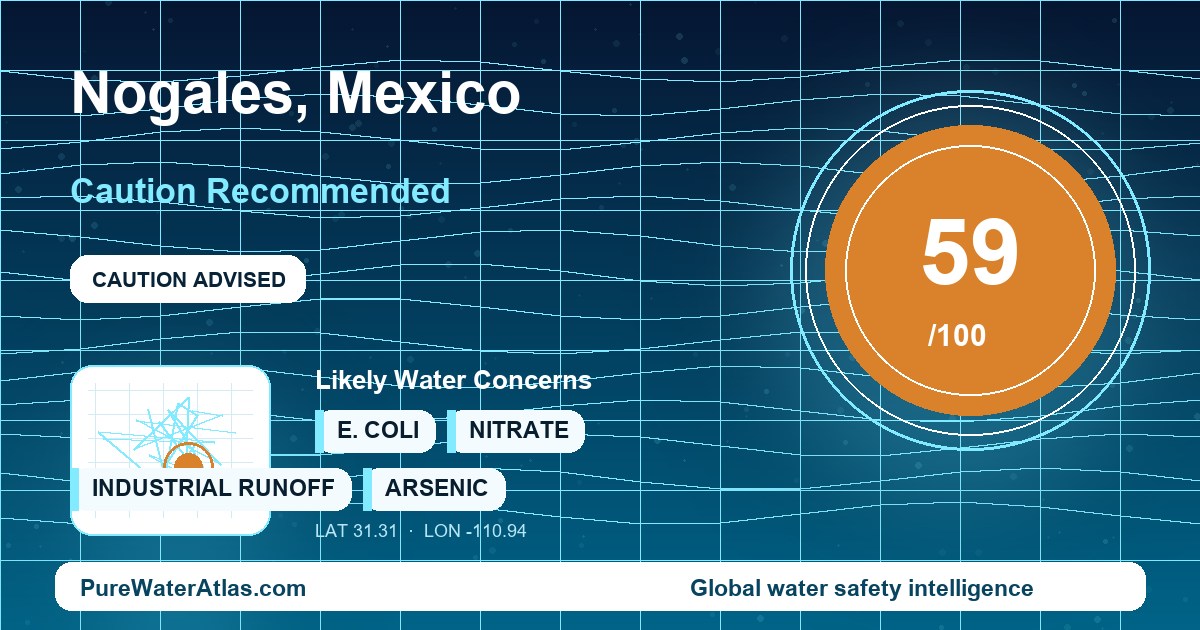
Nogales, Sonora is a groundwater-supplied border city where municipal chlorination exists, but practical tap-water caution is recommended because public neighborhood-level finished-water data are limited and local conditions include drought pressure, steep distribution zones, intermittent service risk, household storage tanks, and the wider Ambos Nogales wastewater and stormwater setting.
Quick Answer
| Overall status | Caution recommended. PureWaterAtlas rates Nogales at 59/100, a practical “Caution Recommended” score rather than a verified citywide unsafe-water finding. |
|---|---|
| Can visitors drink the tap water? | Not recommended for most short-term travelers. Use sealed bottled water or verified agua purificada from a reputable hotel, restaurant, or garrafón supplier. |
| Resident guidance | Municipal water may be usable for washing and cooking when service is normal, but drinking decisions should consider advisories, building plumbing, storage-tank hygiene, pressure interruptions, and household testing. |
| Main water source | Primarily groundwater from municipal wells in local basin aquifers, pumped, disinfected, stored, and distributed by OOMAPAS Nogales. |
| Water authority | Organismo Operador Municipal de Agua Potable, Alcantarillado y Saneamiento de Nogales, commonly known as OOMAPAS Nogales. |
| Filter recommendation | A maintained point-of-use system is sensible for households that drink tap water regularly, especially where there are taste, sediment, storage-tank, old-plumbing, infant, pregnancy, elderly, or immune-risk concerns. |
Why Nogales Is Different
Nogales is not a typical flat-grid water system. It is an arid, high-elevation border city built in steep terrain around Nogales Wash, a drainage corridor connected to the Santa Cruz River system. During summer monsoon storms, stormwater can move quickly through the urban channel, carrying sediment and placing stress on drainage, sewer, and public works infrastructure. That setting matters for water safety because drinking-water reliability is not only about what leaves a well or treatment point; it is also about pressure, pipe condition, storage, emergency response, and household handling.
The broader Ambos Nogales region has a documented history of wastewater and stormwater infrastructure concerns, including binational sewage conveyance to treatment facilities north of the border. This context does not prove that every tap in Nogales is contaminated. It does, however, make source-water protection and incident response especially important in a narrow border drainage where runoff, sewer leaks, pipe breaks, and urban activity can intersect.
Another local feature is trust and reliability. Many households and businesses in Nogales use garrafón water, rooftop or ground-level storage tanks, cisterns, or point-of-use filtration. That behavior should not be interpreted as proof that all municipal water is unsafe; it reflects a mix of taste, mineral content, service reliability, storage practices, and confidence in the system.
Where Does Nogales’s Tap Water Come From?
Nogales, Sonora is supplied primarily by groundwater from municipal wells in local basin aquifers. Water is pumped from wells, chlorinated or otherwise disinfected, stored in tanks or reservoirs, and distributed through the municipal network operated by OOMAPAS Nogales. The city does not have a large, reliable perennial surface-water source comparable to a major river or reservoir system.
Because the city is steep and topographically fragmented, its drinking-water system depends heavily on pumping, storage tanks, reservoirs, and pressure zones. Hillside neighborhoods can be more sensitive to low pressure, pressure variation, and intermittent service than neighborhoods in flatter cities. When a distribution system loses pressure, experiences a main break, or undergoes repairs, sediment can be disturbed and intrusion risk can increase if pipes are damaged or depressurized.
The groundwater setting also means that long-term quality questions should be evaluated with local testing rather than assumptions. In arid northern Mexico, groundwater can have aesthetic mineral issues such as hardness, scaling, salinity, or elevated dissolved solids, but exact levels should not be assumed without current testing. For private or non-municipal wells, testing becomes even more important because household-level results may differ from the municipal supply.
Who Manages Drinking Water in Nogales?
Municipal water, sewer, and sanitation service in Nogales is operated by OOMAPAS Nogales, the Organismo Operador Municipal de Agua Potable, Alcantarillado y Saneamiento de Nogales. OOMAPAS manages the local water and wastewater utility functions, including municipal wells, pumping, disinfection points, storage, and distribution infrastructure.
At the national level, water concessions and aquifer administration fall under CONAGUA. CONAGUA also publishes official groundwater availability and hydrogeology information for Sonora aquifers, including documentation relevant to the Nogales and Santa Cruz regional context. Drinking-water quality criteria are regulated under Mexican potable-water standards, including NOM-127-SSA1-2021, with sanitary surveillance roles involving COFEPRIS and state health authorities such as COESPRIS Sonora.
PureWaterAtlas assigns only medium confidence to this Nogales profile. The utility, regulatory framework, groundwater dependence, and regional border context are identifiable, but recent public tap-water datasets with neighborhood-level microbiology, disinfectant residual, metals, nitrate, salinity, and turbidity results were not found in a form that supports a precise block-by-block or all-season safety claim.
Main Local Water Concerns
- Intermittent service and low pressure: In a hilly distribution system, pressure variation matters. Low pressure or outages can raise intrusion risk if pipes are damaged or depressurized.
- Sediment after repairs or pressure changes: Pipe repairs, outages, and sudden pressure shifts can release sediment and increase turbidity at the tap. Learn more about turbidity in drinking water and sediment in drinking water.
- Household storage tanks and cisterns: A clean municipal supply can become unsafe if stored in an uncovered, dirty, or poorly maintained tinaco or cistern.
- Microbial risk after disruptions: Flooding, long outages, absent chlorine odor, or suspect storage conditions justify testing for total coliform and E. coli.
- Mineral and groundwater taste issues: Hardness, dissolved solids, chloride, sulfate, or salinity-type taste concerns are possible in arid groundwater settings, but Nogales-specific values should be confirmed by testing.
- Older building plumbing: There is not enough public evidence to claim a citywide lead-service-line problem in Nogales, but older internal pipes, solder, fixtures, or storage systems can contribute metals. See lead in drinking water for background.
- Stormwater and wastewater context: The Ambos Nogales drainage and binational wastewater setting is a real local vulnerability context, particularly after monsoon storms, but it should not be overstated as proof of contamination at every household tap.
For Travelers
Short-term visitors should not rely on untreated Nogales tap water for drinking. Use sealed bottled water or verified purified water. In Spanish, ask for agua purificada, agua embotellada, or garrafón water. Reputable hotels and restaurants commonly use purified water for drinking and ice, but it is still worth confirming, especially if you are staying outside a standard hotel setting or in a building with unknown tank hygiene.
For brushing teeth, bottled or purified water is the safer choice for short-term travelers, immunocompromised visitors, young children, and anyone with a low tolerance for stomach illness. Many residents may use tap water for brushing, but traveler guidance should be more conservative because visitors do not know the condition of the building plumbing, storage tank, or recent outage history.
Use ice only from reputable hotels, restaurants, or commercial sources that use purified water. Avoid informal ice if the water source is unclear. Carry bottled water during hot weather and border-crossing delays. Be especially cautious after heavy rain, local flooding, water outages, pressure loss, or reported pipe repairs. If you must treat tap water, boiling is a strong emergency method: bring water to a rolling boil. Filtration alone is not enough for microbial safety unless the device is rated for bacteria and protozoa or is paired with disinfection. See the PureWaterAtlas boiling water purification guide for practical steps.
For Residents
Residents can often use municipal water for washing and cooking when service is normal, but drinking-water decisions should be based on local advisories, household plumbing condition, storage-tank hygiene, and testing. A home filter is not automatically required for every use, but it is reasonable for households that drink tap water daily, notice taste or sediment problems, rely on a tinaco or cistern, live in an older building, or include infants, pregnant people, elderly residents, or immunocompromised people.
For broad household protection, consider sediment prefiltration plus activated carbon, with system selection guided by testing. If testing indicates mineral, nitrate, arsenic, fluoride, or dissolved-solids concerns, a certified reverse-osmosis unit may be appropriate. UV can help after filtration when microbial risk is tied to household storage, but UV does not remove chemicals; read the PureWaterAtlas UV water purification guide before relying on it.
Test for total coliform and E. coli if water is stored in a cistern or tinaco, after flooding, after long outages, or when chlorine odor disappears. Check free chlorine residual at the tap if you suspect poor disinfection or if water sits in a household tank. Observe turbidity and sediment after repairs, pressure changes, or monsoon events. Test TDS, conductivity, hardness, chloride, and sulfate if taste, scaling, or salinity is a concern. Test nitrate if infants, pregnant people, or private wells are involved. Test arsenic and fluoride if using a private well or choosing a long-term groundwater treatment system.
Older buildings deserve special attention. There is not enough public evidence to claim a citywide lead-service-line problem in Nogales, but old internal plumbing can still contribute lead, copper, or other metals. Flush stagnant water, use cold water for cooking, and test first-draw and flushed samples if children or pregnant people live in the home. For more detail, see lead testing and detection methods.
Tinacos and cisterns should be tightly covered, screened against insects and dust, cleaned and disinfected on a routine schedule, and inspected after dust storms, flooding, or service interruptions.
Relevant Contaminants and Water-Quality Issues
The most relevant Nogales issues are not a single proven citywide contaminant, but a practical combination of disinfection, distribution reliability, storage, and groundwater chemistry. Chlorine matters because municipal systems rely on disinfectant residual to control microbial risk through the network. If chlorine disappears after storage or during pressure disruptions, microbiological testing becomes more important.
Turbidity and sediment matter after outages, pipe repairs, pressure surges, and monsoon-related operational stress. E. coli is the key indicator for fecal contamination and should be tested after flooding, storage-tank problems, or suspicious service interruptions. For groundwater or private-well users, nitrate, arsenic, fluoride, dissolved solids, hardness, chloride, and sulfate are reasonable parameters to consider. In older buildings, lead and copper testing is prudent even if the municipal supply leaving the utility is disinfected.
How to Verify Your Water Quality
Because public, recent, neighborhood-level finished-water data for Nogales are limited, the safest approach is to verify the water at the point where you actually use it. Start with any current local advisories from OOMAPAS Nogales or health authorities. Then test based on your risk situation: microbiology and chlorine for storage tanks or outage history; turbidity and sediment after repairs; TDS, hardness, chloride, and sulfate for taste or scaling; nitrate for infants, pregnancy, or non-municipal wells; arsenic and fluoride for groundwater treatment planning; and lead and copper for older buildings.
PureWaterAtlas resources that can help include the complete guide to water testing, the drinking water safety guide, the water microbiology guide, and the water treatment systems guide. You can also use the Global Water Quality Checker and search specific issues in the Contaminants Search Engine. For deeper testing topics, see the guides to arsenic testing and nitrate testing.
Official and Technical Sources
- OOMAPAS Nogales — local municipal water, sewer, and sanitation operator for Nogales, Sonora.
- CONAGUA — Mexico’s national water authority for water concessions, aquifer administration, and national water information.
- CONAGUA groundwater availability documents for Sonora aquifers — official hydrogeology and groundwater availability information relevant to the Nogales and Santa Cruz regional context.
- Diario Oficial de la Federación, NOM-127-SSA1-2021 — Mexican drinking-water quality standard for water for human use and consumption.
- COFEPRIS: Agua de uso y consumo humano — federal sanitary surveillance context for drinking water in Mexico.
- International Boundary and Water Commission — source for binational wastewater infrastructure context, including the Nogales International Wastewater Treatment Plant setting.
- U.S. EPA U.S.-Mexico Border Program — regional border water, wastewater, and environmental-health context relevant to Ambos Nogales.
- USGS Publications Warehouse — scientific background on the Santa Cruz basin and binational aquifer studies.
- CDC Travelers’ Health: Mexico — travel-health guidance supporting conservative use of bottled, boiled, or treated water for visitors.
Bottom Line
Nogales tap water should be treated as a caution-recommended situation, not as a simple safe-or-unsafe citywide answer. The city relies mainly on groundwater wells managed by OOMAPAS Nogales, with municipal disinfection requirements under Mexican standards. However, steep terrain, pressure zones, storage tanks, drought stress, monsoon runoff, pipe repairs, intermittent service, and the broader Ambos Nogales wastewater context create practical risks that can vary by neighborhood and building. Short-term visitors should use sealed bottled or verified purified water for drinking, brushing teeth, and ice. Residents who drink tap water regularly should monitor advisories, maintain cisterns and tinacos, test when conditions change, and consider a well-maintained point-of-use treatment system matched to actual test results.
Read the full guide: Global Water Quality Guide
Explore more in this category: Global Water Quality Articles