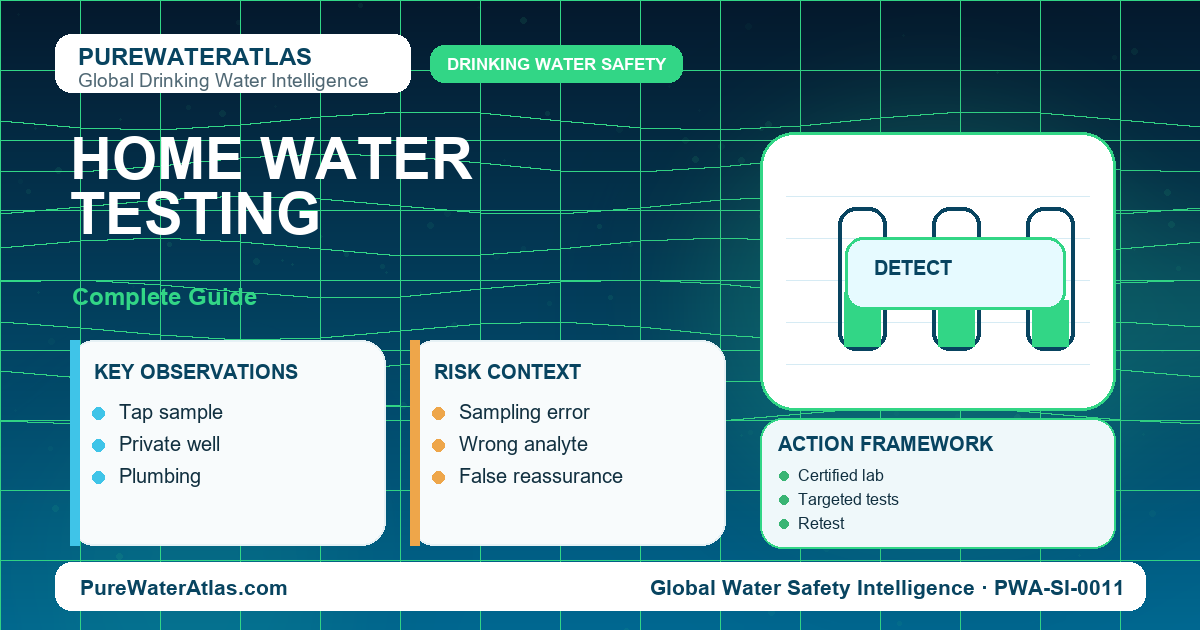
Home water testing is most useful when it answers a specific question: whether a private well has changed, whether household plumbing may be contributing lead, whether a flood or nearby activity has affected groundwater, or whether an unusual result needs confirmation. The right approach depends first on the water source and then on the contaminant or condition being investigated.
A common assumption is that clear, odorless water is automatically safe. In reality, many contaminants cannot be seen, smelled, or tasted. Lead, nitrates, arsenic, certain bacteria, and volatile organic compounds may all be present without obvious warning signs. Conversely, an unusual taste, odor or color is a reason to investigate, not proof by itself that water is unsafe.
Home water testing can involve simple screening kits, samples submitted to certified drinking-water laboratories, or professional sampling. Those routes are not interchangeable. Consumer kits can be useful for limited screening, but they cannot substitute for appropriately certified laboratory analysis for every contaminant, health-sensitive decision or regulatory/compliance determination. EPA directs consumers seeking drinking-water testing to laboratories certified for the relevant analyses.
When home water testing is useful
Testing is particularly useful when the result can change a household decision. Examples include assessing a private well, investigating plumbing-specific lead concerns, responding to flooding or nearby contamination, checking a persistent change in water quality, or confirming whether corrective work has been effective.
For homes supplied by a public or community water system, broad routine household testing is not automatically necessary. The utility’s water-quality information is the logical starting point, followed by tap testing when there is a home-specific reason. EPA notes that system-wide lead monitoring, for example, cannot establish the lead concentration at a particular faucet. For the broader question of evaluating household tap water, see Is Tap Water Safe to Drink?.
Private wells require a different approach because the owner generally arranges testing and maintenance. EPA recommends annual private-well testing for total coliform bacteria, nitrate, total dissolved solids and pH, along with additional contaminants suggested by local geology, land use or a known concern. EPA also identifies events such as flooding, nearby land disturbance, well repairs and changes in odor, color or taste as reasons for prompt testing. State and local requirements can add to this guidance.
Testing is therefore better treated as a source- and risk-based process than as a single universal panel. The same principle appears in the World Health Organization’s 2026 Guidelines for drinking-water quality, which emphasize risk management from source to consumer rather than relying on one sample as a complete assessment of safety.
Start with your water source and risk profile
Public or community water systems
In the United States, community water systems are regulated under the Safe Drinking Water Act and routinely monitor regulated contaminants. Customers should begin with the utility’s Consumer Confidence Report (CCR), the annual report describing the water source, regulated contaminants detected, relevant violations and other system information. EPA provides CCR information for consumers and a broader CCR resource.
A CCR describes the community system; it is not a laboratory report for every individual faucet. Water can also be affected after treatment by distribution infrastructure, service lines, building plumbing, solder, fittings or fixtures. That distinction matters particularly for plumbing-related contaminants such as lead and copper.
CCR requirements are also changing. As of September 2026, EPA’s revised CCR requirements generally do not take effect until January 1, 2027, so the forthcoming provisions should not be treated as though they already govern 2026 reports.
Private wells
Private wells deserve special attention because the homeowner is usually responsible for arranging testing and maintenance rather than relying on routine utility monitoring. Exact legal responsibilities vary by jurisdiction and circumstance.
Well-water risks depend on the aquifer, well construction and nearby activities. Naturally occurring arsenic, uranium or other substances can be geographically important. Septic systems, agriculture, fuel storage, mining and surface-water intrusion can introduce different concerns. Heavy rain may carry pathogens, sediment and fertilizers toward water sources; flooding may overwhelm septic systems and contaminate wells; drought can alter groundwater conditions.
Property and local risk factors
Household plumbing is another potential source. Older pipes, service lines, solder, brass components and fixtures can contribute metals under some conditions. Stagnation can also influence plumbing-related results, which is one reason sampling instructions matter.
Location should guide test selection as well. A private well beside intensively managed farmland presents different questions from a well near buried fuel storage or a public-water home with suspected lead-containing plumbing. EPA advises private-well owners to consult local health authorities about substances known to occur in local groundwater.
For a wider framework covering water sources, advisories, plumbing and household exposure, see the household drinking-water safety guide.
What to test for
Water testing commonly addresses several categories: microbiological contaminants such as total coliform and E. coli; chemical contaminants such as nitrate, lead, arsenic, pesticides and volatile organic compounds; physical indicators such as turbidity; general chemistry such as pH and total dissolved solids; and, where geographically relevant, radiological contaminants. These categories organize the possibilities; they do not constitute a universal test panel.
For private wells, EPA’s annual baseline is total coliform bacteria, nitrate, total dissolved solids and pH. Other targets should follow the risk profile. EPA associates intensive agriculture with nitrate/nitrite, pesticides and coliforms; suspected fuel contamination with volatile organic compounds; and lead-containing plumbing or service-line concerns with lead, copper and pH.
| Situation | What to test | Why | Test route |
|---|---|---|---|
| Private well, routine annual check | Total coliform bacteria, nitrate, total dissolved solids and pH; add locally relevant contaminants | EPA’s recommended annual private-well baseline | Certified drinking-water laboratory or local health department guidance |
| Public/community system, general water-quality question | Start with existing utility monitoring rather than automatically ordering a duplicate broad panel | The CCR reports system source, detected regulated contaminants and compliance information | Utility CCR; certified laboratory if a household-specific concern remains |
| Lead-containing plumbing or service-line concern | Lead; depending on the situation, related testing can include copper and pH | Plumbing can create tap-specific exposure not represented by system-wide results | Certified laboratory using the prescribed sampling protocol |
| Intensive agriculture near a private well | Nitrate, nitrite, pesticides and coliform bacteria | EPA identifies these as relevant to this risk profile | Certified laboratory |
| Fuel odor, gas station or buried-fuel concern near a private well | Volatile organic compounds | EPA identifies VOC testing for this situation | Certified laboratory |
| Flooded private well | Testing selected with health or environmental authorities after appropriate inspection, cleaning and disinfection | Floodwater can introduce contaminants | Health/environmental authorities, experienced well contractor and certified testing as appropriate |
Total coliform and E. coli results also require careful interpretation. Total coliform organisms do not necessarily mean disease-causing organisms are present, but they can indicate a pathway through which contamination has entered the system. E. coli is more significant because its detection indicates fecal contamination. See the separate guide to E. coli water contamination for organism-specific detail.
Home kits vs certified laboratory testing
At-home kits are available for parameters such as pH, hardness, disinfectant residual and some other substances. They can provide convenient preliminary information when a kit is designed for the parameter being measured. Their capabilities, sensitivity, instructions and reliability vary, however, and a kit’s result should not be assumed to have the same analytical status as a certified laboratory result.
For drinking-water safety decisions, confirmation of significant findings and analyses requiring regulatory-quality methods, use a laboratory certified or accredited as appropriate for the specific drinking-water analysis and jurisdiction. EPA explains that public-system compliance samples are analyzed through certified laboratories using applicable methods and provides contact information for drinking-water laboratory certification programs.
| Home kit vs lab | Best use | Limitation |
|---|---|---|
| Home screening kit | Preliminary screening or checking a parameter when the kit is designed for that purpose | Cannot be assumed equivalent to certified laboratory or approved compliance analysis and may cover only selected analytes |
| Certified drinking-water laboratory | Safety decisions, confirmation of screening findings, private-well testing and household-specific contaminant investigation | The correct analyte still has to be selected, and collection and handling requirements must be followed |
| Public-system CCR | Understanding source water, detected regulated contaminants and compliance history for a community system | System-level information cannot resolve every tap-specific plumbing issue |
This distinction does not mean that every home kit is inaccurate. It means that screening and certified laboratory analysis answer different questions, and a consumer kit cannot substitute for accredited or certified laboratory testing for every contaminant or compliance decision.
Sampling correctly
Different contaminants require different sampling methods, preservation steps and laboratory techniques. There is no universal procedure that is correct for every water test. EPA’s home-testing guidance advises following the testing laboratory’s instructions for the supplied containers, sample collection, preservation and handling.
Follow the laboratory protocol
Using the wrong container, contaminating the bottle, failing to preserve a sample correctly or delaying delivery can compromise a result. Microbiological sampling is particularly sensitive to handling: EPA specifies sterile containers and sterile conditions for coliform samples.
Lead sampling illustrates why generic instructions can be misleading. Depending on the purpose of the test and applicable protocol, the timing and manner of sample collection may be important. Rather than automatically flushing the faucet or automatically collecting a first-draw sample, follow the laboratory, utility or regulatory protocol for the question being investigated.
Avoid cross-contamination and handling errors
Read the instructions before opening the container and identify any time limits, temperature requirements or preservatives supplied by the laboratory. Do not transfer a sample into an improvised household bottle unless specifically instructed to do so. Record the sampling location and any requested contextual information so the result can later be interpreted against the way the sample was collected.
How to read a water test report
Numbers alone do not tell the full story. A report should be read by identifying the analyte, reported concentration, units, analytical reporting information and the benchmark that actually applies. Sampling context also matters: a result from a particular faucet or sampling protocol may answer a different question from a source-water or system-wide measurement.
| Result element | Example | Interpretation | Mistake |
|---|---|---|---|
| Concentration | A laboratory-reported amount with units | The measured concentration of the analyte | Comparing it with a benchmark expressed in different units |
| Detection/reporting limit | Method detection limit or reportable limit | An analytical boundary relevant to whether or how a result is reported | Treating the reporting limit as a health or regulatory standard |
| MCL | An applicable EPA Maximum Contaminant Level | The highest contaminant level allowed in drinking water under the regulatory definition | Confusing it with the MCLG |
| MCLG | An applicable Maximum Contaminant Level Goal | A health goal below which there is no known or expected health risk, allowing a margin of safety | Calling it an enforceable MCL |
| Action level | An applicable AL | A concentration that triggers treatment or other water-system requirements under the relevant rule when exceeded | Describing it simply as an MCL |
EPA notes that laboratory reports may identify concentrations and whether results exceed relevant primary or secondary drinking-water standards. But the exact meaning depends on the contaminant, water source and regulatory context. A detection is not automatically a regulatory violation, and it does not by itself establish the level of health risk.
Units, detection limits and regulatory benchmarks
Detection is not exceedance
A detection or reporting limit describes an analytical aspect of the test; it is not automatically the safety threshold. A contaminant can be reported as detected without exceeding its applicable regulatory benchmark. Conversely, interpreting a result requires knowing whether the analytical method was suitable for the concentration and decision at issue.
Units must also match. A concentration reported in one unit should not be compared directly with a benchmark stated in another without a correct conversion. This is a common source of serious interpretation errors in laboratory reports and online discussions of water quality.
MCL, MCLG and action level are different
Under EPA terminology, a Maximum Contaminant Level (MCL) is the highest contaminant level allowed in drinking water under the applicable regulatory definition. A Maximum Contaminant Level Goal (MCLG) is a health goal rather than an enforceable MCL. An action level has another regulatory function: exceeding it can trigger treatment or other requirements for a water system. Treatment techniques and secondary standards are additional categories with different meanings.
These concepts apply within specific regulatory frameworks and should not be treated as interchangeable household pass/fail numbers. Private-well responsibilities can differ from public-system compliance requirements, and terminology outside the United States also varies. For a fuller explanation, see the drinking-water safety standards guide.
What to do after an abnormal result
First establish exactly what the report says: the contaminant, concentration, units, sampling method and relevant benchmark. Do not select a generic filter solely because a test produced an unusual number. There is no single treatment system that solves every water-quality problem, and the wrong device may provide little benefit while creating false reassurance.
For a private-well result exceeding a health standard, EPA recommends contacting the public-health department for specific next steps and retesting to confirm the contaminant’s presence and concentration. The eventual response depends on the contaminant, concentration and condition of the well. Treatment may sometimes be appropriate; in other circumstances, work on the well or a different water source may be necessary.
For a public-water household, contact the utility when the result could reflect a distribution-system issue and consult appropriate health authorities for health-related questions. A plumbing-specific result may instead require investigation of the service line, pipes or fixtures. The aim is to locate the source before choosing the corrective measure.
Flooded private wells
A flooded well is not a routine monitoring situation. EPA advises owners not to drink or wash with water from a flooded well and recommends assistance with inspection, cleaning and disinfection, along with guidance from health or environmental authorities about testing. Waiting for the next scheduled annual test is not an appropriate response to flooding.
Verify corrective action
Testing should not end when treatment or repairs are installed. Treatment systems are not set-and-forget devices: filters load with contaminants, membranes can foul and disinfection equipment requires maintenance. Post-intervention testing can show whether the chosen measure is actually controlling the contaminant under the conditions in the home.
Retesting and ongoing monitoring
Monitoring schedules should distinguish private wells from public water supplies. For private wells, EPA recommends annual testing for total coliform bacteria, nitrate, total dissolved solids and pH, with additional testing based on local risks. Testing should occur sooner when conditions changeâfor example, after relevant well repairs, flooding or land disturbance, known groundwater problems, or a notable change in odor, color or taste.
An abnormal private-well result can also call for confirmation testing rather than waiting for the next annual cycle. Likewise, testing after corrective work can establish whether the intervention is effective. The appropriate interval thereafter depends on the contaminant, source, treatment and advice from the laboratory or relevant health authority.
Public-water customers should not simply adopt the private-well annual schedule. Their utility’s monitoring and CCR provide system-level information; household laboratory testing is most useful when there is a tap-specific risk, local advisory or other reason the system-wide information does not answer the household’s question.
A single clean sample does not always guarantee ongoing safety, particularly where water quality can change with weather, well condition, plumbing or nearby activity. The practical goal is not to test everything continually, but to match reliable testing to the water source, known risks and events that can change those risks.
For current U.S. guidance, EPA maintains resources on home drinking-water testing, private-well testing and protection, and Consumer Confidence Reports.
Read the full guide: Drinking Water Safety Guide
Explore more in this category: Drinking Water Safety Articles