
Introduction
Water is rarely just H2O. As it moves through soil, rock, pipes, and storage systems, it dissolves and carries a wide range of naturally occurring and human-influenced substances. Among the most common of these are minerals. Understanding minerals in drinking water causes and sources is essential for homeowners, public health professionals, water utility operators, and anyone interested in water quality. Some minerals are harmless at typical levels, some improve taste, and a few are beneficial in small amounts. Others can create aesthetic problems, damage plumbing, interfere with appliances, or contribute to health concerns when concentrations become too high.
Minerals enter drinking water from many pathways. Groundwater often picks up calcium, magnesium, iron, manganese, sodium, sulfate, and other dissolved substances from the aquifer materials surrounding it. Surface water can carry minerals from erosion, stormwater runoff, agricultural lands, industrial discharges, and natural geologic weathering. Even after water leaves the source, it can continue to acquire dissolved metals and minerals from distribution pipes, household plumbing, and water heaters. This means mineral content is shaped by a combination of geology, infrastructure, land use, and treatment practices.
Because mineral content affects taste, hardness, staining, scaling, and sometimes safety, it is an important topic in both household and municipal water management. Readers looking for broader background may also find useful context in /category/water-science/ and the overview at /minerals-in-drinking-water-complete-guide/. This article explains what these minerals are, where they come from, how they are detected, what risks they may present, and what can be done to reduce minerals in drinking water household exposure. It also covers minerals in drinking water common sources, important minerals in drinking water risk factors, and practical strategies for minerals in drinking water prevention.
What It Is
Minerals in drinking water are inorganic substances that dissolve into water as charged particles called ions or as part of other compounds. They may be present naturally, introduced through environmental contamination, or released from plumbing and treatment systems. Not all dissolved minerals are dangerous, and many are routinely found in water at low to moderate concentrations. In fact, the mineral composition of water is one reason different water sources taste different from one another.
Common minerals found in drinking water include:
- Calcium and magnesium, the main contributors to water hardness
- Sodium and potassium, often associated with geology, road salt, or water softening
- Iron and manganese, which can cause staining and metallic tastes
- Sulfate, which may affect taste and cause laxative effects at high levels
- Fluoride, which may occur naturally or be adjusted in some public systems
- Chloride, often linked to salt sources, wastewater, or industrial inputs
- Copper, lead, and zinc, which may leach from plumbing materials
- Arsenic, selenium, and other trace elements that may occur naturally in certain geologic formations
These minerals may be discussed as total dissolved solids, hardness, alkalinity, specific ions, or trace metals depending on the context. Some are primarily a nuisance issue, while others are monitored because of potential toxic effects. For example, calcium and magnesium are usually considered aesthetic or operational concerns because they cause scale buildup. By contrast, arsenic and lead are of much greater health concern even at relatively low levels.
The mineral profile of drinking water depends heavily on whether the source is groundwater or surface water. Groundwater spends more time in contact with rocks and sediments, so it often contains more dissolved minerals. Surface water may have lower mineralization in some watersheds but can also pick up contaminants from runoff and human activities. Water chemistry can also change during treatment and distribution. If the water is corrosive, it may dissolve metals from pipes and fixtures, altering the mineral content before it reaches the tap.
Understanding the difference between beneficial minerals, nuisance minerals, and harmful metals is important. Water quality discussions often group them together, but the implications are not the same. A complete background on this topic is available at /minerals-in-drinking-water-complete-guide/.
Main Causes or Sources
The primary explanation for minerals in drinking water causes and sources is contact between water and the materials it flows through. Water is a very effective solvent, especially when it contains dissolved carbon dioxide or when it is acidic. As rainwater infiltrates the ground, it dissolves minerals from limestone, gypsum, sandstone, shale, volcanic rock, and other formations. Over time, these dissolved substances accumulate in aquifers, springs, rivers, reservoirs, and distribution networks.
Natural geologic weathering
Natural weathering is the most widespread source of minerals in drinking water. Different rock types release different substances:
- Limestone and dolomite commonly release calcium and magnesium, leading to hard water.
- Gypsum contributes calcium and sulfate.
- Halite and saline deposits release sodium and chloride.
- Iron-rich and manganese-rich formations can dissolve into low-oxygen groundwater.
- Arsenic-bearing rocks and sediments may release arsenic under certain pH and redox conditions.
Geology is one of the strongest predictors of mineral content. In many regions, the local aquifer naturally produces mineral-rich water without any pollution event. This is why neighboring communities can have very different water characteristics depending on the underlying formations.
Groundwater residence time
The longer water remains underground, the more opportunity it has to dissolve minerals. Deep wells and slow-moving aquifers often show elevated hardness, dissolved solids, iron, manganese, fluoride, or trace elements. Shallow groundwater may have lower concentrations in some cases, but it can also be more vulnerable to contamination from the surface.
Soil composition and local hydrology
Soils influence how water moves and what it carries. Acidic soils may increase metal mobility. Areas with poor drainage can create reducing conditions that release iron and manganese. Saline soils can contribute sodium and chloride. Seasonal changes, drought, and flooding also affect concentration levels by changing recharge patterns and dilution.
Agricultural inputs
Farming can alter the mineral profile of nearby water sources. Fertilizers may add nitrate, phosphate, potassium, and trace elements. Irrigation return flows can concentrate salts and dissolved solids, especially in arid regions. Lime amendments and animal waste can also affect groundwater chemistry. Although many agricultural impacts are discussed as nutrient pollution, they are also relevant to minerals in drinking water common sources because they influence dissolved inorganic content.
Road salt and de-icing chemicals
In colder climates, road salt is a significant source of sodium and chloride in groundwater and surface water. Meltwater carries these salts into storm drains, streams, and shallow aquifers. Over time, this can increase the mineral load of drinking water sources, especially private wells near roads, parking lots, and storage sites.
Industrial and mining activities
Mining, mineral processing, energy production, and manufacturing can introduce or mobilize dissolved metals and salts. Acid mine drainage can dissolve iron, manganese, sulfate, aluminum, and other substances from exposed rock. Industrial wastewater can contribute a broad range of minerals depending on the process. Even when regulated, legacy contamination may persist in sediments and groundwater for many years.
Wastewater and septic system influence
Wastewater discharges and failing septic systems can affect local water chemistry. Chloride, sodium, boron, and other dissolved substances may enter groundwater or nearby surface waters. In densely populated areas with many septic systems, cumulative impacts can become significant, especially in shallow aquifers.
Water treatment chemicals and operational changes
Some treatment steps intentionally alter mineral content. Utilities may add lime, caustic soda, or phosphate-based corrosion inhibitors. Water softening processes can exchange calcium and magnesium for sodium or potassium. Blending water from multiple sources can change hardness, alkalinity, and other mineral parameters. These changes are often beneficial, but they still influence the final water chemistry at the tap.
Corrosion of distribution systems and plumbing
Not all minerals come from the source water itself. Water can pick up metals after treatment as it travels through mains and household plumbing. Corrosive water may dissolve:
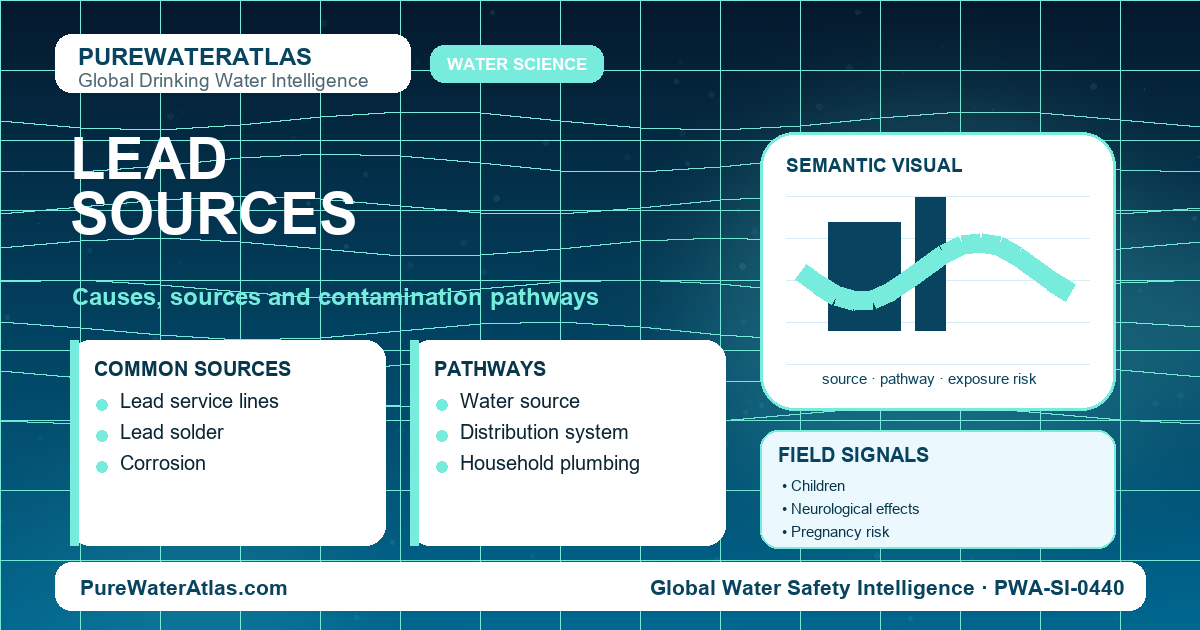
- Lead from older service lines, solder, or brass components
- Copper from household plumbing
- Iron from cast iron pipes
- Zinc, nickel, and other metals from fixtures and alloys
This is a major pathway for certain harmful substances, and it is one reason tap water chemistry can differ from utility source water reports.
Household equipment and storage conditions
Water heaters, treatment units, storage tanks, and plumbing dead-ends can all affect mineral levels. Warm water may dissolve materials more easily. Sediment accumulation can alter taste and appearance. Improperly maintained treatment systems may release resin beads, concentrated brine byproducts, or trapped minerals back into the water.
In practical terms, minerals in drinking water household exposure is shaped by both source quality and what happens inside the home. People on private wells are especially dependent on local geology and on-site plumbing conditions.
Health and Safety Implications
The presence of minerals in drinking water does not automatically mean the water is unsafe. Many minerals are common and expected. However, the concentration, type of mineral, and the health status of the individual all matter. The key question is whether the mineral causes mainly aesthetic issues, operational problems, or true health risks.
Aesthetic and household effects
Some minerals affect water quality without posing major health threats. Hard water from calcium and magnesium can:
- Create scale in pipes, kettles, and water heaters
- Reduce soap lather and leave residue on dishes and fixtures
- Shorten the lifespan of appliances
Iron and manganese can stain sinks, laundry, and plumbing fixtures. Sulfate and chloride can affect taste. High total dissolved solids can give water a salty, bitter, or otherwise unpleasant flavor. These issues may not be medically serious, but they can strongly influence water acceptance and household costs.
Potential health concerns from certain minerals and metals
Some dissolved substances are more concerning:
- Lead can harm the nervous system, especially in infants and children.
- Arsenic is associated with increased risk of cancer and other chronic health effects.
- Manganese at elevated levels may be a concern for infants and neurological health.
- Sodium may matter for people on medically restricted low-sodium diets.
- Sulfate can cause diarrhea or dehydration, particularly in visitors not accustomed to it and in infants.
- Copper may cause gastrointestinal symptoms at high levels.
For more detail on specific health outcomes, see /minerals-in-drinking-water-health-effects-and-risks/.
Risk factors that increase concern
Important minerals in drinking water risk factors include:
- Private well use, because wells are not always monitored as frequently as public systems
- Local geology, especially regions known for arsenic, fluoride, iron, manganese, or salinity
- Older plumbing, which increases the chance of lead and copper leaching
- Corrosive water chemistry, including low pH and low alkalinity
- Industrial, mining, or agricultural activity nearby
- High road salt use in cold climates
- Infants, pregnant people, older adults, and medically vulnerable individuals, who may be more sensitive to certain contaminants
Exposure does not come only from drinking. Cooking, formula preparation, beverages, and even incidental ingestion contribute to minerals in drinking water household exposure. In some cases, inhalation can also matter indirectly, such as breathing aerosolized water during showering, though this is more relevant for certain chemicals and microbes than for most minerals.
When minerals may be beneficial
It is also worth noting that some minerals are not inherently negative. Calcium and magnesium are essential nutrients, and fluoride can support dental health at appropriate levels. However, water should not be assumed to provide safe or adequate nutrition simply because it contains minerals. The concern is balance: enough to remain acceptable and useful, not so much that it causes health, taste, or infrastructure problems.
Testing and Detection
Reliable minerals in drinking water detection depends on laboratory analysis, field measurements, and sometimes system-wide monitoring records. Because many dissolved minerals are colorless and odorless, testing is often the only way to know what is present. Visible signs such as scale, staining, or salty taste can suggest a problem, but they are not enough to identify the exact substance or concentration.
Common signs that suggest mineral problems
- White crust or scale on fixtures and appliances
- Red, brown, black, or blue-green staining
- Metallic, bitter, salty, or sulfur-like taste
- Soap not lathering well
- Cloudy water or sediment after standing
- Blue-green corrosion marks near plumbing joints
These clues can help narrow the possibilities, but confirmatory testing is still necessary.
Parameters commonly tested
Depending on the concern, testing may include:
- Hardness
- Calcium and magnesium
- Iron and manganese
- Sodium and chloride
- Sulfate
- Fluoride
- Lead and copper
- Arsenic and other trace metals
- Total dissolved solids
- pH, alkalinity, and conductivity
How testing is performed
Public water systems routinely monitor many regulated substances and provide water quality reports. Private well owners usually need to arrange testing themselves through certified laboratories or local health departments. Sampling methods matter. For example, lead and copper tests may require first-draw samples after water has sat in the pipes, while other tests may require flushed samples or special preservation techniques.
Laboratories may use methods such as atomic absorption spectroscopy, inductively coupled plasma mass spectrometry, ion chromatography, and gravimetric or titration-based hardness testing. Field meters can measure conductivity, pH, and sometimes specific ions, but laboratory testing is more definitive for health decisions.
When to test
Testing is recommended:
- When buying or selling a home with a private well
- Annually for key well-water parameters, or more often in high-risk areas
- After flooding, drought, wildfire, nearby construction, or changes in taste or appearance
- After installing new plumbing or treatment equipment
- If a household member has a sensitive medical condition or infant formula is being prepared with tap water
More detailed discussion of sampling and analysis methods is available at /minerals-in-drinking-water-testing-and-detection-methods/.
Interpreting results
Results should be compared with health-based standards, secondary aesthetic guidelines, and local baseline conditions. A result that is acceptable in one context may still justify treatment for taste, corrosion control, or appliance protection. Interpretation should consider whether the source is public or private, whether the contaminant originates in the aquifer or the plumbing, and whether any sensitive populations are present in the home.
Prevention and Treatment
Effective minerals in drinking water prevention begins with source protection, regular testing, and selecting the right treatment for the specific mineral problem. There is no single filter that solves every issue, so identifying the contaminant first is essential.
Source protection and exposure reduction
- Protect wells from surface runoff, flooding, and nearby chemical storage
- Maintain proper setbacks from septic systems, livestock areas, and roads
- Seal abandoned wells and repair damaged well caps
- Support watershed protection and proper industrial waste controls
- Reduce de-icing salt use where appropriate and feasible
For municipal systems, prevention also includes corrosion control, treatment optimization, infrastructure maintenance, and source-water monitoring.
Household treatment options
Treatment depends on the specific minerals present:
- Water softeners reduce calcium and magnesium hardness through ion exchange.
- Reverse osmosis removes many dissolved minerals, salts, and some trace metals.
- Oxidation followed by filtration is often used for iron and manganese.
- Activated alumina or specialty media may be used for fluoride or arsenic in certain cases.
- Corrosion control and pH adjustment help reduce lead and copper leaching.
- Distillation can remove many minerals but is slower and energy intensive.
Point-of-use devices treat water at a single tap, while point-of-entry systems treat water for the whole house. The best choice depends on whether the concern is drinking and cooking water only or broader household impacts such as scale and staining.
Maintenance matters
Treatment systems only work well when maintained properly. Filters need replacement, softeners need correct settings and salt management, membranes can foul, and specialty media eventually exhaust. Poor maintenance can make performance unreliable and may even worsen water quality. Follow manufacturer instructions and confirm effectiveness with follow-up testing.
Reducing plumbing-related mineral exposure
If lead, copper, or other metals may be coming from plumbing:
- Use cold water for drinking and cooking
- Flush water that has been sitting in pipes
- Replace lead service lines and problematic fixtures when possible
- Install certified point-of-use filters for affected taps
- Avoid boiling water to remove metals, since boiling does not remove them and can concentrate some dissolved substances
Households seeking more water safety information can explore /category/drinking-water-safety/.
Common Misconceptions
Misunderstandings about minerals in water are common. Clearing them up helps people make better decisions.
“All minerals in water are harmful”
This is false. Many minerals are naturally present and harmless at ordinary levels. Some, such as calcium and magnesium, are mostly associated with hardness rather than toxicity. The real issue is which mineral is present and at what concentration.
“If water tastes fine, it must be safe”
Not necessarily. Some harmful metals and trace elements have no obvious taste, color, or odor. Arsenic, for example, often cannot be detected without laboratory testing.
“Bottled water is always lower in minerals”
Bottled water varies widely. Some products are intentionally mineralized, and some spring waters naturally contain substantial dissolved solids. Bottled water is not automatically a low-mineral option.
“Boiling removes minerals”
Boiling does not remove dissolved minerals. In fact, as water evaporates, some minerals become more concentrated. This is why kettles often develop scale.
“Water softeners make all water safer”
Softening mainly addresses hardness. It does not necessarily remove arsenic, lead, sulfate, or many other contaminants. In sodium-based softeners, it can also increase sodium levels somewhat.
“Only well water has mineral problems”
Public water systems can also have mineral-related issues, whether from source water, treatment changes, distribution system corrosion, or blending different supplies. Public systems are monitored more regularly, but they are not immune to mineral concerns.
Regulations and Standards
Regulatory oversight helps determine when mineral levels are considered acceptable, aesthetically undesirable, or unsafe. Standards vary by country, but they generally fall into two categories: health-based limits and secondary or aesthetic guidelines.
Health-based standards
Health-based standards are legally enforceable in many public water systems for contaminants such as arsenic, lead, and copper. These standards are designed to reduce long-term and short-term health risks. Action levels, treatment techniques, and maximum contaminant levels may all be used depending on the contaminant and jurisdiction.
Secondary standards
Secondary standards often address taste, odor, staining, color, corrosivity, or scaling rather than direct health effects. Iron, manganese, chloride, sulfate, and total dissolved solids are often included in this category. Even though these may be non-enforceable in some areas, they are still important because they affect water usability and customer confidence.
Public water systems versus private wells
Public water systems are typically required to monitor water quality, report findings, and take corrective action if standards are exceeded. Private wells, however, are usually the responsibility of the property owner. This creates a major gap in routine oversight and makes homeowner awareness especially important.
Global variation
Regulatory frameworks differ around the world based on local geology, infrastructure, economics, and public health priorities. In areas with widespread arsenic or fluoride in groundwater, standards and monitoring programs may focus heavily on those contaminants. Regions facing salinization, mining impacts, or aging pipe networks may prioritize different minerals and metals. Readers interested in broader regional perspectives can visit /category/global-water-quality/.
Standards should be seen as a minimum benchmark, not the only decision point. A water supply can meet regulations and still justify treatment because of hardness, staining, corrosivity, or household-specific health needs.
Conclusion
Understanding minerals in drinking water causes and sources is a key part of managing water quality responsibly. Minerals enter drinking water through natural rock weathering, groundwater chemistry, surface runoff, industrial and agricultural activities, road salt, treatment processes, and plumbing corrosion. Some minerals mainly affect taste, staining, and scale. Others can create meaningful health concerns, especially when they involve arsenic, lead, copper, manganese, or high sodium and sulfate in sensitive situations.
The most important takeaway is that mineral content must be evaluated case by case. Local geology, household plumbing, source type, and individual health needs all influence whether a given result is acceptable. Signs like hard water deposits or staining can be useful clues, but proper minerals in drinking water detection requires testing. Once the specific problem is identified, targeted treatment such as softening, reverse osmosis, oxidation-filtration, or corrosion control can reduce minerals in drinking water household exposure effectively.
For homeowners and communities alike, the best strategy combines monitoring, prevention, and informed treatment choices. Protecting the water source, maintaining plumbing and treatment systems, and understanding relevant regulations all support safer and more reliable drinking water. Continued learning through resources such as /minerals-in-drinking-water-complete-guide/, /minerals-in-drinking-water-health-effects-and-risks/, and /minerals-in-drinking-water-testing-and-detection-methods/ can help readers make practical decisions grounded in science.
Read the full guide: Water Science Guide
Explore more in this category: Water Science Articles