
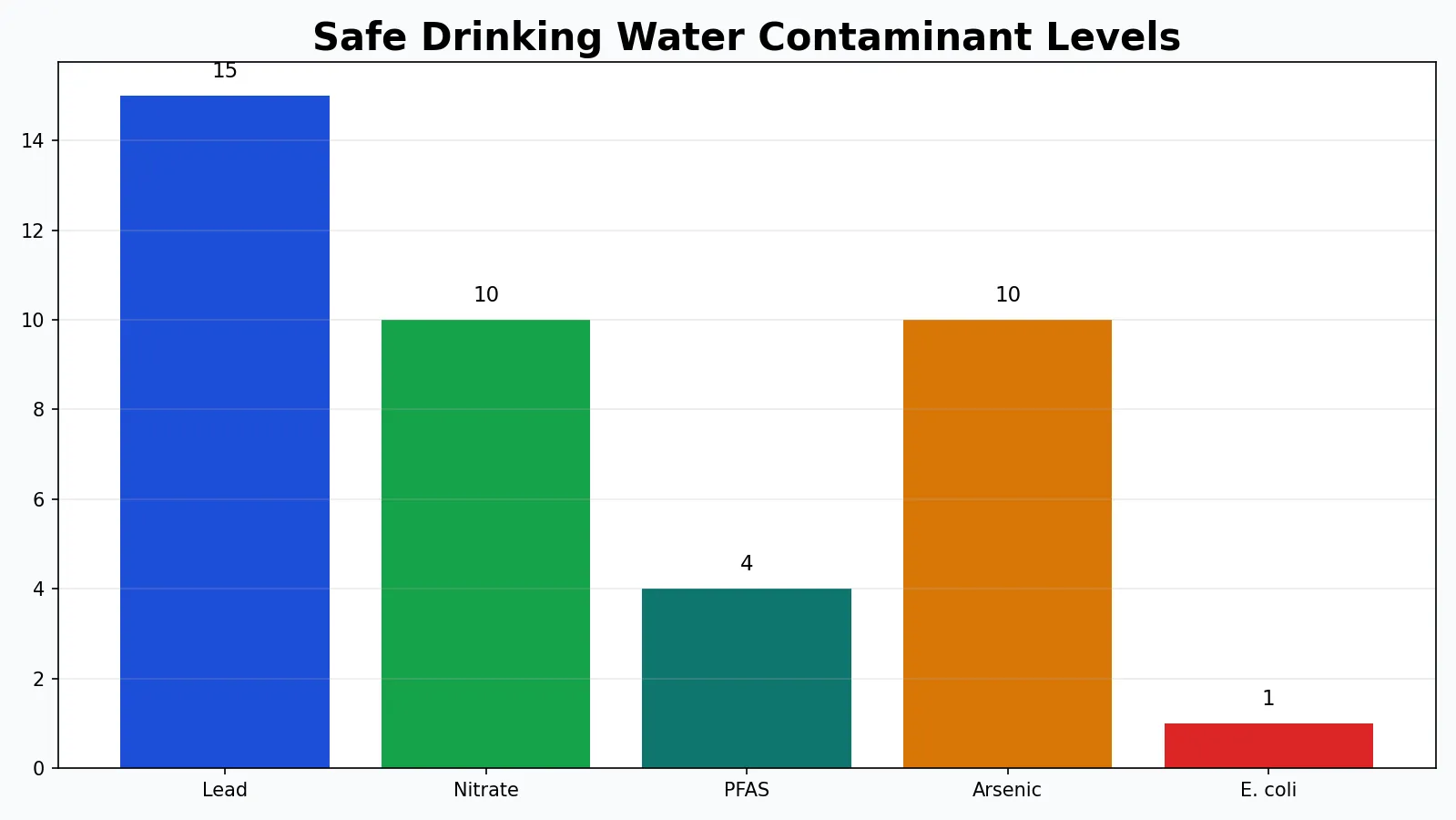
Understanding safe levels for drinking water contaminants is essential for anyone who wants to make informed decisions about household water quality. The phrase water safety levels refers to the concentration thresholds used to judge whether contaminants in drinking water are acceptable, manageable, or potentially harmful. These thresholds are not arbitrary. They are built from toxicology, microbiology, exposure science, engineering feasibility, and public health policy. For homeowners, tenants, schools, clinics, and community water systems, knowing how these levels are defined and applied helps turn a laboratory report from a confusing page of numbers into meaningful information about safe drinking water.
In practice, “safe” does not mean that water contains zero contaminants. Nearly all natural water contains dissolved minerals, trace metals, organic matter, and microorganisms. Water moves through rock, soil, plumbing, and treatment systems before it reaches the tap, and each stage can influence water quality. What matters is whether contaminants are present at levels known to increase health risk, affect taste or odor, damage plumbing, or indicate a treatment problem. This is why modern drinking water standards use measurable thresholds, monitoring rules, and action levels rather than simple all-or-nothing definitions.
If you are new to the topic, it can help to begin with a broader overview of water science, contaminants, treatment, and water quality, because the meaning of a “safe level” depends on the type of contaminant, the source of the water, and the intended use. A level considered acceptable for short-term exposure may not be ideal for lifelong daily consumption, and a number that is not dangerous by itself may still signal a need to investigate the source.
What “water safety levels” actually means
Water safety levels are benchmark concentrations used to evaluate the quality of drinking water. They may be expressed as:
- Maximum contaminant levels or MCLs
- Action levels
- Health advisory levels
- Guideline values
- Treatment technique requirements
- Secondary standards for aesthetic qualities such as taste, odor, and staining
These categories matter because not every substance is regulated in the same way. Some contaminants are controlled with a numerical legal limit in finished drinking water. Others are managed by requiring specific treatment processes. In some cases, public health agencies publish non-enforceable health-based guidance where a universal enforceable standard does not exist.
For example, a regulated contaminant like arsenic may have a maximum allowable concentration in community water systems. Lead is handled differently in many regulatory frameworks because much of it enters water after treatment, when water contacts household plumbing materials. Microbial safety often depends not only on testing finished water but also on maintaining disinfection and distribution system integrity.
This is one reason people often feel confused when comparing who water standards, epa water limits, and lab report flags. A laboratory report may show a contaminant detected at a very low concentration, but whether that result represents a health concern depends on the applicable benchmark, the duration of exposure, the reliability of the sample, and the vulnerability of the person drinking the water.
Why safe contaminant levels matter for drinking water safety
Drinking water is consumed repeatedly over long periods, which makes even low-level exposures important when they are chronic. The science of water safety therefore focuses on both acute risks and long-term risks.
Acute risks
Acute risks are effects that may appear soon after exposure. These include gastrointestinal illness from pathogens such as bacteria, viruses, and protozoa; short-term nitrate toxicity in infants; or chemical contamination from a spill or industrial release. Microbial contamination is especially important because a water source that looks clear and tastes normal can still transmit infection.
Chronic risks
Chronic risks are associated with repeated exposure over months or years. These may include increased risk of certain cancers, neurological effects, kidney effects, reproductive or developmental concerns, and cardiovascular impacts, depending on the contaminant. Metals like arsenic and uranium, disinfection byproducts, and some synthetic organic chemicals are evaluated largely in this long-term context.
Infrastructure and household implications
Not all water quality concerns are direct health hazards, but they still matter. Excess iron and manganese can cause staining and unpleasant taste. High hardness can reduce appliance efficiency. Corrosive water can dissolve plumbing metals. Therefore, some standards are health-based and some are operational or aesthetic. A complete view of water contamination levels should consider all three dimensions.
For a practical homeowner-oriented overview of tap water risk assessment, readers may also find it useful to review how to know if your tap water is safe to drink. The central lesson is that water safety is not determined by appearance alone. Reliable conclusions come from understanding both source and measurement.
Who sets drinking water standards?
Several institutions influence drinking water benchmarks, and their roles are related but not identical.
United States Environmental Protection Agency
In the United States, the EPA establishes national regulations for public drinking water systems under the Safe Drinking Water Act. These rules define legal standards for many contaminants and treatment obligations for public systems. The EPA’s drinking water program covers microbiological contaminants, inorganic chemicals, organic chemicals, radionuclides, disinfection requirements, and monitoring obligations. The agency’s main public resource is the EPA ground water and drinking water portal.
World Health Organization
The World Health Organization publishes guideline values and public health guidance used globally, especially in countries adapting or building national standards. WHO values are based on toxicology and microbiology, but they are guidance rather than automatically enforceable legal limits. Their drinking water fact sheet is available through the World Health Organization drinking water page.
Centers for Disease Control and Prevention
The CDC provides public health communication and practical advice on drinking water, private wells, emergency disinfection, and contamination events. It is especially useful for understanding microbial safety, boil water notices, and vulnerable populations. A relevant public resource is the CDC drinking water overview.
National and local regulators
States, provinces, municipalities, and national ministries may adopt stricter requirements, additional monitoring, or region-specific limits. This matters because water chemistry and contamination patterns differ by geography. A rural private well drawing from an agricultural aquifer faces different hazards than a large urban utility treating surface water from a protected watershed.
Scientific basis of contaminant thresholds
To understand why one number is considered acceptable and another is not, it helps to know how standards are developed. Though the exact process varies by agency and contaminant, several scientific principles appear repeatedly.
Toxicology and dose-response
Toxicologists study how a chemical affects biological systems and how risk changes with dose. From animal studies, human epidemiology, mechanistic research, and exposure modeling, agencies identify levels associated with harmful effects or levels below which harm is unlikely. Safety factors are often added to protect sensitive populations and account for uncertainty.
Exposure assumptions
A contaminant concentration in water means little without considering how much water people drink and for how long. Health-based standards usually assume regular daily consumption over many years. Special assumptions may be used for infants, pregnant people, or other sensitive groups when the contaminant has age- or condition-specific effects.
Microbial risk assessment
For pathogens, standards often rely on a different framework than for chemicals. Infection risk can rise from extremely low numbers of organisms, and testing every pathogen directly is impractical. Instead, regulations may use indicators such as total coliforms or E. coli, treatment performance requirements, source protection, turbidity limits, and disinfectant residuals.
Analytical detection and treatment feasibility
Even if a health-based ideal concentration is extremely low, the regulatory limit must also consider whether laboratories can reliably measure that level and whether treatment systems can consistently achieve it. This practical component is one reason regulatory numbers are not always identical to purely health-based goals.
Risk management
Ultimately, drinking water standards are public health tools. They balance evidence on hazard and exposure with engineering reality, monitoring logistics, and cost-effectiveness, while aiming to protect the population. That does not mean economics overrides safety; rather, regulators must design standards that can actually be implemented, verified, and enforced.
Main categories of drinking water contaminants
When interpreting water safety levels, the first question should be: what kind of contaminant is this? Different categories behave differently in the environment and in the body.
Microbiological contaminants
This group includes bacteria, viruses, and protozoa from fecal contamination, animal waste, sewage intrusion, surface runoff, or distribution system failures. Key examples include E. coli, Salmonella, norovirus, Giardia, and Cryptosporidium. The health consequences may include diarrhea, vomiting, dehydration, and severe illness in vulnerable individuals.
For microbial contamination, the concept of “safe levels” is often stricter than for chemicals. The desired level for certain indicator organisms in drinking water is effectively non-detectable. However, because direct pathogen testing is complex, water systems also rely on treatment barriers and operational monitoring.
Inorganic chemicals
This category includes arsenic, lead, nitrate, nitrite, fluoride, uranium, chromium, selenium, and other metals or ions. Some occur naturally in geology; others arise from agriculture, mining, industrial activity, or plumbing materials. Their health effects vary widely, from developmental impacts to kidney damage to cancer risk, depending on the substance and exposure level.
Organic chemicals
Pesticides, solvents, petroleum compounds, industrial chemicals, and disinfection byproducts fall into this category. These contaminants may enter source water from industrial discharge, spills, landfills, agricultural runoff, wastewater influence, or water treatment reactions. Their standards can be difficult for the public to interpret because names are technical and concentrations are often very small, such as micrograms per liter.
Radiological contaminants
Radionuclides such as radium, uranium, and gross alpha particles may be present in some groundwater sources. Long-term exposure is the key concern. Specialized laboratory analysis is required, and treatment may involve ion exchange, reverse osmosis, or other targeted methods.
Aesthetic and operational parameters
Iron, manganese, sodium, hardness, total dissolved solids, pH, sulfate, and chloride are often discussed even when they are not always primary toxicological hazards at common concentrations. They affect taste, color, odor, corrosivity, scale formation, and appliance performance. In some cases, these parameters also influence whether other contaminants are mobilized from plumbing or whether disinfection works effectively.
Common drinking water standards and what they mean
Consumers often see a mixture of terms on municipal reports and private lab analyses. Understanding the terminology is more useful than memorizing isolated numbers.
Maximum Contaminant Level (MCL)
An MCL is the highest concentration of a contaminant allowed in water delivered by public systems under a regulatory framework. It is enforceable. If a public system exceeds it, corrective action and public notification requirements may apply.
Maximum Contaminant Level Goal (MCLG)
An MCLG is a non-enforceable health-based goal. It reflects a level at which no known or expected health effect is anticipated, often including a margin of safety. For some contaminants, the MCLG is lower than the enforceable MCL, especially when treatment limitations exist.
Action Level
An action level is a threshold that triggers treatment changes, corrosion control review, source investigation, or public education rather than functioning exactly like a standard at the consumer tap. Lead and copper are classic examples in many regulatory systems.
Health Advisory
Health advisories are guidance values for contaminants not always subject to enforceable standards or for special exposure scenarios. They can be especially important during emerging contaminant investigations.
Secondary Maximum Contaminant Level
These standards address cosmetic or aesthetic effects such as staining, taste, color, and odor. While often not health-based, they can still be important because they influence acceptability and may reveal treatment or plumbing issues.
If you want a structured explanation of how these categories appear in reports and regulations, PureWaterAtlas has a useful resource on water quality standards explained.
Examples of important contaminants and their safety thresholds
The exact numerical benchmark for a contaminant may depend on the jurisdiction and context, so any household decision should rely on current local regulations and lab interpretation. Still, several contaminants are common enough that they deserve special discussion.
Lead
Lead is a major drinking water concern because it can enter water from older service lines, solder, brass components, and some plumbing fixtures. It is especially hazardous for infants and children because of its effects on neurological development. In many systems, compliance is based on an action level rather than a simple concentration limit for every household tap sample. This reflects the fact that lead contamination often varies from one building to another depending on plumbing.
Testing requires careful sampling because first-draw and flushed samples can produce different results. If lead is a concern in your home, the most practical next step is focused testing and sample interpretation. PureWaterAtlas provides a detailed guide to testing lead in water.
Nitrate and nitrite
Nitrate contamination often arises from fertilizers, septic systems, manure, and agricultural runoff. It is particularly important in private wells and rural groundwater supplies. Elevated nitrate can interfere with oxygen transport in infants, causing methemoglobinemia, and may also indicate broader source contamination.
Because nitrate is colorless, odorless, and tasteless at typical concentrations, laboratory analysis is essential. If you live in an agricultural area or rely on a shallow well, nitrate testing should be routine. For practical sampling guidance, see testing nitrates in water.
Arsenic
Arsenic commonly occurs naturally in some groundwater formations, though mining and industrial activity can also contribute. Long-term exposure has been associated with skin changes, cardiovascular effects, and increased cancer risk. Arsenic is one of the clearest examples of why water may appear normal and still be unsafe at the tap.
Fluoride
Fluoride occupies a special place in public health because low concentrations can reduce dental caries, while excessive levels may contribute to dental or skeletal fluorosis. The distinction between beneficial and excessive exposure illustrates the core concept of water safety levels: concentration matters, and the same substance can have different implications at different doses.
Disinfection byproducts
When disinfectants react with natural organic matter, compounds such as trihalomethanes and haloacetic acids can form. These byproducts are regulated because long-term exposure at elevated levels may increase health risks. Utilities control them by optimizing source treatment, precursor removal, disinfectant type, and contact conditions.
PFAS and emerging contaminants
Per- and polyfluoroalkyl substances have attracted major attention because they are persistent, widely distributed, and associated with potential health concerns. Regulatory frameworks are evolving quickly. For emerging contaminants, it is especially important to distinguish between health advisories, proposed standards, final enforceable standards, and laboratory detection limits.
Total coliforms and E. coli
Coliform bacteria are used as indicators of sanitary integrity. E. coli is a stronger indicator of fecal contamination and possible pathogen presence. Detection of these organisms in drinking water can trigger immediate public health action, especially when a system serving the public is involved. The standard for E. coli in treated drinking water is effectively zero tolerance because its presence suggests unacceptable microbiological risk.
Why a lab report can be hard to interpret
Many consumers receive a water test report and immediately focus on whether each contaminant says “pass” or “fail.” That is understandable, but it can oversimplify the issue. Interpretation requires context.
Units matter
Water results may be reported in mg/L, µg/L, ppb, ppm, colony-forming units, or other units. A result that looks tiny may still be significant if the health benchmark is even smaller. Conversely, a number may look large because of the unit format but still be below a relevant threshold.
Detection limit versus health limit
“Not detected” does not necessarily mean zero. It means the concentration was below the laboratory’s reporting or detection limit. Likewise, a detected result is not automatically dangerous. The correct question is whether the concentration exceeds an applicable standard, action level, or advisory.
Sample type matters
First-draw samples, flushed samples, raw well samples, post-treatment samples, and bacteriological samples each answer different questions. Improper sampling can produce misleading reassurance or unnecessary alarm.
One result is not always the whole story
Some contaminants fluctuate seasonally or with rainfall, pumping conditions, temperature, treatment performance, or plumbing stagnation. Microbial contamination and nitrate spikes, for example, can be episodic. A single compliant result is valuable, but it may not always represent long-term conditions.
For a step-by-step explanation of report language, flags, and units, see understanding water test results.
How water is tested for safety levels
Testing methods depend on the contaminant. Accurate interpretation starts with proper sample collection, transport, preservation, and laboratory method selection.
Microbiological testing
Bacteriological testing usually uses sterile containers and strict handling requirements. The sample must often reach the lab quickly and be processed within a defined time window. Common tests include total coliform and E. coli analyses. Because contamination can occur during sample collection, technique is crucial.
Chemical testing
Chemical analysis may involve acid-preserved bottles, chilled transport, or special containers depending on whether the target is metals, volatile organics, PFAS, nutrients, or radionuclides. Certified laboratories use validated methods such as ICP-MS for metals, ion chromatography for anions, and chromatography-mass spectrometry methods for organic contaminants.
Field parameters
Some characteristics such as pH, conductivity, dissolved oxygen, and chlorine residual can be measured in the field or shortly after collection because they can change rapidly during transport.
Routine monitoring versus diagnostic testing
Public water systems perform regular compliance monitoring under regulatory schedules. Homeowners with private wells must usually arrange testing independently. Diagnostic testing is more targeted and may be prompted by staining, a plumbing upgrade, nearby agriculture, flooding, unusual taste, or a vulnerable household member.
If you are comparing test options for your home, the PureWaterAtlas water testing category is a useful starting point for screening, contaminant-specific testing, and result interpretation.
Public water systems versus private wells
The meaning of safe contaminant levels changes somewhat depending on whether your water comes from a regulated public system or a private source.
Public water systems
Public systems are generally required to monitor contaminants, maintain treatment, publish annual reports, and notify customers about violations or acute threats. This does not mean problems never occur, but it does mean there is a formal compliance framework. Consumers should review annual water quality reports and local notices, especially for lead service line issues, microbial advisories, or source water changes.
Private wells
Private wells are usually not subject to the same routine regulatory monitoring. Responsibility for testing falls largely on the owner. This makes private well users more dependent on understanding water contamination levels, local geology, nearby land use, well construction quality, and testing frequency. Annual testing for bacteria and nitrate is often recommended, with additional tests based on regional risks such as arsenic, uranium, manganese, or pesticides.
Vulnerable populations and lower tolerance for risk
Not everyone faces the same risk from the same water contaminant level. Infants, young children, pregnant people, older adults, and people with weakened immune systems may require more cautious interpretation.
- Infants: especially sensitive to nitrate and dehydration from waterborne illness
- Children: more vulnerable to neurotoxic effects of lead
- Pregnant people: may require extra attention to contaminants with developmental implications
- Immunocompromised individuals: at greater risk from opportunistic pathogens and protozoa
- Kidney patients or medically restricted diets: may be affected by sodium, potassium, or mineral content depending on circumstances
This is why a result that appears technically compliant may still prompt additional caution in a particular household. Safety decisions should consider who is drinking the water, not just what the legal threshold says.
When a contaminant exceeds a safe level
If a water result exceeds a health-based standard, action level, or advisory, the response depends on the contaminant and the severity of exceedance.
Confirm the result
Start by confirming sample validity. Was the sample collected correctly? Was the lab accredited for the method? Is repeat testing needed? Some contaminants require follow-up sampling to determine whether the issue is persistent, localized, or sample-specific.
Identify the source
Is the contamination from source water, treatment failure, household plumbing, or temporary intrusion? Lead often points to plumbing. Nitrate often points to watershed or well vulnerability. Coliforms may indicate a well cap problem, flooding influence, or sanitary defect.
Use an appropriate interim measure
Depending on the contaminant, appropriate short-term actions may include using bottled water certified for drinking, installing a properly selected and maintained treatment device, flushing stagnant water, or following boil water guidance for microbial hazards. It is important to note that boiling is not suitable for every contaminant; it can worsen some chemical exposures by concentrating dissolved substances as water evaporates.
Select treatment based on the contaminant
No single treatment solves all problems. Reverse osmosis can reduce many dissolved contaminants but not all. Activated carbon is useful for many organics and taste-and-odor issues but not for nitrate in standard configurations. UV can disinfect microbiological contamination but does not remove chemicals and requires low turbidity. Ion exchange can remove nitrate, hardness, and some metals depending on resin type. Oxidation and filtration may be needed for iron, manganese, or arsenic in certain water chemistries.
How standards differ from ideal water quality
A common misunderstanding is that water meeting all regulations is automatically perfect. Regulatory compliance is essential, but “ideal” household water quality can be a broader concept.
For example, water may meet health-based limits for iron and still stain fixtures because iron is controlled mainly as an aesthetic issue. Hard water may be safe to drink but may scale kettles and reduce soap efficiency. Chlorine residual may be necessary for microbial safety while causing an objectionable taste to some consumers. Therefore, water quality decisions often involve both public health protection and household preferences.
This distinction is important for SEO conversations around safe drinking water. Safety is the first priority, but quality includes safety, reliability, appearance, taste, plumbing compatibility, and confidence in monitoring.
How WHO and EPA approaches compare
People frequently compare who water standards and epa water limits. In many cases, the values are similar because both draw on overlapping toxicological and microbiological evidence. However, differences can occur for several reasons:
- Different update cycles and review timing
- Different policy assumptions or exposure models
- Different treatment feasibility assessments
- Differences between guideline values and enforceable regulations
- Regional priorities and implementation realities
WHO guidance is designed for global applicability, including settings with very different water infrastructures. EPA regulations are tailored to the U.S. legal and compliance system. Neither should be interpreted in isolation from context. The most useful approach is to identify which benchmark applies to your water source and use current official references when evaluating a contaminant result.
Practical advice for households
For most people, the best response to concern about water safety levels is systematic rather than reactive.
- Know whether your water comes from a public system or a private well.
- Read your annual consumer confidence report if you use municipal water.
- Test private wells on a schedule, not only when water looks unusual.
- Test for contaminants relevant to your region, plumbing, and land use.
- Use certified laboratories and follow sample instructions carefully.
- Interpret results against current standards, action levels, or advisories.
- Choose treatment that matches the contaminant rather than buying a generic filter.
- Retest after installing treatment or making plumbing changes.
Households should also be cautious about overinterpreting home test strips. They can be useful for screening some parameters, but they are not a substitute for accredited laboratory analysis when making decisions about health-relevant contaminants.
Selected contaminant categories and typical regulatory context
| Contaminant category | Common source | Why it matters | Regulatory approach |
|---|---|---|---|
| Microbial indicators | Fecal contamination, treatment failure, intrusion | Acute infection risk | Zero-tolerance indicators, treatment techniques, monitoring |
| Lead | Corroding plumbing materials | Neurodevelopmental and cardiovascular concerns | Action level and corrosion control requirements |
| Nitrate | Agriculture, septic systems, manure | Infant toxicity, source vulnerability indicator | Maximum contaminant level |
| Arsenic | Natural geology, mining influence | Long-term cancer and systemic effects | Maximum contaminant level |
| Disinfection byproducts | Reaction of disinfectants with organic matter | Long-term health risk at elevated levels | Maximum contaminant levels and operational controls |
| Iron and manganese | Natural groundwater chemistry | Staining, taste, operational problems | Often secondary or aesthetic standards |
FAQ
Does “detected” mean my water is unsafe?
No. A contaminant can be detected at a concentration well below any health-based concern. The key question is whether the measured level exceeds a relevant standard, action level, or advisory and whether the sample accurately represents your water.
Are public water systems always safe if they meet regulations?
Meeting regulations is an important sign of compliance and risk management, but no system is beyond all possible problems. Water quality can change with source conditions, infrastructure issues, or household plumbing. Compliance data should be combined with local notices and, when appropriate, household testing.
Should private wells be tested even if the water tastes fine?
Yes. Many important contaminants such as nitrate, arsenic, and some microbes may be present without obvious taste, odor, or color changes. Testing is the only reliable way to evaluate many well water risks.
Can boiling water make it safe from any contaminant?
No. Boiling can kill many microbes, but it does not remove metals, nitrate, or many other dissolved chemicals. In some cases it can increase chemical concentration slightly by reducing water volume.
How often should drinking water be tested?
It depends on the source and the contaminant. Public systems follow regulatory schedules. Private wells are often tested annually for bacteria and nitrate, with additional testing based on local risks, plumbing age, flooding, repairs, or changes in taste, odor, or appearance.
Conclusion
Water safety levels are the scientific and regulatory backbone of drinking water protection. They help translate chemistry, microbiology, and exposure science into practical thresholds for action. But those numbers only become useful when they are understood in context: the contaminant type, the water source, the person exposed, the sampling method, and the applicable regulatory framework. Whether you are comparing drinking water standards, reviewing who water standards, checking epa water limits, or trying to make sense of household water contamination levels, the goal is the same: to ensure access to truly safe drinking water based on evidence rather than guesswork. Good decisions start with accurate testing, careful interpretation, and treatment choices matched to the specific contaminant involved.
Featured image: Photo by Jo McNamara on Pexels.
Read the full guide: Water Testing Guide
Explore more in this category: Water Testing Articles