
Introduction
Arsenic is one of the most important drinking water contaminants for homeowners, landlords, well owners, public health professionals, and anyone concerned about long-term water safety. Interest in arsenic in drinking water warning signs is understandable: people want to know whether there are clues that suggest contamination before it causes harm. The challenge is that arsenic often behaves very differently from contaminants people can easily detect with their senses. In many cases, water can look clear, smell normal, and taste completely acceptable while still containing unsafe levels of arsenic.
That is why arsenic requires an educational, evidence-based approach. Rather than relying on guesswork, visible changes, or sudden illness alone, it is important to understand where arsenic comes from, who is most at risk, what kinds of health effects may develop over time, and when testing is appropriate. For many households, especially private well users, regular screening is the only dependable way to know whether arsenic is present.
Arsenic contamination can occur naturally in groundwater or result from past industrial, agricultural, or mining activities. It can affect private wells, community systems, and homes in both rural and urban settings. Because symptoms from chronic exposure may be subtle, nonspecific, or delayed, many people do not recognize a problem until testing reveals it. That makes awareness of arsenic in drinking water risk indicators especially valuable.
This article explains what arsenic is, the main causes of contamination, practical warning signs and red flags, potential health consequences, how testing works, and what treatment options are available. If you want broader background on contamination issues, see water contamination resources. For a more comprehensive overview of this specific topic, visit this complete guide to arsenic in drinking water.
What It Is
Arsenic is a naturally occurring element found in rocks, soil, air, and water. In drinking water discussions, it usually refers to dissolved arsenic that has entered groundwater or surface water sources. It can exist in several chemical forms, but the forms most often discussed in water safety are inorganic arsenic compounds, which are generally considered more harmful than most organic arsenic compounds.
In groundwater, arsenic typically enters water as it moves through arsenic-bearing rock formations and sediments. Under certain geochemical conditions, arsenic can dissolve from minerals into the water supply. This is why some regions have persistent arsenic problems even where there is no obvious industrial pollution nearby.
Two major forms are commonly discussed in water treatment:
- Arsenite (As III): Often more difficult to remove with some treatment methods and common in low-oxygen groundwater.
- Arsenate (As V): Often easier to remove after oxidation and more common in oxygen-rich conditions.
Understanding the chemical form matters because treatment effectiveness can depend on it. A system that works well for one arsenic species may perform less effectively for another unless water chemistry is adjusted first.
People often ask about arsenic in drinking water taste and odor or arsenic in drinking water visible signs. The key fact is that arsenic itself usually does not create a reliable taste, smell, or appearance change at levels relevant to drinking water exposure. This makes it different from contaminants such as sulfur compounds, iron, or manganese, which may create obvious staining or unpleasant odors. The lack of sensory clues is one of the biggest reasons arsenic can go unnoticed for years.
Because arsenic cannot usually be detected by the senses, terms like “warning signs” should be interpreted carefully. In practice, warning signs often mean contextual red flags rather than direct sensory proof. These include the location of the water source, local geology, nearby contamination history, well depth, and unexplained health patterns that may justify testing.
Main Causes or Sources
The most common source of arsenic in drinking water is natural geology. Certain rock and sediment formations contain arsenic-bearing minerals, and groundwater can dissolve arsenic as it passes through them. This is especially relevant for private wells that draw from aquifers with naturally elevated arsenic concentrations.
Important natural sources include:
- Bedrock and sediment with arsenic-rich minerals
- Groundwater chemistry that encourages arsenic release
- Seasonal or long-term changes in water table conditions
- Deep aquifers in regions known for elevated geologic arsenic
Human activity can also contribute. While natural sources dominate in many areas, contamination may be linked to current or historical land use. Potential anthropogenic sources include:
- Mining and ore processing
- Smelting and metal-related industries
- Combustion residues and industrial waste disposal
- Older pesticides and herbicides that contained arsenic compounds
- Wood preservatives used in certain treated lumber products in the past
- Improper disposal of arsenic-containing materials
If your property is near former agricultural land, mining areas, industrial facilities, or waste sites, these may be arsenic in drinking water risk indicators. Local records, environmental maps, and public health advisories can help identify whether your area has known concerns. For a deeper review of where contamination comes from, see arsenic in drinking water causes and sources.
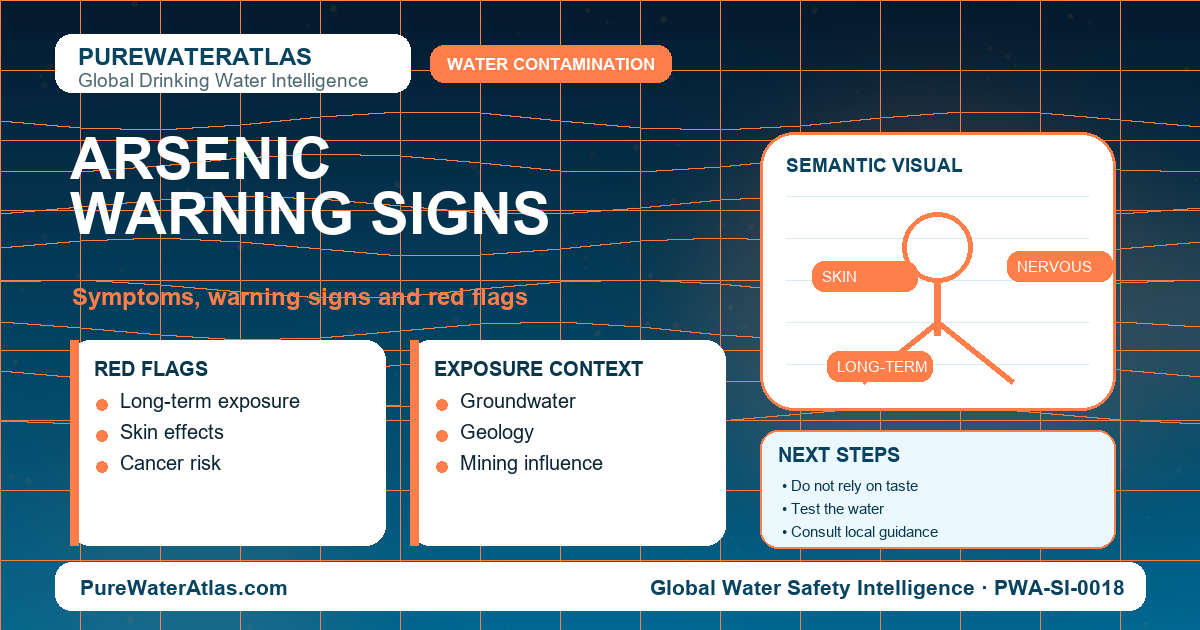
Several practical red flags increase the likelihood that testing is warranted:
- You use a private well, especially in a region with known geologic arsenic issues.
- Neighbors have had arsenic detected in their wells.
- Your home is located near mining, industrial, or historically agricultural land.
- Your local health department has issued groundwater advisories.
- You are buying or selling a home with a private water supply.
- You have never tested your well, or testing has not been repeated in years.
- You have changed your well depth, pump, plumbing, or water source configuration.
Another important point is that contamination is not always uniform. Two nearby wells can have very different arsenic levels depending on geology, depth, construction, and groundwater flow patterns. A neighbor’s safe result does not guarantee your well is safe, and a contaminated nearby well should motivate prompt testing of your own supply.
Health and Safety Implications
When people search for arsenic in drinking water health symptoms, they are often hoping for a checklist that can confirm exposure. Unfortunately, arsenic-related health effects can be difficult to identify based on symptoms alone. Low-to-moderate chronic exposure may not produce immediate or specific symptoms, and many possible effects overlap with other health conditions.
The main health concern with arsenic in drinking water is long-term exposure. Chronic ingestion has been associated with increased risks of serious health outcomes, particularly when arsenic levels are elevated over time. Potential health effects may include:
- Skin changes such as darkened patches or thickening
- Numbness or tingling in hands and feet
- Digestive complaints in some cases
- Cardiovascular effects
- Neurological effects
- Developmental concerns for fetuses, infants, and children
- Increased risk of certain cancers, including skin, bladder, and lung cancers
Short-term exposure to very high levels can cause more acute symptoms, but this is less commonly how household arsenic problems are discovered. More often, the concern is quiet, cumulative exposure over years. That is why waiting for illness is not a safe strategy.
Potential red flags related to health are not definitive proof of arsenic, but they may justify discussing testing with a healthcare provider and testing the water source:
- Multiple household members rely on the same untreated well water for years.
- There is a known local arsenic problem and vulnerable individuals live in the home.
- There are unexplained chronic skin changes or peripheral nerve complaints alongside environmental risk factors.
- Pregnant individuals, infants, or young children are consuming untested private well water.
It is important not to self-diagnose arsenic exposure based on symptoms alone. Many of these signs can result from unrelated medical conditions. Water testing and professional medical evaluation are both important if exposure is suspected.
Certain groups may face higher concern from exposure:
- Infants and children: Developing bodies may be more vulnerable to toxic effects.
- Pregnant people: Exposure during pregnancy raises added concern for fetal development.
- People with long-term well water use: Duration of exposure matters.
- Immunocompromised individuals or those with chronic illness: Overall health status may affect resilience.
For more on health outcomes and risk context, see arsenic in drinking water health effects and risks.
Testing and Detection
Testing is the only reliable way to confirm arsenic in drinking water. This is the central answer to questions about arsenic in drinking water visible signs and arsenic in drinking water taste and odor: there usually are no dependable sensory clues. Clear, odorless, normal-tasting water can still exceed recommended safety limits.
If you are wondering about arsenic in drinking water when to test, several situations should trigger action:
- When you first move into a home with a private well
- Before purchasing a property served by a well
- When local authorities identify arsenic concerns in your area
- After major well repairs, replacement, or changes in water source
- When neighboring wells show arsenic contamination
- As part of routine periodic well maintenance testing
- When pregnant individuals, infants, or children are using the water supply
Public water systems are generally subject to regulatory monitoring requirements, but private wells are usually the owner’s responsibility. That means many well users are exposed to potential contaminants without routine oversight unless they arrange testing themselves.
Laboratory testing is preferred over informal assumptions or non-validated methods. A certified lab can measure arsenic concentration accurately, usually in micrograms per liter (µg/L), which is equivalent to parts per billion (ppb) in water. Depending on the situation, additional analysis may include:
- Total arsenic concentration
- Arsenic speciation, distinguishing arsenite from arsenate
- Related water chemistry such as pH, iron, manganese, sulfate, and hardness
- Other contaminants that may influence treatment selection
Speciation may be especially useful when designing treatment because arsenite and arsenate can behave differently in purification systems. If a treatment device is already installed, post-treatment testing is essential to confirm performance.
People sometimes assume that staining, sediment, or metallic taste points directly to arsenic. In reality, those issues are more often linked to iron, manganese, sulfur, corrosion, or other water quality problems. They may coexist with arsenic, but they are not reliable arsenic indicators by themselves. In other words, unpleasant water quality can be a reason to test broadly, but it should not be treated as proof of arsenic.
For households evaluating overall water safety, it may be helpful to combine arsenic testing with broader screening for microbiological and chemical concerns. For related topics, see water microbiology and water purification.
Best practices for testing include:
- Use a state-certified or nationally accredited laboratory when possible.
- Follow sample collection instructions carefully to avoid invalid results.
- Test raw water before treatment and treated water after treatment if a system is installed.
- Keep written records of all results and dates.
- Retest periodically according to local guidance or whenever conditions change.
If arsenic is found, the next step is not panic but confirmation, assessment, and action. A professional can help interpret whether the result exceeds applicable standards, whether repeat testing is needed, and which treatment method fits your water chemistry.
Prevention and Treatment
Preventing arsenic exposure starts with awareness and testing, especially for private wells. Since arsenic often cannot be detected by the senses, prevention is largely about proactive management rather than reacting to obvious changes in water appearance or smell.
Key prevention strategies include:
- Testing all private wells on a routine basis
- Reviewing local groundwater quality data and advisories
- Testing before using a new or newly purchased well as a drinking source
- Paying close attention to vulnerable household members, such as infants and pregnant individuals
- Using certified treatment devices when arsenic is detected
If arsenic is present, boiling the water is not an effective solution. Boiling removes water through evaporation but does not remove arsenic; in fact, it can slightly increase arsenic concentration as water volume decreases. This is a critical safety point.
Effective treatment methods may include:
- Reverse osmosis: Commonly used at the point of use, such as under the kitchen sink, and effective in many cases when properly designed and maintained.
- Adsorptive media: Specialized media can capture arsenic from water, often used in residential and larger systems.
- Anion exchange: Can remove arsenate effectively under suitable water chemistry conditions.
- Oxidation followed by filtration: Often used when arsenite must be converted to arsenate before removal.
- Distillation: Effective in some applications, though often less practical for whole-house use.
The best option depends on several factors:
- Arsenic concentration
- Whether arsenic is present as arsenite or arsenate
- pH and general water chemistry
- Presence of iron, manganese, sulfate, silica, or competing ions
- Household water use volume
- Budget, maintenance capacity, and certification status of equipment
A point-of-use system may be appropriate when the main concern is water used for drinking and cooking. A point-of-entry or whole-house system may be selected in some cases, but treatment design should be based on actual water quality data and expected performance.
Maintenance matters as much as installation. Treatment systems can lose effectiveness if filters, membranes, or media are not replaced on schedule. A device that worked well initially may provide inadequate protection later if performance is not verified. That is why follow-up testing is essential.
If arsenic levels are elevated and treatment is not yet installed, temporary risk reduction steps may include:
- Using bottled water from a reputable source for drinking, infant formula, and cooking
- Avoiding the use of untested untreated well water for beverages
- Seeking professional advice on treatment selection quickly
In most cases, skin contact during bathing or showering is a much lower concern than ingestion, but treatment decisions should still be guided by total household exposure and local professional recommendations.
Common Misconceptions
Misunderstanding arsenic is common because people often expect contaminants to announce themselves through taste, smell, color, or immediate illness. Several myths can delay testing and increase exposure risk.
“If the water tastes fine, it must be safe.”
This is false. Questions about arsenic in drinking water taste and odor are common, but arsenic usually has no reliable taste or smell at levels relevant to health protection. Sensory acceptability does not equal safety.
“If the water looks clear, there is no arsenic.”
This is also false. There are usually no dependable arsenic in drinking water visible signs. Water can be crystal clear and still contain arsenic above health-based limits.
“Only industrial pollution causes arsenic contamination.”
Not true. While industrial and agricultural activities can contribute, naturally occurring arsenic in geology is one of the most common causes of groundwater contamination.
“Boiling removes arsenic.”
False. Boiling does not remove arsenic and may make concentrations slightly higher by reducing water volume.
“A neighbor’s well tested safe, so mine is safe too.”
Not necessarily. Arsenic can vary significantly from one well to another due to differences in geology, depth, and water flow. Each well should be evaluated on its own.
“If no one in the house feels sick, the water is fine.”
False. Chronic arsenic exposure may not cause immediate or specific symptoms. Waiting for illness can mean years of unnecessary exposure.
“Any home filter will remove arsenic.”
No. Only certain treatment technologies are effective, and their success depends on the form of arsenic and the chemistry of the water. Always verify that a device is suitable for arsenic reduction and test performance after installation.
Regulations and Standards
In many countries, arsenic in public drinking water is regulated because of its well-established health risks. In the United States, the Environmental Protection Agency has established a maximum contaminant level of 10 micrograms per liter, or 10 parts per billion, for public water systems. This standard is intended to reduce long-term health risks from exposure.
Public systems are generally required to monitor for arsenic and take corrective action when levels exceed the legal limit. Consumers served by these systems may receive water quality reports that summarize contaminant monitoring results.
Private wells are different. In most jurisdictions, privately owned wells are not regulated in the same routine way as community water systems. The owner is usually responsible for:
- Testing the water
- Interpreting results
- Selecting treatment if needed
- Maintaining treatment equipment
- Retesting to ensure continued safety
This lack of automatic oversight is one of the biggest reasons education is so important. Homeowners may assume that all drinking water is automatically checked, when in fact private well quality can go unmonitored for long periods.
It is also helpful to understand the difference between a legal standard and a practical household decision. Even if water is close to a regulatory threshold, families with pregnant individuals, infants, or other vulnerable members may choose more conservative management and more frequent monitoring. Consultation with local health agencies, water professionals, and medical providers can help guide these decisions.
Additional standards, certification programs, and product testing frameworks may apply to treatment devices. When choosing filtration or purification equipment, look for products evaluated for arsenic reduction under recognized certification protocols, and make sure the device is installed and used exactly as intended.
Conclusion
The most important lesson about arsenic in drinking water warning signs is that the biggest red flag is often the absence of obvious clues. Arsenic commonly does not produce reliable taste, odor, or appearance changes, so water that seems normal may still be unsafe. That is why location, geology, well ownership, local contamination history, and proper laboratory testing are far more useful than trying to detect arsenic with the senses.
When considering arsenic in drinking water risk indicators, pay close attention to whether you use a private well, live in an area with known groundwater issues, have neighbors with contaminated wells, or have never tested your water. If you are asking arsenic in drinking water when to test, the safest answer is early, routinely, and whenever circumstances change.
Health effects from arsenic exposure are often associated with long-term consumption rather than immediate dramatic illness, which makes prevention especially important. If testing identifies arsenic, effective treatment options are available, but they must be selected carefully and maintained properly. Boiling is not a solution, and not all filters are suitable.
Ultimately, the best protection is informed action: understand the sources, recognize the contextual red flags, test with a qualified laboratory, and use validated treatment when necessary. With the right approach, households can greatly reduce exposure and make confident decisions about drinking water safety.
Read the full guide: Water Contamination Guide
Explore more in this category: Water Contamination Articles