Introduction
Understanding radioactive contaminants in drinking water regulations is essential for anyone responsible for water quality, public health, facility management, or household water safety. Radioactivity in water is not always the result of industrial accidents or nuclear facilities. In many cases, it originates from naturally occurring geologic materials that release radionuclides into groundwater and, less commonly, surface water. Because these contaminants can pose long-term health risks when present above accepted thresholds, regulatory frameworks have been developed to establish monitoring requirements, treatment expectations, and enforceable limits for public water supplies.
Drinking water regulations for radioactive substances are designed to reduce chronic exposure rather than address a taste, odor, or immediate appearance problem. Many radionuclides are invisible, odorless, and tasteless, which means contaminated water may look completely normal. This makes regulation, routine monitoring, and proper interpretation of laboratory results especially important. Public water systems, regulators, laboratories, and treatment professionals all play a role in ensuring water remains within acceptable safety benchmarks.
This article explains what radioactive contaminants are, where they come from, how they affect health, how they are tested, and what treatment options exist. It also reviews the major principles behind radioactive contaminants in drinking water epa standards, compares them with radioactive contaminants in drinking water WHO guidelines, and clarifies how utilities and operators approach radioactive contaminants in drinking water compliance. If you are building a broader understanding of contamination issues, see water contamination resources and the complete guide to radioactive contaminants in drinking water.
What It Is
Radioactive contaminants in drinking water are unstable atoms, called radionuclides, that emit radiation as they break down over time. This radiation may be released in the form of alpha particles, beta particles, or gamma radiation. In drinking water regulation, the focus is generally on radionuclides that can be ingested and that present a measurable long-term risk to human health.
The radionuclides most commonly addressed in drinking water programs include:
- Radium-226 and radium-228, often associated with certain geologic formations
- Uranium, a naturally occurring radioactive metal that may dissolve into groundwater
- Gross alpha particle activity, a screening measure used to identify alpha-emitting radionuclides
- Beta particle and photon radioactivity, categories used for broader radiation exposure screening
- Radon, which may be present in some groundwater sources, though regulation varies by jurisdiction
It is important to distinguish between radiation and radioactive material. Radiation is the energy emitted during radioactive decay, while radioactive material is the substance producing that energy. In the context of drinking water, standards may regulate either a specific radionuclide concentration or the resulting radiological activity measured in units such as picocuries per liter (pCi/L) or becquerels per liter (Bq/L).
Not every trace amount of radioactivity in water is automatically considered unsafe. Small amounts of natural radioactivity are common in the environment. The concept of radioactive contaminants in drinking water safe limits refers to levels at which regulators judge the risk to be acceptably low over a lifetime of consumption. These limits are based on toxicological and radiological risk assessment, technological feasibility, and public health policy.
For readers new to this topic, radioactive contamination should be viewed as one part of a larger water quality framework that also includes chemical, microbiological, and physical contaminants. Related topics can be explored in water microbiology and other educational resources focused on source water protection and treatment.
Main Causes or Sources
Most radioactive contaminants found in drinking water come from natural geologic sources. As water moves through soil and rock, it can dissolve minerals that contain uranium, radium, or other radionuclides. Groundwater systems are especially susceptible because they remain in prolonged contact with subsurface materials.
The most common source categories include:
- Naturally occurring bedrock and aquifer materials such as granite, shale, phosphate deposits, and other mineral-rich formations
- Groundwater dissolution processes that mobilize radionuclides into wells and aquifers
- Mining and mineral processing activities that disturb radioactive minerals and increase environmental release potential
- Industrial discharges involving radioactive materials or byproducts in limited cases
- Nuclear fuel cycle activities including uranium milling, fuel fabrication, and waste handling, though these are less common drinking water sources than natural geology
- Medical and research facility releases, generally small and tightly controlled, but still subject to monitoring where relevant
Natural background contamination remains the dominant concern for many utilities, especially in regions that depend heavily on deep wells. Uranium and radium are particularly important in these settings. Their concentration can vary dramatically from one well to another, even within the same community, depending on local hydrogeology and water chemistry.
Factors that influence radionuclide mobility in water include:
- pH and alkalinity
- Oxidation-reduction conditions
- Water hardness and dissolved solids
- Contact time between water and rock
- Aquifer depth and mineral composition
Human activities can also affect how radioactive contaminants move through the environment. Excavation, drilling, waste disposal failures, and poor management of industrial residues may change groundwater pathways or expose radioactive materials that were previously contained. However, from a regulatory standpoint, the presence of contamination matters regardless of whether the source is natural or man-made.
A more detailed breakdown of origins, pathways, and environmental transport can be found in this guide to causes and sources of radioactive contaminants in drinking water.
Health and Safety Implications
The health significance of radioactive contaminants in drinking water depends on the radionuclide involved, the concentration, the duration of exposure, and how the substance behaves in the body. Unlike many acute microbial threats, radiological contaminants in drinking water usually present a chronic risk rather than an immediate illness after short-term consumption.
Long-term ingestion of water containing elevated radionuclide levels may increase the risk of:
- Cancer, especially bone cancer and certain internal organ cancers depending on the radionuclide
- Kidney effects, particularly with uranium because it has both radiological and chemical toxicity
- Bone accumulation, since radium can behave chemically like calcium and deposit in skeletal tissue
- Total cumulative radiation exposure, which contributes to lifetime risk assessment
Different radionuclides affect the body differently. For example, uranium is important not only because it is radioactive, but also because of its chemical toxicity to the kidneys. Radium, by contrast, tends to accumulate in bones. Alpha-emitting radionuclides are often highly damaging when ingested because they release substantial energy over a very short distance inside the body.
Risk evaluation also considers population sensitivity. Infants, children, pregnant individuals, and people with long-term high water consumption may have different exposure patterns. Still, most drinking water radiological standards are designed around lifetime consumption assumptions, often using a 70-year exposure model.
From a safety perspective, the challenge is that radioactive contamination cannot be detected through normal household senses. A consumer cannot reliably determine whether water is safe without laboratory testing and interpretation against applicable standards. This is why public communication, routine sampling, and regulatory oversight are central to protection strategies.
It is also worth noting that a test result above a regulatory limit does not necessarily mean immediate poisoning or a public emergency. In many cases, concern is based on incremental lifetime cancer risk. Nevertheless, exceedances must be taken seriously because prolonged exposure is exactly what regulations are intended to prevent.
For a deeper discussion of pathways, dose, and health risk interpretation, see health effects and risks of radioactive contaminants in drinking water.
Testing and Detection
Because radioactive contaminants are not visible, testing is the only dependable way to determine whether they are present at levels of concern. Public water systems follow prescribed monitoring schedules based on source type, historical results, system size, and regulatory requirements. Private well owners, by contrast, usually must request testing voluntarily unless local rules require otherwise.
Laboratory detection often begins with broad screening parameters, followed by more specific radionuclide analysis when needed. Common tests include:
- Gross alpha activity, used as a screening tool for alpha-emitting radionuclides
- Combined radium-226/228, often required where geology suggests risk
- Uranium concentration, measured directly
- Beta particle and photon activity, often relevant when man-made sources are a concern or as a compliance category
- Radon testing, in some regions or specific groundwater evaluations
Analytical methods vary depending on the target radionuclide. Techniques may include radiochemical separation, liquid scintillation counting, alpha spectrometry, gamma spectrometry, or mass spectrometry. Certified laboratories are important because radiological analysis requires specialized handling, quality control, calibration, and interpretation.
A proper testing program usually includes:
- Representative sample collection procedures
- Use of approved sample containers and preservation methods
- Chain-of-custody documentation
- Holding time compliance
- Quality assurance and quality control checks
- Comparison of results to applicable regulatory thresholds
One of the key practical issues is understanding that screening results may not tell the whole story. For instance, gross alpha is useful but does not identify the exact radionuclide source. If screening values are elevated, more detailed follow-up testing may be needed to determine whether uranium, radium, or another radionuclide is responsible.
Testing frequency under radioactive contaminants in drinking water water rules is typically lower than for disinfectant residuals or microbial indicators because radionuclide concentrations generally change more slowly. However, frequency can increase when source changes occur, treatment is modified, or past exceedances have been documented.
Private well owners in high-risk geologic areas should consider periodic screening even if no public utility is involved. A common misconception is that clear, good-tasting groundwater is inherently safe. For radioactive contaminants, appearance offers no assurance at all.
Prevention and Treatment
Preventing radioactive contamination in drinking water is often more difficult than preventing some other water quality problems because many radionuclides originate naturally in the aquifer itself. Still, source management, system design, and treatment selection can significantly reduce exposure.
Prevention strategies may include:
- Source assessment to identify wells or aquifers with elevated radionuclide risk
- Well siting and construction planning to avoid higher-risk geologic zones where possible
- Blending high-activity water with lower-activity sources when regulations allow and water quality remains acceptable
- Routine monitoring to detect changes before they become prolonged compliance issues
- Operational control such as rotating wells or changing source use patterns
When treatment is needed, the best method depends on the specific radionuclide and overall water chemistry. Common treatment options include:
- Ion exchange, often used for radium and some other dissolved radionuclides
- Reverse osmosis, effective for uranium and various dissolved contaminants at point-of-use or centralized scales
- Lime softening, which can remove radium under suitable conditions
- Coagulation and filtration, in some system-specific applications
- Anion exchange, sometimes used for uranium removal depending on water chemistry
Treatment creates an additional challenge: residual waste handling. Media, brines, sludge, or concentrated reject streams may contain elevated radioactivity after contaminant removal. Utilities and treatment operators must manage these residuals according to applicable environmental and radiological requirements. Removing contamination from drinking water does not eliminate the need to handle the removed material safely.
For households, point-of-use treatment may be an option where contamination is limited and professionally evaluated. However, not every home filter is capable of removing radioactive contaminants. Consumers should look for systems independently certified or specifically designed for the target contaminant, and they should verify replacement schedules and treatment performance. General-purpose taste-and-odor filters are usually not sufficient.
A larger overview of treatment strategies, source control, and filtration technologies is available in water purification resources.
Common Misconceptions
Public understanding of radiological water contamination is often shaped by dramatic media coverage of nuclear incidents, but many real-world drinking water issues are more ordinary and more geological than people expect. Clearing up misconceptions helps consumers and operators make better decisions.
Misconception 1: Radioactive contamination only happens near nuclear plants
In reality, naturally occurring uranium and radium in rock formations are among the most common sources of radioactive contaminants in groundwater. Communities far from any nuclear facility may still face significant radiological water concerns.
Misconception 2: If water looks clear, it is safe
Radioactive contaminants generally do not affect water color, smell, or taste. Clear water can still exceed regulatory limits.
Misconception 3: Any detectable radioactivity means the water is dangerous
Low levels of natural radioactivity exist throughout the environment. Risk depends on concentration, radionuclide type, and duration of exposure. Regulations establish thresholds intended to keep lifetime risk acceptably low.
Misconception 4: Boiling water removes radioactive contaminants
Boiling does not reliably remove dissolved radionuclides. In some cases, it can slightly increase concentration if water evaporates while contaminants remain behind.
Misconception 5: All filters remove radioactive substances
Many common consumer filters are designed for chlorine, sediment, or taste and odor compounds. Specialized treatment is typically needed for radium or uranium.
Misconception 6: Private wells are automatically safer than public systems
Public systems are regulated and routinely monitored. Private wells may be excellent sources, but safety depends on testing and maintenance. Without testing, owners may not know whether radionuclides are present.
Misconception 7: A regulatory exceedance always means immediate health crisis
Most radiological drinking water standards address long-term chronic exposure risk. Exceedance should prompt corrective action, but the nature of the risk is usually cumulative rather than immediate acute toxicity.
Regulations and Standards
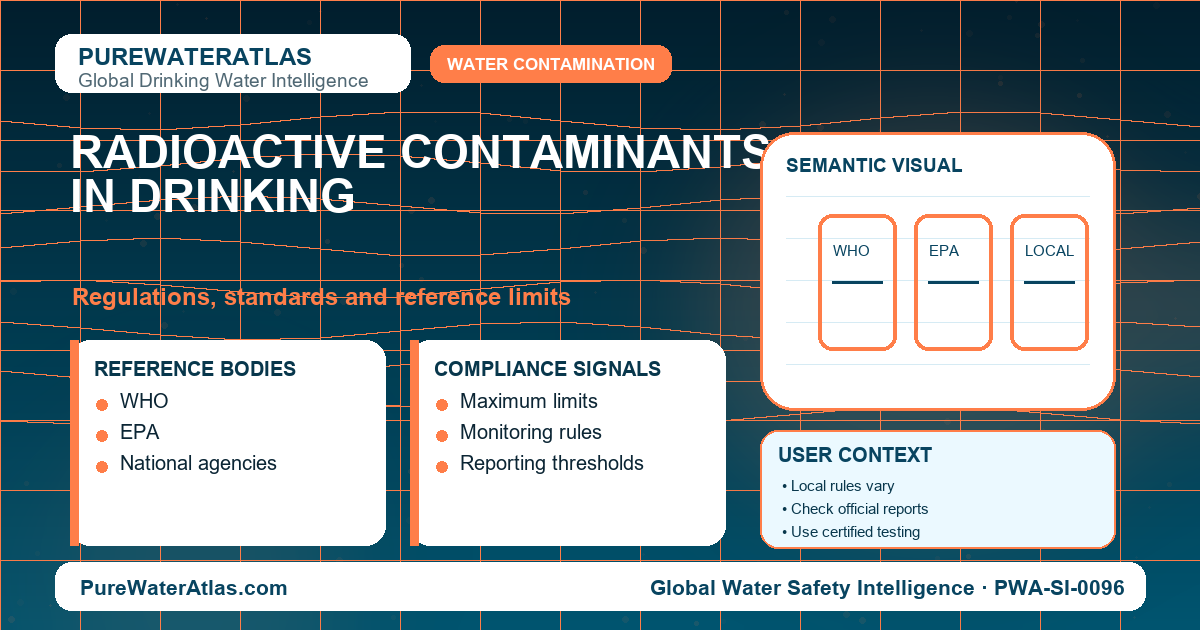
The core purpose of radioactive contaminants in drinking water regulations is to establish enforceable or recommended limits that protect public health, define how water systems monitor for radionuclides, and specify what happens when results exceed accepted levels. The details vary by country, but the overall approach is broadly similar: identify contaminants of concern, set numerical standards or guidance values, require approved testing, and mandate corrective actions when limits are exceeded.
EPA standards in the United States
In the United States, the Environmental Protection Agency regulates radionuclides in public drinking water under the Safe Drinking Water Act. These rules are often described through radioactive contaminants in drinking water epa standards, which include enforceable Maximum Contaminant Levels, or MCLs, for specific radiological parameters.
Key federal standards commonly referenced include:
- Combined radium-226 and radium-228: 5 pCi/L
- Gross alpha particle activity: 15 pCi/L, excluding radon and uranium
- Beta particle and photon radioactivity: a dose-based standard generally expressed as 4 millirem per year
- Uranium: 30 micrograms per liter
These standards apply to community water systems and, in many cases, non-transient non-community systems such as schools or workplaces served by their own water supply. Monitoring frequency depends on source type, prior results, and system characteristics. Systems that exceed an MCL may be required to increase monitoring, notify consumers, install treatment, change sources, or implement other corrective actions.
EPA regulation also relies on concepts such as:
- Monitoring and reporting requirements
- Public notification when standards are exceeded
- Consumer Confidence Reports for community water systems
- Laboratory certification and approved methods
- State primacy enforcement, where states implement federal drinking water rules if they meet EPA requirements
The phrase radioactive contaminants in drinking water compliance refers to meeting all of these obligations, not just staying below the numeric MCL. A system may have compliance responsibilities involving schedules, sample location plans, treatment verification, recordkeeping, and customer communication.
WHO guidelines and international approaches
Outside the United States, the World Health Organization provides a widely used public health framework through the Guidelines for Drinking-water Quality. These radioactive contaminants in drinking water WHO guidelines are not global laws, but they strongly influence national regulations and risk management strategies.
WHO generally recommends a screening-based approach. Rather than immediately requiring detailed radionuclide-specific analysis for every water supply, WHO guidance often begins with screening values for gross alpha and gross beta activity. If those screening levels are exceeded, more detailed radionuclide identification and dose assessment may follow.
The WHO framework emphasizes:
- Reference dose concepts for annual ingestion
- Screening methods to simplify initial assessment
- Source-specific investigations when screening results are elevated
- Optimization of protection based on overall public health risk
- National adaptation based on local geology, infrastructure, and resources
Many countries use WHO guidance as a scientific foundation but adapt final rules to local legal systems and technical capacity. Some jurisdictions set explicit numeric limits for individual radionuclides, while others rely more heavily on total indicative dose or screening activity levels.
Safe limits and how they are determined
When people ask about radioactive contaminants in drinking water safe limits, they are usually asking how much radioactivity can be present without creating unacceptable risk. Regulatory limits are developed from risk models that estimate cancer probability or radiation dose over a lifetime of exposure. They may also take into account analytical capability, treatment feasibility, and cost-benefit considerations.
A limit is therefore not a line between absolute safety and absolute danger. Instead, it is a policy-based health protection threshold intended to keep risks low enough to be acceptable within a regulatory framework. This distinction matters because small variations around a limit must still be interpreted carefully and professionally.
Water rules, enforcement, and public communication
The practical side of radioactive contaminants in drinking water water rules includes more than laboratory thresholds. Rules typically address:
- Which systems must monitor
- How often sampling must occur
- Where samples must be collected
- What analytical methods are approved
- How violations are reported
- What public notices must be issued
- What corrective actions are required
State, provincial, or national agencies may impose additional requirements beyond baseline federal or international guidance. For example, a state with uranium-rich geology may encourage more aggressive monitoring or provide technical assistance for small systems. Rural communities and small utilities may face special compliance challenges because radiological treatment can be expensive and technically demanding.
Public systems versus private wells
One of the most important regulatory distinctions is that public water systems are usually subject to formal enforceable standards, while private wells often are not. This does not mean private wells are exempt from health concerns; it means the responsibility for testing and corrective action usually falls on the owner. In areas with known radionuclide occurrence, private well education is a critical public health tool.
In summary, regulations and standards for radioactive contaminants are built on a combination of radiological science, long-term risk modeling, engineering practicality, and legal accountability. They are intended to make invisible risks manageable through routine oversight and evidence-based intervention.
Conclusion
Radioactive contaminants in drinking water present a unique challenge because they are usually invisible, often naturally occurring, and primarily associated with long-term exposure risks rather than immediate illness. That is why strong monitoring programs, reliable laboratory testing, effective treatment options, and well-designed regulatory frameworks are so important.
A clear understanding of radioactive contaminants in drinking water regulations helps consumers, utilities, and decision-makers interpret test results responsibly and respond appropriately. Whether the focus is on radioactive contaminants in drinking water epa standards, radioactive contaminants in drinking water WHO guidelines, or questions about radioactive contaminants in drinking water compliance, the main goal remains the same: reducing risk and protecting public health over the long term.
The most effective approach combines source awareness, scheduled testing, informed treatment selection, transparent communication, and adherence to established water quality rules. For anyone continuing their research, additional background can be found in the water contamination category, the complete guide, the page on causes and sources, the article about health effects and risks, and broader references on water microbiology and water purification.
Read the full guide: Water Contamination Guide
Explore more in this category: Water Contamination Articles