Introduction
Concerns about drinking water quality often focus on microbes, lead, pesticides, or industrial chemicals, but naturally occurring and human-made radionuclides can also affect water supplies. Understanding radioactive contaminants in drinking water testing is important for homeowners, water operators, environmental professionals, and public health agencies alike. Radioactive substances are not always visible, do not change the taste or smell of water, and may persist for long periods if they are not identified and managed properly.
Testing for radioactive contaminants is a specialized area of water analysis that combines field sampling, laboratory science, radiation measurement, and careful interpretation of results. Unlike simple color-strip tests used for chlorine or pH, radioactive testing often requires controlled sampling procedures, calibrated instruments, and highly specific analytical methods. The goal is not just to determine whether radiation is present, but to identify which radionuclides are present, at what concentration, and whether those levels pose a regulatory or health concern.
This article explains how radioactive contaminants enter drinking water, why they matter, and how they are detected. It also covers the strengths and limitations of radioactive contaminants in drinking water home testing, the role of radioactive contaminants in drinking water lab analysis, and the importance of proper radioactive contaminants in drinking water sampling methods. For readers looking for broader background, additional resources can be found in water contamination, water science, and the complete guide to radioactive contaminants in drinking water.
What It Is
Radioactive contaminants in drinking water are unstable atoms, known as radionuclides, that emit radiation as they decay. These substances may occur naturally in rocks, soils, and groundwater formations, or they may originate from industrial, medical, mining, energy, or military activities. When radionuclides dissolve in water, attach to particles, or migrate through aquifers, they can enter private wells and public water systems.
Common radionuclides of concern in drinking water include radium, uranium, radon, gross alpha-emitting particles, gross beta particle activity, and in some settings isotopes such as strontium-90, cesium-137, iodine-131, tritium, and plutonium. Not every radioactive substance appears in every water source. The contaminants that matter most depend on geology, land use, local history, and the type of water source involved.
It is useful to distinguish between broad screening measurements and specific radionuclide tests:
- Gross alpha activity measures the total alpha radiation from many possible alpha-emitting radionuclides, with some exclusions depending on the method.
- Gross beta activity measures overall beta particle activity, which can indicate the need for more detailed follow-up testing.
- Radium testing may target combined radium-226 and radium-228 or measure them separately.
- Uranium analysis may report total uranium concentration and sometimes isotopic composition.
- Radon testing is usually performed separately because radon behaves differently from dissolved metals and is easily lost from water if samples are not handled correctly.
These results are typically expressed in units such as picocuries per liter (pCi/L) for radioactivity or micrograms per liter (µg/L) for some contaminants such as uranium. Because the science can be technical, accurate interpretation requires attention to units, detection limits, uncertainty ranges, and applicable standards.
Main Causes or Sources
The most common source of radioactive contaminants in drinking water is natural geology. As groundwater moves through bedrock and sediment, it can dissolve small amounts of radioactive elements. In some regions, granite, shale, phosphate-bearing formations, and uranium-rich deposits contribute measurable levels of radionuclides to wells and springs. This is especially relevant for private well owners, because groundwater quality may vary significantly from one property to the next.
Naturally occurring radioactive materials can enter water through several processes:
- Dissolution of uranium, radium, or radon from rock and soil into groundwater
- Weathering and erosion of mineral-bearing formations
- Changes in water chemistry, such as pH or oxidation-reduction conditions, that increase radionuclide mobility
- Movement of radioactive particles or sediments into surface water sources
Human activities can also affect radionuclide levels. These include mining, milling, oil and gas production, coal combustion waste, phosphate processing, industrial discharges, and improper handling of radioactive materials. Some areas may also have legacy contamination from weapons production, research facilities, or historical waste disposal practices. In rare cases, accidental releases from nuclear facilities or transport incidents can create localized concerns.
Another important pathway involves water treatment and distribution conditions. Some radionuclides are removed effectively by treatment, while others may remain dissolved. In addition, treatment residuals such as spent media, sludge, or filter backwash can concentrate radioactive materials, creating disposal and operational challenges even when finished drinking water meets standards.
To learn more about pathways and geologic origins, readers may find helpful context in causes and sources of radioactive contaminants in drinking water and broader articles within global water quality.
Health and Safety Implications
The health significance of radioactive contaminants depends on the radionuclide, concentration, exposure duration, route of exposure, and individual susceptibility. Drinking contaminated water over long periods is generally the main concern, although inhalation can also matter for volatile radionuclides such as radon released from water into indoor air during showering, cooking, or other household uses.
Long-term exposure to elevated radionuclide levels may increase the risk of cancer and other adverse health effects. Different radionuclides behave differently in the body:
- Radium can accumulate in bone and may increase the risk of bone cancer and other disorders.
- Uranium presents both radiological and chemical toxicity concerns, with the kidneys being an important target organ.
- Radon in indoor air is strongly associated with increased lung cancer risk; water can contribute to indoor radon exposure in some homes.
- Strontium-90 can behave similarly to calcium and may accumulate in bone.
- Iodine-131 can concentrate in the thyroid, though it is usually more relevant in emergency or short-term contamination events than in routine groundwater issues.
Risk is not determined by detection alone. A laboratory may identify measurable radioactivity in water that is still below health-based or regulatory thresholds. This is why radioactive contaminants in drinking water test results must be evaluated carefully rather than interpreted as simply “safe” or “unsafe” based on presence alone.
Special populations may warrant greater caution, including pregnant individuals, infants, children, immunocompromised people, and those relying on private wells in regions with known geologic risks. Public communication is also important, because radiation topics often create anxiety. Clear explanation of actual concentration, exposure pathways, and control measures helps people make informed decisions.
For a deeper discussion of risks and exposure pathways, see health effects and risks of radioactive contaminants in drinking water.
Testing and Detection
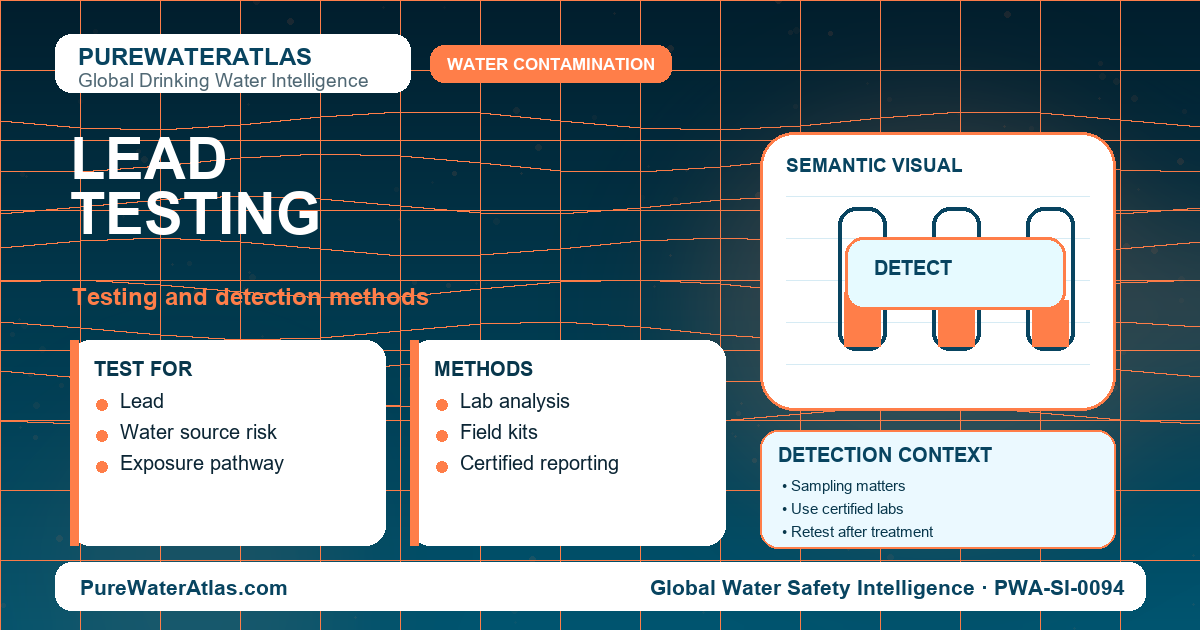
Radioactive contaminants in drinking water testing usually follows a stepwise approach. Screening tests are often used first to identify whether total alpha or beta activity suggests the need for more targeted analysis. If screening levels are elevated, laboratories perform radionuclide-specific testing to determine exactly which contaminants are present and how much of each is in the sample.
Why testing is different from ordinary water screening
Radiological testing differs from standard household water checks because radionuclides may be present at very low levels, require longer count times, and demand strict quality control. Analytical systems must be calibrated, background radiation must be accounted for, and sample preservation requirements may vary by contaminant. These factors strongly influence radioactive contaminants in drinking water accuracy.
Common testing methods
Several analytical techniques are used in routine and advanced water testing:
- Gross alpha and gross beta counting: Broad screening methods that estimate total radioactivity in a sample after preparation and counting.
- Gamma spectroscopy: Identifies and quantifies gamma-emitting radionuclides based on their characteristic energy signatures.
- Liquid scintillation counting: Commonly used for low-energy beta emitters and radionuclides such as tritium.
- Alpha spectrometry: Used for certain alpha-emitting radionuclides after chemical separation.
- Radiochemical separation methods: Required when specific radionuclides such as radium isotopes, strontium-90, or uranium need to be isolated before counting.
- Mass spectrometry techniques: In some laboratories, methods such as ICP-MS help measure uranium and selected isotopes with high sensitivity.
Sampling methods matter
Reliable results begin with correct collection procedures. Radioactive contaminants in drinking water sampling methods should be chosen based on the water source, the radionuclide of concern, and the intended use of results. A poorly collected sample can produce misleading data even if the laboratory performs excellent analysis.
Key sampling considerations include:
- Source selection: Sampling from a kitchen tap, pressure tank, wellhead, raw water intake, or treatment plant effluent can produce different results.
- First-draw versus flushed samples: For radionuclides that may be associated with sediments or plumbing deposits, the sample protocol should be clearly defined.
- Container type: Laboratories may require specific bottle materials and volumes.
- Preservation: Some samples need acidification or other preservation steps to stabilize dissolved constituents.
- Holding time: Delays can affect certain analyses, especially if radionuclides decay quickly or volatile components are lost.
- Chain of custody: Documentation is important when results are used for compliance, legal, or environmental investigations.
Radon sampling deserves special attention. Because radon can escape from water easily, samples must be collected without aeration or agitation and typically filled completely to avoid headspace. Even a small handling error can make measured concentrations appear lower than they really are.
Home testing versus laboratory analysis
Interest in radioactive contaminants in drinking water home testing has grown as more homeowners seek direct information about private well safety. However, home testing for radionuclides has significant limitations. At-home kits often involve collecting a sample and mailing it to a certified laboratory rather than performing a true measurement in the home. This can still be useful, but it is more accurate to think of these products as homeowner sampling kits, not complete analytical systems.
True in-home radiation devices may be helpful for screening in some cases, but they generally do not offer the precision, sensitivity, or contaminant-specific identification needed for drinking water decisions. Most consumers cannot use a handheld radiation detector to reliably assess radionuclide concentrations in water. The instrument may detect elevated radiation in unusual cases, but it cannot replace a formal laboratory test.
For this reason, radioactive contaminants in drinking water lab analysis remains the preferred approach when accurate results are needed. Certified laboratories use validated methods, standardized quality control procedures, blanks, spikes, duplicates, and instrument calibration to ensure defensible measurements. This is particularly important if a result may trigger treatment decisions, regulatory reporting, or public health action.
How laboratories ensure accuracy
Radioactive contaminants in drinking water accuracy depends on much more than instrument sensitivity. Good laboratories control multiple factors at once:
- Method selection appropriate for the radionuclide and concentration range
- Calibration using traceable standards
- Measurement of background radiation
- Use of blanks to identify contamination introduced during preparation
- Matrix spikes and control samples to verify recovery
- Duplicate analyses to check reproducibility
- Clear reporting of counting uncertainty and detection limits
- Participation in proficiency testing programs
Detection limits are especially important. A “non-detect” does not necessarily mean zero. It means the analyte was not observed above the method reporting or detection threshold under the conditions of the analysis. Conversely, a result just above the detection limit may have relatively large uncertainty and should be interpreted with caution.
Interpreting test results
Understanding radioactive contaminants in drinking water test results requires attention to context. A report may list one or more of the following:
- The radionuclide or screening category tested
- The measured concentration
- The analytical uncertainty or counting error
- The method detection limit or reporting limit
- The unit, such as pCi/L or µg/L
- The applicable regulatory standard or screening level
When reviewing a result, ask the following questions:
- Was the sample collected from the right location for the concern being evaluated?
- Was the laboratory certified or qualified for radiological drinking water analysis?
- Is this a one-time result or part of a trend over time?
- Was the result based on gross screening or radionuclide-specific analysis?
- Does the measured level exceed a health advisory or enforceable standard?
- Could seasonal changes, pumping conditions, or treatment performance influence the concentration?
If results are elevated, confirmation testing is often advisable before major corrective action is taken, especially for private wells. In regulated systems, follow-up requirements may already be defined by law or permit conditions.
Prevention and Treatment
Preventing exposure to radioactive contaminants begins with knowing the source and maintaining a monitoring plan. For private well owners, prevention often means testing at appropriate intervals and after major changes such as new drilling, pump replacement, flooding, nearby industrial activity, or noticeable changes in water quality. For public systems, source monitoring and treatment optimization are central strategies.
Treatment options depend on the specific radionuclide:
- Ion exchange: Often effective for radium and some other dissolved radionuclides.
- Reverse osmosis: Can reduce uranium, radium, and several dissolved contaminants at the point of use or point of entry, depending on system design.
- Lime softening: Used in some municipal systems to reduce radium and other hardness-associated constituents.
- Adsorptive media: Specialized media may remove uranium or radium under the right conditions.
- Aeration or granular activated carbon: May be used for radon, though treatment design and venting are important.
No treatment should be selected solely on assumptions. Water chemistry influences removal performance, and waste residuals may become radioactive enough to require special handling. A treatment system that works well for one home may not be suitable for another. That is why treatment decisions should be based on documented laboratory results and professional guidance.
Operational maintenance is equally important. Filters, membranes, resin beds, and treatment media can lose effectiveness over time. If replacement schedules are ignored, finished water quality may deteriorate. In some systems, contaminants may break through suddenly after the media reaches capacity.
Households using bottled water as a temporary response should treat it as an interim measure, not a substitute for finding and managing the root problem. Long-term safety depends on understanding the contaminant source and implementing a sustainable solution.
Common Misconceptions
Radiological contamination is often misunderstood. Several myths can interfere with good decision-making.
- “If water looks clear, it cannot contain radioactive substances.”
Radioactive contaminants are typically invisible and do not affect taste, color, or odor at levels relevant to health. - “A simple handheld detector can tell me exactly what is in my water.”
Most handheld devices are not suitable for precise drinking water analysis and cannot reliably identify specific radionuclides in household samples. - “Any detected radiation means the water is dangerous.”
Detection alone does not equal significant risk. Proper interpretation requires concentration, exposure duration, radionuclide type, and comparison with standards. - “Boiling water removes radioactive contamination.”
Boiling generally does not remove dissolved radionuclides and may even concentrate some contaminants as water evaporates. - “If my neighbor’s well is fine, mine must be fine too.”
Groundwater conditions can vary over short distances due to geology, well depth, and local hydrogeology. - “One test lasts forever.”
Water quality can change over time, so periodic retesting may be necessary, especially in higher-risk areas.
A practical understanding of these misconceptions helps consumers choose appropriate testing and avoid false reassurance or unnecessary alarm.
Regulations and Standards
In many countries, drinking water regulations include limits for certain radionuclides or screening measures. In the United States, for example, public water systems are subject to federal standards for contaminants such as combined radium-226/228, gross alpha particle activity, beta particle and photon radioactivity, and uranium. States may adopt additional requirements, guidance values, or monitoring procedures. Private wells, however, are often not regulated in the same way, leaving testing decisions largely to property owners.
Regulatory programs generally define:
- Which radionuclides or screening categories must be monitored
- Sampling frequency and approved methods
- Maximum contaminant levels or equivalent dose limits
- Requirements for confirmation, public notification, and corrective action
- Laboratory certification and quality assurance expectations
It is important to recognize that standards can differ by jurisdiction and may be updated as scientific understanding evolves. Some standards are based on lifetime cancer risk models, while others reflect technical feasibility, treatment capability, and policy considerations. As a result, a regulatory limit is not simply a line between zero risk and danger; it is part of a broader public health management framework.
Water professionals and consumers should always consult current local and national regulations when interpreting results. When using private laboratories, it is wise to confirm that the lab is accredited or certified for the specific radiological methods requested. Regulatory compliance testing and informational homeowner testing are not always identical in method, documentation, or reporting format.
Conclusion
Understanding radioactive contaminants in drinking water testing is essential because radiological contamination is often undetectable without proper analysis and can have important long-term health implications. The most effective approach combines awareness of local sources, correct sampling, qualified laboratory analysis, and careful interpretation of results. While radioactive contaminants in drinking water home testing can help homeowners begin the process, true confidence usually depends on professional radioactive contaminants in drinking water lab analysis performed with validated methods and strong quality control.
Accurate decisions require more than a single number on a report. Reliable radioactive contaminants in drinking water sampling methods, a clear understanding of radioactive contaminants in drinking water accuracy, and thoughtful review of radioactive contaminants in drinking water test results all play a critical role. When elevated levels are found, targeted treatment and follow-up monitoring can reduce risk and protect public health.
For readers exploring related topics, useful next steps include reviewing broader resources on water contamination, scientific background in water science, global perspectives in global water quality, and specialized guides such as the complete guide, causes and sources, and health effects and risks pages. With informed testing and evidence-based action, radioactive drinking water concerns can be addressed in a practical and scientifically sound way.
Read the full guide: Water Contamination Guide
Explore more in this category: Water Contamination Articles