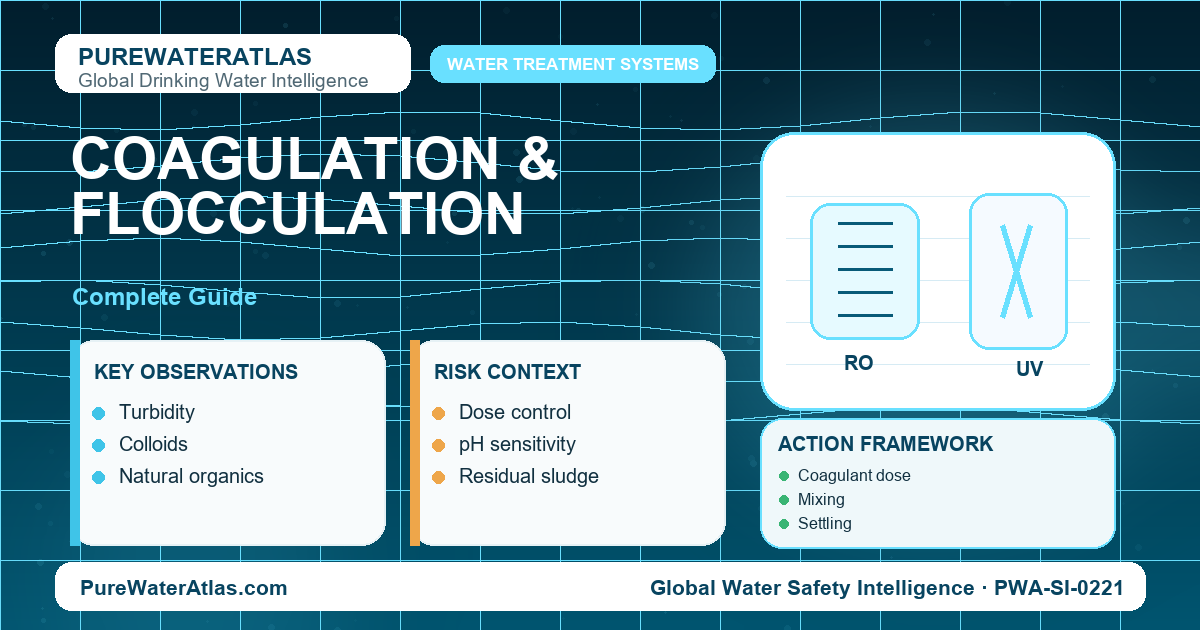
Coagulation and flocculation are closely connected steps used in many drinking-water, wastewater and industrial treatment systems. Their central job is not to remove every contaminant directly. Coagulation chemically destabilizes selected suspended and colloidal material; flocculation then promotes collisions that build those destabilized particles into larger aggregates. Clarification, dissolved air flotation or filtration subsequently provides the physical separation.
Why coagulation and flocculation are used
Raw water can contain clay, silt, algae, natural organic matter (NOM), microorganisms and other suspended or colloidal material. Very small particles may remain dispersed rather than settling readily because surface charges and other stabilizing forces inhibit aggregation. Their concentration and character can also change rapidly with rainfall, erosion, seasonal biological activity and other watershed conditions.
Although coagulation and flocculation are often grouped together, they describe different but closely connected operations. Coagulation is the chemical destabilization of particles, while flocculation is the gentle mixing stage that encourages those destabilized particles to collide and form larger aggregates called flocs. Once flocs become large and otherwise suitable for separation, they can be removed through sedimentation, dissolved air flotation or filtration.
In conventional treatment, this conditioning of particles helps clarification and filtration work more effectively. Some treatment configurations instead use direct filtration, while others employ dissolved air flotation or specialized clarification systems. For the broader sequence of barriers used by a utility, see the municipal water treatment process.
Performance is contaminant-specific. Coagulation can improve removal of some NOM and particle-associated constituents, for example, but many dissolved substances respond poorly or require entirely different treatment. It is therefore more accurate to view coagulation and flocculation as particle-conditioning processes within a larger treatment train than as universal purification steps.
Coagulation: destabilizing suspended particles
During coagulation, a chemical coagulant is dispersed rapidly through the water. Common inorganic coagulants include aluminum sulfate (alum), ferric chloride and ferric sulfate. Under suitable chemical conditions, their reactions reduce the forces keeping colloids dispersed or produce precipitates that incorporate particles. The immediate objective is destabilization and formation of small aggregates, not final solids separation.
Several mechanisms can contribute, sometimes simultaneously:
- Charge neutralization: coagulant species reduce electrostatic repulsion between particles.
- Sweep coagulation: metal-hydroxide precipitates form and enmesh suspended or colloidal material.
- Adsorption and bridging: suitable polymers can attach to more than one particle and promote aggregation.
- Interparticle collision: mixing brings destabilized particles into contact so aggregates can begin to develop.
Rapid mixing matters because the chemical must be distributed through the water while the relevant coagulation reactions are occurring. Too little mixing can result in uneven chemical contact. But the appropriate energy, duration and chemical dose are plant- and water-specific; a setting that performs well for one source water cannot simply be transferred to another.
Flocculation: building removable flocs
After coagulation, lower-intensity mixing encourages destabilized particles and microfloc to collide and stick together. Over time, these collisions create larger flocs that can be separated more readily in downstream treatment. Operators may also use polymeric coagulant or flocculant aids where bench and plant experience show a benefit.
Flocculation is therefore physical aggregation rather than another name for coagulation. Mixing must be strong enough to create useful particle collisions while avoiding excessive shear. If agitation is too intense, newly formed flocs can break apart. Effective design balances mixing energy, detention time, basin geometry and the characteristics of the floc being produced.
Floc does not necessarily have to become a heavy, rapidly settling particle. The desired properties depend partly on what happens next. Gravity clarification favors settleable floc, whereas dissolved air flotation can separate suitably formed, low-density floc by carrying it toward the surface. Filters likewise depend on upstream coagulation producing particles that the particular filtration system can effectively retain.
Common coagulants and coagulant aids
The appropriate coagulant depends on source-water chemistry, treatment objectives and the downstream process. Aluminum and iron salts are established choices in drinking-water treatment. Alum, for example, hydrolyzes in water and can produce aluminum-hydroxide species and precipitates involved in adsorption, destabilization and sweep coagulation. Ferric salts use related metal-hydroxide chemistry, although their operating behavior is not identical to alum.
Pre-hydrolyzed aluminum products such as polyaluminum chloride are also used by some facilities. Polymers can serve as coagulants or as aids that alter aggregation and floc properties. No one option is intrinsically best for every water. Selection and dose should account for raw-water conditions, pH and alkalinity, treatment goals, residuals handling and evidence from site-specific testing.
| Process step | Purpose | Control variable | Downstream effect |
|---|---|---|---|
| Coagulant addition / rapid mix | Disperse treatment chemical and destabilize colloidal and suspended material | Coagulant type and dose; pH and alkalinity; rapid-mix conditions | Produces destabilized particles and microfloc capable of further aggregation |
| Flocculation | Promote collisions and aggregation into larger flocs | Mixing intensity, detention time and hydraulic or mechanical conditions | Creates floc more amenable to downstream physical separation |
| Sedimentation / clarification or dissolved air flotation | Physically separate floc; gravity settling removes settleable floc, while dissolved air flotation can separate low-density floc | Upstream floc quality and separation-system design and operation | Reduces the particulate and floc load carried toward filtration |
| Filtration | Remove remaining particulate and floc material through filter media | Upstream coagulation quality plus filter design and operation | Provides further particulate removal before subsequent treatment barriers |
The role of pH, alkalinity and raw-water chemistry
The effectiveness of coagulation and flocculation depends strongly on source-water chemistry. Turbidity, alkalinity, temperature, organic content, pH and ionic conditions can all influence particle behavior and coagulant reactions. This is why treatment plants do not rely on a single dose under all conditions.
pH is particularly important for metal-salt coagulants because it affects hydrolysis, precipitate formation and the chemical species present in the water. Adding alum or an iron salt can also consume alkalinity and lower pH. Where source water has insufficient buffering capacity, a plant may need pH or alkalinity adjustment, but the appropriate chemicals and targets depend on the treatment process and source water.
NOM creates an additional treatment objective. Some organic matter can be removed during properly configured coagulation and subsequent solids separation, but the fraction removed varies with its chemical characteristics and operating conditions. The U.S. Environmental Protection Agency describes enhanced coagulation as improving removal of disinfection-byproduct precursor material, with NOM removal measured using total organic carbon (TOC). Reducing precursor NOM can reduce subsequent disinfection-byproduct formation; it does not guarantee a particular finished-water byproduct concentration.
| Operating factor | Effect on coagulation/flocculation | Practical response |
|---|---|---|
| pH | Changes coagulant speciation, hydrolysis and particle interactions | Determine an appropriate operating region through source-specific testing and adjust where necessary |
| Alkalinity | Provides buffering and can be consumed by metal-salt coagulation | Track pH and alkalinity together; add alkalinity or adjust chemistry when justified by testing |
| Turbidity and particle character | Changes particle concentration, collision behavior and chemical demand | Reassess dose and mixing when storms or other source changes alter the raw water |
| NOM / DOC | Can change coagulant demand and, depending on organic-matter character, removal performance | Use appropriate organic-matter indicators alongside jar tests and treatment objectives |
| Temperature | Can affect reaction, aggregation and settling behavior; cold conditions may make floc development more difficult | Evaluate mixing, flocculation and dose as seasonal conditions change |
Jar testing and process control
Jar testing is the classic bench-scale method for evaluating coagulation and flocculation. Multiple samples of representative source water can receive different coagulant doses, pH adjustments or treatment aids while rapid mixing, flocculation and settling are simulated. Operators can then compare floc formation, settling behavior, turbidity, color or other parameters relevant to the plant’s objectives.
This makes jar testing useful for answering practical questions: whether a dose should change after a storm, whether pH adjustment improves performance, or whether an aid changes floc behavior. It is inherently site-specific. Results depend on how well the test reproduces the water and treatment conditions of interest.
Jar testing also has limits. A beaker-scale settling test cannot by itself establish how a full-scale filter will perform. Hydraulic conditions, recycle streams, floc breakage, filter media and numerous other factors can differ from the bench test. Pilot testing or full-scale operating data may therefore be needed when downstream filtration performance is the question.
Routine process monitoring can include parameters relevant to source-water conditions and treatment objectives, such as turbidity, pH, alkalinity, temperature and organic-matter indicators. The measurements used and their significance are plant-specific.
Online turbidity meters, flow-paced chemical feed systems and process-control instrumentation provide faster feedback as conditions change, but they complement rather than eliminate jar testing and operator assessment. Visual observations of floc, settled-water performance, filter behavior and residual production can provide additional evidence when diagnosing a process change.
How coagulation supports sedimentation and filtration
Once floc is formed, a physical process has to separate it from the water. Gravity sedimentation is a common choice in conventional plants: sufficiently settleable floc moves downward and is collected as residual solids. Plate or tube settlers and other clarification configurations can increase effective settling area or alter how clarification is accomplished.
Dissolved air flotation (DAF) offers another separation route for appropriate waters and floc. EPA describes DAF as a method used in place of conventional gravity settling to separate low-density floc particles. This can be useful where low-density floc is suitable for flotation, but DAF is an option rather than a universally preferable replacement for sedimentation.
Filtration provides another physical separation barrier. In a conventional treatment train, clarification typically reduces particulate loading before the filters. Direct-filtration configurations omit a conventional sedimentation stage and depend more heavily on coagulation and filtration working together. In either case, upstream coagulation quality strongly influences what reaches the filters and how those filters perform.
This separation of roles is important: coagulant chemistry changes particle behavior, flocculation builds aggregates, and clarification, flotation and/or filtration remove those aggregates from the water. Disinfection then addresses microbial risk through a different treatment mechanism.
Limitations and contaminant-specific performance
Coagulation is selective rather than universal. It is particularly relevant to colloidal and suspended matter and can remove fractions of some organic material after downstream separation. Performance for any associated contaminant depends on its chemical form, whether it is particulate or dissolved, its affinity for floc, source-water chemistry and the separation process that follows.
This distinction also matters for microorganisms. Coagulation and flocculation are not substitutes for disinfection. By incorporating particles and particle-associated microorganisms into separable floc, the overall clarification and filtration train can reduce particulate loading and contribute to microbial control.
Dose optimization is equally important. Under-dosing may leave particles inadequately destabilized, while the useful dose depends on the actual source water and operating conditions. The appropriate dose is therefore an operating target established through site-specific testing, not a simple case of more chemical producing better treatment.
NOM illustrates the same limitation. Enhanced coagulation can increase removal of TOC and other precursor organic material under suitable conditions, thereby helping reduce the potential for formation of disinfection byproducts. EPA’s Disinfectants and Disinfection Byproducts Rules guidance likewise explains the relationship between naturally occurring organic material and byproduct formation. This does not mean that all organic compounds are equally removable by coagulation or that controlling TOC alone controls every disinfection byproduct.
Coagulation and flocculation are consequently best understood as an integrated pair of particle-conditioning operations. A complete understanding includes particle destabilization, controlled floc growth, the influence of pH and alkalinity, site-specific jar testing and continuous attention to downstream separation. Their value comes from making targeted material more removable by the rest of the treatment train—not from acting as a universal contaminant-removal process on their own.
Read the full guide: Water Treatment Systems Guide
Explore more in this category: Water Treatment Systems Articles