
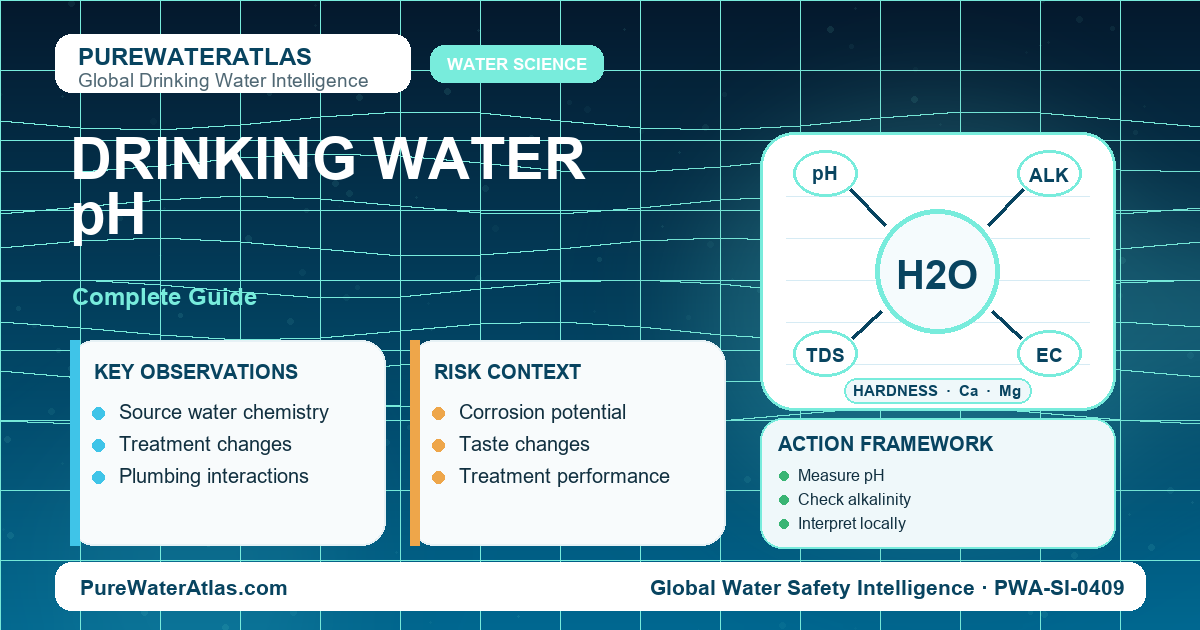
pH is one of the basic measurements used to describe drinking-water chemistry. Although pH does not tell the full story of whether water is safe to drink, it provides valuable information about how acidic or alkaline the water is, how it may interact with plumbing materials, and how well some treatment processes may perform.
Its importance is mainly chemical and operational. pH can affect corrosion, metal release, mineral deposition, disinfection and other treatment processes, but none of those outcomes is controlled by pH alone. Alkalinity, hardness, dissolved carbon, treatment chemicals, plumbing materials and other conditions also matter.
For that reason, a pH result should not be treated as a drinking-water safety score. In the United States, the familiar 6.5–8.5 range is an EPA secondary drinking-water guideline, not a federal primary health-based limit. Water inside that range is not necessarily safe from every contaminant, and water outside it is not automatically unsafe.
What pH measures
pH describes the acid-base state of water. More precisely, it is logarithmically related to hydrogen-ion activity: lower pH indicates more acidic conditions, while higher pH indicates more basic or alkaline conditions. The U.S. Geological Survey’s explanation of pH and water describes pH in terms of the relative amounts of hydrogen and hydroxyl ions in a solution.
pH is related to several other aspects of water chemistry, but they are not interchangeable. Alkalinity describes the water’s capacity to neutralize acid; hardness primarily reflects dissolved calcium and magnesium; and corrosivity describes the tendency of water to interact adversely with plumbing and other materials. Water can have an apparently ordinary pH while its other chemical characteristics still make corrosion or scaling important.
This distinction is fundamental to interpreting a water test. It is also useful background for understanding the broader relationships covered in our water chemistry basics guide.
How the pH scale works
On the familiar aqueous pH scale under ordinary conditions, values are commonly interpreted as follows:
- Below 7: acidic
- Around 7: neutral
- Above 7: basic or alkaline
The commonly taught 0–14 scale is useful for ordinary water chemistry, although it is not an absolute mathematical boundary for every solution. Neutral pH also varies somewhat with temperature, so 7 should be understood as the familiar reference value rather than an invariant neutral point under all conditions.
Why one pH unit is a large chemical change
The scale is logarithmic. A one-unit change in pH corresponds to a tenfold difference in hydrogen-ion activity. Thus, the difference between pH 6 and pH 7 is tenfold on this measure, while the difference between pH 5 and pH 7 is one hundredfold. This is why seemingly small numerical pH changes can be chemically significant.
That logarithmic relationship should not be confused with a proportional change in health risk. A one-unit pH difference says something specific about acid-base chemistry; it does not mean that one sample is ten times safer or more hazardous than another.
What controls pH in natural and treated water
The pH of drinking water can vary for many reasons. Some influences occur naturally in the source water, while others arise from treatment and distribution. Finished-water pH therefore reflects both environmental chemistry and, in many systems, deliberate engineering choices.
Natural controls
Carbon dioxide is an important part of natural water chemistry. When carbon dioxide dissolves in water, it participates in carbonate chemistry that can lower pH. Rainfall is naturally mildly acidic in part because it takes up carbon dioxide from the atmosphere. Source-water chemistry then changes as water interacts with its surroundings.
Natural waters consequently do not have one universal pH. Their acid-base conditions depend on the chemical system in which the water has formed and moved. More detailed investigation of an unusual result should consider the water source rather than assuming that the pH value itself identifies the cause.
Treatment and distribution controls
Drinking-water utilities may deliberately alter pH or associated carbonate chemistry. Treatment conditions can be adjusted for coagulation and clarification, disinfection, corrosion control and distribution-system stability. The desirable operating condition can differ between treatment stages because the chemistry that favors one process is not necessarily optimal for another.
Water chemistry can continue to evolve after treatment. Distribution conditions and interactions with plumbing are particularly important when evaluating corrosion and metal release. For a household investigation, this means that source-water pH, finished-water pH and conditions at the tap are related but not necessarily identical questions.
A fuller discussion of why pH changes is available in the guide to common causes and sources of pH changes in drinking water.
Typical operating ranges and why they are not a safety score
In the United States, EPA lists pH 6.5–8.5 as a Secondary Maximum Contaminant Level range. EPA’s secondary drinking-water standards are non-mandatory federal guidelines concerned principally with aesthetic, cosmetic or technical effects. This is different from an enforceable National Primary Drinking Water Regulation established to protect health.
The distinction matters. A pH of 7.2, for example, does not demonstrate that water is microbiologically safe or free of lead, arsenic, nitrate or other contaminants. Conversely, a result slightly below 6.5 or above 8.5 is not by itself evidence that the water is unsafe to drink.
| pH range/context | Operational meaning | Possible effects | Caveat |
|---|---|---|---|
| Below 6.5 in relation to the U.S. EPA secondary range | Below EPA’s secondary guidance range | EPA associates lower pH with corrosion and possible bitter or metallic taste | A result below 6.5 does not by itself establish that water is unsafe or that metals are elevated |
| 6.5–8.5 | EPA secondary drinking-water guidance range | A benchmark used for aesthetic and technical water-quality management | Not a federal primary health-based limit and not a universal safety range |
| Above 8.5 in relation to the U.S. EPA secondary range | Above EPA’s secondary guidance range | EPA associates higher pH with deposits, slippery feel and soda-like taste; pH can also affect chlorine performance | Effects depend on the rest of the water chemistry and treatment conditions; pH alone does not indicate toxicity |
| Any pH used as part of corrosion control | One operating variable among several | Changing pH can affect metal solubility, protective scales and metal release | Alkalinity and carbon chemistry, calcium, oxidants, inhibitors and plumbing materials can also be important |
Why there is no universal ideal pH
The World Health Organization’s current Guidelines for Drinking-water Quality treat pH as an important operational water-quality parameter rather than establishing a health-based guideline value for pH. Operational targets depend on factors such as source-water chemistry, treatment objectives and distribution-system materials.
Standards and operating requirements can also differ among countries and local jurisdictions. The U.S. 6.5–8.5 secondary range should therefore not be universalized into a worldwide legal or health boundary. A pH reading by itself cannot confirm that water is safe, nor can it confirm that water is unsafe.
pH, corrosion and metal release
One important connection between pH and drinking-water safety is indirect: water chemistry affects corrosion, and corrosion can release metals from plumbing. pH is an important part of that chemistry, but it does not determine corrosivity by itself.
Why pH is only one corrosion variable
Depending on the system, corrosion behavior can be influenced by pH, alkalinity and carbonate chemistry, calcium, dissolved oxygen and other oxidants, corrosion inhibitors, treatment conditions and the materials present in pipes and fixtures. Two waters with the same pH can therefore behave differently in the same type of plumbing.
This is why statements such as “low pH means lead” are not reliable. A low pH result can be a reason to investigate corrosion conditions, but actual exposure depends on whether relevant plumbing materials are present and whether metals are being released into the water.
Lead, copper and other plumbing metals
Corrosion can increase concentrations of metals at consumers’ taps. EPA notes that corrosion-control treatment can reduce leaching of copper, iron and zinc, while lead and copper control requires system-specific attention to water chemistry and plumbing materials. pH, alkalinity and corrosion-inhibitor conditions can be among the water-quality parameters used in a utility’s corrosion-control program.
For public systems subject to U.S. lead and copper requirements, corrosion control is intended to minimize lead and copper concentrations at consumers’ taps while maintaining compliance with other primary drinking-water requirements. That is a more complex objective than simply raising water to a predetermined pH.
If lead or copper exposure is the concern, pH testing is therefore not a substitute for appropriate metals testing. See the separate discussion of pH-related health effects and risks for additional context.
pH, scaling and treatment performance
pH also affects mineral deposition and treatment chemistry. Here again, the practical effect depends on the water as a whole rather than on a single number.
When higher pH can contribute to scale
Under suitable chemical conditions, increasing pH can favor calcium-carbonate precipitation. This is particularly relevant where water contains enough calcium and carbonate species to become scale-forming. Deposits can accumulate in water heaters, pipes, valves, faucets and treatment equipment.
High pH alone, however, does not prove that scale will form. Hardness, alkalinity and dissolved inorganic carbon, temperature and other chemical conditions help determine whether calcium carbonate will precipitate. EPA corrosion-control guidance also cautions against using scaling indices as if they directly measured lead or copper corrosivity.
Disinfection, coagulation and other treatment tradeoffs
pH can materially affect treatment performance. With free chlorine, pH changes the balance between hypochlorous acid and hypochlorite ion; lower pH within practical treatment conditions favors a larger fraction of hypochlorous acid, the more effective disinfecting species. That does not mean treatment plants should simply drive pH downward, because corrosion, coagulation, distribution stability and other objectives must also be considered.
Coagulation and clarification can have their own preferred pH conditions. pH changes during chlorination can also alter disinfection-by-product chemistry; WHO guidance notes that decreasing pH tends to reduce trihalomethane formation while increasing haloacetic acids, with increasing pH tending toward the opposite pattern. Water treatment therefore involves balancing multiple chemical objectives rather than pursuing one universally “best” pH.
How pH is measured
pH testing can range from rough household screening to calibrated electrode measurements used by laboratories and water professionals. The appropriate method depends on what the result will be used for.
Strips versus pH meters
Indicator strips are convenient for estimating pH: the developed color is compared with a reference scale. Their limitations include relatively coarse resolution and errors in interpreting color, so they are better suited to screening than to situations in which a precise value is important.
Digital pH meters use an electrode system to convert an electrochemical response into a pH reading. They can provide much more useful quantitative measurements when the electrode is properly maintained and the instrument is correctly calibrated with standard buffer solutions.
Why prompt measurement, calibration and temperature matter
A pH value is only as reliable as the measurement procedure. EPA Method 150.3 for drinking-water pH measurement calls for prompt analysis, minimizing aeration and bubbles, recording temperature, and calibrating with reference buffers that bracket the expected sample pH, followed by a calibration check.
Prompt measurement matters because a sample can exchange gases with the atmosphere after collection. For water whose chemistry is influenced by dissolved carbon dioxide, that exchange can change the measured pH. Temperature also affects both electrode response and the water’s acid-base equilibria; an instrument’s temperature compensation can address electrode behavior but cannot undo a real chemical change in the sample.
Broader testing may be appropriate when an unusual pH accompanies metallic taste, staining, corrosion, deposits or another water-quality problem. Measuring pH does not identify metals, microorganisms or other contaminants. More detailed practical guidance is available in pH testing and detection methods for drinking water.
pH vs alkalinity
pH and alkalinity are closely related but fundamentally different. pH describes the water’s current acid-base state. Alkalinity describes its capacity to neutralize added acid and is commonly associated with bicarbonate and carbonate species in drinking water.
That distinction explains why two samples can have the same measured pH but respond differently when treatment chemicals or acids are added. Water with greater buffering capacity can resist pH change more strongly than poorly buffered water starting at the same pH.
| pH vs alkalinity | What it measures | Relationship | Treatment relevance |
|---|---|---|---|
| pH | The current acid-base state of the water, related to hydrogen-ion activity | Can change when acids or bases are added; how readily it changes depends partly on buffering | Relevant to corrosion control, coagulation, disinfection, disinfection-by-product chemistry and scaling |
| Alkalinity | The water’s capacity to neutralize acid | Bicarbonate and carbonate commonly provide much of the buffering that resists pH change | Important to pH stability and corrosion-control chemistry and is commonly considered alongside pH and dissolved inorganic carbon |
Hardness is another separate property, primarily associated with dissolved calcium and magnesium. Consequently, “alkaline,” “high alkalinity” and “hard” are not interchangeable descriptions of water. Understanding these distinctions prevents a single pH number from being asked to describe chemistry it does not measure.
When pH adjustment is used
In many cases, the goal is not pH “removal,” because pH is a property rather than a contaminant. The goal is adjustment of pH or related chemistry to achieve a particular treatment, corrosion-control or distribution objective.
Treatment and corrosion-control uses
Utilities can adjust pH and carbonate chemistry as part of treatment optimization or corrosion control. Depending on the source water and objective, approaches can include chemical pH adjustment, changes to alkalinity or hardness, corrosion inhibitors, limestone contactors or aeration. The appropriate method depends on the chemistry that is producing the operational problem.
Household treatment follows the same general principle: diagnose before adjusting. Neutralizing media such as calcite can be used in some acidic private-well waters, for example, but dissolving mineral media changes more than pH and can increase hardness. Chemical-feed systems provide another means of adjustment but require appropriate design, control and maintenance.
Where the concern is plumbing-wide corrosion or scale, treating water only at one drinking faucet generally does not address conditions throughout the building. A properly designed point-of-entry system may be more relevant, but treatment choice should follow analysis of the source water and the specific problem rather than a numerical pH target alone.
Why adjustment depends on the whole water chemistry
Changing pH can have consequences elsewhere in the system. Raising it may alter mineral precipitation and corrosion chemistry; lowering it can change corrosion behavior, treatment performance and disinfectant chemistry. Alkalinity influences how much treatment is needed to produce and maintain a given change.
For these reasons, successful pH management depends on matching the solution to the actual water chemistry, not just reacting to a single reading. Follow-up measurement is also important: without it, a treatment system can drift out of adjustment or solve one chemistry problem while creating another.
The central interpretive rule is simple: pH is an important description of drinking-water chemistry, not a verdict on drinking-water safety. It is most useful when interpreted alongside alkalinity, hardness, treatment conditions, plumbing materials and measurements of any contaminants of concern. In the United States, EPA’s 6.5–8.5 range provides useful secondary operational and aesthetic guidance, but it should not be mistaken for a universal health-based boundary.
Read the full guide: Water Science Guide
Explore more in this category: Water Science Articles