
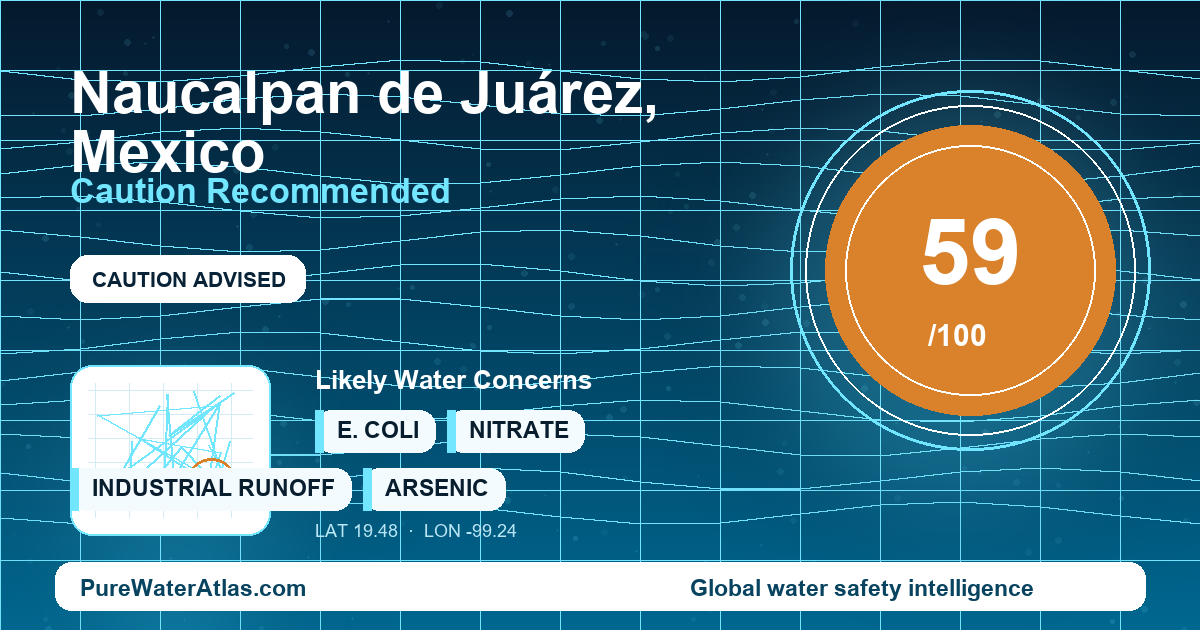
Naucalpan de Juárez, Mexico: municipal and metropolitan water supply with caution recommended because tap safety can vary by neighborhood pressure, building storage, cisterns, tinacos, outages, and plumbing condition.
Quick Answer
| Overall tap-water status | Caution recommended. Naucalpan de Juárez is connected to formal municipal and metropolitan water systems, but water at the faucet may vary by building, storage conditions, pressure events, and local interruptions. |
|---|---|
| PureWaterAtlas safety score | 59 / 100 — managed supply, but reduced confidence due to intermittent service, dependence on imported bulk water, local wells, aging distribution infrastructure, household storage, and limited public city-level tap-water reporting. |
| Traveler advice | Short-term visitors should not rely on untreated tap water for drinking. Use sealed bottled water, hotel-provided purified water, professionally filtered water, or boiled water. |
| Resident advice | Treat tap water as building-dependent. A maintained point-of-use filter is prudent, especially in homes using cisterns, tinacos, pressure tanks, or pipas. |
| Main water source | A mix of imported metropolitan bulk water, especially the Cutzamala System and other regional sources, plus municipal or local groundwater wells. |
| Water authority | OAPAS Naucalpan, with regional links to the Comisión del Agua del Estado de México and CONAGUA. |
| Filter recommendation | Sediment prefilter plus activated carbon for taste, odor, chlorine, and particulates; add lead-certified filtration in older buildings and microbial treatment where cistern or tinaco risk is suspected. |
Why Naucalpan de Juárez Is Different
Naucalpan de Juárez sits on the northwest edge of the Mexico City metropolitan area in the State of Mexico, adjoining Mexico City and other urban municipalities such as Tlalnepantla and Atizapán. Its drinking-water situation is therefore not the same as a city supplied by one small local reservoir or one isolated wellfield. Naucalpan is tied to the larger Valley of Mexico water system, where regional transfers, municipal wells, pumping stations, storage infrastructure, and private building tanks all influence what comes out of the tap.
The most important practical point is that the regional system may be engineered and disinfected, but the quality of water at a specific apartment, house, hotel, school, or office can depend heavily on local conditions after water leaves the utility network. Intermittent supply, low pressure, pipe repairs, and the common use of cisterns and rooftop tinacos can change the risk profile. A well-maintained hotel using purified water and clean storage may offer safer practical drinking water than an older residence with a neglected tinaco or internal plumbing that has not been assessed.
PureWaterAtlas rates Naucalpan de Juárez as Caution Recommended, not because every tap is known to be unsafe, but because verifiable, current, neighborhood-level tap-water results are limited and the city faces the same storage and supply-stability challenges seen across parts of the Valley of Mexico.
Where Does Naucalpan de Juárez’s Tap Water Come From?
Naucalpan de Juárez is part of the metropolitan water network of the Valley of Mexico. Its supply is understood to be a mix of imported bulk water delivered through State of Mexico and federal infrastructure, especially the Cutzamala System and other regional sources, plus local or municipal groundwater wells operated or coordinated by the municipal water utility.
The Cutzamala System captures, stores, treats, and pumps water from reservoirs west of the Valley of Mexico into the Mexico City metropolitan area and municipalities of the State of Mexico. Naucalpan also relies on municipal wells, pumping stations, local distribution mains, storage tanks, pressure-regulating infrastructure, household cisterns, rooftop tinacos, and, during shortages or pressure reductions, water-truck supply known locally as pipas.
This layered infrastructure creates two separate questions. First, is the bulk water managed and treated before distribution? In formal systems, yes, water is intended to be treated and disinfected under Mexican drinking-water standards. Second, does the water remain consistently safe by the time it reaches every faucet? That is less certain. Low-pressure events can increase intrusion risk in aging distribution lines; storage tanks can introduce microbial contamination if poorly sealed or not cleaned; and older building plumbing may contribute metals after stagnation.
Naucalpan historically developed as an urban and industrial municipality on the northwest side of the Valley of Mexico. As population and industrial demand grew, local groundwater, regional transfers, and metropolitan bulk-water systems became increasingly important. Like many municipalities in the basin, Naucalpan relies on external systems in part because local aquifers are heavily stressed and urban surface waters are not simple direct drinking-water sources without treatment.
Who Manages Drinking Water in Naucalpan de Juárez?
The local drinking-water, sewerage, and sanitation utility is OAPAS Naucalpan, the Organismo de Agua Potable, Alcantarillado y Saneamiento de Naucalpan. Regional bulk supply and infrastructure are linked to the Comisión del Agua del Estado de México, while national water management and major federal water infrastructure are associated with CONAGUA.
Drinking water in Mexico is regulated under federal health standards, including NOM-127-SSA1-2021, which covers water for human use and consumption. Sanitary oversight involves health authorities such as COFEPRIS, while water-sector management involves federal, state, and municipal bodies.
However, the existence of a national standard does not prove that every household tap in Naucalpan meets that standard at all times. Water can change after passing through distribution pipes, private plumbing, cisterns, rooftop tanks, pressure tanks, and temporary tanker supply. Publicly accessible, current, neighborhood-level tap-water results for Naucalpan were not found in the reviewed sources, so this assessment uses a cautious interpretation rather than claiming universal safety or universal contamination.
Main Local Water Concerns
- Intermittent supply and low pressure: When pressure drops and then returns, aging distribution lines may face higher intrusion risk, especially after repairs or outages.
- Cisterns and rooftop tinacos: These are common in buildings and can introduce microbial risk if they are uncovered, cracked, poorly sealed, or not cleaned and disinfected routinely.
- Sediment and turbidity: Brown water, particles, or cloudy water may appear after pipe repairs, pressure changes, dry-season interruptions, or the return of water after an outage.
- Chlorine taste or odor: Residual disinfectant may be noticeable because chlorine is used to help protect water during distribution.
- Older internal plumbing: Older buildings may contain plumbing materials, solder, fixtures, or corrosion conditions that can contribute metals such as lead, particularly after overnight or weekend stagnation.
- Pipas: Water trucks are useful during shortages, but safety depends on the source, tanker cleanliness, handling, and the condition of the storage tank receiving the water.
- Regional stressors: The Valley of Mexico faces heavy groundwater extraction and subsidence issues, which can affect long-term infrastructure reliability.
Seasonally, the late dry season, often roughly March to May, can bring stronger water-stress conditions when regional reservoirs and local wells are under pressure. Rainy season runoff can increase turbidity in some source waters and can stress urban drainage systems, indirectly affecting distribution conditions after repairs or flooding. Scheduled maintenance on the Cutzamala System can temporarily reduce supply to metropolitan municipalities and increase dependence on stored water or pipas.
For Travelers
Visitors to Naucalpan de Juárez should use a conservative drinking-water strategy. Untreated tap water is not recommended for drinking, because travelers usually cannot verify the condition of the building tank, recent outage history, hotel filtration, or pipe maintenance. Use sealed bottled water, hotel-provided purified water, professionally filtered water, or water that has been brought to a rolling boil and then stored in a clean covered container.
For brushing teeth, bottled or filtered water is the safest choice. Many healthy adults may brush with tap water without problems, but children, pregnant travelers, immunocompromised people, and anyone with a sensitive stomach should use bottled or purified water. Tap water is generally reasonable for bathing and handwashing, but avoid swallowing water in the shower if you are risk-sensitive.
Use ice only from hotels, restaurants, or cafés that state they use purified water or commercial ice. Established hotels and restaurants commonly use garrafón water, commercial ice, or filtration for drinking water and beverages, but smaller venues should be asked directly. Avoid informal ice if you cannot verify the source. Carry bottled water during outings, avoid drinking from bathroom taps, and use bottled water for infant formula. The CDC’s Mexico traveler guidance supports conservative food and water precautions for travelers.
For Residents
Residents should treat Naucalpan tap water as a managed but building-dependent water source. A home filter is advisable for most households that intend to drink tap water. At minimum, consider a sediment prefilter plus activated carbon for taste, odor, chlorine, and particulates. If the building has old plumbing or uncertain pipe materials, use a filter certified for lead reduction. If water is stored in cisterns or tinacos and microbial risk is suspected, combine filtration with disinfection such as boiling, UV, or another properly maintained system.
Testing should focus on the water after it has passed through your own building plumbing and storage, not only on the street connection. Older homes and apartment blocks should consider first-draw and flushed samples for lead and other metals if plumbing age or materials are uncertain. After repeated outages, pipe repairs, flooding, or tanker deliveries, temporarily boil drinking water or test if turbidity, unusual odor, or illness concerns appear.
Cisterns, pressure tanks, and tinacos should be covered, screened, structurally intact, and cleaned and disinfected routinely. A dirty tinaco can turn otherwise treated municipal water into unsafe household water. If water arrives by pipa, store it only in a clean disinfected tank and avoid mixing it with visibly dirty residual water. If relying on a private or local well, laboratory testing should include microbiology, nitrate, hardness, iron, manganese, arsenic, and basic chemistry. Use an accredited laboratory when results will guide health decisions, infant feeding, medical vulnerability, or filter selection.
Relevant Contaminants and Water-Quality Issues
The most relevant Naucalpan water-quality issues are not limited to one contaminant. They relate to distribution stability, storage hygiene, and building plumbing. Chlorine in drinking water is relevant because disinfectant residual can create noticeable taste or odor while helping protect water in the network. Turbidity and sediment are important after outages, pressure changes, dry-season interruptions, and pipe repairs.
For older buildings, lead in drinking water is a building-plumbing concern rather than a claim about all municipal supply. Stagnation overnight or over weekends can increase metal pickup, so residents should flush cold water before drinking and avoid using hot tap water for cooking or infant formula. For cisterns, tinacos, tanker deliveries, and post-outage conditions, E. coli and other microbial indicators are especially relevant. PureWaterAtlas also provides broader context in Water Microbiology and Drinking Water Safety.
How to Verify Your Water Quality
Because current public neighborhood-level Naucalpan tap-water data are limited, the best verification is location-specific testing. Test the water that actually comes from your kitchen tap after it has passed through your building’s cistern, tinaco, pressure tank, pipes, and fixtures. If you live in an older building, use both first-draw and flushed sampling for metals. If your building stores water or receives pipas, include total coliform and E. coli testing, especially after cleaning, flooding, outages, or suspected contamination.
PureWaterAtlas resources that may help include the complete guide to water testing, the Global Water Quality Checker, and the Contaminants Search Engine. Residents choosing treatment equipment should also review Water Treatment Systems. For specific methods, see lead testing and detection, boiling water purification, and UV water purification.
Official and Technical Sources
- OAPAS Naucalpan — official municipal water, sewerage, and sanitation authority for Naucalpan de Juárez.
- Comisión del Agua del Estado de México — state water authority involved in infrastructure and bulk-water coordination.
- CONAGUA — national water authority responsible for federal water management and major infrastructure.
- CONAGUA information on the Cutzamala System — reference for a major bulk-water system serving the Valley of Mexico and the State of Mexico.
- NOM-127-SSA1-2021 — Mexican federal standard for water for human use and consumption.
- COFEPRIS — federal health protection authority involved in sanitary control and public-health protection.
- CDC Travelers Health: Mexico — traveler food and water precaution guidance.
- WHO Guidelines for Drinking-water Quality — international reference for drinking-water risk management and household storage considerations.
Data limitation: A current public dataset with routine Naucalpan neighborhood-level tap-water results, building-level results, or transparent time-series compliance data was not found in the reviewed sources. This profile does not claim that every tap is unsafe or safe; it reflects known supply pressures, storage dependence, and limited verifiable city-level reporting.
Bottom Line
Naucalpan de Juárez has formal municipal and metropolitan water infrastructure, including OAPAS Naucalpan, regional coordination through the State of Mexico, and supply links to systems such as Cutzamala. The caution rating comes from what happens between source and faucet: intermittent service, pressure changes, aging distribution lines, local wells, cisterns, tinacos, pipas, and older building plumbing can all affect household water quality. Travelers should use bottled, purified, filtered, or boiled water for drinking and should verify ice. Residents who drink tap water should maintain storage tanks, consider sediment and carbon filtration, add lead-certified treatment in older buildings, and test after outages, repairs, tanker deliveries, or suspected contamination.
Read the full guide: Global Water Quality Guide
Explore more in this category: Global Water Quality Articles