
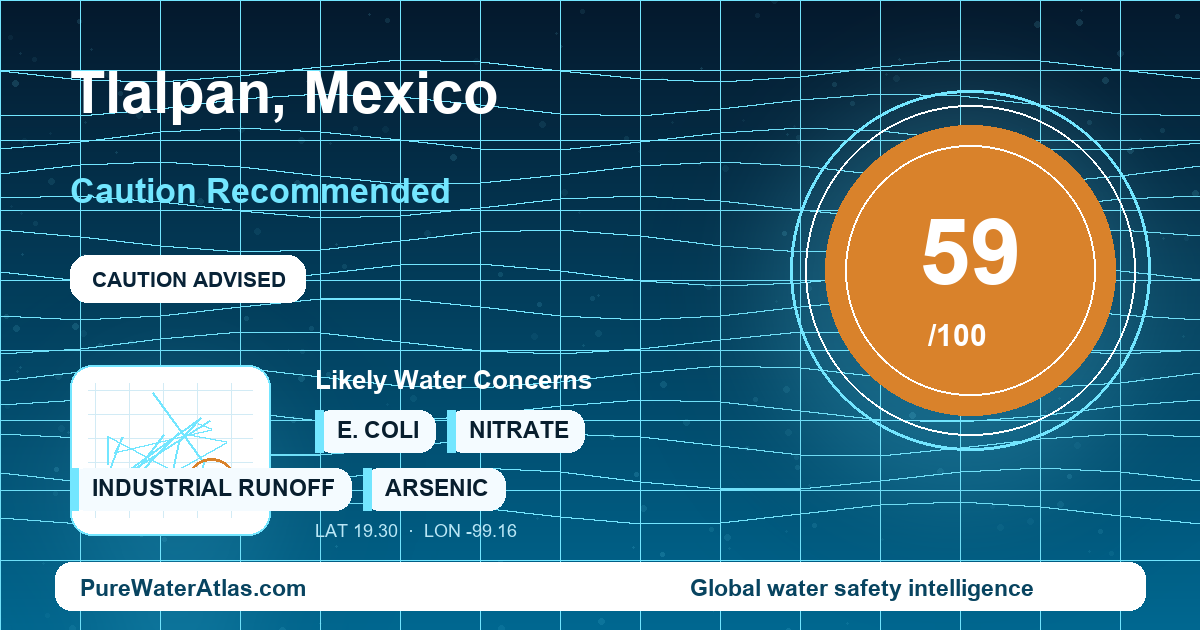
Tlalpan, Mexico: tap water is supplied through Mexico City’s mixed municipal network and is intended to be disinfected, but building-level storage, intermittent pressure, old plumbing and limited borough-level reporting mean extra caution is recommended.
Quick Answer
| Water safety score | 59 / 100 |
|---|---|
| Risk level | Caution Recommended |
| Can you drink the tap water? | Not recommended as a default, especially for short-term visitors. Use sealed bottled water or properly filtered water for drinking. |
| Traveler advice | Tap water is generally acceptable for showering and handwashing. Many healthy adults use it for brushing teeth, but cautious travelers, children, pregnant people and immunocompromised visitors should use bottled or filtered water. |
| Resident advice | Treat household tap water as building-specific. The condition of cisternas, rooftop tinacos, old fixtures and pressure interruptions can matter as much as the municipal source. |
| Main water source | Mexico City’s blended metropolitan supply: groundwater from the Mexico City Basin aquifer and well fields, imported Cutzamala System surface water, and historically Lerma System supply. |
| Water authority | SACMEX, Sistema de Aguas de la Ciudad de México, with national water-resource oversight by CONAGUA. |
| Filter recommendation | At minimum, a maintained activated-carbon filter for taste, odor and some byproducts, with sediment prefiltration where water runs cloudy. Higher-risk homes should consider certified purification and lab testing. |
The practical answer for Tlalpan is not that every tap is unsafe or that every tap is safe. Tlalpan is part of Mexico City’s official drinking-water system, but water quality at the kitchen tap can vary by pressure zone, service continuity, building plumbing and the maintenance condition of private storage tanks.
Why Tlalpan Is Different
Tlalpan is not a standalone water system with a separate municipal utility. It is Mexico City’s largest borough by area and includes dense urban neighborhoods, rural villages and conservation land in the Ajusco and southern highland zone. That geography matters for tap water. Elevation changes and hilly terrain make pressure management and pumping more difficult than in flatter central districts of the capital.
The main safety issue in Tlalpan is therefore not only whether water was treated before entering the network. The larger practical issue is what happens during distribution and storage: intermittent service, pressure changes, pipe repairs, leaks, sediment mobilization, household cisternas and rooftop tinacos. When water service is cut or pressure drops, intrusion risk and turbidity complaints can increase, especially in older or poorly maintained networks and tanks.
Tlalpan also sits near the Ajusco volcanic highlands and conservation land that functions as an important recharge area for the Mexico City aquifer. Historically, the southern basin relied on springs, local groundwater and gravity-fed supplies before the modern metropolitan system expanded. Today, however, Tlalpan depends on the same broad regional architecture as the rest of Mexico City: overdrawn groundwater, imported water and a complex distribution network.
Where Does Tlalpan’s Tap Water Come From?
Tlalpan receives water through the Mexico City metropolitan supply operated at city scale. The raw-water mix is not a single Tlalpan river, reservoir or well. It is a blended system that can include groundwater from the Mexico City Basin aquifer and well fields, imported surface water from the Cutzamala System west of the Valley of Mexico, and historically supply from the Lerma System.
In practice, the exact mix can vary by pressure zone, season, maintenance events and Cutzamala availability. This is important for residents comparing water taste or appearance between neighborhoods. A home in a higher-elevation or peripheral part of Tlalpan may experience different pressure behavior and storage dependence than a home in a denser urban zone connected to a more stable part of the distribution network.
Key infrastructure affecting Tlalpan includes the Mexico City distribution network, local and regional groundwater wells, the Cutzamala imported-water system, the older Lerma system, storage tanks, pumping infrastructure, pressure zones and household-level cisternas and tinacos. Many homes and apartment buildings rely on private storage because water may not arrive continuously. Even if municipal water is chlorinated, a dirty or uncovered tank can reintroduce sediment, biofilm, insects or microbial contamination before the water reaches the kitchen tap.
Regional source-water stress also matters. Mexico City has long depended on overdrawn groundwater plus imported Lerma and Cutzamala water. Drought or maintenance affecting Cutzamala can reduce pressure and service continuity across parts of the capital, while groundwater reliance raises long-term concerns about aquifer stress and variable mineral content. For Tlalpan households, those regional pressures are experienced locally as low pressure, tandeo, water-truck dependence or changes in taste, clarity and flow.
Who Manages Drinking Water in Tlalpan?
Public drinking-water service in Tlalpan is the responsibility of the Mexico City government through its water authority, SACMEX, Sistema de Aguas de la Ciudad de México. Tlalpan’s borough government, the Alcaldía Tlalpan, can coordinate local complaints, public works and emergency support such as water-truck assistance, but it is not a separate drinking-water utility.
At the federal level, CONAGUA oversees national water resources and provides reporting on major systems such as Cutzamala. Drinking-water quality in Mexico is regulated under federal health rules, including NOM-127-SSA1-2021, the official standard for water for human use and consumption.
The important limitation for this Tlalpan profile is data granularity. There is official information on Mexico City’s water authority, the Cutzamala system, federal drinking-water standards and Tlalpan’s geography. However, recent public data that isolates Tlalpan tap-water quality by neighborhood, pressure zone, building storage condition and sampling date is limited. For that reason, this guide does not claim that every tap in Tlalpan meets or fails a specific contaminant limit. It focuses on the documented system architecture and the practical risk factors most relevant at the household tap.
Main Local Water Concerns
The most important local concern in Tlalpan is variability. The same citywide system can deliver different household outcomes depending on pressure, pipe condition and building storage. Residents should pay special attention after service cuts, pressure restoration, main repairs or tank refills, because these are times when sediment and turbidity may appear.
- Intermittent service and tandeo: Some areas rely on scheduled or interrupted delivery, increasing dependence on stored water and sometimes on water trucks.
- Low pressure: Higher-elevation or peripheral neighborhoods can be more vulnerable to pressure instability than flatter central areas.
- Sediment, color or turbidity: Pipe repairs, pressure changes and service restoration can disturb material in distribution lines or tanks.
- Chlorine taste and odor: Mexico City water is intended to be disinfected, and chlorine taste can be noticeable, especially when water is stored.
- Building-level microbiological risk: Cisternas, tinacos and private plumbing can introduce risk if they are uncovered, dirty or poorly maintained.
- Older-building metals: Public Tlalpan-specific lead exceedance data was not found in the reviewed sources, but older fixtures, brass components, galvanized pipe corrosion and stagnant water can increase metal exposure risk.
- Regional drought and Cutzamala stress: Reduced imported-water availability can affect continuity and pressure more than routine treatment quality.
Season also matters. Dry-season and drought periods can intensify pressure cuts or water-truck dependence. Rainy-season runoff and storm events can increase raw-water turbidity and can also coincide with repairs or pressure changes that disturb local distribution sediment. Warm weather and stagnant household storage can worsen taste, odor and microbial regrowth if tanks are not cleaned and covered.
For Travelers
Short-term visitors should not treat Tlalpan tap water as reliably drinkable by default. Use sealed bottled water, water from a reliable hotel-grade filtration system or water treated by a properly maintained purifier. The concern is not proof that every tap in Tlalpan is unsafe; it is that visitors usually cannot verify the condition of a rental building’s cisterna, rooftop tank, plumbing or recent service history.
For brushing teeth, most healthy adults are unlikely to have a major exposure from occasional use, but cautious travelers should use bottled or filtered water. This is especially sensible in older guesthouses, rentals, peripheral neighborhoods or any place where the storage tank looks poorly maintained.
For ice, choose established restaurants, hotels and cafes that use purified water or commercial ice. Ask for agua purificada or bottled water if uncertain. Avoid ice from informal vendors unless the purified source is clear. Better hotels and restaurants in Mexico City commonly use garrafón water, commercial ice or filtration for drinking water, but bathroom tap water or a rental kitchen tap should not be assumed to be equivalent.
Carry bottled water on arrival, particularly if staying in southern or higher-elevation parts of Tlalpan. If using a reusable bottle, refill only from purified sources. Boiling can help address microbes during an advisory or after a service interruption, but boiling does not remove dissolved metals, salts, nitrates or many chemical contaminants. For more detail, see PureWaterAtlas’s Boiling Water Purification: Complete Guide.
For Residents
Residents should evaluate Tlalpan tap water at the building level. A home filter is advisable for most households that intend to drink tap water regularly. At minimum, consider a certified activated-carbon filter to improve chlorine taste, odor and some organic compounds, plus sediment prefiltration where water runs cloudy. If microbiological risk is a concern because of intermittent service, cisternas, tinacos or vulnerable residents, consider a certified purifier such as reverse osmosis with proper maintenance, ultraviolet treatment after sediment filtration or another system matched to lab results.
Testing is especially important if the building is old, if infants or pregnant people live in the home, or if the water has persistent color, particles, metallic taste or odor. Useful basic indicators include free residual chlorine, pH, turbidity and total dissolved solids. If there are stomach-illness concerns, tank contamination concerns or repeated service interruptions, use a certified laboratory for E. coli or total coliforms.
Older plumbing can be a bigger risk than the city supply itself. Lead service lines are not documented publicly at a Tlalpan-wide level, but older brass fixtures, solder, galvanized pipe corrosion and stagnant water can elevate metals. Flush stagnant water before drinking, use only cold water for cooking and test if the building is old or plumbing materials are unknown. PureWaterAtlas has a detailed guide to lead testing and detection methods.
Cisternas and tinacos should be tightly covered, inspected and cleaned and disinfected on a routine schedule. A dirty tank can defeat municipal chlorination. After a long outage or tank refill, let water run until clear, avoid drinking visibly turbid water and disinfect or test if contamination is suspected. Retest after major plumbing work, tank cleaning, flooding, long outages or any lasting change in taste, color or odor.
Relevant Contaminants and Water-Quality Issues
The most relevant Tlalpan water-quality issues are linked to distribution and storage rather than a single confirmed borough-wide contaminant. Chlorine is relevant because Mexico City tap water is intended to be disinfected and residents often notice disinfectant taste or odor, especially after storage. Turbidity and sediment are important after repairs, pressure changes, tank disturbance or rainy-season events.
E. coli is not something to assume is present in every tap, but it is a key indicator to test for when cisternas, tinacos, trucked water, service interruptions or gastrointestinal illness raise concern. Lead is relevant for older buildings and fixtures even when the municipal water has been treated. Nitrate is most relevant where households use private wells, trucked supply or nonstandard sources in rural or peri-urban settings rather than relying only on the city network.
How to Verify Your Water Quality
Because Tlalpan-specific public sampling data by neighborhood and building is limited, the most reliable verification is a combination of official notices, household inspection and targeted testing. Start with current information from SACMEX, the Alcaldía Tlalpan and Mexico City government notices. If service has been interrupted, if water arrives cloudy or if the building relies heavily on storage tanks, do not rely on citywide assumptions alone.
PureWaterAtlas resources can help interpret results and choose next steps. Use the Water Testing guide for sampling strategy, the Drinking Water Safety guide for risk assessment, and the Water Microbiology guide when tanks, outages or illness suggest microbial concerns. If treatment is needed, compare options in the Water Treatment Systems guide and the UV Water Purification guide.
You can also compare Tlalpan with other destinations using the Global Water Quality Checker, or look up specific lab-report terms in the Contaminants Search Engine. Related PureWaterAtlas categories include Drinking Water Safety, Water Testing, Water Purification and Water Contamination.
Official and Technical Sources
- Sistema de Aguas de la Ciudad de México, SACMEX — Mexico City water-service authority for supply, distribution, infrastructure works and user service affecting Tlalpan.
- Comisión Nacional del Agua, CONAGUA — federal authority for national water resources and major water-system reporting.
- CONAGUA Sistema Cutzamala information — source-water system information for the imported reservoir system supplying a significant portion of Mexico City.
- Diario Oficial de la Federación, NOM-127-SSA1-2021 — official Mexican drinking-water health standard for water for human use and consumption.
- Alcaldía Tlalpan — local borough source for public notices, works, emergency support and service coordination.
- Gobierno de la Ciudad de México — city government portal for public services and cross-agency water-related announcements.
- INEGI — national statistics authority for geographic and demographic context on Mexico City boroughs including Tlalpan.
- SEDEMA — environmental authority with context on southern Mexico City conservation land and recharge areas relevant to Tlalpan.
Bottom Line
Tlalpan’s tap water should be approached with caution. It is supplied through Mexico City’s municipal system and is intended to be disinfected, but the borough’s hilly terrain, pressure variability, intermittent service, older distribution areas and widespread use of cisternas and rooftop tinacos create building-specific risk. Visitors should use sealed bottled or reliably purified water for drinking and should be cautious with ice and rental-kitchen taps. Residents who drink tap water regularly should maintain filtration, clean and cover storage tanks, flush stagnant plumbing and test when water is cloudy, odorous, metallic-tasting or affected by outages. The main uncertainty is limited recent public tap-water data specific to Tlalpan neighborhoods and buildings, so household verification matters.
Read the full guide: Global Water Quality Guide
Explore more in this category: Global Water Quality Articles