Introduction
Portable water purification systems are used in homes, outdoor settings, emergencies, humanitarian operations, travel, and field work to improve water quality when a centralized treatment system is unavailable or uncertain. Because these systems are often relied on in high-stakes situations, understanding how they are evaluated is essential. Portable water purification systems testing helps determine whether a device can actually reduce contaminants to a meaningful level, whether it performs consistently in realistic conditions, and whether its claims are supported by evidence.
Testing is not a single activity. It includes field screening, controlled laboratory studies, challenge testing with known contaminant loads, sampling protocols, interpretation of laboratory reports, and verification over time as filters age or environmental conditions change. A portable purifier that works well with clear municipal tap water may perform differently with turbid river water, cold mountain runoff, stored rainwater, or water containing dissolved chemicals. This is why both real-world use and formal validation matter.
Consumers and professionals often want straightforward answers: How should samples be collected? What contaminants should be measured? How reliable are strips and handheld meters? When is laboratory confirmation necessary? How should results be interpreted if one parameter passes and another fails? These questions are central to portable water purification systems home testing, field validation, and portable water purification systems lab analysis.
This article explains the major testing and detection methods used to assess portable purification devices, including filters, ultraviolet systems, chemical disinfectants, gravity units, pump filters, reverse osmosis units, and hybrid devices. It also examines contamination sources, health implications, standards, and common misunderstandings about system performance. Readers looking for broader background may also explore water purification resources, a complete guide to portable systems, and additional materials in water science.
What It Is
A portable water purification system is a compact device or treatment kit designed to reduce or remove contaminants from water at the point of use. Depending on its design, it may target biological hazards such as bacteria, viruses, and protozoa; physical contaminants such as sediment and turbidity; chemical contaminants such as chlorine, pesticides, or volatile compounds; and aesthetic issues such as taste and odor.
These systems are commonly grouped by treatment mechanism:
- Mechanical filtration: Uses a porous barrier to remove particles and some microbes based on size exclusion.
- Adsorptive treatment: Uses activated carbon or specialty media to reduce organic compounds, chlorine, and certain metals.
- Ultraviolet disinfection: Uses UV-C light to inactivate microorganisms by damaging nucleic acids.
- Chemical disinfection: Uses chlorine, iodine, chlorine dioxide, or related compounds to inactivate pathogens.
- Membrane separation: Includes nanofiltration and reverse osmosis for broad reduction of dissolved contaminants.
- Hybrid systems: Combine filtration, adsorption, disinfection, and sometimes pre-treatment to improve performance.
The phrase “purification” is often used loosely in marketing, but from a technical standpoint not every portable system is a true purifier. Some are only filters, some are primarily disinfectants, and some address a narrow set of contaminants. Testing therefore has to match the treatment claims. A system that claims to protect against bacteria should be tested for bacterial reduction. If it claims reduction of lead, pesticides, or cysts, those specific contaminant reductions must also be examined.
It is also important to understand that testing can assess both the device and the treated water. Device-focused testing looks at reduction capability under controlled challenge conditions. Water-focused testing evaluates the quality of the water entering and leaving the system in actual use. Together, these approaches provide a more complete picture of safety and performance.
Main Causes or Sources
Portable treatment systems are used because source water can be contaminated in many different ways. The type of contamination strongly affects which testing methods are appropriate and which performance claims matter most.
Microbiological sources
Surface waters such as lakes, rivers, ponds, and streams may contain bacteria, viruses, and protozoa from human sewage, livestock, wildlife, stormwater runoff, and decaying organic material. Common indicators include total coliforms and Escherichia coli. Protozoan cysts and oocysts, such as Giardia and Cryptosporidium, are important in wilderness and rural settings. Viral contamination is especially significant where human waste enters water sources.
Chemical sources
Chemical contamination can come from industrial discharge, agricultural runoff, mining, old plumbing, fuel storage, disinfection byproducts, and naturally occurring minerals. Lead, arsenic, nitrates, fluoride, pesticides, solvents, and petroleum compounds are all examples of contaminants that may require specialized testing. A portable unit that performs well microbiologically may do little for dissolved chemicals, which is why source assessment is essential.
Physical sources
Sediment, turbidity, and suspended solids can enter water through erosion, flooding, construction, or disturbed streambeds. High turbidity is not only an aesthetic problem; it can also interfere with UV disinfection and chemical treatment by shielding microorganisms. In practical portable water purification systems sampling methods, turbidity is often measured early because it influences how other results should be interpreted.
Storage and handling sources
Even initially safe water can become contaminated during storage, transfer, or use. Dirty containers, biofilm in hoses or reservoirs, cross-contamination from hands, and prolonged storage in warm environments can all reintroduce hazards after treatment. Portable systems should therefore be tested not just at the outlet, but sometimes at the point of consumption after a realistic holding period.
For a more detailed discussion of contamination pathways, readers may review portable water purification systems causes and sources and broader materials in global water quality.
Health and Safety Implications
The health significance of untreated or inadequately treated water depends on the contaminants present, the exposure level, and the vulnerability of the person consuming it. Infants, older adults, pregnant individuals, and people with compromised immune systems are especially sensitive to waterborne risks.
Microbial risks
Pathogens can cause acute gastrointestinal illness, fever, vomiting, diarrhea, dehydration, and in severe cases hospitalization or death. Bacterial contamination may result in rapid illness, while protozoa can cause prolonged symptoms. Some viruses spread efficiently in crowded conditions or emergency settings, making effective testing critical when portable systems are deployed in disasters, camps, or temporary housing.
Chemical risks
Chemical contaminants may produce acute effects, chronic effects, or both. Nitrate exposure can be dangerous for infants. Lead affects neurological development and long-term health. Arsenic is associated with chronic toxicity and cancer risk. Pesticides and solvents may cause a wide range of organ-specific effects depending on concentration and duration of exposure. Portable treatment products are often assumed to be universally protective, but many are not designed for chemical removal.
Operational risks
There are also safety issues associated with system misuse. Filters can clog and channel, UV lamps can lose intensity, batteries can fail, and chemical disinfectants require sufficient contact time. If testing is not repeated after maintenance lapses or cartridge aging, users may rely on a system that no longer performs as expected. This is a major reason why portable water purification systems accuracy must be evaluated over the full service life of the device rather than only when new.
Additional context on exposure outcomes can be found in portable water purification systems health effects and risks.
Testing and Detection
This is the core of performance assessment. Effective testing begins with a clear question: what exactly needs to be verified? The answer determines the contaminants to test for, the sample volume, the timing, and the analytical methods.
Establishing the testing objective
Testing objectives generally fall into one or more of the following categories:
- Confirming that source water is contaminated or at risk.
- Comparing untreated and treated water.
- Validating a manufacturer claim under controlled conditions.
- Monitoring performance over time as a filter ages.
- Investigating a suspected failure in the field.
Without a defined objective, results can be misleading. For example, a negative bacterial test on one day does not prove long-term protection, and a good taste result does not confirm pathogen removal.
Key parameters commonly tested
Portable system evaluation often includes a mix of physical, chemical, and microbiological parameters:
- Turbidity and suspended solids
- pH, temperature, conductivity, and total dissolved solids
- Free chlorine or disinfectant residual where relevant
- Total coliforms and E. coli as microbial indicators
- Heterotrophic plate count in some investigations
- Protozoan surrogates or challenge organisms
- Viruses or viral surrogates in laboratory studies
- Metals such as lead, arsenic, iron, copper, or manganese
- Nutrients such as nitrate and nitrite
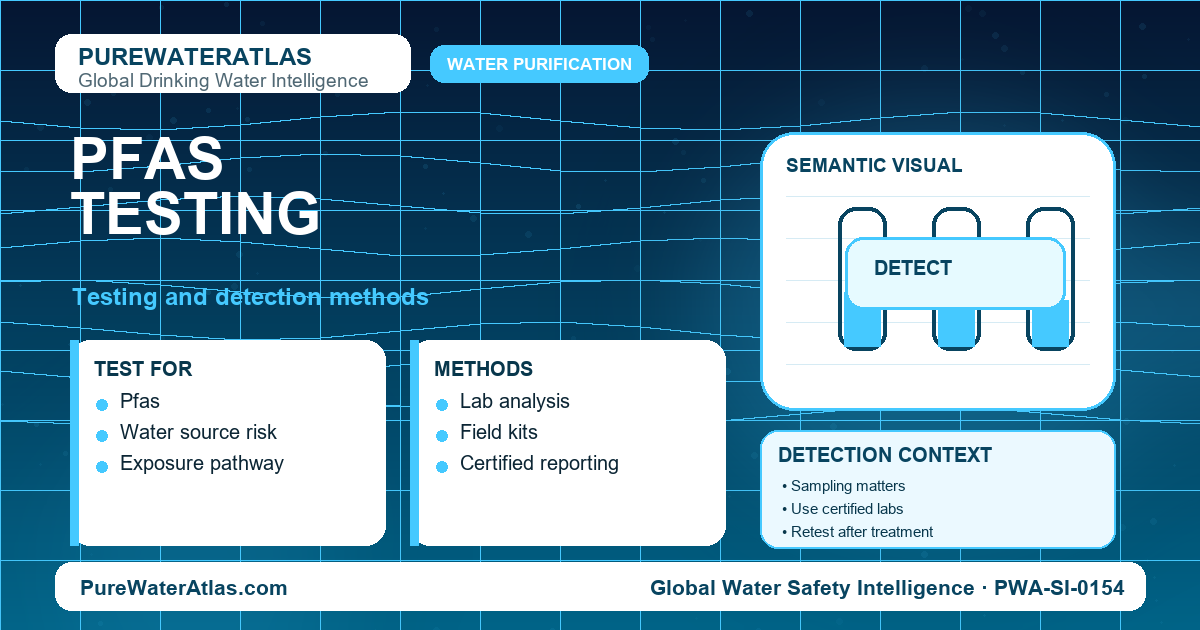
- Organic chemicals such as pesticides, VOCs, PFAS where relevant and feasible
Home testing methods
Portable water purification systems home testing can provide useful screening information, especially for routine checks and field decision-making. Common tools include:
- Test strips: Often used for pH, chlorine, hardness, nitrate, nitrite, and some metals. They are quick and inexpensive but generally less precise than laboratory methods.
- Handheld meters: Useful for conductivity, TDS, pH, oxidation-reduction potential, and sometimes turbidity. These require calibration and proper maintenance.
- Field microbiology kits: Presence-absence tests for coliforms or E. coli can indicate fecal contamination risk.
- Visual observations: Clarity, odor, color, and unusual residue can signal problems, though they are not proof of safety or danger by themselves.
Home testing is valuable for trends and rapid screening, but users should understand its limitations. A TDS meter cannot tell whether dangerous pathogens are present. Clear water can still contain viruses or dissolved chemicals. Likewise, a strip result may suggest contamination, but confirmation often requires laboratory analysis.
Laboratory analysis
Portable water purification systems lab analysis is the most reliable approach when legal, medical, emergency response, procurement, or engineering decisions depend on the outcome. Laboratories use validated methods, controlled conditions, trained analysts, quality control samples, and calibrated instrumentation.
Typical laboratory methods include:
- Culture-based microbiology: Membrane filtration, multiple-tube fermentation, or enzyme-substrate methods for total coliforms and E. coli.
- Molecular methods: PCR and related tools for rapid or specific pathogen detection in specialized settings.
- ICP-MS or ICP-OES: For trace metals such as lead and arsenic.
- Ion chromatography: For anions such as nitrate, nitrite, sulfate, and fluoride.
- GC-MS or LC-MS: For volatile and semi-volatile organic compounds and some emerging contaminants.
- Nephelometric turbidity measurement: For turbidity.
Laboratory analysis is especially important when assessing claims about chemical removal, low-level contaminants, or microbial reductions that home kits cannot reliably quantify.
Sampling methods
Portable water purification systems sampling methods are a major source of error if not performed carefully. Even excellent analytical methods cannot fix poor sample collection. Good practice generally includes:
- Using clean, appropriate sample containers supplied or approved by the testing laboratory.
- Collecting both influent and effluent samples whenever possible.
- Labeling samples with date, time, location, treatment stage, and device condition.
- Recording water temperature, source type, and any unusual field conditions.
- Following preservation requirements such as cooling, acidification, or rapid delivery.
- Avoiding contamination from hands, lids, tubing, bottle rims, or non-sterile surfaces.
For microbial samples, sterile technique is essential. For chemical samples, the wrong bottle type or delayed shipment can alter results. If chlorine or another disinfectant is present, a neutralizing agent may be required in the sample container to prevent continued disinfection after collection.
Challenge testing and performance verification
Many authoritative performance claims come from challenge testing, in which the system is exposed to water containing a known concentration of target contaminants or surrogate organisms. The treated water is then measured, and log reduction values are calculated. This method is useful because natural waters vary too much for fair comparison across products.
Challenge tests may evaluate:
- Reduction of bacteria, viruses, and protozoan surrogates
- Performance at beginning, middle, and end of cartridge life
- Effect of flow rate, pressure, and temperature
- Performance under high turbidity or adverse water chemistry
- Integrity after drop tests, transport stress, or repeated use cycles
A key issue in portable water purification systems accuracy is whether the test conditions reflect realistic use. A device tested only in ideal lab water may not perform similarly in cold, silty, or heavily contaminated field water. High-quality evaluations therefore examine both standardized challenge conditions and representative real-world scenarios.
Understanding accuracy, precision, and uncertainty
Accuracy refers to how close a measurement is to the true value. Precision refers to how consistent repeated measurements are with one another. A test can be precise but inaccurate if it is systematically biased, and accurate on average but imprecise if repeated results vary widely. In water testing, uncertainty can come from sampling, transport, preservation, instrument calibration, operator technique, matrix interference, and short-term fluctuations in source water.
When comparing methods, several questions help evaluate reliability:
- Was the instrument recently calibrated?
- Were duplicates or blanks used?
- Was the method validated for this type of water?
- Was the sample collected at a representative time and location?
- Were results near the detection limit?
These factors shape confidence in portable water purification systems test results. A single reading is rarely enough for strong conclusions if the consequences of error are serious.
Interpreting test results
Portable water purification systems test results should always be interpreted in context. Important considerations include:
- Influent quality: A treated water result means more when compared to the raw water entering the system.
- Detection limits: “Not detected” does not necessarily mean zero; it means below the method’s reporting threshold.
- Standards and benchmarks: Results should be compared against relevant health-based or performance-based criteria.
- Timing: A fresh cartridge may perform differently than one near the end of its rated life.
- Intended use: Emergency survival use, routine household use, and clinical settings may justify different levels of caution.
If a portable system improves turbidity and taste but does not reduce nitrates or viruses, that is not necessarily a failure; it may simply be operating outside its intended scope. The real problem occurs when users assume broad protection without evidence.
Prevention and Treatment
Testing is only one part of risk reduction. Prevention and treatment work best together. Before relying on a portable system, users should choose technology that matches the likely contaminants and operating environment.
Source selection and pre-treatment
The cleanest available source should always be selected first. Water from a protected supply, known municipal source, or clear moving stream upstream of human activity is generally preferable to stagnant or visibly polluted water. When turbidity is high, pre-treatment may be necessary:
- Allow sediment to settle before treatment.
- Pre-filter through cloth or sediment media.
- Use coagulation or flocculation products when appropriate.
- Reduce flow rate if the system’s design allows for better contact or filtration efficiency.
Matching treatment to contaminant type
- For bacteria and protozoa: Microfilters, UV systems, and chemical disinfectants may be effective, depending on the device and water quality.
- For viruses: Viral reduction often requires chemical disinfection, UV with validated dose, ultrafiltration, or reverse osmosis; many simple microfilters are insufficient.
- For metals and dissolved chemicals: Activated carbon may help with some organics, but reverse osmosis or specialty media may be needed for reliable removal of specific dissolved contaminants.
- For turbidity: Sediment filtration and settling are important before fine treatment or disinfection.
Maintenance and retesting
Portable systems need routine care. Cartridges should be replaced on schedule, seals checked for damage, UV lamps monitored for output or replacement interval, and storage reservoirs cleaned regularly. Retesting is recommended:
- After installing a new system
- After replacing major components
- After long storage or transport
- When source water changes substantially
- When taste, odor, flow rate, or clarity changes unexpectedly
In many practical scenarios, a layered strategy is best: source selection, pre-filtration, primary purification, safe storage, and periodic verification.
Common Misconceptions
Misunderstandings about portable systems can lead to unsafe decisions. Several misconceptions appear repeatedly in both consumer and field settings.
“Clear water is safe water”
Clear water may still contain pathogens, nitrates, heavy metals, or industrial chemicals. Visual clarity only addresses appearance, not microbiological or chemical safety.
“A filter removes everything”
No single portable technology removes all contaminants under all conditions. Some filters target particles and bacteria but not viruses or dissolved chemicals. Others improve taste but do little for serious hazards.
“One good test means the system is always reliable”
Performance changes with cartridge age, fouling, temperature, flow rate, and source water quality. Testing should be periodic and relevant to actual use conditions.
“Home kits are as definitive as lab reports”
Home screening tools are useful, but they are not substitutes for validated laboratory methods when precise or health-critical decisions are required. Field kits can miss low-level contaminants or be affected by user technique.
“Manufacturer claims guarantee field performance”
Claims may be based on idealized conditions, limited targets, or tests not representative of real source water. Independent verification and careful reading of claim scope are essential.
Regulations and Standards
Portable water purification devices are evaluated through a mix of regulatory frameworks, performance standards, certification programs, and procurement criteria. The applicable standard depends on the device type, market, and intended use.
Performance standards
In many markets, performance verification relies on independent standards organizations. Standards may cover microbiological purifiers, drinking water treatment units, filter materials, structural integrity, and specific contaminant reduction claims. Certification bodies may verify that a product was tested against a recognized protocol for bacteria, viruses, protozoa, cysts, lead, chlorine, or other contaminants.
These standards matter because they define challenge conditions, minimum reduction targets, sample numbers, and reporting rules. They help make product comparisons more meaningful than unverified marketing language.
Regulatory context
Portable devices may not always be regulated in the same way as centralized public water systems. Public water systems are subject to extensive legal requirements for treatment, monitoring, and reporting. Portable consumer devices are more often governed through product standards, labeling rules, and consumer protection laws. In emergency or humanitarian contexts, procurement agencies may require evidence of microbiological reduction, durability, flow capacity, and operational suitability.
What users should look for
- Independent certification to a recognized standard
- Clear identification of contaminants reduced
- Rated capacity and maintenance requirements
- Testing at end-of-life, not only when new
- Instructions that address turbidity, contact time, and safe storage
Standards do not eliminate the need for context-specific testing, but they provide a valuable baseline. A certified product with appropriate field verification is generally a much safer choice than a device with broad unsupported claims.
Conclusion
Portable water treatment can be highly effective, but only when the device matches the contaminants of concern and when its performance is properly verified. Portable water purification systems testing is therefore not just a technical exercise; it is the basis for informed use, risk reduction, and realistic expectations. Good evaluation combines source assessment, appropriate portable water purification systems sampling methods, practical field screening, and rigorous portable water purification systems lab analysis when needed.
For everyday users, portable water purification systems home testing offers helpful screening data, especially for parameters like chlorine, pH, or general water quality trends. For higher-risk decisions, laboratory confirmation provides stronger evidence and a clearer basis for action. Throughout the process, understanding portable water purification systems accuracy and properly interpreting portable water purification systems test results are essential to avoid false confidence.
The most important takeaway is that no portable system should be assumed to solve every water problem. Effective protection depends on realistic claims, correct operation, routine maintenance, safe storage practices, and repeated verification over time. When those elements come together, portable purification systems can provide a valuable and sometimes lifesaving barrier between uncertain water sources and safer drinking water.
Read the full guide: Water Purification Guide
Explore more in this category: Water Purification Articles