Chattogram, Bangladesh: treated municipal surface water exists, but point-of-use safety depends heavily on distribution pressure, storage tanks, seasonal river conditions, and household plumbing.
Quick Answer
| Overall safety status | Caution recommended. Chattogram has a formal municipal utility and major treated surface-water plants, but ordinary tap water should not be assumed reliably potable at the tap without additional precautions. |
|---|---|
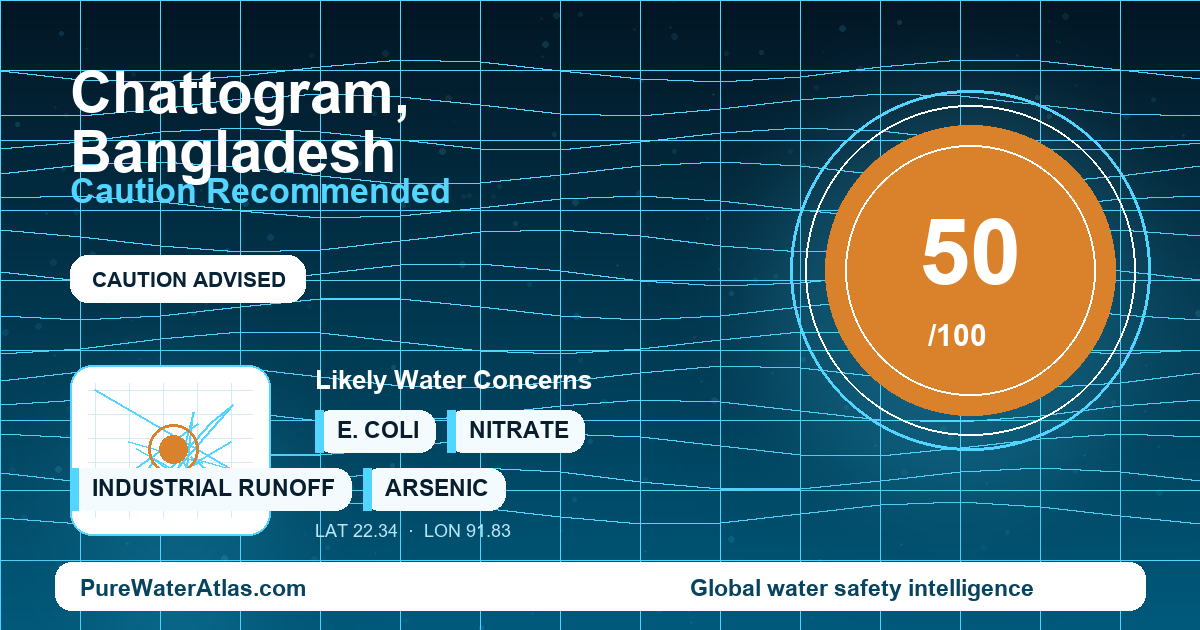
| PureWaterAtlas score | 50 / 100 — risk level: Caution Recommended. |
| Traveler advice | Most short-term visitors should drink sealed bottled water or water that has been boiled, UV-treated, or purified by a reliable system. Use caution with ice, street drinks, and water served in reused containers. |
| Resident advice | Residents using Chattogram WASA water should manage household risk: clean storage tanks, check plumbing, and consider sediment filtration plus activated carbon and UV or another validated disinfection step where storage or intermittent supply is an issue. |
| Main water source | Mainly treated surface water from the Halda-Karnaphuli river system, including major production from Mohara, Madunaghat, and Sheikh Hasina/Karnaphuli treatment facilities, with some groundwater and private boreholes still relevant in certain settings. |
| Water authority | Chattogram Water Supply and Sewerage Authority, commonly called Chattogram WASA or CWASA. |
| Filter recommendation | Often advisable at point of use, especially where water is stored in rooftop or underground tanks, supply is intermittent, or vulnerable people live in the home. |
Why Chattogram Is Different
Chattogram is not a city where the water-safety question can be answered only by asking whether a treatment plant exists. The city is a large coastal port in southeastern Bangladesh, located around the Karnaphuli River and near the Bay of Bengal. Its public supply is strongly connected to the Halda-Karnaphuli river system, so raw-water conditions are influenced by monsoon rainfall, upstream flow, tides, coastal salinity dynamics, urban runoff, and industrial pressure in the Karnaphuli corridor.
The city has benefited from major treated surface-water expansion, including donor-supported projects intended to reduce historic shortages and expand service in a fast-growing port city. That is an important improvement. However, Chattogram’s practical drinking-water risk often appears after treatment: water may pass through transmission mains, service reservoirs, distribution pipes, underground reservoirs, rooftop tanks, pumps, and building plumbing before it reaches a glass.
For that reason, a household in Chattogram can receive treated municipal water but still face point-of-use concerns if supply is intermittent, pressure drops, tanks are dirty, pipes leak, or building plumbing is poorly maintained. This is why PureWaterAtlas rates Chattogram as Caution Recommended rather than “drink freely from any tap.” The strongest advice is different for a traveler staying a few days than for a resident managing a home or apartment system year-round.
Where Does Chattogram’s Tap Water Come From?
Chattogram’s public supply is mainly based on treated surface water abstracted from the Halda-Karnaphuli river system. Major facilities associated with this supply include the Mohara Water Treatment Plant, the Madunaghat Water Treatment Plant, and Sheikh Hasina Water Treatment Plant facilities developed under Karnaphuli water supply projects. These plants substantially increased treated-water production capacity for the city.
Historically, Chattogram depended more heavily on groundwater and had smaller production capacity. Public-sector and development-bank projects were introduced because the city faced rapid demand growth and water-supply constraints. Surface-water treatment expansion has helped reduce dependence on groundwater and improve service potential, but it does not eliminate all drinking-water risk for the consumer.
The final part of the system matters. Transmission mains, service reservoirs, local distribution pipelines, underground building reservoirs, rooftop tanks, and household taps are all part of the real drinking-water pathway. If treated water enters a dirty storage tank, loses disinfectant residual, or passes through a compromised connection, the quality at the tap can differ from the quality leaving a plant. Private tubewells and building-level backup sources also remain common where municipal supply is intermittent or where households want additional water security.
Who Manages Drinking Water in Chattogram?
The main municipal water authority is Chattogram Water Supply and Sewerage Authority, commonly known as Chattogram WASA or CWASA. It operates within Bangladesh’s local government sector institutional framework and is the primary public water-supply authority for Chattogram city.
Bangladesh’s drinking-water quality context involves national standards and public-health oversight through government agencies including the Local Government Division, the Department of Public Health Engineering, the Department of Environment, and related authorities. Bottled water is regulated separately through Bangladesh standards and market oversight.
For consumers in Chattogram, the practical utility-facing organization is Chattogram WASA. A key limitation is that recent, comprehensive, neighborhood-level public tap-water compliance data are not readily available. Public sources document the utility, major projects, and infrastructure context better than they document continuous consumer-tap results for microbiology, chlorine residual, turbidity, salinity, metals, and private wells. Conditions can vary by season, pressure zone, household storage, and building plumbing.
Main Local Water Concerns
- Microbial contamination after treatment: Intermittent supply, low pressure, cross-connections, leaky pipes, contaminated rooftop tanks, and poorly maintained underground reservoirs can allow treated water to become unsafe before use.
- Monsoon turbidity and sediment: During monsoon rains, river turbidity, runoff, drain overflows, and flood-related contamination pressure can increase. High sediment loads in raw surface water can challenge treatment and affect appearance, taste, and disinfection performance if not well managed.
- Dry-season salinity pressure: Chattogram’s coastal and tidal river setting means dry-season salinity intrusion can affect raw-water availability and taste, especially in lower river reaches influenced by tides and reduced upstream flow.
- Urban and industrial source-water pressure: The Karnaphuli corridor has urban and industrial pollution pressure, making source-water protection important even when treatment plants are in place.
- Private well uncertainty: Private boreholes and wells should not be assumed safe. Depending on location and aquifer conditions, microbial quality, salinity, iron, manganese, arsenic, and nitrate can be relevant.
- Localized metals risk: Lead is not documented here as a proven citywide Chattogram tap-water problem, but older building plumbing, fittings, solder, brass fixtures, and stagnant water can create localized exposure risk.
For Travelers
Most travelers should not drink untreated tap water in Chattogram. The municipal supply is treated, but point-of-use safety is uncertain for visitors because they usually cannot verify the condition of neighborhood pipes, hotel storage tanks, ice production, or restaurant water handling. The safer default is sealed bottled water from a reliable brand, with the cap seal intact.
For brushing teeth, use bottled, boiled, or properly filtered water, especially if you are visiting for a short time, traveling with children, pregnant, older, immunocompromised, or prone to gastrointestinal illness. For infant formula, use boiled water and follow safe preparation practices.
Be careful with ice. Avoid ice from street vendors or informal restaurants unless you can verify it was made from treated water. In higher-end hotels and restaurants, ask whether ice is made from purified water. The same caution applies to diluted juices, street drinks, and water served in reused containers.
Better hotels may use storage tanks, filtration, UV treatment, or bottled water, but travelers should ask directly rather than assume. If using a travel device, use a purifier rated for bacteria, viruses, and protozoa, or pair filtration with disinfection. For practical background, see PureWaterAtlas guides to boiling water purification and UV water purification.
For Residents
For households connected to Chattogram WASA, a home treatment system is often advisable, but it should match the actual risk. A practical setup may include sediment prefiltration, activated carbon for taste, odor, and chlorine byproduct concerns, and UV or another validated disinfection step where stored water, low pressure, or pipe contamination is a concern. Reverse osmosis may be useful where testing confirms salinity, dissolved solids, arsenic, nitrate, or metals, but it should not be installed blindly without understanding maintenance and water chemistry.
Storage tanks are one of the most important local control points. Rooftop and underground tanks should be sealed, screened against insects and animals, cleaned and disinfected on a schedule, protected from floodwater entry, and inspected after storms. A dirty tank can make treated municipal water unsafe at the household tap.
Older buildings need extra attention. Stagnant water in internal pipes, corroded plumbing, brass fixtures, old solder, and poorly maintained pumps can affect taste, metals, and microbial quality. Flush stagnant taps before drinking, especially after overnight stagnation or long interruptions. If infants, pregnant people, or children drink the water, testing is especially important where plumbing materials are unknown.
Private wells and boreholes should be tested before drinking. Recommended tests include E. coli or thermotolerant coliforms, arsenic, iron, manganese, salinity or electrical conductivity, chloride, total dissolved solids, nitrate, and relevant metals. If water tastes salty, laboratory testing for conductivity, chloride, and TDS is better than relying on taste alone.
Relevant Contaminants and Water-Quality Issues
Chattogram’s main concerns are local and pathway-specific. Microbial risk is especially important where intermittent supply, low pressure, flooding, or storage tanks are involved. Learn more about E. coli in drinking water and broader water microbiology risks.
Monsoon conditions can increase river sediment and cloudy water risks, making turbidity and sediment relevant for Chattogram households. Disinfection also matters: chlorine residual helps protect treated water in distribution, so residents may want to understand chlorine in drinking water and how it interacts with storage and household treatment.
For private groundwater sources, Bangladesh’s broader groundwater context means residents should pay attention to arsenic, iron, and manganese. Lead should be treated as a possible building-level issue rather than a confirmed citywide problem; see lead in drinking water if your building is older or plumbing materials are unknown.
How to Verify Your Water Quality
The most reliable way to verify drinking-water safety in Chattogram is to test the water actually used for drinking: at the tap, after the storage tank, and after any household filter or purifier. If a private well or borehole is used, test the raw source separately. Use an accredited or recognized laboratory where possible; field kits can screen but should not replace laboratory confirmation for arsenic, lead, nitrate, and microbiology.
Useful triggers for testing include recent flooding, cyclone or storm impacts, waterlogging, long supply interruptions, tank cleaning, pipe repairs, salty taste, cloudy water after rain, illness clusters in the household, or installation of a new filter. For private groundwater, test before routine drinking use rather than after problems appear.
PureWaterAtlas resources that can help include the complete water testing guide, the Contaminants Search Engine, the Global Water Quality Checker, and the broader guide to water purification methods. For specific testing topics, see guides on arsenic testing, lead testing, and nitrate testing.
Official and Technical Sources
- Chattogram Water Supply and Sewerage Authority official website — local utility context for Chattogram water supply and projects.
- World Bank: Bangladesh Chittagong Water Supply Improvement and Sanitation Project — documentation of major water-supply and sanitation infrastructure investments.
- World Bank Projects: Bangladesh Chittagong Water Supply Improvement and Sanitation Project — context on water-supply constraints, utility development, and infrastructure improvement needs.
- Japan International Cooperation Agency: Bangladesh activities and water-sector cooperation — background on Japan-supported water infrastructure cooperation in Bangladesh.
- WHO and UNICEF Joint Monitoring Programme: Bangladesh household drinking-water data — national drinking-water service context, not a substitute for Chattogram tap-level testing.
- Department of Public Health Engineering, Bangladesh — national public-health engineering and water-quality context.
- Department of Environment, Bangladesh — environmental regulation and water-pollution control context relevant to source-water protection.
Bottom Line
Chattogram has an established municipal water utility and major treated surface-water plants, so the city is not dependent only on informal sources. However, ordinary tap water should still be treated with caution at the point of use. The main risks are distribution and household factors: intermittent supply, pressure changes, leaky or aging pipes, storage tanks, monsoon turbidity, dry-season salinity pressure, and local plumbing. Travelers should use sealed bottled water or properly treated water and avoid uncertain ice. Residents should clean tanks, test stored water and private wells, and consider filtration plus disinfection where needed. Because recent neighborhood-level public tap-water data are limited, household-level verification is the safest approach.
Read the full guide: Global Water Quality Guide
Explore more in this category: Global Water Quality Articles