
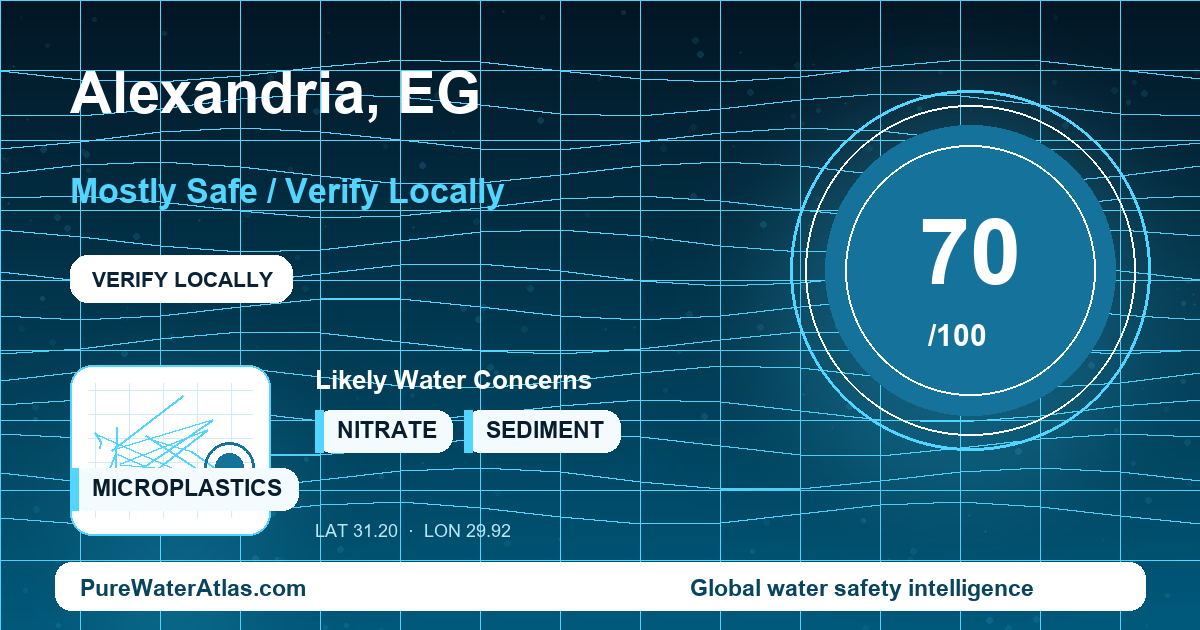
Alexandria’s tap water is generally treated municipal Nile-canal water, but safety at the final tap depends heavily on local verification, building plumbing, pressure history, and rooftop or private storage tanks.
Quick Answer
| Overall safety status | Mostly Safe / Verify Locally. Alexandria tap water is best classified as mostly safe on the regulated municipal network, but not automatically safe at every tap. |
|---|---|
| Water safety score | 70 / 100 — medium confidence because recent, public, citywide tap-water results are limited. |
| For travelers | Use sealed bottled water or water treated by a reputable hotel or restaurant. Tap water is commonly chlorinated and widely used locally, but short-stay visitors may be sensitive and usually cannot verify building tanks or pipes. |
| For residents | Municipal tap water can generally be used if it is clear, normally chlorinated, and supplied through a maintained building system. Older buildings, rooftop tanks, pressure interruptions, or recurring discoloration justify testing and filtration. |
| Main water source | Treated surface water: Nile freshwater conveyed to Alexandria through Delta canals, especially the Mahmoudia Canal system. |
| Local water authority | Alexandria Water Company, also presented as the Alexandria Drinking Water Company, within Egypt’s Holding Company for Water and Wastewater structure. |
| Filter recommendation | Not mandatory for every municipal connection, but a sediment prefilter plus activated carbon is practical where taste, chlorine odor, particles, or tank storage are concerns. Reverse osmosis should be considered only where dissolved salts, nitrate, or metals are verified concerns. |
Why Alexandria Is Different
Alexandria is not a typical riverbank city drawing directly from the main Nile in the urban center. It sits on Egypt’s Mediterranean coast at the western edge of the Nile Delta, near Lake Mariout, and depends on imported Nile freshwater conveyed through canal systems. That coastal geography matters: Alexandria is a large coastal city whose drinking-water identity is tied to Delta freshwater management rather than seawater, local groundwater, or a single visible river intake inside the city.
The city-specific feature to understand is the Mahmoudia Canal. Historically, Alexandria relied on canals and cistern-style freshwater management because it is not located on the main Nile channel. The Mahmoudia Canal, built in the Muhammad Ali period, became a major freshwater and navigation link between the Nile’s Rosetta branch area and Alexandria. Today, the broader freshwater landscape still reflects that dependence on Nile/Delta canal conveyance.
This also explains why Alexandria’s tap-water risk is not just a question of central treatment. Municipal water is intended to be treated and disinfected before distribution, but the quality at an apartment tap can be changed by dense urban distribution, older internal pipes, service pressure changes, and rooftop or basement storage tanks. In Alexandria, the building is often as important as the utility when judging whether a specific tap is safe to drink.
Where Does Alexandria’s Tap Water Come From?
Alexandria’s municipal drinking-water supply is primarily a treated surface-water system. The raw water is Nile freshwater delivered through Delta canals, especially the Mahmoudia Canal corridor, rather than groundwater or seawater. This is important because normal municipal mains should not be assumed to have the same risk profile as a private well, tanker supply, or unverified storage source.
The main infrastructure chain includes Nile/Delta canal raw-water conveyance, municipal treatment plants, pumping and distribution assets operated by Alexandria Water Company, the urban pipe network serving dense coastal districts, and building-level plumbing and storage. Each stage can affect the final glass of water. Central treatment is designed to make canal water potable, but distribution pressure, repairs, sediment disturbance, and private storage tanks can alter water clarity and microbial safety before it reaches the kitchen tap.
For normal municipal connections, coastal salinity is more relevant to private wells, groundwater, and low-lying Delta water management than to the regulated drinking-water mains. If a property in or around Alexandria is using a private well, tanker water, or an unverified building storage source, it should not be judged by the municipal-network rating. Those sources need separate testing for salinity or total dissolved solids, bacteria, nitrate, and relevant metals before drinking.
Who Manages Drinking Water in Alexandria?
Alexandria’s local public water utility is Alexandria Water Company, commonly presented as the Alexandria Drinking Water Company. It is the customer-facing utility responsible for municipal drinking-water services in the city. At the national level, local utilities operate within the structure of Egypt’s Holding Company for Water and Wastewater.
Egypt’s water and wastewater sector also has a regulatory and consumer-protection context through the Egyptian Water Regulatory Agency, while public-health authorities are involved in drinking-water quality control. National water-resource context is shaped by Egypt’s dependence on Nile water and managed irrigation and drainage systems, documented by sources such as FAO AQUASTAT.
The key limitation for users is transparency at the tap level. Alexandria has a named utility and a clear Nile-canal source-water context, but recent neighborhood-by-neighborhood public results for disinfectant residuals, microbial compliance, lead at customer taps, or rooftop-tank conditions are not readily available in a transparent format. For that reason, this guide does not claim universal safety at every Alexandria tap.
Main Local Water Concerns
Raw-water pressure in Delta canals: Alexandria’s source-water pathway can be affected before treatment by agricultural drainage, urban runoff, wastewater pressure, and high organic loads in Nile Delta canal systems. Treatment is intended to address these challenges, but source-water stress can influence taste, odor, turbidity, and treatment demand.
Turbidity, sediment, and discoloration: Canal disturbance, maintenance, storms, distribution repairs, or pressure changes can produce cloudy, rusty, or particle-laden water at the tap. If water suddenly becomes discolored, residents should avoid drinking it until it clears and should flush taps after work or outages.
Chlorine taste and odor: Municipal surface water is disinfected, and some Alexandria users may notice a chlorine taste or smell, especially during warm periods or after operational changes. A normal chlorine odor can indicate residual disinfectant, but strong or unusual odors should be verified locally.
Building plumbing and storage tanks: Older pipes, dead-end plumbing, leaks, intermittent pressure, corrosion, and rooftop tanks can introduce sediment or microbial risk after the water has left the utility network. Poorly sealed or infrequently cleaned tanks are a major practical concern because treated water can be recontaminated inside the building.
Seasonal and operational factors: Hot summer temperatures can reduce chlorine residual faster in storage tanks and pipes. Canal maintenance, heavy runoff, unusual turbidity, high-demand periods, local pipe repairs, pressure loss, or flooding can all temporarily change water quality at the tap.
For Travelers
For a cautious visitor, Alexandria tap water should not be your main drinking water unless your hotel specifically confirms treatment and tank maintenance. Use sealed bottled water or water treated by a reputable hotel or restaurant, especially for children, pregnant travelers, older adults, and anyone with a sensitive stomach. Check that bottle caps are intact.
Brushing teeth with tap water is often tolerated by residents, but short-stay travelers should use bottled water for brushing, particularly in older buildings or where the tap water is cloudy, rusty, or supplied through a roof tank. Avoid swallowing shower water and use bottled or properly treated water for infant formula.
Ice is a separate risk. Avoid ice unless it is made from purified water in a reputable hotel or restaurant. Small shops, street vendors, and informal cafés may use tap or stored water that travelers cannot verify. Higher-end hotels and established restaurants are more likely to maintain storage and filtration, but this should still be asked rather than assumed.
If you need emergency treatment, bring water to a rolling boil. Boiling helps reduce microbial risk, but it does not remove dissolved salts or metals. For broader purification options, see the PureWaterAtlas guide to boiling water purification and the overview of water purification methods. The CDC Travelers’ Health page for Egypt supports cautious food, water, and ice practices for visitors.
For Residents
Residents connected to the Alexandria Water Company network can generally use municipal tap water when it is clear, has normal disinfectant characteristics, and comes through a maintained building system. However, household conditions matter. A home filter is not automatically required for every municipal connection, but it is practical in older buildings, buildings with roof tanks, homes with recurring discoloration, or households with infants, pregnant people, elderly residents, or immunocompromised residents.
A sediment prefilter can help with particles after repairs, tank disturbance, or pressure changes. Activated carbon can improve chlorine taste and odor. Reverse osmosis is a stronger option where dissolved salts, nitrate, or metals are verified concerns, but it requires maintenance and careful cartridge replacement. An overdue filter can become a microbial growth site and may worsen water quality.
Test water at the kitchen tap after the building tank, not only at the building inlet. If water is cloudy, rusty, has black particles, smells sewage-like, or follows a pressure outage, test for indicator bacteria such as total coliform and E. coli and avoid drinking until resolved. In older apartments or buildings with unknown plumbing history, test first-draw and flushed samples for lead and other metals, especially where children or pregnant residents live.
Rooftop and basement tanks should be cleaned and disinfected on a regular schedule, kept sealed, and inspected for dust, insects, birds, cracked covers, damaged vents, and overflow problems. Let water run after long stagnation, and do not use hot tap water for cooking or drinking.
Relevant Contaminants and Water-Quality Issues
The most relevant Alexandria issues are practical and location-specific rather than proof of a single citywide contaminant exceedance. Chlorine is relevant because treated municipal surface water is disinfected and users may notice taste or odor. Turbidity and sediment matter because canal conditions, network repairs, tank disturbance, and pressure changes can produce cloudy water or particles.
E. coli is relevant for storage-tank hygiene, pressure-loss events, and traveler gastrointestinal risk. Lead is mainly a building-plumbing concern in older properties, not a confirmed citywide utility exceedance in this dataset. Nitrate is relevant to agricultural drainage pressure in the wider Nile Delta and to private wells or non-network sources. For broader background, see PureWaterAtlas resources on agricultural runoff in drinking water, lead testing and detection, and nitrate testing and detection.
How to Verify Your Water Quality
Because recent public, neighborhood-level Alexandria tap-water data are limited, verification should happen at the tap you actually drink from. For residents, the best approach is to test after the building’s storage tank and internal plumbing. Compare a first-draw sample after stagnation with a flushed sample if you are evaluating old plumbing or possible metals. If the concern is illness, sewage odor, pressure loss, or dirty tank conditions, prioritize microbiological testing for total coliform and E. coli.
If the water comes from a private well, tanker, or unverified non-network source, do not assume it matches municipal quality. Test for total dissolved solids or salinity, bacteria, nitrate, and relevant metals before drinking. If you are deciding between boiling, carbon filtration, UV, or reverse osmosis, start with the PureWaterAtlas guides to water testing, water microbiology, and UV water purification.
You can also use the Contaminants Search Engine to look up specific substances and the Global Water Quality Checker to compare Alexandria with other destinations. For general decision-making, see Drinking Water Safety and the PureWaterAtlas categories for Global Water Quality, Drinking Water Safety, Water Testing, and Water Treatment Systems.
Official and Technical Sources
- Alexandria Water Company official website — local utility responsible for Alexandria municipal drinking-water services and public customer information.
- Holding Company for Water and Wastewater, Egypt — national structure under which local water and wastewater companies operate.
- Egyptian Water Regulatory Agency — sector regulatory and consumer-protection context.
- FAO AQUASTAT country profile: Egypt — national water-resource context, including dependence on Nile water and managed irrigation and drainage systems.
- CDC Travelers’ Health: Egypt — food, water, and safe-beverage precautions for travelers.
- WHO/UNICEF Joint Monitoring Programme data portal: Egypt — national WASH service context, not a substitute for Alexandria tap testing.
- Encyclopaedia Britannica: Alexandria, Egypt — geographic context for Alexandria as a Mediterranean coastal city in the Nile Delta region.
Bottom Line
Alexandria tap water is best treated as mostly safe on the regulated municipal network, but it should be verified locally. The city relies on treated Nile freshwater conveyed through Delta canals, especially the Mahmoudia Canal system, and the local utility is Alexandria Water Company. The biggest uncertainty is not only central treatment, but what happens inside dense urban distribution systems, old buildings, pressure interruptions, and rooftop or basement storage tanks. Travelers should prefer sealed bottled water or verified treated water and avoid unverified ice. Residents should focus on tank hygiene, flushing after outages, testing at the kitchen tap, and using sediment/carbon filtration where taste, particles, or old plumbing create recurring concerns.
Read the full guide: Global Water Quality Guide
Explore more in this category: Global Water Quality Articles