
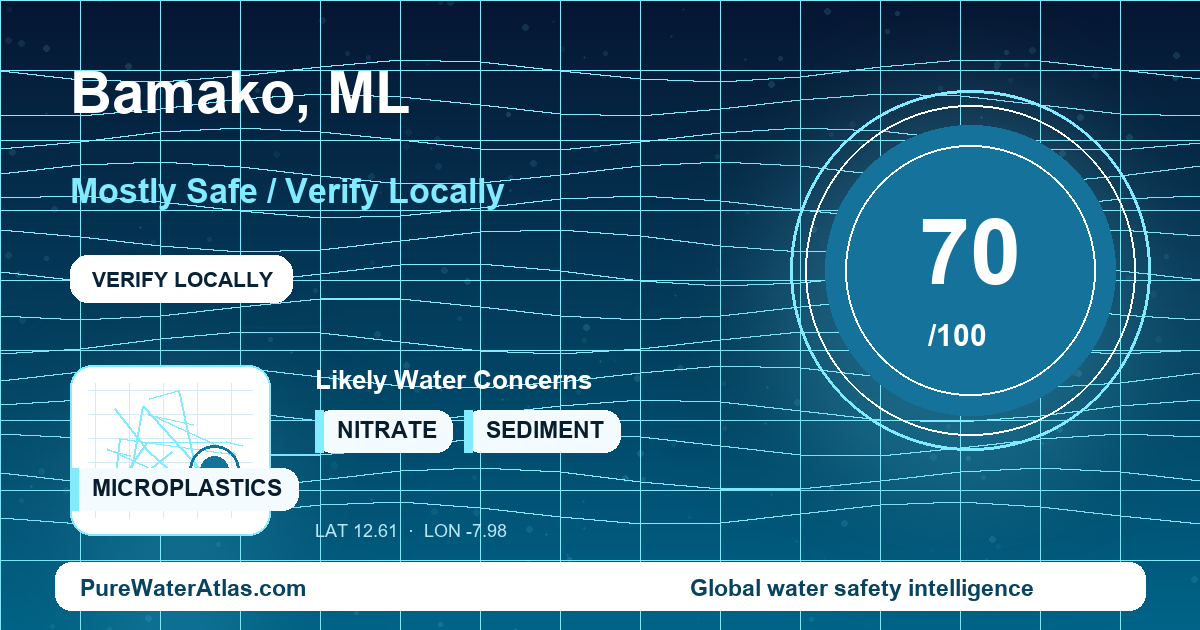
Bamako’s tap water is treated municipal water when it comes from the official SOMAGEP network, but safety at the tap depends heavily on pressure continuity, rainy-season turbidity, building storage, and local verification.
Quick Answer
| Overall safety score | 70 / 100 |
|---|---|
| Risk level | Mostly Safe / Verify Locally |
| Can you drink the tap water? | Bamako’s piped tap water should be considered mostly safe only when it comes from the formal SOMAGEP network, is clear, has normal pressure, and has a detectable disinfectant residual. Do not assume every tap, tank, well, or vendor supply is safe. |
| Traveler advice | Short-stay visitors should use sealed bottled water or properly treated water for drinking and brushing teeth. Tap water in reputable hotels may be treated, but ask about filtration, disinfection, and ice. |
| Resident advice | Residents connected to the formal network can generally use tap water after checking local service quality, but should manage storage carefully, flush stagnant plumbing, and treat water when pressure is intermittent, cloudy, or stored for long periods. |
| Main water source | Primarily treated surface water from the Niger River. |
| Water authority | SOMAGEP-SA operates urban drinking-water service; SOMAPEP-SA holds public drinking-water infrastructure assets. |
| Filter recommendation | Not automatically required for every connected household. Consider sediment filtration, activated carbon, and UV or boiling when water is turbid, stored, or service is intermittent. Reverse osmosis should be based on testing, not assumption. |
Why Bamako Is Different
Bamako’s drinking-water situation is closely tied to the Niger River. The city is built along the river, and its formal urban supply depends primarily on river water that is abstracted, treated, and distributed through the municipal network. That makes treatment performance and distribution integrity central to tap-water safety. In Bamako, the practical question is not only “is the city water treated?” but also “is this building connected to the official network, has pressure been continuous, is the water clear after rains, and are tanks or containers clean?”
The city has also grown quickly. Development-bank project documents identify Bamako’s water supply as a major priority because older production and distribution capacity was under pressure from rapid population growth. The Kabala drinking-water supply program was developed to expand treated-water production, transmission mains, reservoirs, and distribution coverage for Bamako and surrounding areas. This matters for safety because treated water leaving a plant can differ from water reaching a household tap if pressure drops, pipes are damaged, or water is stored after delivery.
PureWaterAtlas rates Bamako at 70 out of 100: mostly safe in the formal network, but not a “drink anywhere without checking” city. The confidence level is medium because Bamako’s main source, operating institutions, and infrastructure projects are documented, while recent public neighborhood-by-neighborhood compliance data are not consistently available in open sources.
Where Does Bamako’s Tap Water Come From?
Bamako’s urban drinking-water system relies primarily on surface water from the Niger River. Raw water is abstracted from the river, treated, and then moved through transmission mains, storage reservoirs, pumping stations, and distribution extensions that serve neighborhoods and peri-urban areas.
Key infrastructure includes Niger River raw-water intakes, older treatment and production facilities serving the Bamako network, and the Kabala drinking-water production and supply infrastructure. The Kabala program is especially important because it was developed as a major expansion of Bamako’s supply capacity, including treatment, transmission, storage, and distribution works.
The river source creates seasonal and operational challenges. During the rainy season, runoff and suspended sediment can increase turbidity in the Niger River. High turbidity can increase the burden on treatment and may reduce disinfection effectiveness if not properly controlled. Even when treatment is working, distribution conditions still matter: pipe breaks, pressure changes, illegal connections, and household storage can create contamination risks between the treatment plant and the tap.
Household and building-level tanks are a major control point in Bamako. A clean, covered, regularly maintained tank can help households manage intermittent supply. A poorly protected tank can do the opposite, allowing dust, insects, hands, containers, or microbial regrowth to compromise water that was previously treated.
Who Manages Drinking Water in Bamako?
Urban drinking-water service in Bamako is managed by national water institutions. SOMAGEP-SA, the Société Malienne de Gestion de l’Eau Potable, is the operating utility responsible for potable water service management in urban centers including Bamako. SOMAPEP-SA, the Société Malienne de Patrimoine de l’Eau Potable, is the asset-holding company responsible for public drinking-water infrastructure assets.
The water sector is overseen through Mali’s national institutional framework, including the ministry responsible for water and sanitation and CREE, the Commission de Régulation de l’Électricité et de l’Eau, which regulates the electricity and water sectors. These institutions establish the formal context for Bamako’s treated municipal supply.
However, publicly accessible regulator or utility pages do not provide a complete, recent, neighborhood-by-neighborhood tap-water compliance database for Bamako. This is an important limitation. A citywide statement cannot certify the quality of every tap, tank, private borehole, vendor supply, or informal connection. Local pressure zone, outage history, internal plumbing, storage practices, and whether the property is truly connected to the formal network all matter.
Main Local Water Concerns
The most important documented concerns for Bamako are practical and system-related rather than a single verified citywide chemical contaminant. They include source-water pressure on the Niger River, rainy-season turbidity, intermittent pressure, distribution integrity, household storage, and point-of-use contamination.
- Rainy-season turbidity: Heavy rains can increase sediment and runoff entering the Niger River. If water looks cloudy, muddy, or unusually colored, do not drink it untreated.
- Microbial risk during pressure problems: When pressure is intermittent or pipes are damaged, contaminated water can enter the distribution system. Testing for E. coli is the clearest way to evaluate fecal contamination risk.
- Storage-tank contamination: Water stored in tanks or containers can lose disinfectant residual and become vulnerable to microbial regrowth, especially during hot periods or long storage.
- Chlorine taste or odor: A detectable disinfectant residual is useful protection in distribution. Some taste or odor from chlorine may be noticeable, but absence of residual at the tap can be a warning sign where microbial risk is suspected.
- Sediment and disturbed mains: Sediment, iron-like color, or particles can appear after outages, pressure changes, or pipe repairs. Treat these as signs to flush, filter, and investigate.
- Building-specific metals: Lead is not documented in the available public sources as a Bamako-wide municipal contaminant, but old internal plumbing, brass fittings, solder, or imported fixtures can create building-specific risk.
- Private wells and informal supplies: If a household uses a borehole, well, tanker, or vendor water rather than the SOMAGEP network, city network assumptions do not apply. Test for microbes, nitrate, conductivity or salinity, iron, manganese, and locally relevant metals.
For Travelers
For most short-term travelers, untreated tap water in Bamako is not the best choice. Use sealed bottled water with intact caps, boiled water, UV-treated water, or water treated by a purifier appropriate for microbes. This is especially important after heavy rain, during outages, where water is stored in tanks, or anywhere the supply source is unclear.
Use bottled or treated water for brushing teeth if you have a sensitive stomach, are staying for only a short time, or are in accommodation with intermittent supply. Avoid ice unless you are confident it was made from treated water in a reputable hotel or restaurant. Ice from unknown vendors should be considered a higher-risk exposure route.
Higher-end hotels and restaurants may use filtered or treated water, but travelers should still ask: Is drinking water filtered or disinfected? Are ice cubes made from treated water? Are tanks cleaned and covered? In smaller establishments, choose sealed bottled drinks and be cautious with raw foods that may have been washed in untreated water.
Carry oral rehydration salts, avoid refilling bottles from unknown taps, and treat water if it has changed in color, odor, or clarity. Boiling is a strong backup for microbial risk; see the PureWaterAtlas boiling water purification guide. UV can also be useful for clear water; see the UV water purification guide.
For Residents
Residents connected to the formal SOMAGEP network can often use tap water after confirming local conditions, but household practices matter. A home filter is not automatically required for every Bamako household. It becomes more sensible when supply is intermittent, water is stored, vulnerable people live in the home, or the tap water is sometimes cloudy.
A practical setup is sediment prefiltration for visible particles or turbidity, activated carbon for taste and chlorine-related aesthetic issues, and UV or boiling as a microbial backup when needed. Reverse osmosis should not be the default assumption; it is best justified by testing that identifies dissolved chemical concerns such as nitrate, salinity, arsenic, lead, or other metals.
Testing is especially important after flooding, after pipe repairs, when pressure has been unstable, or if household members have recurrent gastrointestinal illness. Test stored water for E. coli or thermotolerant coliforms. Check free chlorine residual at the tap with a simple field kit, particularly during hot weather or after long storage. No residual does not prove contamination, but it means the water has less protection against microbial regrowth.
Older buildings need extra caution. Stagnant water in internal pipes, old fittings, solder, brass components, or corroded plumbing can affect tap quality even if municipal water is properly treated. Flush water after overnight stagnation and consider first-draw and flushed sampling for lead and other metals if children or pregnant people regularly drink from the tap. PureWaterAtlas has a detailed guide to lead testing and detection methods.
For storage tanks and household containers, keep them covered, clean and disinfect them periodically, prevent insects and dust from entering, and avoid dipping cups or hands into stored water. Treat stored water if it has been held for long periods, has no chlorine residual, or becomes cloudy.
Relevant Contaminants and Water-Quality Issues
The most relevant Bamako water-quality issues are linked to river treatment, distribution reliability, and storage. Turbidity is important because rainy-season sediment in the Niger River can make treatment more difficult and can interfere with disinfection if not controlled. Sediment is relevant when residents see particles, discoloration, or cloudy water after outages, repairs, or pressure changes.
E. coli is the key indicator for fecal contamination risk in stored water, intermittent-pressure systems, wells, and informal supplies. Chlorine matters because disinfection protects treated water through the distribution system, even though it may affect taste and odor. Lead should be treated as a building-plumbing issue unless testing shows otherwise. Nitrate is most relevant for private wells, boreholes, peri-urban groundwater, and supplies affected by sanitation or runoff.
How to Verify Your Water Quality
Because complete recent neighborhood-level compliance data are not publicly available for Bamako, verification should be local and practical. Start by confirming whether your building is connected to the formal SOMAGEP network or relies on a borehole, well, tanker, vendor, or mixed source. Then observe pressure continuity, water clarity, odor, and whether on-site tanks are clean and covered.
For household testing, prioritize E. coli or thermotolerant coliforms, free chlorine residual, turbidity, and building-specific metals where plumbing is old or unknown. If using private groundwater or informal supply, add nitrate, conductivity or salinity, iron, manganese, and locally relevant metals. For deeper guidance, use the PureWaterAtlas complete water testing guide, the Global Water Quality Checker, and the Contaminants Search Engine.
Related PureWaterAtlas reference pages include Drinking Water Safety, Global Water Quality, Water Microbiology, and Water Purification.
Official and Technical Sources
- SOMAGEP-SA official website — local utility responsible for potable water service management in urban centers including Bamako.
- SOMAPEP-SA official website — public drinking-water infrastructure asset company.
- Commission de Régulation de l’Électricité et de l’Eau, Mali — regulator for Mali’s electricity and water sectors.
- World Bank: Bamako Water Supply Project, P122826 — project source documenting Bamako water-supply expansion needs.
- World Bank: Mali Urban Water Supply Project, P157438 — context on urban water supply investment and institutional improvements.
- African Development Bank projects and operations — technical and financing documents for Bamako/Kabala drinking-water infrastructure.
- WHO/UNICEF Joint Monitoring Programme: Mali country data — national WASH access context where city-level testing data are limited.
- CDC Travelers’ Health: Mali — traveler food and water precautions.
- WHO Guidelines for Drinking-water Quality — public-health basis for microbial safety, turbidity, disinfection, and risk management.
Bottom Line
Bamako’s tap water is best understood as treated municipal water that can be acceptable when it comes from the official SOMAGEP network and reaches the tap clear, pressurized, and protected by disinfectant residual. The main risks are practical: Niger River turbidity during rains, intermittent pressure, pipe or distribution problems, and contamination in household tanks or containers. Travelers should use sealed bottled or properly treated water. Residents should verify their local connection, flush after outages, maintain storage tanks, and test for E. coli, chlorine residual, turbidity, and plumbing-related metals when conditions warrant. Because recent public neighborhood-level compliance data are limited, Bamako’s water should be treated as mostly safe only with local verification.
Read the full guide: Global Water Quality Guide
Explore more in this category: Global Water Quality Articles