
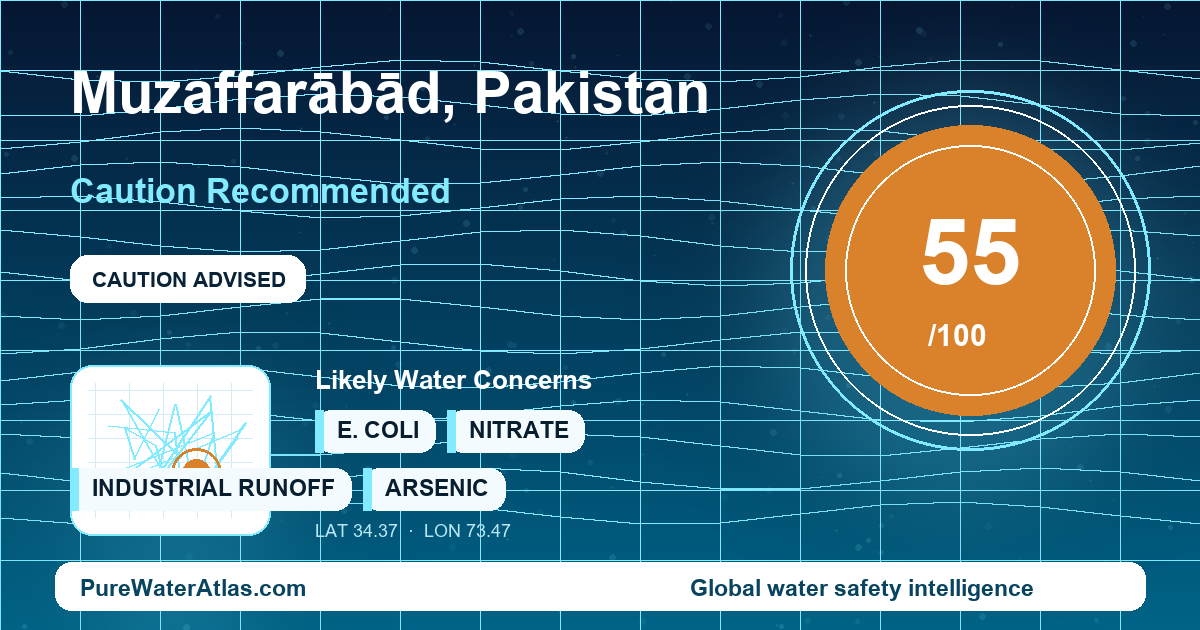
Muzaffarābād’s tap water should be treated as a caution-level supply: the city’s Neelum-Jhelum river setting, steep terrain, storm runoff, landslide exposure, intermittent distribution, and household storage tanks can create microbial risk at the tap.
Quick Answer
| Water safety score | 55 / 100 |
|---|---|
| Risk level | Caution Recommended |
| Can visitors drink the tap water? | Not recommended without treatment. Short-stay travelers should use sealed bottled water from a reputable source, boiled water, or water treated with a reliable purifier capable of microbiological disinfection. |
| Resident advice | Residents should treat household drinking and cooking water, clean and cover storage tanks, and test periodically for E. coli or coliform bacteria, turbidity, residual chlorine, nitrate, and metals where relevant. |
| Main water identity | Surface-water and mountain-catchment influenced supply in a steep Himalayan foothill valley, with river, spring, stream, infiltration, and groundwater components reported depending on the local scheme. |
| Key authority context | Urban water supply and sanitation responsibilities involve the Public Health Engineering Department of the Government of Azad Jammu and Kashmir, local government and Municipal Corporation Muzaffarābād functions, and environmental and health authorities. |
| Filter recommendation | A sediment prefilter plus activated carbon and UV disinfection, or boiling for microbial control, is advisable for municipal drinking water. Private wells, springs, bores, or tanker water should be tested before selecting treatment. |
Verdict: Muzaffarābād tap water should not be assumed safe to drink directly from the tap. The main concern is not only the raw source; it is the combination of surface-water influence, high turbidity after rain or snowmelt, distribution pressure changes, pipe damage, and household storage conditions. Confidence is medium-low for current tap-by-tap safety because routine public neighborhood-level compliance data are limited, but the overall risk profile is well supported by the city’s geography, infrastructure history, and regional WASH context.
Why Muzaffarābād Is Different
Muzaffarābād is the capital of Azad Jammu and Kashmir and sits where the Neelum River joins the Jhelum River. That river-confluence location gives the city abundant mountain water, but it also makes drinking-water safety highly sensitive to the surrounding terrain. The catchment is steep, fast-moving, and vulnerable to monsoon runoff, snowmelt, slope failure, road works, construction disturbance, and flood damage. A clear-looking glass of water on a calm day does not prove that the same tap will be low risk after heavy rain, a landslide, a pipe repair, or a pressure interruption.
The city’s water-safety history is also shaped by the 2005 Kashmir earthquake. Water pipes, tanks, roads, drains, and public buildings were damaged across Muzaffarābād and nearby districts. Reconstruction and rehabilitation improved parts of the system, but rebuilt and older assets can coexist. In practical household terms, this means reliability can vary between service areas, pressure zones, buildings, and storage systems.
Muzaffarābād also has a city-specific river-flow context because of the Neelum-Jhelum Hydropower Project. The project changed the flow regime of the Neelum River through Muzaffarābād, and local concern has focused on source-water conditions and wastewater dilution in the urban river corridor. PureWaterAtlas therefore classifies Muzaffarābād as a caution-recommended city rather than a place where untreated tap water can be broadly endorsed.
Where Does Muzaffarābād’s Tap Water Come From?
Muzaffarābād’s urban drinking-water system is best understood as surface-water and mountain-catchment influenced. Municipal and local water-supply schemes are reported to use a mix of the Neelum-Jhelum river environment, springs, streams, infiltration sources, and groundwater components depending on the service area and scheme. This is not a simple flat-city supply fed by one protected wellfield; it is a mountainous network where source conditions can shift quickly.
Important infrastructure elements include municipal intakes and local schemes, treatment and filtration facilities where sedimentation, filtration, and chlorination are part of the scheme, service reservoirs, pumping stations, distribution mains, and hillside pressure zones. Public reporting on treatment performance is limited, so it is not possible to verify continuous citywide compliance at every consumer tap from accessible public data.
The last-mile system matters greatly in Muzaffarābād. Intermittent pressure, damaged or aging pipes, cross-connections with drains, hillside pipe breaks, and unclean household tanks can allow contamination after water has already left a treatment point. Rooftop tanks, underground storage tanks, and building-level plumbing are therefore part of the actual drinking-water system for many residents, not just accessories.
Who Manages Drinking Water in Muzaffarābād?
Urban water supply and sanitation responsibilities in Muzaffarābād involve the Public Health Engineering Department of the Government of Azad Jammu and Kashmir, local government and Municipal Corporation Muzaffarābād functions, and relevant AJK environmental and health authorities. National technical monitoring and guidance may also involve the Pakistan Council of Research in Water Resources and Pakistan Environmental Protection Agency standards.
Pakistan has National Standards for Drinking Water Quality and national water-quality monitoring programs. However, readily accessible consumer-confidence-style reports for Muzaffarābād are not available in the same routine, neighborhood-by-neighborhood format used in some high-income countries. For health protection, the World Health Organization Guidelines for Drinking-water Quality remain a useful benchmark: treated drinking water should be free from E. coli in any 100 mL sample, disinfection should be effective, and turbidity should be low enough for reliable microbial control.
Main Local Water Concerns
- Microbial contamination: The main practical risk is fecal contamination from leaking distribution lines, cross-connections with drains, sanitation pressure, and contaminated household storage. See the PureWaterAtlas guide to E. coli in drinking water for why any confirmed E. coli result is a serious warning.
- Turbidity and sediment: Monsoon rain, snowmelt, slope failure, road works, river disturbance, and high flows can raise suspended sediment. High turbidity can interfere with disinfection and may indicate increased microbial risk. Read more on turbidity and sediment in drinking water.
- Variable chlorine residual: Chlorination may be reduced by long distribution distances, intermittent supply, storage tanks, or high organic load. Low or absent residual chlorine at the tap is a warning sign when municipal chlorination is relied on. See chlorine in drinking water.
- Earthquake and landslide vulnerability: Pipelines, service reservoirs, and hillside water infrastructure can be affected by slope movement, major storms, earthquakes, pipe breaks, and road cuts.
- Neelum-Jhelum flow and wastewater dilution: Reduced river flow and urban discharge pressures are local concerns associated with the changed Neelum River flow regime through Muzaffarābād.
- Nitrate in private sources: Shallow wells, springs, and private sources near septic systems, drains, livestock, or cultivated land may require nitrate testing. See nitrate in drinking water.
- Metals from building plumbing: Older internal plumbing, brass fixtures, solder, galvanized lines, or stagnant water can contribute lead or other metals even when the municipal source is not the primary metal source. See lead in drinking water.
For Travelers
Visitors to Muzaffarābād should not treat untreated tap water as a low-risk drinking choice. Use sealed bottled water from a reputable brand, boiled water, or water treated with a purifier capable of microbiological disinfection. Check bottle caps and seals, especially when buying from small shops or during road travel.
Use bottled, boiled, or properly filtered and disinfected water for brushing teeth. This is especially important for children, pregnant travelers, immunocompromised people, and anyone with a sensitive stomach. Tap water may be acceptable for bathing and handwashing, but it should not be assumed safe for drinking in guesthouses, rented homes, or buildings where storage tank condition is unknown.
Avoid ice unless you know it was made from treated water. In small restaurants, roadside vendors, guesthouses, and wedding halls, assume ice may have been made from ordinary tap or stored water. Higher-end hotels may use filtration or bottled water, but do not assume this without asking. Be cautious with raw salads, chutneys, cut fruit, and drinks mixed with local ice.
For trekking, road travel, or stays outside the central city, carry bottled water or use a combined treatment approach: prefilter cloudy water for sediment, then boil, use UV, chlorine dioxide, or a purifier rated for bacteria and protozoa. Boiling is a practical emergency method for microbial risk; the PureWaterAtlas boiling water purification guide explains how it works. Remember that boiling does not remove metals, nitrate, salts, or chemical contaminants. UV is another option when water is clear enough; see the UV water purification guide.
For Residents
Residents should use a household treatment barrier for drinking and cooking water. For municipal water, a sediment prefilter plus activated carbon and UV disinfection can address common turbidity, taste, chlorine, and microbial concerns if the system is maintained correctly. Boiling is also useful for emergency microbial protection after storms, pipe breaks, floods, sewage backups, supply interruptions, or official advisories.
If your home uses a private bore, spring, tanker, shallow well, or mixed source, choose treatment after laboratory testing rather than by taste or appearance. Test at least annually for E. coli or thermotolerant coliforms, and retest after floods, landslides, pipe repairs, tank cleaning, sewage backups, or long interruptions. Where municipal chlorination is relied on, measure turbidity and residual chlorine at the tap.
Private wells and springs should be tested for nitrate, electrical conductivity, total dissolved solids, hardness, pH, iron, manganese, and arsenic where laboratory access allows. Older homes, schools, clinics, guesthouses, and buildings with old metal plumbing should test first-draw and flushed samples for lead and other metals. For more detail, see PureWaterAtlas resources on lead testing methods and nitrate testing methods.
Storage tanks are a major control point in Muzaffarābād. Rooftop and underground tanks should be covered, sealed from insects and rodents, protected from drain backflow, and cleaned and disinfected on a schedule. If water smells, looks cloudy, or the tank has sediment, algae, insects, or loose covers, treat the water as unsafe until the tank is cleaned and disinfected.
Relevant Contaminants and Water-Quality Issues
The most relevant Muzaffarābād drinking-water issues are microbial safety, turbidity, sediment, chlorine residual, nitrate in private sources, and metals from older plumbing. Start with E. coli and turbidity because they are directly connected to fecal contamination risk and treatment reliability. Add sediment where water turns cloudy after storms or repairs. Review chlorine if your household depends on municipal disinfection. For private wells, springs, or shallow sources, include nitrate. For older buildings, include lead and other metals testing.
For broader background, see Drinking Water Safety: How to Know If Your Tap Water Is Safe to Drink, Water Microbiology, and Water Purification Methods.
How to Verify Your Water Quality
Because Muzaffarābād does not have readily accessible continuous public tap-by-tap compliance data, verification should be local and practical. Test the water you actually drink: after your building storage tank, at the kitchen tap, and after any home filter if used. For microbiology, use sterile bottles and submit samples promptly to a recognized laboratory where possible, such as government public-health, PCRWR-linked, university, or certified private laboratories.
A basic Muzaffarābād household panel should include E. coli or thermotolerant coliforms, turbidity, residual chlorine if municipal water is chlorinated, pH, electrical conductivity, and total dissolved solids. Add nitrate for private wells, springs, bores, or mixed sources. Add lead and metals for older buildings or long-stagnation plumbing. The PureWaterAtlas complete guide to water testing explains how to plan a sampling strategy. You can also compare regional risk using the Global Water Safety Checker and research specific pollutants in the PureWaterAtlas Contaminants Search Engine.
Official and Technical Sources
- World Health Organization: Guidelines for Drinking-water Quality — global benchmark for microbial safety, turbidity control, disinfection, and risk management.
- Pakistan Council of Research in Water Resources — Pakistan’s key federal research and monitoring body for drinking-water quality context and methods.
- Pakistan Environmental Protection Agency: National Standards for Drinking Water Quality — national regulatory reference point for drinking-water quality standards in Pakistan.
- Government of Azad Jammu and Kashmir — official AJK portal for public-service, local government, public health engineering, and environmental context.
- WAPDA: Neelum-Jhelum Hydropower Project — relevant to Muzaffarābād’s Neelum River flow and source-water context.
- Asian Development Bank: Pakistan Earthquake Emergency Assistance Project — documents post-2005 earthquake reconstruction context relevant to water-supply and sanitation rehabilitation.
- UNICEF Pakistan: Water, Sanitation and Hygiene — public-health context for WASH risks, household water safety, sanitation, and vulnerable populations.
- CDC Pakistan Traveler View — traveler-focused health guidance supporting caution with food and waterborne disease risks in Pakistan.
Bottom Line
Muzaffarābād’s tap water deserves a caution recommendation. The city’s Neelum-Jhelum confluence setting provides mountain water, but also exposes the supply to turbidity spikes, monsoon runoff, landslides, flood damage, wastewater pressures, and infrastructure vulnerability. The biggest practical risks are microbial contamination, variable chlorine residual, intermittent pressure, pipe damage, and unclean household storage tanks. Visitors should drink sealed bottled water or properly treated water and avoid local ice unless the source is known. Residents should treat drinking and cooking water, keep tanks sealed and disinfected, and test periodically for E. coli, turbidity, chlorine residual, nitrate, and metals where relevant. Because current public tap-by-tap compliance data are limited, no blanket safety claim should be made for every Muzaffarābād tap.
Read the full guide: Global Water Quality Guide
Explore more in this category: Global Water Quality Articles