
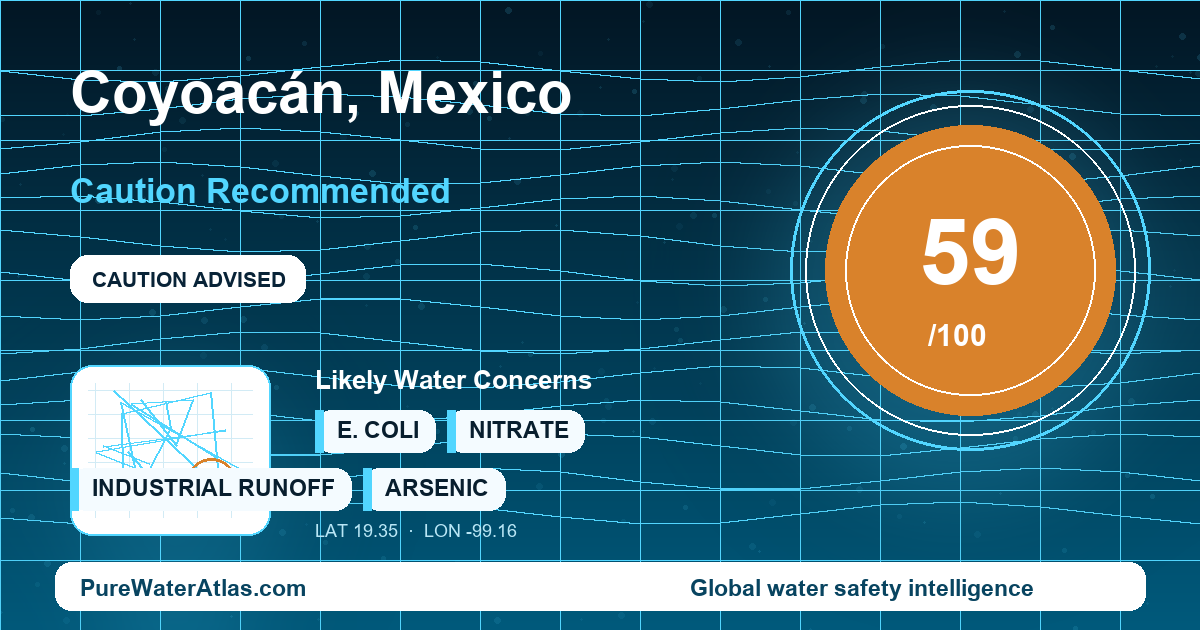
Coyoacán is served by Mexico City’s integrated SACMEX water system, where the practical safety question depends heavily on pressure conditions, building plumbing, cisterns, rooftop tinacos, and point-of-use treatment.
Quick Answer
| Overall safety status | Caution recommended. PureWaterAtlas score: 59/100. Coyoacán does not operate a separate municipal drinking water system; it is supplied through Mexico City’s broader network. |
|---|---|
| Can visitors drink the tap water? | Not recommended for routine drinking without treatment. Visitors should use sealed bottled water, hotel-provided purified water, garrafón water, or water treated with a reliable purifier. |
| Resident recommendation | Residents should not judge safety by clarity alone. A maintained point-of-use filter or purifier is prudent, especially in older buildings or homes using cisterns and rooftop tinacos. |
| Main water sources | A changing blend of Valley of Mexico groundwater and imported water from the Cutzamala and Lerma systems, distributed through Mexico City’s SACMEX network. |
| Water authority | Sistema de Aguas de la Ciudad de México, commonly known as SACMEX. |
| Filter recommendation | For regular drinking, use sediment prefiltration plus activated carbon, and consider reverse osmosis or another certified system if testing shows dissolved contaminants such as metals, arsenic, nitrate, high dissolved solids, or other chemistry concerns. |
Confidence level: Medium. The Mexico City water supply system and regulatory framework are well documented, but public, current, Coyoacán-specific point-of-tap results by colonia and building are limited.
Why Coyoacán Is Different
Coyoacán is a south-central alcaldía of Mexico City, not a stand-alone city with its own separate water utility. That matters because water safety in Coyoacán must be interpreted through two layers: the larger Mexico City water supply system and the specific building where the water is actually consumed. The main concern is not a single proven contaminant unique to Coyoacán. The more realistic risk is the combination of mixed source water, aging distribution infrastructure, intermittent pressure, local storage, and limited public point-of-tap data at the colonia or building level.
This is especially important in Coyoacán because the alcaldía contains older historic areas as well as dense modern residential zones. Two apartments on the same street can have different practical water safety. One may receive water with adequate pressure and limited storage time; another may rely on a cistern or rooftop tinaco where water sits, loses disinfectant residual, accumulates sediment, or is exposed through poor maintenance. For renters, travelers, and residents, the better question is not only “does the tap run?” but “is the drinking water filtered, purified, or supplied from sealed garrafón?”
Mexico City’s long history of groundwater extraction, subsidence, leaks, and dependence on imported water also shapes Coyoacán’s risk profile. Over-extraction from the Valley of Mexico aquifer system has contributed to land subsidence and pipe stress across the metropolitan system. Those system-level pressures can affect distribution reliability, pressure management, repairs, and final-mile water quality.
Where Does Coyoacán’s Tap Water Come From?
Coyoacán receives drinking water as part of Mexico City’s integrated supply operated by SACMEX. The broader system uses a blend of groundwater from the Valley of Mexico aquifer system and imported water from the Cutzamala and Lerma systems. The exact blend at a specific Coyoacán tap can change with pressure zones, maintenance, seasonal availability, operational decisions, and local storage conditions.
The main infrastructure relevant to Coyoacán includes SACMEX primary and secondary distribution networks serving Mexico City alcaldías, groundwater wells and wellfields in the Valley of Mexico supply system, imported surface-water infrastructure from the Cutzamala System, and the historically important Lerma System. The Comisión Nacional del Agua overview of the Sistema Cutzamala provides official context for one of the major imported supply systems used by the Mexico City metropolitan area.
For household safety, however, the water’s journey does not stop at the municipal network. Local pumping stations, pressure sectors, neighborhood storage, building cisterns, rooftop tinacos, and internal plumbing can all affect final tap quality. In Coyoacán, this final-mile infrastructure is often the difference between centrally treated water that remains acceptable and water that becomes more vulnerable to sediment, microbial regrowth, or loss of disinfectant residual before use.
Who Manages Drinking Water in Coyoacán?
The main operating authority is Sistema de Aguas de la Ciudad de México, or SACMEX. Coyoacán is an alcaldía within Mexico City, so it does not function as an independent drinking water utility. SACMEX handles water supply and drainage operations for Mexico City, including service areas such as Coyoacán.
Drinking water quality in Mexico is governed by federal health standards, especially NOM-127-SSA1-2021, Agua para uso y consumo humano. National water resources and concessions are regulated by CONAGUA, whose official water information can be accessed through the Sistema Nacional de Información del Agua. Health oversight involves authorities including Secretaría de Salud and COFEPRIS.
The practical limitation for Coyoacán users is that official and technical information is usually reported at the Mexico City system, aquifer, or infrastructure level rather than as complete, current, public point-of-use results for every Coyoacán colonia, hotel, restaurant, apartment building, cistern, and rooftop tank. That is why this guide uses a cautious system-level interpretation and recommends building-specific verification.
Main Local Water Concerns
The most important Coyoacán-specific concern is not necessarily the water leaving a treatment or distribution entry point; it is what happens before the water reaches the glass. Intermittent service or low pressure in parts of Mexico City can increase vulnerability to intrusion through leaks or aging pipes. Pressure changes and repairs can disturb sediment, causing cloudy, brown, or discolored water at the tap.
Cisterns and rooftop tinacos are common in Mexico City buildings and are highly relevant in Coyoacán homes, rental apartments, and small lodging properties. If a tank is dirty, uncovered, poorly screened, or not disinfected, it can become a contamination point. Stored water may also lose disinfectant residual over time, making microbial regrowth more plausible even if the incoming municipal supply was treated.
Older building plumbing can contribute rust, scale, sediment, or metals independent of the municipal water source. Coyoacán includes older housing and historic structures where internal pipes, fixtures, solder, or corroded galvanized plumbing may affect water quality. This does not justify a blanket contaminant claim for every Coyoacán home, but it does justify point-of-use testing when water is rusty, metallic-tasting, cloudy, or has changed after plumbing work.
Seasonal and operational conditions can also matter. Dry-season shortages and reduced Cutzamala storage can lead to operational changes, pressure reductions, or more reliance on alternative supply zones. Rainy-season storms can increase turbidity in surface-water systems and can also disturb local distribution through flooding, repairs, and drainage problems. During announced maintenance, pipe breaks, or intermittent supply, residents should flush taps, avoid visibly dirty water, and treat water before drinking.
For Travelers
Visitors to Coyoacán should generally avoid drinking unfiltered tap water. Use sealed bottled water, purified water supplied by a hotel, sealed garrafón water, or water treated with a reliable filter or purifier. This advice is consistent with the cautious approach used for Mexico travel health guidance, including the CDC Mexico Traveler View, which supports caution around untreated water and unsafe ice.
For brushing teeth, many healthy adults consider tap water a lower-risk exposure than drinking a full glass. However, cautious travelers, children, pregnant travelers, and immunocompromised people should use bottled or purified water for brushing teeth in Coyoacán. This is especially sensible in private rentals or older buildings where cistern and tinaco maintenance is unknown.
Ice in established hotels, cafés, and restaurants in Coyoacán is commonly made from purified water or purchased commercially, but travelers should not assume that for informal stalls, private rentals, or any place where the water source is unclear. If in doubt, skip the ice.
When staying in Coyoacán, ask direct questions: Is the drinking water filtered? Is it from sealed garrafón? Is the ice made from purified water? Does the apartment use a cistern or rooftop tinaco? Carry bottled water or refill a travel bottle only from a verified purified source. Do not drink water that is brown, cloudy, sewage-smelling, or appears immediately after a supply outage until it has been flushed and treated.
For Residents
Residents in Coyoacán should use a practical, building-specific approach. A home filter or purifier is advisable for regular drinking water, particularly in older buildings, rental apartments, homes with cisterns or tinacos, and households with infants, pregnant people, older adults, or immunocompromised residents. A sensible baseline setup is sediment prefiltration plus activated carbon to reduce particles, improve taste, and address chlorine-related issues. If testing identifies dissolved contaminants of concern, reverse osmosis or another certified treatment technology may be appropriate.
Testing should be performed at the point of use, not inferred from citywide averages. Prioritize total coliform and E. coli if the building uses a cistern or rooftop tank, has experienced outages, has flooded, or has had pressure disruptions. Check free residual chlorine after water has passed through building storage; low or absent residual can indicate higher microbial vulnerability. In older buildings or homes with rusty, metallic-tasting, or sediment-heavy water, test for lead, copper, iron, and manganese.
Additional chemistry testing may be appropriate for arsenic, fluoride, nitrate, hardness, conductivity, and total dissolved solids when a private well source is involved, local authorities recommend it, or household members are medically vulnerable. Any claim about arsenic, fluoride, manganese, salinity, or other geogenic contaminants at a specific Coyoacán tap should be verified with testing rather than assumed from regional context.
Cisterns and rooftop tinacos should be covered, screened, cleaned, and disinfected on a regular schedule. After cleaning, plumbing work, outages, or pipe breaks, flush taps and verify odor, clarity, and disinfectant residual before using the water for drinking. First-draw and flushed samples can help distinguish building-plumbing contamination from incoming supply.
Relevant Contaminants and Water-Quality Issues
Several PureWaterAtlas contaminant profiles are especially relevant to Coyoacán’s practical risk pattern. Chlorine in drinking water matters because Mexico City distribution depends on disinfectant residual, while stored water in cisterns or tinacos may lose that protection. Turbidity and sediment are relevant after repairs, pressure changes, tank disturbance, or rainy-season operational stress.
For microbial safety, residents should understand E. coli in drinking water, especially after low-pressure events, flooding, storage-tank problems, or suspected intrusion. In older buildings, lead may be a plumbing-related concern that requires testing rather than assumptions. Arsenic is relevant as a dissolved contaminant to screen for in broader groundwater-related contexts, but a household claim in Coyoacán should be based on actual point-of-use results.
How to Verify Your Water Quality
The safest approach in Coyoacán is to verify water at the tap you actually use. PureWaterAtlas recommends starting with the complete guide to water testing and analysis, then choosing tests based on building conditions: microbiological indicators for cisterns and tinacos, residual chlorine for stored water, and metals for older plumbing.
If microbial risk is suspected, the boiling water purification guide explains emergency treatment, while the UV water purification guide explains another option for microbial control when used appropriately after filtration. For older buildings, review lead testing and detection methods and, if testing confirms a problem, lead filter and treatment options. For dissolved groundwater-related screening, see arsenic testing methods.
Users can also research suspected issues through the PureWaterAtlas Contaminants Search Engine and compare Coyoacán with other destinations using the Global Water Quality Checker. For broader decision-making, see the PureWaterAtlas guides to drinking water safety, water microbiology, and water treatment systems.
Official and Technical Sources
- Sistema de Aguas de la Ciudad de México — primary local water authority for Mexico City, including Coyoacán.
- Sistema Cutzamala, CONAGUA — official context for imported surface-water infrastructure supplying the Mexico City metropolitan area.
- Sistema Nacional de Información del Agua — national official water information portal.
- CONAGUA aquifer document for the Zona Metropolitana de la Ciudad de México — relevant to groundwater dependence and over-extraction context.
- NOM-127-SSA1-2021 — federal Mexican drinking water standard for human use and consumption.
- COFEPRIS — federal health protection authority relevant to sanitary risk oversight.
- CDC Mexico Traveler View — traveler health guidance supporting caution with untreated tap water and unsafe ice.
- Portal de Datos Abiertos de la Ciudad de México — official open data portal where Mexico City service and infrastructure datasets may be published.
Bottom Line
Coyoacán’s tap water deserves caution, not panic. The alcaldía is supplied through Mexico City’s SACMEX system using a variable blend of Valley of Mexico groundwater and imported Cutzamala and Lerma water. The main practical risks are final-mile conditions: intermittent pressure, aging pipes, sediment disturbance, old internal plumbing, cisterns, and rooftop tinacos. Visitors should avoid routine drinking of untreated tap water and use bottled, purified, garrafón, or reliably treated water. Residents should maintain storage tanks, use an appropriate point-of-use filter or purifier, and test at the tap for microbiological indicators, chlorine residual, metals, and relevant chemistry when conditions warrant. Public data do not support precise safety claims for every Coyoacán colonia or building.
Read the full guide: Global Water Quality Guide
Explore more in this category: Global Water Quality Articles