
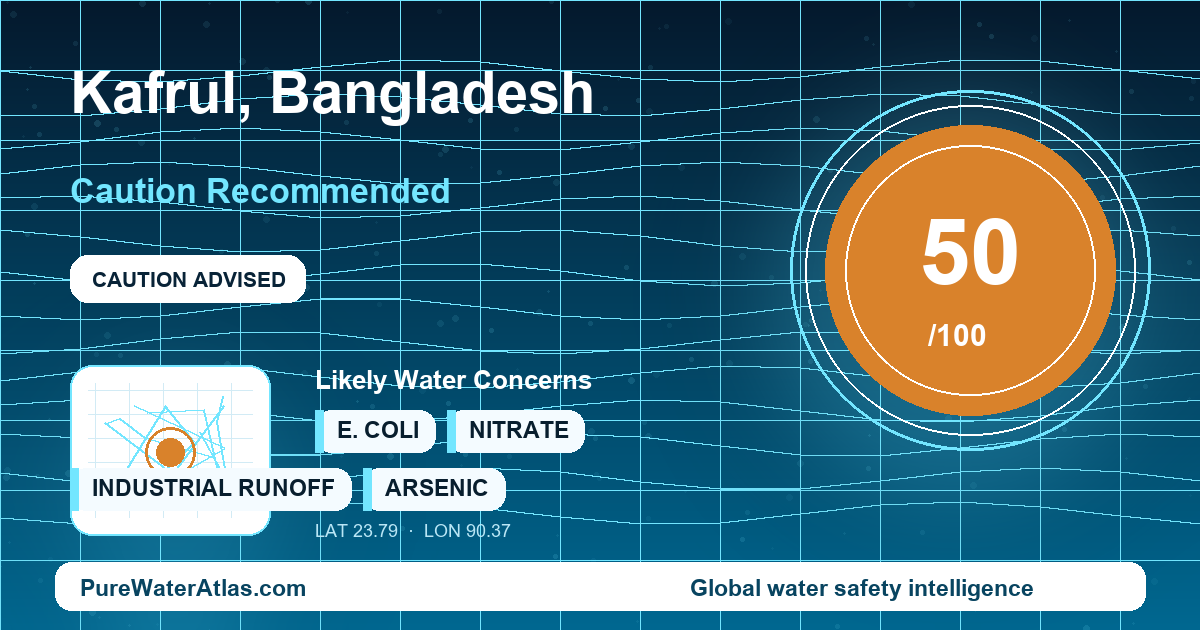
Kafrul, Bangladesh: Dhaka WASA municipal supply with household-level caution due to distribution, storage tank, plumbing, and seasonal contamination risks.
Quick Answer
| Water safety score | 50 / 100 |
|---|---|
| Risk level | Caution Recommended |
| Can you drink tap water directly in Kafrul? | Not recommended. Untreated tap water should be treated before drinking, especially for travelers and sensitive residents. |
| Traveler advice | Use sealed bottled water, boiled water, or water treated by a reliable purifier. Avoid uncertain ice and do not judge safety by clarity or taste. |
| Resident advice | Treat water at the point of use unless recent test results from the actual drinking tap and building storage system show it is safe. |
| Main water source context | Kafrul is supplied within the Dhaka WASA metropolitan system, historically groundwater-heavy and increasingly supported by treated surface-water projects. |
| Water authority | Dhaka Water Supply and Sewerage Authority, commonly Dhaka WASA. |
| Filter recommendation | Sediment prefiltration plus boiling, UV, or a maintained purifier for microbial safety; add targeted treatment such as reverse osmosis only where testing shows dissolved contaminants. |
Overall verdict: Caution is recommended in Kafrul. Treated municipal water exists, but final tap safety can be affected by leaky distribution pipes, intermittent or fluctuating pressure, underground reservoirs, rooftop tanks, internal building plumbing, and seasonal flooding or turbidity events. Publicly available Kafrul-specific tap sampling data is limited, so the safest practical approach is to treat and test water at the household level.
Why Kafrul Is Different
Kafrul is not a separate municipality with its own independent drinking-water utility. It is an urban thana of Dhaka in the Dhaka North City Corporation area, near Mirpur, Shewrapara, Ibrahimpur, and cantonment-adjacent urban zones. That matters because Kafrul’s water safety should be evaluated as part of the wider Dhaka WASA system rather than as a stand-alone city water system.
The key local issue in Kafrul is the final delivery chain. A household may receive water that originated in a municipal supply network, but the water reaching the kitchen tap can be altered by aging or leaking distribution lines, low-pressure episodes, illegal or poorly sealed connections, underground building reservoirs, rooftop tanks, booster pumps, and internal plumbing. In dense apartment and mixed-use areas, two nearby buildings can have very different tap-water risk profiles if one has a clean, sealed, regularly maintained tank and another has a dirty underground reservoir or corroded pipework.
This is why PureWaterAtlas rates Kafrul as Caution Recommended rather than clearly safe or clearly unsafe. The risk is not simply “does Dhaka have municipal treatment?” The more practical question is whether treated water remains protected through the neighborhood distribution system and the building’s own storage and plumbing before it is consumed.
Where Does Kafrul’s Tap Water Come From?
Kafrul is served within the Dhaka WASA metropolitan supply network. Dhaka’s municipal water supply has historically depended heavily on groundwater from deep production tube wells. Long-term groundwater abstraction inside and around Dhaka has contributed to documented groundwater-level decline, which is one reason Dhaka WASA and development partners have pushed toward larger treated surface-water projects.
Major surface-water components for Dhaka include the Saidabad Water Treatment Plant system, which uses river water from the Shitalakhya system; the Padma Jashaldia Water Treatment Plant and transmission infrastructure, intended to bring Padma River water toward Dhaka and reduce dependence on stressed groundwater; and older treatment capacity such as Chandnighat. Kafrul, as part of the Mirpur and north Dhaka urban context, should be understood as receiving water within this combined metropolitan system rather than from a Kafrul-only raw-water source.
Important infrastructure affecting Kafrul users includes Dhaka WASA distribution lines, deep production tube wells and local pump infrastructure, major surface-water treatment assets, and the building-level systems that many residents interact with most directly: underground reservoirs, rooftop tanks, booster pumps, and internal pipes. These building systems can be final barriers when well maintained, or failure points when poorly sealed, uncleaned, or exposed to floodwater and pests.
Who Manages Drinking Water in Kafrul?
Drinking water in Kafrul falls under the Dhaka metropolitan service context managed by Dhaka Water Supply and Sewerage Authority. Dhaka WASA is the municipal water and sewerage utility responsible for water supply in Dhaka. Kafrul does not have a separate named Kafrul water utility.
Dhaka WASA operates under Bangladesh’s WASA institutional framework and the Government of Bangladesh local government sector. Drinking-water quality expectations are shaped by Bangladesh national standards and public-health guidance, alongside international drinking-water principles such as those in the WHO Guidelines for Drinking-water Quality. However, neighborhood-level enforcement and tap-level surveillance data are not consistently published for Kafrul.
This data limitation is important. Official and development-agency sources document the identity of the utility, Dhaka’s source-water transition, and major infrastructure investments, but publicly accessible, recent, Kafrul-thana-specific compliance datasets were not found in the reviewed sources. Therefore, this profile does not claim that every Kafrul tap is safe or unsafe. It focuses on the documented Dhaka system context and the local risk factors most relevant to households.
Main Local Water Concerns
The main local concerns in Kafrul are practical distribution and premise-plumbing risks rather than a proven Kafrul-only contaminant pattern. The most important issue is microbial contamination risk from water entering compromised pipes or storage systems, especially where pressure is intermittent or tanks are not properly sealed and cleaned. If residual disinfectant declines during long distribution or inside household tanks, microbial regrowth becomes more plausible.
Turbidity and sediment can also matter. Cloudy water, visible particles, or sudden sediment may occur when pipes are disturbed, after repairs, during pressure changes, or when storage tanks accumulate deposits. Turbidity is not only an aesthetic issue; high turbidity can reduce the effectiveness of disinfection and may indicate that the building storage system needs attention.
Groundwater-related aesthetic and chemical concerns in Dhaka can include iron and manganese staining or taste in some supplies, but Kafrul-specific concentrations should not be assumed without testing. Arsenic is a Bangladesh-wide groundwater concern, but Dhaka municipal deep groundwater is not the same risk profile as rural shallow tubewells. Any household using a private well or building-managed groundwater source should test rather than rely on assumptions.
Lead is best treated as a premise-plumbing concern in Kafrul. There is not enough public evidence to claim a Kafrul-wide lead problem, but old fittings, solder, brass components, stagnant water, and older internal pipes can raise building-specific risk. Seasonal conditions add another layer: monsoon flooding and waterlogging in Dhaka can increase the chance of dirty water entering compromised lines or poorly protected underground reservoirs, while hot weather can accelerate microbial regrowth in rooftop tanks when disinfectant residual is low.
For Travelers
Short-term visitors should not drink untreated tap water in Kafrul. Use sealed bottled water, properly boiled water, or water treated by a reliable purifier. This is especially important because travelers may not have local immunity and may be more vulnerable to gastrointestinal illness from water that residents tolerate or routinely treat.
Use bottled, boiled, or properly filtered water for brushing teeth if you are visiting Kafrul, and be especially cautious if you are immunocompromised, pregnant, traveling with children, or prone to stomach illness. Tap water may be acceptable for bathing, but avoid swallowing it.
Avoid ice unless you know it was made from treated safe water. In small eateries, street stalls, informal shops, or places where water handling is uncertain, assume ice may have been made from ordinary tap or stored water. Higher-end hotels and restaurants may use filtration or commercial bottled water, but it is still sensible to ask. Prefer sealed bottles opened in front of you and hot tea or coffee made with boiled water. The CDC’s Bangladesh traveler health guidance supports a conservative approach to safe beverages and uncertain water or ice.
For emergencies, boiling is a reliable microbial safety step when done properly. PureWaterAtlas has a detailed guide to boiling water purification for travelers and households.
For Residents
For most Kafrul residents, point-of-use treatment is advisable unless the household has recent reliable results from the actual drinking tap and building storage system. A practical setup is sediment prefiltration to reduce visible particles, activated carbon where taste or odor control is needed, and a microbial barrier such as boiling, UV, or a maintained purifier. For homes considering UV, see the PureWaterAtlas UV water purification guide.
Reverse osmosis can be considered where testing shows dissolved contaminants such as arsenic, nitrate, salinity, or metals, but it should not be installed blindly as a substitute for testing and maintenance. Poorly maintained treatment systems can create their own risks. Filter cartridges, UV lamps, storage tanks, and purifier housings must be serviced on schedule.
Testing should be done from the actual drinking tap, not only from the building pump or street connection, because storage tanks and internal plumbing can change water quality. At minimum, Kafrul households should consider testing for E. coli or thermotolerant coliforms, total coliforms, turbidity, pH, electrical conductivity or TDS, residual chlorine, iron, manganese, and arsenic if groundwater or a private tube well is involved. If infants, pregnant people, kidney patients, or immunocompromised residents live in the home, include nitrate and consider a broader laboratory panel.
Older Kafrul buildings may have corroded pipes, dead-end plumbing, old valves, brass fittings, or poorly maintained internal lines. Let stagnant water run briefly before collecting drinking water, avoid using hot tap water for cooking, and test first-draw and flushed samples for lead if plumbing age is unknown. Underground reservoirs and rooftop tanks are major control points: they should be covered, screened against pests, cleaned on a schedule, protected from floodwater entry, and inspected for cracks, sludge, and cross-connections.
Relevant Contaminants and Water-Quality Issues
The most relevant health indicator for Kafrul household taps and storage tanks is E. coli, because it indicates fecal contamination and potential microbial risk. Turbidity and sediment are also important because cloudy or particle-laden water may point to pipe disturbance, tank deposits, or reduced disinfection performance.
Chlorine matters because residual chlorine helps protect distributed water against microbial regrowth. If chlorine residual is depleted before water reaches a household tap or after water sits in a rooftop tank, microbial risk can increase.
For households using private groundwater, building-managed tube wells, or uncertain sources, Bangladesh groundwater awareness makes arsenic testing important. PureWaterAtlas also provides a focused guide to arsenic testing and detection methods. Iron and manganese can be relevant where groundwater chemistry affects taste, color, or staining. Lead is most relevant to old building plumbing and stagnant premise water; older buildings can use the PureWaterAtlas guide to lead testing and detection methods.
How to Verify Your Water Quality
The only reliable way to know whether a specific Kafrul tap is safe is to test that tap and understand the building’s storage system. Start with the PureWaterAtlas guide to water testing, then compare your results with relevant contaminant profiles in the Contaminants Search Engine.
Retest after pipe repairs, tank cleaning, flooding, a change in water source, unusual color or odor, or repeated gastrointestinal illness among residents. If you are comparing Kafrul with other destinations, use the Global Water Quality Checker and the broader PureWaterAtlas guide to global water quality.
For background on how to judge drinking-water safety, see Drinking Water Safety, Water Microbiology, and Water Treatment Systems. These resources are especially useful in Kafrul because the household tank and plumbing chain can be as important as the municipal source.
Official and Technical Sources
- Dhaka Water Supply and Sewerage Authority official website — identifies Dhaka WASA as the responsible water supply and sewerage utility for Dhaka.
- Dhaka WASA Annual Report and publications — source mix, production, service-zone, and infrastructure context.
- World Bank: Bangladesh Dhaka Water Supply and Sanitation Project — documents major Dhaka water-supply and sanitation improvement work.
- Asian Development Bank: Dhaka Environmentally Sustainable Water Supply Project — documents Dhaka’s shift toward treated surface water and the Padma Jashaldia system.
- World Bank: Securing water for Dhaka’s future — explains Dhaka groundwater depletion pressure and the need for sustainable surface-water sources.
- UNICEF Bangladesh: Water, sanitation and hygiene — Bangladesh public-health context for safe water, sanitation, hygiene, and contamination risk.
- CDC Travelers’ Health: Bangladesh — supports conservative traveler advice on safe beverages and untreated water.
- WHO Guidelines for Drinking-water Quality — international technical basis for microbial risk management, disinfection, turbidity, and health-based drinking-water principles.
- Bangladesh Bureau of Statistics — supports administrative identification of Kafrul as a Dhaka urban thana.
Bottom Line
Kafrul’s tap water should be treated with caution. The area is served within the Dhaka WASA metropolitan system, not by a separate Kafrul utility, and Dhaka has major municipal water infrastructure. However, public Kafrul-specific tap compliance data is limited, and final drinking-water quality can change inside local distribution lines, underground reservoirs, rooftop tanks, booster pumps, and building plumbing. Travelers should avoid untreated tap water and use sealed bottled, boiled, or reliably purified water. Residents should test the actual drinking tap, maintain storage tanks, and use point-of-use treatment unless recent results confirm safety. In Kafrul, the condition of the building’s water system may be the difference between acceptable and unsafe tap water.
Read the full guide: Global Water Quality Guide
Explore more in this category: Global Water Quality Articles