The best water testing kits are not always the most expensive kits, the kits with the longest contaminant list, or the kits with the most dramatic marketing claims. A good water test is one that answers the right question with enough accuracy to support a safe decision. For a household, that may mean confirming whether a private well has coliform bacteria after heavy rain. For a renter, it may mean checking whether old plumbing is contributing lead. For a small facility, it may mean tracking disinfectant residual, pH, or nitrate between formal laboratory tests.
Water testing sits between science and practical risk management. No single kit can prove that water is completely safe under all conditions. Drinking water safety depends on the water source, treatment, distribution plumbing, storage, seasonal changes, and the people drinking it. Infants, pregnant people, older adults, and immunocompromised individuals may need a more cautious testing strategy than a healthy adult using municipally treated water.
This complete guide explains how to choose among the best water testing kits, what different tests actually measure, where at-home kits are useful, and when a certified laboratory is the better choice. It also explains common pitfalls: confusing total dissolved solids with safety, assuming clear water is clean, relying on a single test strip for complex contaminants, or buying a broad panel that misses the contaminant of concern. For a deeper foundation on sampling, parameters, and interpretation, see the PureWaterAtlas Water Testing Guide.
What Makes a Water Testing Kit Good?
A water testing kit is only as useful as the quality of its method, the clarity of its instructions, and the relevance of the contaminants it measures. The best water testing kits share several features: they specify detection limits, describe sample collection steps clearly, include expiration dates, explain interferences, and provide results in units that can be compared with health-based guidelines or regulatory limits.
A basic chlorine test strip may be excellent for monitoring a carbon filter or checking swimming pool-style disinfectant residual in emergency storage water, but it is not a complete drinking water safety test. A laboratory kit for metals and volatile organic compounds may be very useful for a home near an industrial site, but it will not necessarily detect microbial contamination unless a bacteria test is included. A handheld total dissolved solids meter may help track reverse osmosis membrane performance, but it cannot identify arsenic, lead, pesticides, bacteria, or PFAS.
Scientific quality also depends on whether the method is qualitative, semi-quantitative, or quantitative. A qualitative test may say present or absent. A semi-quantitative test may estimate a concentration range by color comparison. A quantitative laboratory test provides a numeric concentration using validated instrumentation. Each has a role, but they should not be treated as equivalent.
The strongest kits also make uncertainty visible. If a nitrate strip changes color near a decision threshold, the correct response is not to guess; it is to repeat the test or send a sample to a certified lab. If a lead screening test is positive, laboratory confirmation is usually appropriate because health decisions, filter selection, and potential landlord or utility discussions require defensible data.
First Decide What You Need to Test For
Many people search for the best water testing kits before defining the risk. That leads to mismatched testing. The correct starting point is not the kit; it is the water situation.
Municipal tap water is usually disinfected and monitored under regulatory programs, but it can still be affected by distribution system problems, aging service lines, building plumbing, disinfection byproducts, or short-term disruptions. Private well water is usually the responsibility of the owner and can be vulnerable to bacteria, nitrate, arsenic, manganese, hardness, corrosivity, fuel spills, pesticides, or local geology. Rainwater, spring water, cistern water, emergency stored water, and untreated surface water each require different testing priorities.
The U.S. Environmental Protection Agency provides drinking water information for regulated public systems, while the World Health Organization emphasizes that safe drinking water is a foundation for public health. For local context, PureWaterAtlas also tracks regional concerns through Global Water Quality.
Use the following risk questions before buying a kit:
- What is the source? Municipal supply, private well, spring, rainwater, bottled water, or emergency storage?
- What is the immediate concern? Illness, odor, staining, cloudy water, nearby contamination, old pipes, floods, or filter performance?
- Who is drinking it? Infants, pregnant people, elderly residents, dialysis patients, or immunocompromised individuals may require more conservative testing.
- Do you need screening or legal-grade documentation? At-home kits are useful for screening; certified laboratory results are needed for real estate, compliance, health investigations, or formal remediation decisions.
- Are results needed quickly? Bacteria presence may require immediate boil-water precautions, while metals testing may require careful sampling and laboratory analysis.
Types of Water Testing Kits
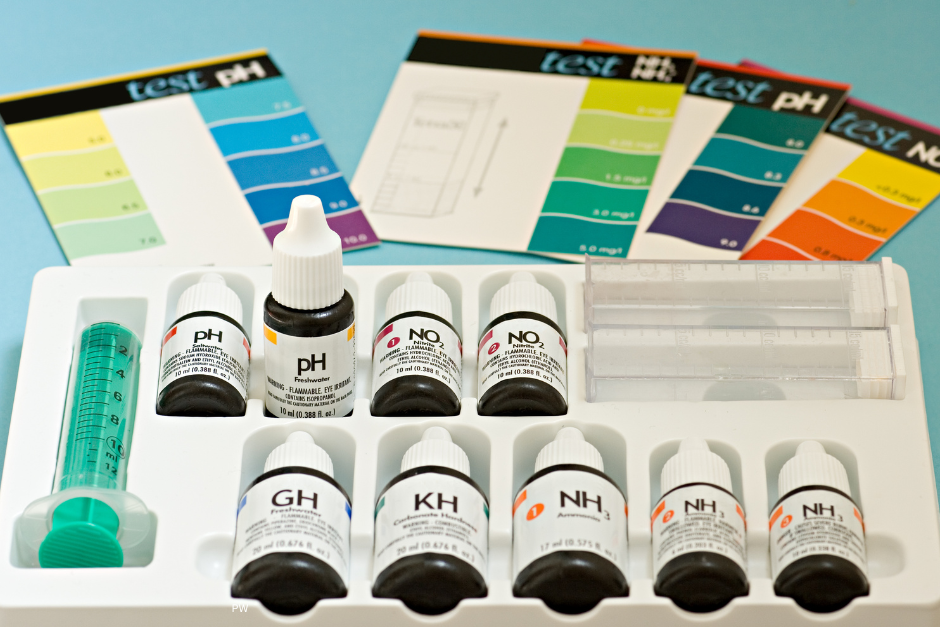
Water testing kits fall into several broad categories. Understanding these categories prevents overconfidence and helps you combine tests wisely.
Test strips
Test strips are inexpensive, fast, and easy to use. They contain reagent pads that change color when exposed to water. They are common for pH, chlorine, hardness, nitrate, nitrite, alkalinity, iron, copper, and sometimes lead or pesticides. Their main advantage is convenience. Their weakness is precision. Lighting, timing, water color, expired strips, and human color perception can affect results. They are best for routine screening, trend monitoring, and deciding whether laboratory testing is warranted.
Color disc and drop-count kits
Color disc kits and drop-count titration kits can be more reliable than basic strips for some parameters. They are often used for chlorine, hardness, alkalinity, pH, and iron. A reagent is added to a measured sample, and the color or number of drops is compared with a scale. These kits are useful for homeowners maintaining treatment systems, small facilities checking residual disinfectant, and field users who need better repeatability than a strip provides.
Digital meters
Digital meters measure parameters such as total dissolved solids, electrical conductivity, pH, oxidation-reduction potential, temperature, and sometimes turbidity. They are not universal contaminant detectors. A TDS meter measures ions that conduct electricity; it does not directly identify contaminants or determine safety. A very low TDS reading from a reverse osmosis system can indicate that the membrane is reducing dissolved ions, but water with low TDS can still contain bacteria or certain organic chemicals. A pH meter requires calibration and electrode care. Poorly maintained meters often produce misleading results.
Bacteria presence-absence tests
Bacteria test kits usually detect total coliform and sometimes Escherichia coli. They may use a treated growth medium that changes color or fluoresces after incubation. These tests are especially relevant for private wells, springs, cisterns, and water after flooding or plumbing repairs. A positive coliform result indicates that the water system may be vulnerable to contamination. E. coli is a stronger indication of fecal contamination and should be treated as urgent. The microbiological side of testing is covered more deeply in PureWaterAtlas Water Microbiology.
Mail-in laboratory kits
Mail-in kits include sample bottles, preservatives when required, instructions, chain-of-custody forms in some cases, and prepaid or directed shipping to a laboratory. They are the best option for contaminants that cannot be reliably measured with household strips, including arsenic, lead, mercury, uranium, volatile organic compounds, pesticides, PFAS, many disinfection byproducts, and microbial enumeration. The quality depends on the laboratory accreditation, analytical methods, holding times, and reporting clarity.
Professional field kits
Professional field kits are used by water operators, environmental consultants, humanitarian teams, and health departments. They may include portable photometers, incubators, membrane filtration devices, turbidity meters, chlorine comparators, and calibrated probes. They are more expensive and require training, but they offer better control than consumer kits when rapid field decisions are needed.
Best Water Testing Kits by Use Case
Because water risks differ, the best kit for one household may be the wrong kit for another. The table below summarizes practical choices by scenario.
| Use case | Best kit type | Priority contaminants or parameters | When to use a certified lab |
|---|---|---|---|
| Municipal tap water general screening | Multi-parameter strip kit plus lead screening or lab panel | Chlorine, pH, hardness, nitrate, copper, lead screening | If lead is detected, water has persistent odor, or vulnerable people are present |
| Private well annual check | Mail-in lab kit plus bacteria test | Total coliform, E. coli, nitrate, arsenic, lead, pH, hardness, iron, manganese | Recommended for baseline and annual or periodic testing |
| After flooding or well repair | Bacteria presence-absence kit and lab confirmation | Total coliform, E. coli, turbidity, nitrate if agricultural area | If any bacteria result is positive or water remains turbid |
| Lead concern in older building | Lead-specific lab kit with first-draw and flushed samples | Lead, copper, pH, alkalinity, corrosivity indicators | Strongly recommended for decision-making |
| Reverse osmosis system monitoring | TDS meter plus periodic lab panel | TDS, conductivity, nitrate, arsenic, fluoride depending on source | If health-related contaminant removal must be verified |
| Odor, chemical taste, fuel concern | Laboratory VOC or semi-volatile panel | Volatile organic compounds, petroleum-related chemicals, disinfection byproducts | Always for suspected chemical contamination |
| Travel or emergency water | Chlorine test, turbidity check, bacteria screening where feasible | Free chlorine, turbidity, E. coli risk indicators | If water will be used long-term or by vulnerable people |
Best Overall Approach for Households
For most households, the best approach is not a single kit but a tiered testing plan. Start with the water source and known local risks. For municipal water, review the local consumer confidence report where available, then test at the tap for plumbing-related issues such as lead, copper, pH, and chlorine residual. For private wells, begin with a certified lab panel covering bacteria, nitrate, arsenic, lead, pH, hardness, iron, manganese, and other local contaminants. Add test strips or meters for routine monitoring after the baseline is known.
A strong household testing plan usually has three layers. The first layer is baseline laboratory testing. The second layer is periodic at-home screening for parameters that change or indicate treatment performance. The third layer is event-based testing after floods, construction, filter changes, odor events, illness clusters, or nearby contamination.
This approach is more reliable than buying a large consumer strip kit and assuming it covers every risk. It also avoids unnecessary spending. If the local geology does not produce arsenic and the water is from a regulated municipal source, arsenic may be a lower priority than lead from plumbing. If the home uses a shallow private well near agriculture, nitrate and bacteria may be higher priorities than chlorine byproducts.
Best Kits for Private Well Water
Private well owners should be more careful than municipal water users because they are usually responsible for testing, maintenance, and treatment decisions. Well water quality can change after storms, droughts, nearby construction, septic failure, agricultural runoff, or changes in groundwater flow. Clear, pleasant-tasting well water can still contain nitrate, arsenic, uranium, bacteria, or other contaminants.
The best water testing kits for wells usually combine a certified laboratory package with a bacteria test. A minimum well panel should include total coliform, E. coli, nitrate, pH, hardness, total dissolved solids or conductivity, iron, manganese, lead, copper, and arsenic where regionally relevant. Depending on location, add uranium, radon, fluoride, sulfate, chloride, pesticides, volatile organic compounds, or PFAS.
Bacteria testing should be performed at least annually for many private wells and after any event that could introduce contamination. Nitrate should be tested more often when infants are in the household, where fertilizer use is nearby, or where shallow groundwater is vulnerable. Arsenic and uranium may not fluctuate as quickly as bacteria, but they should be included in a baseline test and repeated according to local guidance or if the well system changes.
At-home strips can support well maintenance by tracking pH, hardness, iron, and nitrate trends. They should not replace laboratory testing for health-critical decisions. If a strip suggests nitrate is near a health-based limit, send a sample to a lab. If any coliform test is positive, stop treating the water as microbiologically safe until the well has been evaluated, disinfected if appropriate, and retested.
Best Kits for Lead in Drinking Water
Lead requires special attention because it often enters water from service lines, solder, brass fixtures, or building plumbing rather than from the original water source. This means a utility report may show compliance at the system level while an individual building still has lead at the tap. Lead exposure is especially harmful for infants, children, and pregnant people, and there is no practical reason to dismiss a lead concern because water looks clear.
The best lead testing approach uses laboratory analysis with carefully collected samples. A first-draw sample, taken after water has been sitting in plumbing for several hours, can show lead that accumulates during stagnation. A flushed sample can help distinguish premise plumbing from service line or source contributions. Some kits provide only one bottle; better kits explain sampling strategy.
Consumer lead test strips can be useful as a warning tool, but they have limitations. They may not detect low but still concerning concentrations, and they may be affected by water chemistry. If a strip is positive, confirm with a lab. If a strip is negative but the building has lead service lines, old plumbing, or young children, laboratory testing is still the stronger choice.
Testing should also be paired with practical risk reduction. Use only cold water for drinking and cooking, flush stagnant water where appropriate, clean faucet aerators, and use a filter certified for lead reduction if lead is present or suspected. Treatment selection is discussed in more detail in Water Treatment Systems.
Best Kits for Bacteria and Microbial Risk
Microbial contamination can cause acute illness, so bacteria testing is often more urgent than aesthetic testing. Total coliform bacteria are not always harmful themselves, but they indicate that the system may be open to environmental contamination. E. coli is a stronger signal of fecal contamination and should trigger immediate protective action.
The best bacteria kits use sterile sampling containers, clear incubation instructions, and defined result interpretation. Some require room-temperature incubation for a specified period; others require a controlled temperature. Professional tests may use membrane filtration, defined substrate methods, or laboratory culture. Household presence-absence kits are useful for screening, but timing, temperature, and sample handling matter.
If bacteria are detected in a private well, common responses include using bottled or boiled water temporarily, inspecting the well cap and casing, checking nearby septic or drainage issues, disinfecting the well where appropriate, and retesting. A single negative result after disinfection may not be enough if the source of contamination remains. Repeated testing after rainfall can reveal intermittent vulnerability.
For emergency water, microbial safety cannot be judged by appearance. Water can be clear and still infectious. Filtration, boiling, chemical disinfection, or ultraviolet treatment may be needed depending on turbidity and pathogen risk. Testing can support these decisions, but treatment should not wait when fecal contamination is likely.
Best Kits for Nitrate, Nitrite, and Agricultural Areas
Nitrate is a major concern for private wells in agricultural regions, shallow aquifers, and areas with septic influence. High nitrate can be particularly dangerous for infants because it can interfere with oxygen transport in the blood. Nitrite is less commonly persistent in oxygenated groundwater but is also health-relevant.
Nitrate test strips are inexpensive and useful for screening, but laboratory testing is preferred for infant feeding decisions or when results are near a health-based threshold. Sampling should be done at the tap used for drinking, after any treatment device if the goal is exposure assessment, or before and after treatment if the goal is performance verification.
Reverse osmosis, distillation, and anion exchange can reduce nitrate when properly designed and maintained. Boiling does not remove nitrate and can concentrate it as water evaporates. This is a common and dangerous misunderstanding. If nitrate is high, choose a treatment method designed for nitrate reduction and verify performance through testing.
Best Kits for PFAS, Pesticides, VOCs, and Industrial Chemicals
PFAS, pesticides, solvents, petroleum compounds, and other industrial chemicals require laboratory testing. Consumer strips are not reliable for comprehensive detection of these contaminants. Many of these compounds occur at very low concentrations, require specialized sample containers, and may be affected by contamination during sampling. PFAS testing, for example, requires strict handling to avoid contact with materials that can bias results.
If you live near a military installation, airport, industrial site, landfill, firefighting foam training area, dry cleaner, fuel spill, or contaminated groundwater plume, choose a laboratory panel matched to the suspected source. Do not rely on broad marketing phrases such as tests for hundreds of contaminants unless the report lists methods, detection limits, and analytes.
Chemical odors should be taken seriously. A fuel-like, solvent-like, or medicinal odor may require immediate avoidance and professional evaluation. Some volatile compounds can be inhaled during showering or household use, so testing only for ingestion risk may be incomplete. The USGS Water Science School provides useful background on water sources, groundwater movement, and natural water chemistry, which can help explain why contamination sometimes appears far from the original source.
How to Read Water Test Kit Labels
Good labels tell you what the kit can detect, at what level, and under what conditions. Poor labels use broad claims without analytical detail. Before buying, look for these elements:
- Analyte list: The exact contaminants or parameters tested. Avoid vague wording such as detects toxins without a list.
- Detection limit: The lowest concentration the method can reliably detect. This should be below the level relevant to your decision.
- Range: The concentration range the kit can measure. A strip may be useless if all meaningful results fall between two color blocks.
- Units: Results may be reported as mg/L, µg/L, ppm, ppb, CFU, MPN, pH units, or NTU. Know how to compare them.
- Expiration date: Reagents degrade. Expired tests can produce false results.
- Interferences: Chlorine, color, turbidity, pH, iron, and other substances can interfere with some tests.
- Certification or accreditation: For laboratory kits, check whether the lab is accredited for the methods used.
For health-related contaminants, detection limit matters. A kit that detects lead only above a high threshold may miss lower concentrations that still warrant concern. A nitrate kit with broad color blocks may not be adequate when an infant drinks the water. A bacteria kit that does not distinguish total coliform from E. coli may provide incomplete risk information.
How to Collect a Water Sample Correctly
Sampling errors are one of the most common reasons water test results mislead people. Even a high-quality laboratory method can produce an unhelpful result if the sample is collected from the wrong tap, after the wrong flushing time, in the wrong bottle, or after contamination from hands, aerators, or storage containers.
For bacteria testing, use the sterile bottle provided. Do not rinse it. Do not touch the inside of the cap or bottle. If the instructions say to remove the aerator, disinfect the faucet, or avoid flame sterilization, follow the kit instructions exactly. Collect the sample at the specified flow and deliver or incubate it within the required time.
For lead testing, follow the stagnation requirement. First-draw samples usually require water to sit unused for a specified period, often six hours or more. Do not flush the tap immediately before a first-draw lead sample unless instructed. For flushed samples, follow the specified flushing time. These two sample types answer different questions.
For volatile organic compounds, fill vials so there is no headspace if instructed. Air bubbles can allow volatile chemicals to escape. For metals, use the preservative bottle provided by the lab if applicable. For PFAS, avoid prohibited materials and follow the laboratory’s handling instructions carefully.
Always record the sampling location, date, time, water source, recent weather, treatment devices, flushing time, and unusual conditions. These notes help interpret results and can reveal patterns when testing is repeated.
Understanding Results Without Overreacting or Underreacting
Water test results should be interpreted with both caution and perspective. A result above a health-based guideline deserves action, but not every unusual number means immediate danger. Conversely, a result below a detection limit does not prove that all contaminants are absent. It means the tested contaminant was not detected above that method’s reporting limit in that sample.
Compare results with appropriate standards or guidelines, but understand the difference between regulatory limits, health advisories, aesthetic guidelines, and operational targets. Hardness, iron, manganese, sulfate, chloride, and total dissolved solids may affect taste, staining, scaling, or plumbing, but their health significance depends on concentration and context. Lead, arsenic, nitrate, E. coli, certain solvents, and PFAS generally require more serious attention because of their health relevance.
If results are near a threshold, repeat testing or use a more accurate method. If a result is unexpectedly high, confirm it before investing in expensive treatment unless the risk is acute, such as E. coli detection or a strong chemical contamination event. If a vulnerable person is exposed, take protective action while confirmation is pending.
Do not use total dissolved solids as a shortcut for safety. TDS can be useful for tracking reverse osmosis performance, saltwater intrusion, mineralization, or treatment changes. It cannot tell you whether water contains pathogens, lead, arsenic, pesticides, or many organic chemicals. Very low TDS water is not automatically safe; high TDS water is not automatically unsafe, although it may indicate treatment or source issues.
Testing Before and After Water Purification
Water testing and treatment should work together. Testing identifies the problem; treatment addresses it; follow-up testing verifies whether the treatment works. Buying a filter without testing can create a false sense of security. Many filters reduce some contaminants but not others.
Activated carbon can reduce chlorine, taste and odor compounds, many organic chemicals, and some PFAS depending on design and certification. It does not reliably remove nitrate, hardness, many dissolved metals, or microbes unless specifically designed and certified for those targets. Reverse osmosis can reduce many dissolved ions, including arsenic species, nitrate, fluoride, and lead, but performance depends on membrane condition and system design. Ultraviolet disinfection can inactivate many microbes, but it does not remove chemicals and requires clear water. Ion exchange can soften water or target nitrate, arsenic, or other ions depending on resin type. Distillation can reduce many dissolved contaminants but may not be practical for whole-house use.
For a broader comparison of treatment technologies, see Water Purification Methods. After installing treatment, test the treated water for the contaminant of concern. For ongoing maintenance, use simpler tools where appropriate: TDS for reverse osmosis trend monitoring, hardness tests for softeners, chlorine tests for disinfection, and scheduled lab testing for health-critical contaminants.
Common Mistakes When Buying Water Testing Kits
One common mistake is choosing a kit by the number of parameters alone. A 20-in-1 strip kit may sound comprehensive, but if it excludes arsenic, E. coli, VOCs, PFAS, or lead at meaningful levels, it may miss the main risk. Another mistake is assuming a kit is validated because it looks scientific. Clear instructions and a professional layout do not replace method quality.
Some users also test the wrong water. If you want to know what you drink, test the water from the drinking tap after the treatment device you actually use. If you want to know whether a well is contaminated, test raw well water before treatment and treated water after treatment. If you want to evaluate lead from plumbing, follow stagnation instructions rather than collecting a random mid-day sample.
Another frequent mistake is treating a single result as permanent. Water quality changes. Bacteria can appear after heavy rain. Nitrate can vary seasonally. Lead can vary with stagnation time, water chemistry, and plumbing disturbance. Treatment devices can fail or become exhausted. Testing should be repeated based on risk, not performed once and forgotten.
Finally, some people buy treatment before testing and then test only for general parameters. This may leave the original problem unresolved. A filter pitcher may improve taste while doing nothing for nitrate. A water softener may reduce hardness while increasing sodium and not removing arsenic. A UV unit may address microbes but leave fuel contamination unchanged.
Recommended Testing Schedule
The ideal testing schedule depends on source and risk, but the following framework is practical for many households and small facilities.
| Water situation | Suggested testing frequency | Recommended tests |
|---|---|---|
| Municipal water, no known issue | Review utility report annually; test at tap every few years or after plumbing changes | Lead, copper, pH, chlorine residual, hardness if treatment is used |
| Home built before modern lead restrictions | At least once, then after plumbing work or chemistry changes | Lead and copper using first-draw sampling |
| Private well | At least annually for bacteria and nitrate; broader panel every few years or as local guidance recommends | Total coliform, E. coli, nitrate, pH, hardness, arsenic, metals, local contaminants |
| After flood, well repair, or septic failure | Immediately after corrective action and again if conditions recur | Bacteria, turbidity, nitrate, and site-specific contaminants |
| Household treatment system | After installation, after maintenance, and on a routine schedule | Contaminant targeted by treatment plus operational indicators |
| Infant formula preparation from private well | Before use and periodically if risk factors exist | Nitrate, bacteria, and any locally relevant contaminants |
Local health departments, extension services, tribal or regional water programs, and certified laboratories can provide contaminant recommendations based on geology and land use. The PureWaterAtlas Water Testing category also covers testing scenarios in more detail.
How Much Should You Spend?
Cost should follow risk. A basic strip kit may cost little and provide useful screening for pH, hardness, chlorine, and nitrate. A bacteria test may be moderately priced and essential for wells. A certified laboratory panel can cost more, but it is often the best value when health decisions depend on results. Specialized tests for PFAS, VOCs, pesticides, or radionuclides can be expensive because they require advanced instrumentation and strict methods.
For municipal water with no special risk, a modest tap-water screening plan plus targeted lead testing may be enough. For private wells, spending more on a baseline lab panel is usually justified. For suspected industrial contamination, do not waste money on consumer kits that cannot detect the relevant chemicals. Put the budget toward the correct laboratory method.
Also consider the cost of wrong information. A false negative for E. coli, lead, nitrate, or solvent contamination can lead to exposure. A false positive can lead to unnecessary anxiety and expensive treatment. Better sampling and better methods reduce both risks.
Practical Buying Checklist
Before purchasing any water testing kit, use this checklist:
- Match the kit to your source: municipal water, private well, spring, rainwater, or stored water.
- Identify the contaminant of concern before choosing a broad panel.
- Check detection limits and compare them with relevant health or action levels.
- Choose certified laboratory testing for lead confirmation, arsenic, PFAS, VOCs, pesticides, radionuclides, and formal decisions.
- Use bacteria kits carefully and follow sterile sampling instructions.
- Do not rely on TDS meters as safety meters.
- Test before and after treatment when verifying purification performance.
- Keep records of results, dates, sample locations, weather, and treatment maintenance.
- Repeat testing when conditions change.
The best water testing kits help you make better decisions, not just collect numbers. A good result tells you whether water is likely safe for the intended use, whether treatment is needed, whether treatment is working, and whether professional help is required. The safest strategy is targeted, documented, and repeated when risk changes.
FAQ
What is the best water testing kit for home use?
For general home use, the best option is usually a combination of targeted testing rather than one universal kit. Municipal water users may need lead, copper, chlorine, pH, and hardness testing at the tap. Private well owners should use a certified laboratory panel that includes bacteria, nitrate, metals, pH, and local contaminants, supported by at-home screening for routine monitoring.
Are water test strips accurate enough?
Test strips can be accurate enough for screening and trend monitoring when used correctly, but they are not ideal for high-stakes health decisions. They are most useful for parameters such as chlorine, hardness, pH, and sometimes nitrate screening. For lead, arsenic, bacteria confirmation, PFAS, pesticides, VOCs, and regulatory or medical decisions, use a certified laboratory.
Can a TDS meter tell me if my water is safe?
No. A TDS meter measures dissolved ions that conduct electricity. It does not detect bacteria, lead, arsenic, pesticides, PFAS, many solvents, or other important contaminants. TDS meters are useful for tracking reverse osmosis performance and general mineral content, but they should not be treated as drinking water safety meters.
How often should I test private well water?
Many private wells should be tested at least annually for total coliform, E. coli, and nitrate. A broader laboratory panel should be performed for a new well, a newly purchased home, after major well work, after flooding, and periodically based on local geology and land use. Additional testing is needed if taste, odor, color, illness, or nearby contamination changes.
What should I do if my water test is positive for bacteria?
If total coliform or E. coli is detected, avoid assuming the water is safe. Use bottled or properly boiled water for drinking and food preparation until the issue is evaluated. Inspect the well or plumbing, correct possible contamination routes, disinfect if appropriate, and retest. E. coli should be treated as an urgent fecal contamination warning.
Do I need laboratory testing if my water tastes fine?
Yes, in many situations. Lead, nitrate, arsenic, uranium, PFAS, and some bacteria can be present without obvious taste, odor, or color. Taste is not a reliable safety test. Private wells, older buildings, homes with vulnerable residents, and properties near contamination sources should use laboratory testing even if the water seems normal.
Which contaminants require a certified lab?
Certified laboratory testing is strongly recommended for lead confirmation, arsenic, uranium, mercury, PFAS, pesticides, volatile organic compounds, radionuclides, and many formal bacteria tests. Lab testing is also preferred whenever results will guide major treatment purchases, real estate decisions, health investigations, or official documentation.
Should I test before or after installing a water filter?
Both are useful for different reasons. Testing before treatment identifies the contaminant problem and helps select the correct filter or purification method. Testing after installation verifies whether the system is working. For health-related contaminants, periodic follow-up testing is needed because filters can become exhausted or fail.
Read the full guide: Water Testing Guide
Explore more in this category: Water Testing Articles