Where sedimentation fits in the treatment train
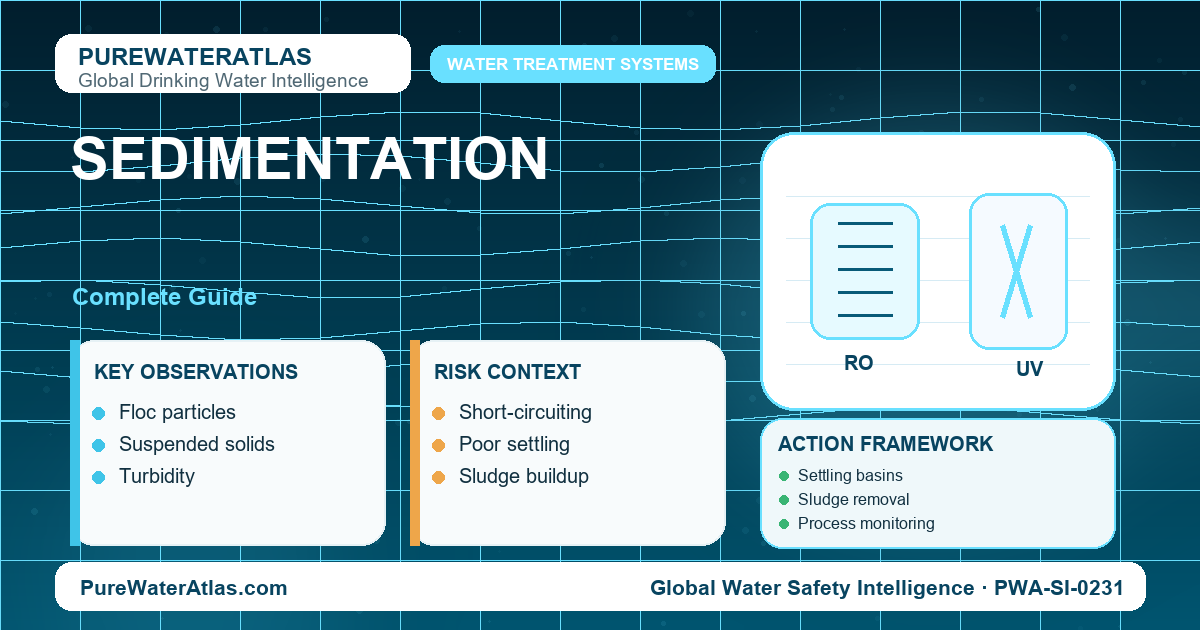
Sedimentation in water treatment is a physical separation process in which suspended particles settle out of water under the influence of gravity. The process typically occurs in specially designed basins, clarifiers, or settling tanks. As water moves through these units under controlled conditions, solids with sufficient settling characteristics sink to the bottom, where they are collected and removed as sludge; clarified water above proceeds to further treatment.
In conventional drinking-water treatment, sedimentation commonly follows coagulation and flocculation and precedes filtration and disinfection. Coagulation destabilizes fine suspended and colloidal material, flocculation brings destabilized particles together into larger flocs, and sedimentation removes much of that particulate material before it reaches the filters. The CDC describes this sequence in its overview of drinking-water treatment, while WHO treats clarification as one component within a broader source-to-consumer system.
This sequence is common, but it is not universal. Source-water characteristics and treatment objectives determine which processes are appropriate, and direct filtration configurations can omit a separate sedimentation step. For a broader comparison of treatment trains, see Municipal Water Treatment Process.
| Treatment step | Purpose | Operating variables | Failure effect |
|---|---|---|---|
| Coagulation | Destabilize fine suspended and colloidal particles so they can aggregate | Coagulant type and dose, pH, raw-water quality, mixing | Poorly conditioned particles remain difficult to flocculate and settle |
| Flocculation | Promote collisions and formation of larger, settleable floc | Mixing conditions, time, upstream coagulation performance | Small, weak, or damaged floc can pass through clarification |
| Sedimentation | Separate settleable floc and other suspended solids from water | Flow distribution, settling conditions, solids accumulation, inlet and outlet performance | Higher particulate loading reaches downstream filtration |
| Filtration | Remove particles remaining after clarification or other pretreatment | Filter condition, loading, upstream water quality, operation | Particle breakthrough or impaired downstream treatment performance can occur |
| Disinfection | Inactivate susceptible microorganisms as part of the microbial treatment barrier | Disinfectant or process, dose or intensity, contact conditions, water quality | Required microbial treatment performance may not be achieved |
Removing particles early reduces solids loading on downstream filters and creates more favorable conditions for later treatment. It is important, however, not to confuse clarification with finished-water safety. Sedimentation alone does not establish microbiological safety and does not reliably remove dissolved contaminants. Filtration and disinfection remain separate downstream barriers in conventional treatment. This multiple-barrier perspective is consistent with the WHO Guidelines for Drinking-water Quality, which frame drinking-water safety as risk management from catchment to consumer rather than the performance of any single unit process.
How particles settle
In basic terms, sedimentation relies on gravity. When water containing suspended particles is held or conveyed through a basin under suitable hydraulic conditions, particles or flocs that settle relative to the surrounding water move toward the bottom. They form a concentrated residual stream or sludge, while clearer water is collected for further treatment.
Not all particles settle equally well. Larger, denser aggregates generally settle more readily than very fine dispersed material. Colloidal particles can remain suspended rather than separating efficiently by simple gravity settling, which is a major reason coagulation and flocculation are commonly used before sedimentation. Those processes convert difficult-to-remove particulate material into aggregates with more favorable settling characteristics.
Engineering terminology also distinguishes different settling behavior. Discrete particles may settle largely independently at low solids concentrations; flocculent particles can change size as they collide and aggregate; at higher concentrations, particles may interact and settle together as a zone, while still more concentrated solids can undergo hindered or compression behavior. These are settling regimes, not interchangeable types of drinking-water treatment plants.
The distinction between particulate and dissolved material is fundamental. Sedimentation is primarily a solid-liquid separation process. It can remove suspended sediment, coagulated floc, and contaminants associated with particles, but a substance dissolved in the water does not simply settle because the water remains in a basin longer. Dissolved salts and many dissolved chemicals therefore require other treatment mechanisms where their removal is necessary.
Coagulation and flocculation before sedimentation
Successful sedimentation in conventional surface-water treatment often depends on what happens upstream. Fine particles that settle poorly must first be destabilized and assembled into floc. Coagulation can involve mechanisms including charge neutralization and incorporation into precipitated coagulant material; the relevant mechanism depends on the coagulant, dose, pH, and water chemistry. Aluminum- and iron-based coagulants are widely used, while polymers may serve particular coagulation or flocculation roles depending on the treatment application.
Flocculation then gently mixes the conditioned water so particles encounter one another and form larger aggregates. The strength, size, and settling behavior of the resulting floc affect clarification performance. Insufficient particle conditioning can produce poorly settling material, while inappropriate mixing conditions can limit floc development or damage floc that has already formed. A fuller treatment of these interactions is available in Coagulation and Flocculation in Water Treatment.
One of the most useful bench-scale tools is the jar test. Operators place raw-water samples in multiple vessels and test different coagulant doses, pH conditions, or mixing programs. They then observe floc formation and settling and measure the quality of the treated water. WHO’s treatment methods and performance guidance describes jar testing as a means of establishing suitable coagulation conditions.
Jar testing is not necessarily a one-time exercise. Changes in raw-water turbidity, organic matter, temperature, pH, alkalinity, or other source characteristics can change coagulant demand and floc behavior. Testing often must be repeated often enough to follow meaningful changes in source-water conditions rather than assuming that a previously successful chemical setting will remain optimal.
Clarifier and basin design concepts
The purpose of a sedimentation basin is not merely to provide a large tank. It must create hydraulic conditions in which settleable material has a realistic opportunity to separate while clarified water is withdrawn without carrying excessive solids with it. Performance therefore depends on the interaction of particle characteristics, basin hydraulics, inlet and outlet arrangements, solids collection, flow, and upstream treatment.
Poor flow distribution can create short-circuiting, in which some water moves through a basin more rapidly or directly than intended, as well as poorly utilized regions. Inlet structures and baffles can help distribute flow, while outlet launders and weirs collect clarified water. At the bottom of the basin, hoppers, scrapers, or other collection systems concentrate and remove settled solids.
Detention time can be relevant to basin operation, but it should not be treated as the sole measure of sedimentation performance. Settling behavior and hydraulic loading are also important, and design criteria depend on process configuration and applicable engineering requirements. A single generic detention time or overflow-rate value is therefore not an appropriate universal design standard.
Clarifiers also differ in configuration. Conventional horizontal-flow basins provide gravity-separation space along the direction of water travel. Other systems maintain a floc or solids blanket that participates in clarification. Inclined settling surfaces can provide greater effective settling area within a given footprint. Whatever the configuration, operational assessment has to consider hydraulics, floc quality, chemical feed, solids accumulation, and clarified-water quality together rather than treating the basin in isolation.
What operators monitor
Turbidity is one of the most useful indicators of particle-removal performance. It is an optical measurement of light scattering by material in water, not an identification of a specific contaminant and not a direct measurement of pathogens. Comparing raw, settled, and downstream turbidity where appropriate can help operators identify changes in clarification performance, but monitoring locations and action thresholds depend on the plant and applicable requirements.
High turbidity does not by itself prove that pathogens or a particular chemical contaminant are present. Conversely, water that looks clear is not necessarily microbiologically or chemically safe. Turbidity is valuable because changing particle levels can indicate changes in source conditions or treatment performance, and particle removal matters to downstream filtration and microbial risk management.
Operators commonly interpret clarified-water quality alongside observations of floc formation, chemical-feed conditions, basin hydraulics, and accumulated solids. Jar tests can help determine whether a change begins with coagulation chemistry rather than the settling basin itself. A rise in post-clarification turbidity, for example, may be consistent with inadequate particle destabilization, weak floc formation, hydraulic disturbance, solids carryover, or a mechanical problem; the actual cause requires plant-specific investigation.
Source-water conditions can change quickly during runoff events and can also shift seasonally. This is why process control is based on measurement and observation rather than fixed chemical settings alone. EPA guidance on conventional treatment similarly treats coagulation, flocculation, sedimentation, filtration, and their operational indicators as connected processes.
Performance limits and common failure modes
Sedimentation is effective when the material entering the basin has suitable settling characteristics and the clarifier provides favorable separation conditions. Poor coagulation or flocculation can leave fine particulate material in suspension. Hydraulic disturbances can carry otherwise settleable floc toward the outlet, while excessive solids accumulation can interfere with normal basin operation. These problems increase the particulate burden passed to downstream filters.
Particles also matter to microbial risk management. Microorganisms can be associated with particulate material, and particles can affect subsequent treatment, including disinfection. Removing particles can therefore improve conditions for downstream microbial barriers. That benefit should not be interpreted as disinfection by sedimentation: the extent of microorganism removal or protection varies with the organism, particle, and treatment process, and clarification alone is not sufficient to establish microbiological safety.
Sedimentation also has clear chemical limitations. It can reduce contaminants that are carried on particles or incorporated into removable floc, but that does not mean it removes the dissolved fraction of the same contaminant. Hydrophobic organic compounds, metals, pesticides, or nutrients may behave differently depending on their chemical form and the water conditions. Particle-bound removal cannot be generalized into complete contaminant removal.
Several practical distinctions follow from these limits:
- Water that looks clear is not necessarily safe to drink.
- Fine material can be removed efficiently when appropriate coagulation and flocculation create settleable floc; sedimentation is not limited to sand and grit.
- Dissolved substances do not settle simply because more time is provided.
- Turbidity is a treatment-performance indicator, not a contaminant identity or universal safety score.
- Intentional use of treatment coagulants is part of established particle-removal practice, not evidence that sedimentation itself has contaminated the water.
For household water, allowing visible sediment to settle can reduce some suspended material, but it should not be treated as a complete drinking-water treatment method. The necessary treatment depends on the actual water-quality hazards, which may include microorganisms or dissolved contaminants unaffected by simple settling.
Sludge handling and downstream filtration
Particle removal transfers contaminants and treatment solids from the water into a concentrated residual. Sedimentation and coagulation therefore produce sludge containing source-water solids, coagulation products, and substances associated with those solids. Removing material from the water is only the first part of managing it.
Settled solids must be withdrawn deliberately so they do not accumulate enough to reduce useful basin capacity or contribute to solids carryover. Clarifiers may use scrapers, hoppers, pumping, or other withdrawal arrangements, depending on their design. The resulting residuals may require thickening, dewatering, further treatment, disposal, or other management appropriate to the facility and governing requirements. EPA’s Drinking Water Treatment Plant Residuals Management Technical Report provides detailed context on these residual streams.
Good clarification also protects downstream filtration. By removing settleable floc before the filters, sedimentation reduces particulate loading and helps filters concentrate on material that remains after clarification. Conversely, weak floc formation or poor settling can send additional solids to the filters and impair downstream performance. Sedimentation and filtration are therefore separate processes whose operation is closely connected.
Modern alternatives and enhanced clarification
Gravity sedimentation remains a contemporary engineered treatment process, but conventional basins are not the only means of clarification. Plants can use inclined settling surfaces, solids-contact or floc-blanket systems, other high-rate clarification designs, or a fundamentally different separation mechanism such as dissolved-air flotation. Technology selection depends on source-water characteristics, treatment objectives, footprint, existing infrastructure, residuals handling, and overall plant design.
| Clarification approach | Principle | Strength | Limitation |
|---|---|---|---|
| Conventional gravity settling | Settleable floc separates downward under gravity in a clarification basin | Established process that integrates directly with conventional coagulation and flocculation | Performance depends strongly on floc characteristics and basin hydraulics and can require substantial basin area |
| Inclined plate or tube settling | Inclined settling surfaces increase effective settling area within a compact arrangement | Can increase clarification capacity or reduce required footprint relative to conventional settling arrangements | Still requires effective upstream floc formation and appropriate hydraulic and solids management |
| Floc-blanket or solids-contact clarification | Water interacts with a maintained solids or floc inventory as clarification proceeds | Can combine particle contact and clarification in a compact process configuration | Performance depends on maintaining suitable solids and operating conditions |
| Dissolved-air flotation | Fine air bubbles attach to particles or floc and carry them toward the surface for removal | Provides an alternative when flotation characteristics favor upward separation | Uses a different process and operating system from gravity sedimentation and is not universally preferable |
These options should not be ranked as a universal progression from older to better technology. WHO’s Compendium of drinking-water systems and technologies emphasizes treatment selection in the context of the whole water system. A high-rate process may solve an important footprint or capacity problem at one facility while conventional settling may remain appropriate at another.
The enduring principle is narrower than any particular clarifier design: sedimentation and related clarification processes remove particulate material so later barriers can operate under better controlled conditions. Sedimentation is highly useful for settleable solids and properly formed floc, but it does not reliably remove dissolved salts, many dissolved chemicals, or all microorganisms on its own. Safe drinking water depends on coordinated treatment and risk management across the system, not on clarity or sedimentation alone.
Read the full guide: Water Treatment Systems Guide
Explore more in this category: Water Treatment Systems Articles