
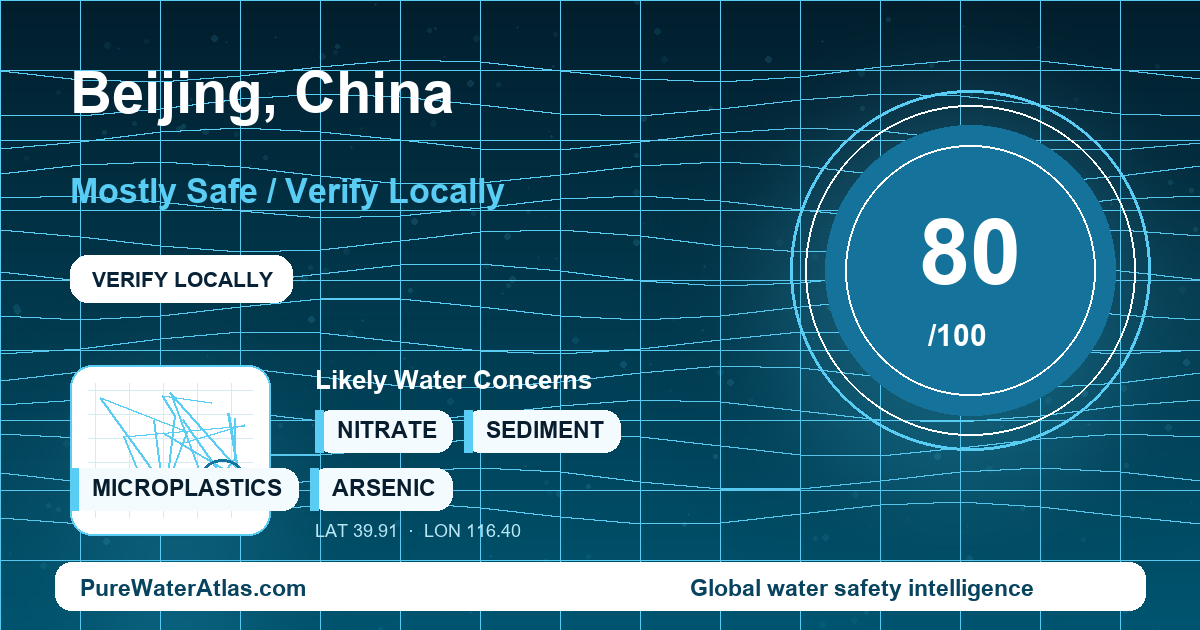
Beijing’s centrally supplied tap water is part of a large, engineered municipal system supported by the South-to-North Water Diversion Project, local reservoirs, and urban treatment plants, but the safety of water at the faucet can still depend on building plumbing, secondary tanks, and local maintenance.
Quick Answer
| Overall safety status | Mostly Safe / Verify Locally — PureWaterAtlas score: 80/100. Beijing’s central municipal supply is generally treated and managed, but not every individual tap should be treated as automatically drinkable without local verification. |
|---|---|
| Can tourists drink it? | Conservative answer: use boiled water, sealed bottled water, or a verified hotel or restaurant filtration system for routine drinking. Tap water is usually acceptable for washing, showering, and brushing teeth in modern central hotels. |
| Resident advice | Residents on the central municipal network can generally regard the supply as managed, but should evaluate their building, especially in older apartments, high-rises with secondary tanks, or homes with rusty or unknown plumbing. |
| Main raw-water system | Beijing’s supply is multi-source, with a major role for the Middle Route of the South-to-North Water Diversion Project bringing water from the Danjiangkou Reservoir system, plus local sources such as Miyun Reservoir and groundwater in the wider resource context. |
| Main authorities | Beijing Waterworks Group is the principal municipal water-supply enterprise for much of the central city. Beijing Water Authority oversees water resources and water-supply administration, with health and ecological-environment authorities also involved. |
| Filter recommendation | A filter is not automatically required for every centrally supplied home, but a certified activated-carbon filter can improve chlorine taste. Older buildings or higher-risk households should consider testing and, where appropriate, lead-rated filtration or reverse osmosis. |
Why Beijing Is Different
Beijing is not a simple “safe” or “unsafe” tap-water city. It is a northern inland megacity with limited local water resources relative to its population and economic demand. That geography makes water supply a strategic infrastructure issue, not just a household convenience. Modern Beijing depends heavily on large-scale water engineering, especially the South-to-North Water Diversion system, while still retaining local reservoirs and groundwater within the broader water-resource picture.
The key Beijing-specific issue is the difference between water leaving a municipal treatment plant and water arriving at a particular faucet. The central supply is managed through a major urban system, but many residents and visitors receive water after it has passed through building-level secondary supply infrastructure: pumps, rooftop or basement tanks, internal pipes, valves, and faucets. In a high-rise apartment, hotel, office, school, or older residential compound, those final building-level components can matter as much as the quality of water in the municipal main.
Another Beijing-specific practical point is local drinking behavior. In Beijing, as in much of China, it is common to drink boiled water rather than untreated cold tap water. For travelers, this should be understood as both a cultural norm and a sensible precaution where building plumbing or tank maintenance is unknown. For residents, it means that “municipally treated” does not always equal “drink cold from every tap without checking.”
Where Does Beijing’s Tap Water Come From?
Modern Beijing’s drinking-water supply is built around a multi-source system. A major source is the South-to-North Water Diversion Project Middle Route, which brings water from the Danjiangkou Reservoir system northward toward Beijing and other parts of northern China. This imported water is strategically important because Beijing historically faced severe water scarcity and groundwater overuse.
Before the Middle Route began delivering water to Beijing in 2014, the city relied much more heavily on local reservoirs and groundwater. The arrival of Danjiangkou-derived water was a major turning point for Beijing’s water-supply resilience and helped reduce pressure on local aquifers. It did not, however, eliminate the need to evaluate water quality at the building or tap level.
Beijing also continues to rely on local source-water infrastructure such as Miyun Reservoir, a major local reservoir and strategic reserve. Important infrastructure in the Beijing system includes the Danjiangkou source-water system, the South-to-North Water Diversion Middle Route, Tuancheng Lake and associated receiving and regulation infrastructure, municipal treatment plants, the urban distribution network, and the secondary water-supply systems used in many high-rise buildings.
For a typical central Beijing user, the relevant question is not only “what is the source?” but also “what happened after treatment?” Water may move from a well-managed municipal network into older internal pipes, a poorly maintained storage tank, or a building system affected by repairs, pressure changes, or sediment disturbance.
Who Manages Drinking Water in Beijing?
Beijing Waterworks Group is the principal municipal water-supply enterprise for Beijing’s central urban tap-water service. The Beijing Water Authority is the municipal government agency responsible for water resources and water-supply administration. Source-water environmental quality is also relevant to the Beijing Municipal Ecological Environment Bureau, while drinking-water sanitation oversight involves health authorities.
China’s urban tap water is expected to be produced under the national drinking-water quality standard, currently GB 5749-2022, which can be checked through the national public service platform for standards. National water-resource policy and water-security context are also addressed by the Ministry of Water Resources of the People’s Republic of China.
PureWaterAtlas does not claim that every individual Beijing building tap meets the national standard unless a recent local test or official notice verifies that endpoint. This is an important data limitation: Beijing has identifiable official agencies and a well-documented water-supply system, but recent routine tap-water test results for every district, hotel, apartment compound, and secondary tank are not uniformly available in English or in one public dataset.
Main Local Water Concerns
- Secondary storage tanks and internal building plumbing: High-rise apartments, hotels, schools, offices, and residential compounds may use pumps and storage tanks after water leaves the municipal main. Poorly maintained tanks or aging pipes can introduce sediment, microbial risk, rust, taste problems, or metals at the tap.
- Old pipework and metal leaching: Lead risk should not be assumed citywide, but older buildings can have aging internal plumbing, metal components, old faucets, or unknown materials. First-draw testing is reasonable where plumbing is old or water has stood overnight.
- Chlorine taste and disinfectant residual: A treated municipal system normally maintains disinfectant residual to protect water in distribution. Some users notice chlorine taste or odor, particularly after maintenance or seasonal changes. Activated carbon can improve taste when maintained properly.
- Turbidity, sediment, or rusty water after works: Construction, main flushing, pressure changes, tank cleaning, and pipe repairs can temporarily mobilize sediment or iron-colored water. Do not drink visibly brown, cloudy, or particle-filled water.
- Source-water scarcity and climate pressure: Beijing’s long-term water security depends on imported water, reservoir management, conservation, and drought resilience. This is primarily a system-resilience issue, not an automatic day-to-day contaminant warning.
- Rural or peri-urban non-centralized supplies: Outlying villages, private wells, small systems, temporary construction sites, or rural-edge housing may not have the same treatment and monitoring reliability as central municipal service. Nitrate, microbial contamination, salinity, hardness, or naturally occurring metals are more relevant in those settings.
Seasonal and operational triggers also matter. Summer rainstorms and flood-season runoff can increase raw-water turbidity, although treatment plants are designed to manage this. Winter changes can affect taste perception and plumbing performance in poorly insulated areas. Drought or high-demand periods may influence source blending or operations. Building maintenance, tank cleaning, and pipe repairs can cause short-term discoloration, sediment, or pressure changes.
For Travelers
For short-term visitors, the conservative PureWaterAtlas answer is: do not make unboiled Beijing tap water your default drinking source unless your hotel, host, or a current local notice confirms that water is suitable at that building. Use boiled water, sealed bottled water, or verified filtered water for routine drinking, especially if you have a sensitive stomach, are traveling with children, or are immunocompromised.
In modern central hotels and serviced apartments, brushing teeth with tap water is generally a reasonable low-risk practice for most healthy adults. If you want extra caution, use bottled water or boiled cooled water for brushing. Hotels commonly provide bottled water or an electric kettle, reflecting local practice. Tea and hot water served in restaurants are typically boiled.
Use caution with ice. Ice in reputable hotels, international restaurants, and major chains is more likely to be made from treated or filtered water, but the source may be uncertain at street stalls or small venues. If avoiding gastrointestinal risk is a priority, skip ice unless the source is clear. Carry sealed water for sightseeing, check that caps are intact, and avoid drinking from bathroom taps in older hostels, guesthouses, construction-site lodging, or rural outskirts unless the water has been boiled or properly filtered.
For wider travel-health context, see the CDC Travelers’ Health China page.
For Residents
Residents connected to Beijing’s central municipal system can generally treat it as a managed public supply, but the building deserves close attention. In newer buildings with well-maintained plumbing and documented secondary supply management, a simple taste-focused approach may be enough. In older apartments, high-rises with tanks, or homes with rusty water, sediment, or unknown pipe materials, testing at the tap is stronger evidence than relying only on citywide statements.
A home filter is not automatically required for every Beijing residence. For chlorine taste and odor, a certified activated-carbon filter is usually sufficient if cartridges are replaced on schedule. For older buildings, infants, pregnancy, or concerns about lead or other metals, consider first testing and then using a point-of-use system certified for lead reduction or a reverse-osmosis system if warranted.
Testing priorities should match the building. Test first-draw and flushed samples for lead where plumbing is old or unknown. Test total coliform and E. coli if a home uses a private well, small community system, or a rooftop or basement tank with questionable maintenance. Check turbidity, iron, manganese, and general minerals if water is cloudy, reddish-brown, blackish, or leaves sediment. For peri-urban groundwater or private wells, include nitrate, arsenic, fluoride, hardness, total dissolved solids, and microbial indicators.
Secondary tanks are a major practical issue in Beijing high-rises and compounds. Ask property management how often tanks are cleaned and disinfected, whether cleaning records are available, and whether water-quality testing is performed after maintenance. After pipe repairs, pressure loss, tank cleaning, or long absences, flush cold water until it runs clear before using it for drinking or cooking.
Relevant Contaminants and Water-Quality Issues
Beijing’s most relevant water-quality concerns are mainly distribution and building-level issues rather than a single citywide contaminant warning. For disinfectant taste and odor, see Chlorine in Drinking Water. For cloudiness after storms, pressure changes, or pipe works, see Turbidity in Drinking Water and Sediment in Drinking Water.
Older apartments and unknown internal plumbing justify attention to Lead in Drinking Water, especially through first-draw and flushed testing. Microbial indicators such as E. coli in Drinking Water are most relevant where tanks are poorly maintained, after outages, or outside the central network. Nitrate in Drinking Water is mainly a concern for private wells or non-centralized supplies rather than verified central municipal service.
How to Verify Your Water Quality
The most reliable way to verify Beijing tap water is to combine official context with point-of-use evidence. Check local utility or property-management notices after repairs, pressure changes, or tank cleaning. Ask hotels or apartment managers whether water passes through a secondary tank and whether cleaning and testing records exist. If the building is old or the water looks, tastes, or smells unusual, test the tap rather than relying on general citywide assumptions.
PureWaterAtlas resources that help with verification include the Water Testing guide, the broader Drinking Water Safety framework, and the Water Purification methods guide. For Beijing travelers using boiled water, see Boiling Water Purification: Complete Guide and Boiling Water Purification: Testing and Detection Methods.
If lead is a concern, review Lead in Drinking Water: Testing and Detection Methods and Lead in Drinking Water: Best Filters, Systems and Solutions. You can also compare destinations with the Global Water Quality Checker and research specific issues in the Contaminants Search Engine. For broader context, see Global Water Quality.
Official and Technical Sources
- Beijing Waterworks Group official website — principal municipal water-supply enterprise context for Beijing’s central urban area.
- Beijing Water Authority official website — municipal water-resource management, water-supply administration, and policy information.
- Beijing Municipal Ecological Environment Bureau — environmental quality and source-water protection context.
- South-to-North Water Diversion Project official website — official context for the project central to Beijing’s modern water-supply mix.
- Ministry of Water Resources of the People’s Republic of China — national water-resource policy and water-security context.
- National public service platform for standards — official platform for checking national standards including GB 5749-2022.
- WHO Guidelines for Drinking-water Quality — international health-based context for water safety, monitoring, and household risk.
- WHO/UNICEF Joint Monitoring Programme: China WASH data — national drinking-water, sanitation, and hygiene context.
Bottom Line
Beijing’s central municipal tap water comes from a large managed system supported by the South-to-North Water Diversion Middle Route, Danjiangkou-derived water, local reservoir infrastructure such as Miyun Reservoir, treatment plants, and urban distribution networks. That makes the city’s supply more robust than its historically water-scarce geography would suggest. The remaining practical risk is usually closer to the faucet: old internal pipes, secondary storage tanks, poor tank maintenance, sediment after repairs, and limited public endpoint data for every building. Travelers should normally drink boiled, bottled, or verified filtered water, while using tap water for washing and brushing in modern hotels is generally reasonable. Residents should evaluate their own building, test when conditions warrant, and choose filtration based on verified concerns.
Read the full guide: Global Water Quality Guide
Explore more in this category: Global Water Quality Articles