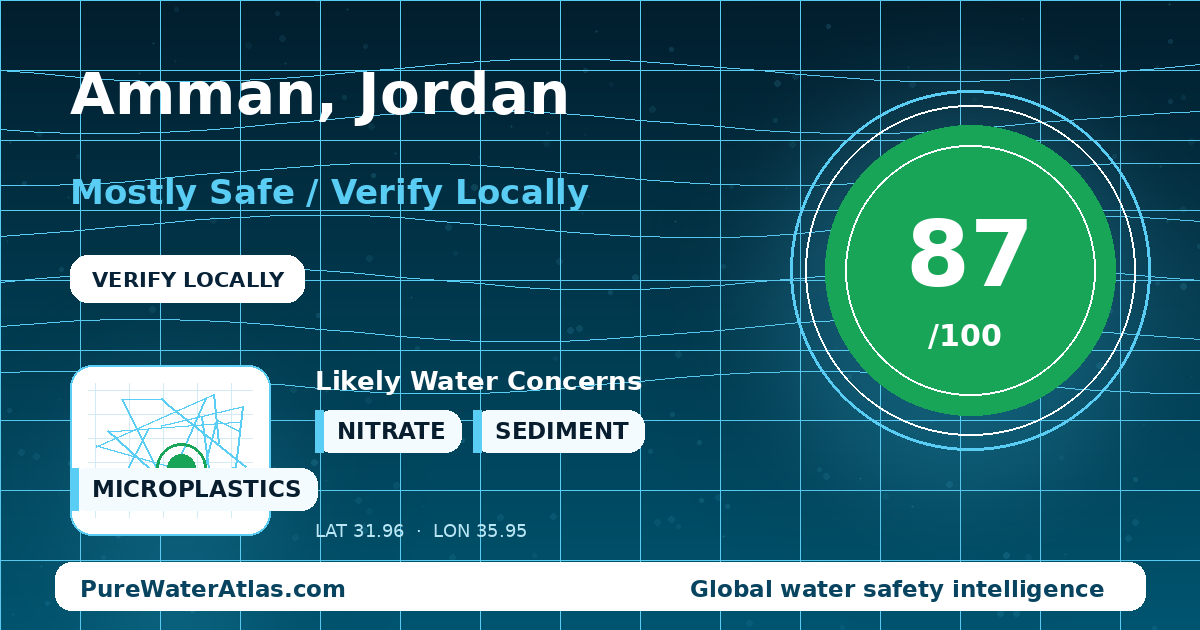
Amman’s water question is not answered adequately by asking whether water leaving a treatment facility is potable. The capital operates under severe scarcity and receives water intermittently, so apartment buildings and houses commonly store each delivery in roof or ground tanks. Water can therefore pass through a utility network, a building connection, pumps, a private tank and premise plumbing before reaching a glass.
Jordan Water Company—Miyahuna supplies Amman and monitors water through its laboratories. Historical official monitoring found high utility-level compliance, while more recent accreditation records confirm that Miyahuna’s water-quality laboratories remain accredited for chemical and microbiological work. What is missing from accessible public sources is a current Amman table showing compliance by parameter and sampling location. The most defensible conclusion is therefore conditional: the municipal supply is intended to be potable, but the safety of a particular tap depends materially on distribution conditions and the building’s storage and plumbing.
Quick Answer
| Overall safety status | Municipal water is produced as potable water, but point-of-use safety should be verified because intermittent distribution and private storage can change water quality. Current evidence does not establish that every Amman tap is safe. |
|---|---|
| Can visitors drink the tap water? | If the property’s tank maintenance and plumbing history are unknown, use factory-sealed bottled water or appropriately treated water for drinking, ice and brushing teeth. |
| Resident advice | Keep storage tanks covered and maintained, investigate low pressure or unusual water, and test the kitchen tap after contamination incidents, tank problems or plumbing work. |
| Main water source | A blended system documented as including the Zai surface-water system, Disi fossil groundwater, local wells and other treatment facilities. A current percentage mix was not verified. |
| Responsible authority | Jordan Water Company—Miyahuna, publicly owned by the Water Authority of Jordan under the Ministry of Water and Irrigation. |
| Filter recommendation | No blanket recommendation. Match treatment to laboratory results or a specific incident; ordinary carbon filters are not substitutes for disinfection and do not reliably remove nitrate or all metals. |
Where Does Amman’s Tap Water Come From?
Amman does not rely on one neighborhood source. Institutional and academic documentation describes a regional supply assembled from the Zai system, which treats surface water conveyed from the Jordan Valley, the long-distance Disi groundwater conveyance, local wells and additional treatment facilities including Zara Ma’in. Jordan’s Ministry of Water and Irrigation also identifies groundwater—including the non-renewable Disi aquifer—as a major component of the country’s municipal supply.
The exact blend can vary operationally and geographically. No current official document accessible in this run gave a reliable citywide percentage for each source, so older percentages should not be presented as Amman’s current supply mix. The ministry’s groundwater dashboard is also source-water monitoring, not proof of quality at a household tap.
Current public sources reviewed did not provide one consolidated treatment train covering every source delivered to Amman. Historical documentation reports physical and chemical treatment at major plants and routine chemical, microbiological and radiological testing. Chlorine residual has also been studied in Amman storage tanks, showing that disinfectant is used in the system, but the older tank study cannot establish present residuals in every building.
Who Manages Drinking Water?
Miyahuna is the operating utility for Amman. The company is wholly publicly owned by the Water Authority of Jordan, which sits under the Ministry of Water and Irrigation. The Water Authority and ministry oversee sector performance, while Jordan’s Ministry of Health has public-health surveillance and enforcement responsibilities for potable water.
The Jordan Accreditation System’s current certificate identifies Miyahuna’s Water Quality Directorate laboratories and confirms competence under ISO/IEC 17025:2017 for specified chemical and microbiological water testing. Accreditation supports confidence in work within the listed scope; it is not, by itself, evidence that every sample or household tap complies.
Main Local Water Concerns
Intermittent supply and pressure
Amman is not supplied continuously citywide. The official 2019 utility-monitoring report recorded approximately 36 pressurized hours per week for Miyahuna-Amman and warned that continuity calculations needed further review. A more recent technical report on intermittent supply gives an average near 38 hours per week for Miyahuna’s service areas. Conditions differ by distribution zone, elevation, season and building, so these figures should not be interpreted as a guaranteed household schedule.
Starting and stopping a network can produce pressure variation and water hammer. Low or negative pressure around leaks can also increase vulnerability to intrusion, although the reviewed sources did not document a current citywide contamination event. In 2024, the IFC and Jordanian authorities began work aimed at reducing losses in Amman’s distribution network, noting old pipelines and substantial water loss.
Roof and ground storage tanks
Because deliveries are intermittent, the building tank is part of Amman’s practical drinking-water system. A tank with an insecure lid, sediment, poor cleaning history, cross-connections or prolonged stagnation can degrade water after it leaves the public network. An Amman study found no total or fecal coliforms in its sampled tanks but found low chlorine in some tanks and concluded that cleaning helped control heterotrophic bacterial counts. The study is useful for explaining the pathway, but it is old and should not be treated as a current citywide survey.
Water scarcity and network losses
Scarcity primarily affects availability and reliability rather than proving contamination. The 2019 official report put non-revenue water for Miyahuna-Amman at 38.7%, while the 2024 IFC project described losses associated largely with old pipelines. Water loss can reduce pressure and delivery volume, but it does not mean that 38.7% of taps were contaminated.
Alternative supplies
Households may buy tanker water when stored municipal water is insufficient. UN-Water reports that Jordan regulates drinking-water tankers and wells through licensing, color coding, monitoring and testing. Even so, users should verify that a tanker is authorized for potable water and should not assume that an unmarked private delivery has the same controls. A tanker can also contaminate an otherwise clean household tank if its source or hose is unsuitable.
National groundwater monitoring identifies nitrate, salinity and naturally occurring trace elements as parameters requiring attention in some Jordanian aquifers. Those national or source-water findings must not be converted into a claim that Amman’s treated municipal taps exceed standards. They are more directly relevant to private wells, unknown tanker sources and decisions about what to test.
For Travelers
Travelers usually cannot inspect a hotel’s or rental property’s tank, pump and internal plumbing. The lowest-uncertainty option is unopened, factory-sealed bottled water. Use the same verified water for drinking, brushing teeth, preparing infant formula and making ice unless the accommodation can confirm that its tap or point-of-use system is maintained and safe.
The US CDC advises travelers not to put tap water in their mouths unless they are reasonably certain it is safe. If microbial contamination is suspected and no chemical contamination is indicated, bringing clear water to a rolling boil for one minute is an effective emergency measure in Amman. Boiling does not remove nitrate, salts, metals or other dissolved chemicals and can concentrate them. Do not rely on taste, clarity or a kettle alone to establish safety.
For Residents
- Ask the building manager which tank supplies the kitchen, when it was last inspected and cleaned, whether its lid and vents exclude dust and animals, and whether any tanker deliveries have been added.
- After an outage, main break, plumbing repair or tank cleaning, follow Miyahuna or Ministry of Health instructions. Do not assume that flushing or boiling is sufficient if officials identify chemical contamination.
- If water arrives discolored, unusually cloudy or with a sewage, fuel or strong chemical odor, do not drink it while waiting for the utility or a qualified laboratory to investigate.
- Use cold water from the drinking tap for cooking and drinking. Where premise-plumbing metals are a concern, flush stagnant water before use and test rather than assuming a citywide lead problem.
- Keep treatment equipment maintained. An expired cartridge, dirty storage vessel or poorly serviced reverse-osmosis unit can create its own water-quality problem.
For broader decision support, consult PureWaterAtlas’s drinking-water safety guide, the complete water-testing guide and the water-testing category.
Relevant Contaminants and Water-Quality Issues
Microbial indicators
Total coliform and E. coli are priority tests after a dirty-tank incident, sewage-like odor, loss of pressure, cross-connection concern or unexplained gastrointestinal illness. Their inclusion as testing priorities does not mean a current Amman-wide E. coli problem was found. If a laboratory confirms microbial contamination, see the E. coli removal and treatment guide; carbon-only filters should not be treated as disinfectants.
Turbidity, sediment and disinfectant residual
Turbidity and visible sediment can reveal tank or plumbing problems and can interfere with UV or chemical disinfection. Free-chlorine residual is useful for trained sampling because a low result can indicate depleted disinfectant, but one home strip does not provide a complete safety assessment.
Nitrate and dissolved minerals
Nitrate, total dissolved solids, conductivity and hardness are reasonable tests for a private well, uncertain tanker source or unexplained salty/mineral taste. The ministry’s national groundwater dashboard reports aquifer-level concerns and Jordanian thresholds, but it does not establish an exceedance in Amman’s treated network. Boiling cannot remove nitrate or salts.
Lead and copper from premise plumbing
No current evidence reviewed established a citywide lead problem in Amman’s municipal supply. Metals can nevertheless enter water from building plumbing, fittings or fixtures, especially after stagnation or corrosion. Older buildings, unexplained metallic taste, renovation work, or households with infants justify first-draw and flushed-sample testing. Treatment should be selected only after results are known; PureWaterAtlas provides a lead home-safety checklist and a comparison of lead removal options.
How to Verify Your Water Quality
- Define the source and sampling point. Record whether the sample comes directly from the municipal connection, after a roof or ground tank, after a tanker delivery, or after a filter.
- Start with sanitary inspection. Check tank covers, vents, sediment, overflow protection, pump arrangement and nearby contamination sources.
- Use an accredited laboratory. For stored municipal water, a practical initial panel includes total coliform, E. coli, turbidity, pH, conductivity or TDS and, when sampled correctly, free-chlorine residual.
- Add source-specific chemistry. For wells or uncertain tanker water, discuss nitrate, fluoride, major ions and locally appropriate trace elements with the laboratory. For old premise plumbing, add lead and copper using proper first-draw and flushed sampling protocols.
- Compare like with like. A source-water result, treatment-plant result and kitchen-tap result answer different questions. Do not use a national groundwater map as a substitute for testing a building’s stored water.
Readers can explore possible parameters with the PureWaterAtlas Contaminants Search Engine and compare broader location guidance with the Global Water Quality Checker. Consumer tests can screen for a few properties, but microbiological confirmation and trace-level chemical analysis require a competent laboratory. See also the home water-testing and system guide.
Treatment Guidance
- Confirmed or credible microbial risk: Follow official instructions. Emergency boiling can inactivate pathogens in clear water, while properly designed UV can disinfect only when water clarity, dose and maintenance are controlled. Ordinary activated carbon does not reliably disinfect water.
- Sediment or turbidity: Correct the tank, pipe or delivery source first. A sediment filter can protect downstream equipment but does not prove microbiological safety.
- Nitrate, salinity or selected dissolved chemicals: Use a laboratory result before purchasing equipment. Appropriately certified reverse osmosis may reduce many dissolved ions, but performance depends on the contaminant, membrane condition, pressure and maintenance. Boiling and ordinary carbon are not suitable nitrate or salinity treatment.
- Lead or copper from plumbing: Replace the contributing fixture or plumbing where practical. If treatment is needed, select a unit certified for the measured metal and maintain it according to its certification conditions.
- Unknown chemical odor or spill: Stop using the water and seek official investigation. Boiling can worsen exposure to some chemicals and is not a general chemical treatment.
For technology limitations and selection, use the water-treatment systems guide and the water-treatment systems category.
Official and Technical Sources
- Groundwater Quality of Jordan — Jordan Ministry of Water and Irrigation
- National Groundwater Quality Baseline Study 2023 — Jordan Ministry of Water and Irrigation
- Jordan Water Utilities Monitoring Report 2019 — Jordan Ministry of Water and Irrigation
- Jordan Water Utilities Monitoring Report 2023 — Jordan Ministry of Water and Irrigation
- Miyahuna Key Performance Indicators KPIs Amman [2022] — Jordan Open Government Data Portal
- Certificate of Accreditation: Laboratories of Water Quality Directorate at Jordan Water Company (Miyahuna) — Jordan Accreditation System, Accreditation Unit
- IFC Inks Agreement to Cut Water Loss and Enhance Water Sustainability in Jordan — International Finance Corporation
- SDG 6 Country Acceleration Case Study: Jordan — UN-Water
- Drinking water quality in roof storage tanks in the city of Amman, Jordan — Water International
- Food and Water Precautions for Travelers — US Centers for Disease Control and Prevention
- Avoid Contaminated Water During Travel — US Centers for Disease Control and Prevention
- Groundwater Policy — Jordan Ministry of Water and Irrigation
Related Contaminant Profiles
Bottom Line
Amman’s public water is managed and tested as potable water, and there is no verified current citywide contamination advisory in the sources reviewed. That does not make every tap equivalent. Intermittent delivery, variable pressure, building tanks, tanker additions and premise plumbing can all alter water after utility treatment.
Visitors should use sealed bottled or otherwise verified water when a property’s storage system is unknown. Residents should focus on tank integrity, incident-specific testing and accredited laboratory analysis rather than buying a generic filter. A stronger publication verdict requires accessible, recent Amman-specific compliance results from the utility or regulator.
Read the full guide: Global Water Quality Guide
Explore more in this category: Global Water Quality Articles