Cairo’s municipal water is treated Nile surface water, but final tap safety depends heavily on local pipes, building tanks, pressure events, and plumbing condition.
Quick Answer
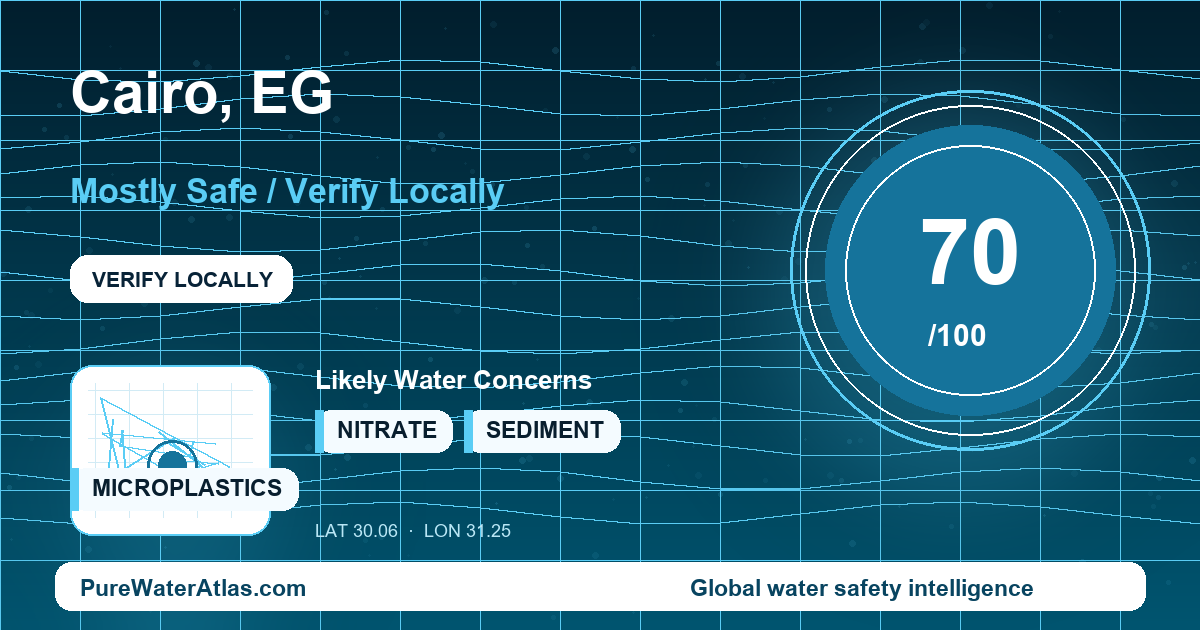
| Water safety score | 70 / 100 |
|---|---|
| Risk level | Mostly Safe / Verify Locally |
| Can you drink the tap water? | Cairo’s official municipal supply is treated and chlorinated, but drinking directly from an unknown tap is not the lowest-risk choice, especially for visitors who cannot verify the building’s tanks and plumbing. |
| Best advice for travelers | Use sealed bottled water or verified filtered water for drinking. Tap water is usually acceptable for brushing teeth in reputable hotels unless it is cloudy, rusty, smells abnormal, or you are medically vulnerable. |
| Best advice for residents | Treat the city supply as a chlorinated public supply, but verify building storage tanks, internal plumbing, and local water changes. Test if there is discoloration, illness, old plumbing, or tank storage. |
| Main water source | Treated surface water from the Nile River system and connected intake canals. |
| Water authority | Cairo Drinking Water Company, affiliated with Egypt’s Holding Company for Water and Wastewater. |
| Filter recommendation | A sediment pre-filter plus activated carbon is a practical baseline for particles, rust, chlorine taste, and odor. Add UV or lab-guided treatment when tank hygiene, microbial risk, salinity, nitrate, or metals are suspected. |
Why Cairo Is Different
Cairo is not a desert groundwater city whose public supply is mainly drawn from a local aquifer. The city sits directly on the Nile in a dense urban section of the river valley, and its core municipal drinking water is principally treated surface water from the Nile River system. That matters because Cairo’s water safety profile is shaped by large centralized treatment plants, river and canal intakes, disinfection, distribution mains, and the condition of buildings after water leaves the official network.
The most important Cairo-specific distinction is the gap between treated water leaving a municipal plant and water reaching an apartment tap. A clean, chlorinated supply can still be affected by long service lines, old internal pipes, booster pumps, pressure changes, underground or rooftop tanks, and storage practices inside individual buildings. In other words, a statement about Cairo’s official water system does not automatically prove the quality of every hotel room, apartment kitchen, rooftop tank, or private compound connection.
Cairo’s water context is also tied to the wider Nile basin. The Nile is Egypt’s dominant freshwater resource, and Cairo’s source-water security is affected by upstream river quality, population growth, wastewater management, agricultural return flows, urban runoff, industrial activity, and national Nile-basin water availability. Treatment reduces risk, but source protection and local infrastructure still matter.
Where Does Cairo’s Tap Water Come From?
Cairo’s public drinking water is primarily treated surface water from the Nile River system. Water is taken through river and canal intakes serving Greater Cairo treatment works, then processed in large conventional drinking-water treatment plants. The treatment process is based on surface-water treatment principles: clarification, filtration, and disinfection before chlorinated water is pumped into the distribution system.
Key infrastructure includes Nile River and connected canal intakes, major treatment plants, pumping stations, reservoirs, trunk mains, and neighborhood distribution networks serving Cairo Governorate. After that point, the water often passes through building-level systems such as roof tanks, underground tanks, booster pumps, risers, old pipes, fixtures, and internal storage. Those building systems can materially affect the quality at the final tap.
Historically, Cairo developed directly on the Nile and relied on the river and connected canals. Modern supply is centralized and treated. The Aswan High Dam has moderated the natural seasonal Nile flood pattern that previously influenced river conditions more strongly, so modern seasonal water-quality changes are more related to operations, source-quality pressures, repairs, tank conditions, and distribution events than to a simple annual flood cycle.
Who Manages Drinking Water in Cairo?
Cairo’s drinking-water service is operated by the Cairo Drinking Water Company. The company is affiliated with Egypt’s Holding Company for Water and Wastewater, the national holding company for public drinking-water and wastewater utilities. In the wider Greater Cairo urban area, adjacent utilities such as Giza Drinking Water and Wastewater Company may serve neighboring districts outside Cairo Governorate, so residents near administrative boundaries should confirm which utility serves their address.
Egypt’s urban drinking-water utilities operate within the national utilities framework associated with the Ministry of Housing, Utilities and Urban Communities and the Holding Company for Water and Wastewater. Sector regulation is associated with the Egyptian Water Regulatory Agency. Drinking-water health surveillance and standards are also linked to the Ministry of Health and Population.
The evidence base for Cairo is moderate rather than complete. The source-water identity, main institutions, and Nile-based treatment system are well established, but recent, easily accessible, neighborhood-level or tap-by-tap public water-quality results are limited, especially in English-language sources. That limitation is important: the existence of a treated public system does not prove that every building tank, old pipe, hotel, apartment, or temporary repair condition delivers identical water quality.
Main Local Water Concerns
The main Cairo water concern is not the absence of municipal treatment. The public supply is a treated, chlorinated surface-water system. The practical concerns are what can happen after treatment and during distribution, especially in buildings that store or re-pump water.
- Building storage tanks: Poorly maintained rooftop or underground tanks can introduce microbial contamination if covers are damaged, tanks are open to dust or animals, or cleaning and disinfection are neglected.
- Sediment and discoloration: Rust, particles, cloudy water, or colored water can occur after pipe repairs, pressure changes, service interruptions, tank disturbance, or corrosion in older internal plumbing.
- Chlorine taste and odor: Residual chlorination is necessary in a hot climate and large distribution network, but it can create strong taste or odor complaints.
- Microbial risk after storage or pressure problems: Negative pressure, unsafe household storage, dirty tanks, or open containers can increase risk even when water was properly treated upstream.
- Metals in older buildings: Older buildings may have legacy plumbing components, solder, fixtures, or stagnant sections that contribute lead or other metals. Exact risk is building-specific and requires testing.
- Source-water pressure: Nile-basin wastewater, agricultural drainage, urban runoff, and industrial activity create source-protection priorities. Treatment reduces risk, but it does not remove the need for monitoring and infrastructure management.
Seasonal and operational factors also matter. Hot weather can accelerate biological growth in poorly maintained tanks. Pipe works and pressure fluctuations can temporarily cause cloudy or colored water. Short intense rain events and urban runoff can increase drainage contamination pressure, although Cairo’s main Nile supply is treated before distribution.
For Travelers
For short-term visitors, the conservative choice in Cairo is sealed bottled water or verified filtered water for drinking. Cairo’s tap water is treated, but travelers usually cannot inspect the hotel’s plumbing, rooftop tank, underground storage, booster pumps, or maintenance history. That uncertainty is the main reason bottled or properly filtered water is recommended for drinking.
Brushing teeth with tap water is usually acceptable in reputable hotels and modern accommodations. Use bottled water instead if you have a sensitive stomach, are immunocompromised, are preparing infant formula, or notice cloudy, rusty, discolored, sewage-like, or otherwise abnormal tap water. If the water source appears to involve a visibly questionable storage tank, avoid drinking it until the building can confirm safety.
Use ice only in reputable hotels, restaurants, and cafes that are likely to use treated, filtered, or commercial ice. Avoid ice from informal street sources when the water source and handling cannot be verified. Higher-end hotels and established restaurants commonly manage drinking water through bottled water service, filtration, or controlled ice supply, but it is still reasonable to ask whether drinking water and ice are filtered.
Carry sealed bottled water during sightseeing, especially in hot weather. Avoid bottles with broken seals or signs of refilling. Do not assume that water quality in one Cairo building applies to another building nearby, because internal tanks and pipes can differ substantially.
For Residents
Residents connected to Cairo’s official network can generally view the supply as chlorinated municipal water, but household decisions should be based on building conditions. A home filter is not automatically required for every household, yet it is often practical where there is chlorine taste, visible particles, tank storage, old plumbing, or vulnerable residents.
A common baseline approach is a sediment cartridge followed by activated carbon. The sediment stage helps with rust, sand, and particles; the carbon stage helps reduce chlorine taste and odor. If water is stored in rooftop or underground tanks and microbial risk is suspected, UV treatment may be appropriate after effective filtration. Reverse osmosis should not be treated as the default solution for every Cairo home; it is more appropriate when testing indicates dissolved contaminants, high salinity, nitrate, or another issue that sediment and carbon will not solve.
Testing is strongly recommended after moving into an older building, after major plumbing work, after repeated service interruptions, or when water changes color, odor, or taste. If lead or metals are a concern, collect both first-draw and flushed samples. Basic field checks include free chlorine residual, turbidity, color, odor, pH, and electrical conductivity or TDS. Use a certified laboratory for total coliform and E. coli if the building uses roof or underground storage tanks or if residents report recurring gastrointestinal illness.
Older buildings need extra caution. Corroded internal pipes, stagnant sections, old fixtures, and unknown materials can release metals or particles. Let water run until cold after long stagnation, avoid using hot tap water for cooking or infant formula, and test if the building age or plumbing history is uncertain. Rooftop and underground tanks should be covered, screened, protected from dust and animals, cleaned and disinfected on a routine schedule, and inspected after repairs or outages.
Relevant Contaminants and Water-Quality Issues
Cairo’s most relevant water-quality issues are linked to surface-water treatment, disinfection, distribution, tanks, and old plumbing rather than a single citywide contaminant claim. Chlorine is relevant because Cairo’s treated municipal supply relies on residual disinfection, which can cause taste and odor complaints even when disinfection is protective.
Turbidity and sediment are important when water appears cloudy, colored, rusty, or particle-laden after pipe works, pressure changes, tank disturbance, or internal corrosion. These signs do not automatically identify a specific contaminant, but they are practical warning indicators that water should not be consumed until the cause is understood.
Lead is relevant mainly as a building-plumbing issue. The concern is older internal components, fixtures, solder, or stagnant first-draw water, not a blanket claim that Cairo’s treated source water contains lead. Residents in older buildings should review Lead in Drinking Water: Testing and Detection Methods for first-draw and flushed sampling guidance.
E. coli is relevant where tanks, pressure loss, unsafe storage, or plumbing intrusion may introduce microbial contamination. Nitrate is most relevant for private wells, non-network supplies, agricultural drainage concerns, or tanker and compound sources around Greater Cairo rather than as a universal claim about Cairo municipal taps. For non-network sources, see Nitrate Contamination in Drinking Water: Testing and Detection Methods.
How to Verify Your Water Quality
Because public neighborhood-level tap data for Cairo is limited, verification should happen at the actual tap, tank, or building system you use. Start with the general PureWaterAtlas guide to Drinking Water Safety, then use the Water Testing guide to choose appropriate field checks and lab tests.
For residents with storage tanks or recurring illness concerns, review Water Microbiology and consider lab testing for total coliform and E. coli. If treatment is needed, compare sediment, activated carbon, UV, and reverse osmosis options in the Water Treatment Systems guide. UV can be useful after filtration where tank-related microbial risk is suspected; see UV Water Purification: Complete Guide. Boiling can be an emergency microbial precaution after suspected contamination or interruptions; see Boiling Water Purification: Complete Guide.
Travelers comparing Cairo with other destinations can use the Global Water Quality Checker. For specific substances and symptoms, use the Contaminants Search Engine. Related PureWaterAtlas categories include Drinking Water Safety, Global Water Quality, Water Testing, and Water Microbiology.
Official and Technical Sources
- Holding Company for Water and Wastewater, Egypt — national holding company for public drinking-water and wastewater utilities.
- Cairo Drinking Water Company — local utility source for Cairo drinking-water service information and institutional identity.
- Egyptian Water Regulatory Agency — sector regulator for water and wastewater services in Egypt.
- Ministry of Housing, Utilities and Urban Communities, Egypt — national ministry responsible for utilities policy and infrastructure.
- FAO AQUASTAT Egypt Country Profile — high-authority context on Egypt’s Nile dependence and national water resources.
- WHO and UNICEF Joint Monitoring Programme, Egypt household water data — national drinking-water service access context, not a substitute for Cairo tap testing.
- CDC Travelers’ Health, Egypt — conservative food and water safety guidance for travelers.
- World Bank, Egypt water and sanitation sector context — infrastructure and water-sector context for Egypt.
Bottom Line
Cairo tap water comes mainly from the Nile River system and is treated and chlorinated through official municipal infrastructure. For residents on the Cairo network, the main question is usually not whether a central treatment system exists, but whether the building’s tanks, pumps, pipes, and fixtures preserve water quality to the final tap. For travelers, sealed bottled water or verified filtered water remains the low-risk drinking choice because building conditions are hard to verify. Brushing teeth with tap water is usually acceptable in reputable hotels, but abnormal color, odor, cloudiness, or visible storage concerns should be treated as warning signs. Cairo’s public data is sufficient to identify the system, but not enough to guarantee every neighborhood tap without local verification.
Read the full guide: Global Water Quality Guide
Explore more in this category: Global Water Quality Articles