
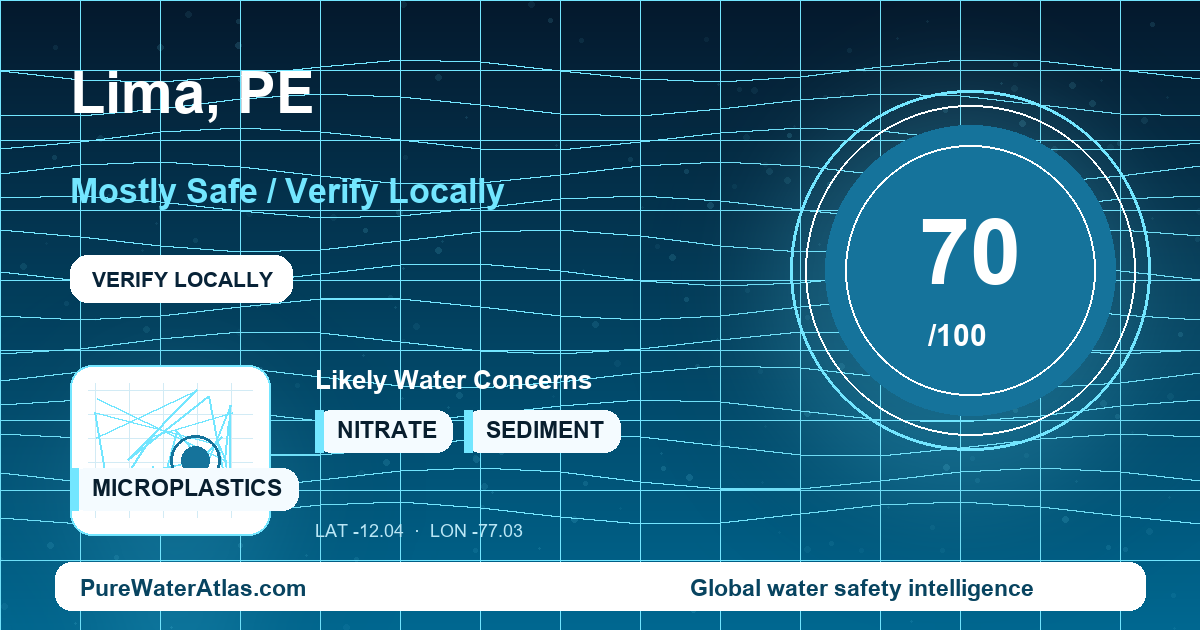
Lima tap water is generally best treated as “mostly safe but verify locally”: utility-treated water is widely supplied through SEDAPAL, but final safety can change by district, building plumbing, storage tanks, pressure history, and rainy-season turbidity events.
Quick Answer
| Overall safety status | Mostly Safe / Verify Locally. PureWaterAtlas score: 70/100. Lima tap water is most defensible for residents connected to SEDAPAL’s treated network, but building-level conditions matter. |
|---|---|
| Short answer for travelers | Most short-stay visitors should use sealed bottled water, boiled water, or properly filtered and disinfected water for drinking. This is a traveler-health precaution, not a claim that all Lima tap water is unsafe. |
| Short answer for residents | Residents on SEDAPAL service can often use tap water after checking for local alerts, maintaining tanks, flushing after interruptions, and verifying unusual taste, odor, color, sediment, or low chlorine residual where possible. |
| Main water source | Mainly treated surface water from the Rímac River basin, with additional contributions from the Chillón system and groundwater wells within the metropolitan service area. |
| Main authority | SEDAPAL is the main water and sewerage utility for Lima and Callao. SUNASS, DIGESA, and ANA are also important for regulation, health surveillance, and water-resource management. |
| Filter recommendation | A filter is not automatically required for every SEDAPAL-connected home, but many households reasonably use point-of-use treatment because tanks, old plumbing, pressure changes, and taste preferences can affect tap-level quality. |
Why Lima Is Different
Lima is not a typical rainy-city water system. It is a desert megacity on Peru’s Pacific coast, so its drinking-water security depends heavily on Andean river flow, reservoirs, aquifers, and engineered transfer works rather than local rainfall. The city historically grew around the Rímac River in an extremely arid coastal setting, and the same basic geography still defines its modern water risk: Lima must collect, treat, store, transfer, and distribute water that originates largely outside the dry urban plain.
This makes Lima’s tap-water safety more location-specific than a simple “safe” or “unsafe” label. A modern hotel connected to a maintained distribution system may have a very different risk profile from an older apartment building with a neglected rooftop tank, a home in an area affected by intermittent supply, or a property using private well water. In Lima, the “last mile” is often decisive: internal plumbing, household cisterns, rooftop tanks, pressure loss, and recent service interruptions can affect water after it has already left centralized treatment.
PureWaterAtlas classifies Lima as Mostly Safe / Verify Locally with a moderate confidence level. The city has identifiable official water institutions and major treatment infrastructure, but easily accessible, current, neighborhood-level tap-water results are limited. Public information does not support precise claims that every district, hotel, building, or tap has the same water quality.
Where Does Lima’s Tap Water Come From?
Metropolitan Lima is supplied mainly by treated surface water from the Rímac River basin. The Rímac is the critical source because it crosses the Andes-to-coast corridor that supports Lima’s principal treatment and distribution system. The city also receives supplementary water from the Chillón system and from groundwater wells operated or managed within the SEDAPAL service area.
Key infrastructure includes the La Atarjea drinking water treatment complex in the Rímac corridor, widely described as Lima’s principal potable-water production facility. Lima also has Huachipa treatment and conveyance infrastructure that was developed to strengthen service in parts of northern and eastern Lima. The metropolitan system is supported by Chillón River supply infrastructure, groundwater abstraction, Andean reservoirs, intake structures, tunnels, and transfer works associated with the upper Rímac and Marcapomacocha or Marca system.
Once treated water enters Lima’s urban network, it passes through large distribution systems, reservoirs, and in many cases building-level storage. Cisterns and rooftop tanks are especially important in practical tap-water decisions. A well-operated treatment plant and a functioning utility network can still be undermined at the tap if a building tank is dirty, open, poorly covered, or not disinfected after maintenance.
Who Manages Drinking Water in Lima?
SEDAPAL, Servicio de Agua Potable y Alcantarillado de Lima, is the main water and sewerage utility for Lima and Callao. It is the central institution residents and visitors should associate with service notices, water-supply interruptions, and utility-level infrastructure information.
Peru’s water governance is not handled by one city agency alone. SUNASS is the national sanitation services regulator and oversees utilities such as SEDAPAL. DIGESA, within Peru’s Ministry of Health, is a key health authority for drinking-water quality standards and sanitary surveillance. The Autoridad Nacional del Agua manages water resources and river-basin authority functions.
Drinking-water quality is regulated through national health rules, including Peru’s Reglamento de la Calidad del Agua para Consumo Humano, Decreto Supremo N. 031-2010-SA. For a Lima household, however, official regulation is only one part of the safety picture. Tap-level safety also depends on building maintenance and recent distribution conditions.
Main Local Water Concerns
The most important source-water issue for Lima is the condition of the Rímac and related coastal river systems. The Rímac basin is both Lima’s core water source and a heavily pressured urban, industrial, road, wastewater, solid-waste, and mining-influenced watershed. That does not mean treated water is automatically unsafe, but it does mean continuous treatment, monitoring, and upstream watershed management are essential.
Seasonality matters. January through March is the main Andean rainy season, when high river turbidity, landslides, huaicos, and treatment stress are more likely. During extreme El Niño or coastal-rainfall events, source-water quality and infrastructure reliability can deteriorate quickly. High turbidity in the Rímac and other coastal rivers has historically contributed to service interruptions or precautionary alerts, so consumers should be especially cautious after heavy-rain events, visible cloudiness, or pressure disruptions.
Distribution and building issues are also central. Intermittent supply in some peripheral areas can increase intrusion risk when pipes lose pressure and can force households to store water. Household tanks, cisterns, and rooftop storage are a major practical risk when cleaning, disinfection, covers, or screens are neglected. Old internal plumbing may add sediment, unpleasant taste, or metals at the tap, although the available public evidence is not sufficient to claim widespread lead service-line contamination across Lima.
Groundwater can be part of the metropolitan supply context, and in a coastal megacity groundwater can be affected by over-abstraction and salinity concerns in some aquifer settings. Tap-level salinity should not be generalized across Lima without local testing, especially where a property relies on a private well or a groundwater-dependent supply.
For Travelers
For most short-term travelers, the safer default in Lima is to avoid drinking untreated tap water. Use sealed bottled water, water boiled for one minute, or water treated with a reliable filter plus disinfection. This is especially sensible for visitors who are not accustomed to local water, people with sensitive stomachs, immunocompromised travelers, and families with young children. For more on boiling, see the PureWaterAtlas Boiling Water Purification: Complete Guide.
Brushing teeth with tap water is commonly lower risk in higher-standard hotels, but cautious travelers should use bottled or boiled water. The key question is not only whether the building receives treated utility water, but also whether its internal plumbing and tanks are maintained.
Use ice only in reputable hotels, restaurants, and cafes that state they use purified water or commercial ice. Avoid informal or unknown-source ice. In hotels and restaurants, ask whether drinking water and ice are filtered, purified, or supplied from sealed containers. Modern hotels and established restaurants are generally lower risk than informal venues, but storage practices still matter.
During day trips, carry bottled water. Avoid swallowing shower water if you are sensitive. Treat any water that looks cloudy, contains sediment, smells unusual, or appears after a service interruption. During heavy-rain, huaico, or service-alert periods, switch to bottled or boiled water until conditions normalize. Traveler-health guidance for Peru is also available from CDC Travelers’ Health.
For Residents
For Lima residents connected to SEDAPAL, a home filter is not automatically required in every case. However, point-of-use treatment is a reasonable choice for many households because final tap quality can be influenced by rooftop tanks, cisterns, old plumbing, intermittent pressure, and taste or chlorine preferences. A sediment prefilter plus activated carbon can improve clarity and taste. Reverse osmosis or other certified systems are more appropriate where testing shows dissolved metals, salinity, nitrate, arsenic, or another specific contaminant.
Testing is especially important if your building uses a cistern, rooftop tank, private well, or has experienced a recent service interruption. Test for total coliform and E. coli when microbial contamination is plausible. Check turbidity, residual chlorine, conductivity or total dissolved solids, and basic chemistry if the water changes color, taste, or odor. Test lead, copper, iron, and other metals if the building is old, has metallic internal plumbing, or if water has been stagnant overnight.
Old-building risk in Lima is often about internal plumbing and storage condition rather than the treated source itself. First-draw water and flushed water can differ because stagnant water may pick up sediment, metals, or taste from pipes. After plumbing repairs, flooding, tank cleaning, or loss of pressure, flush lines and consider microbiological testing before returning to normal drinking use.
Cisterns and rooftop tanks should be covered, screened, periodically drained, cleaned, and disinfected by qualified personnel. A dirty or open tank can defeat the protection provided by centralized treatment and residual disinfectant.
Relevant Contaminants and Water-Quality Issues
Several PureWaterAtlas contaminant guides are especially relevant to Lima’s practical risk profile. Turbidity is important because Andean rainy-season events can raise river cloudiness and stress treatment operations. E. coli is relevant to building tanks, pressure interruptions, and traveler gastrointestinal risk. Chlorine matters because disinfectant residual is a key protection in Lima’s distribution system.
Sediment can appear after disturbed mains, old plumbing, tank problems, or post-interruption flushing. Lead should be considered for older internal plumbing, but Lima-specific public information does not support broad claims of citywide lead service-line contamination. Residents in older homes can also use Lead in Drinking Water: Testing and Detection Methods to understand sampling strategy.
For households focused on microbial control, UV Water Purification: Complete Guide can be useful, particularly when paired with filtration for cloudy water. UV and disinfection methods work best when turbidity and particles are controlled first.
How to Verify Your Water Quality
The most reliable Lima-specific decision is local verification. Start with current SEDAPAL service notices, building management information, and visible tap conditions. If water is cloudy, has sediment, smells unusual, or appears after pressure loss, do not assume it is safe to drink untreated. Flush, use bottled or boiled water temporarily, and test if the condition persists.
For a broader framework, use the PureWaterAtlas Drinking Water Safety guide, the Water Testing guide, and the Water Purification guide. You can also compare city-level guidance with the Global Water Quality Checker and research specific substances in the Contaminants Search Engine.
Data limitations matter in Lima. Official institutions and infrastructure are well identified, but current neighborhood-level tap-water datasets are not as easily accessible as in some cities. Public sources do not prove that every district, hotel, or building has the same water quality. For individual decisions, test the water you actually drink.
Official and Technical Sources
- SEDAPAL — main drinking-water and sewerage utility for Lima and Callao.
- SUNASS — Peru’s national sanitation services regulator.
- DIGESA, Ministerio de Salud del Perú — health authority involved in drinking-water standards and sanitary surveillance.
- Reglamento de la Calidad del Agua para Consumo Humano, Decreto Supremo N. 031-2010-SA — national drinking-water quality regulation framework.
- Autoridad Nacional del Agua — official water-resources and river-basin authority.
- World Bank Peru resources — context for water security, infrastructure, and service challenges.
- CDC Travelers’ Health: Peru — traveler-oriented food and water precautions.
- WHO Guidelines for Drinking-water Quality — international reference for microbial safety, turbidity, disinfection, and household treatment principles.
Bottom Line
Lima tap water is best classified as mostly safe for many residents on SEDAPAL’s treated network, but not something to judge citywide without local verification. The main supply comes from the Rímac River basin, supported by the Chillón system, groundwater, treatment plants, reservoirs, and Andean transfer infrastructure. The biggest practical uncertainties are rainy-season turbidity, service interruptions, intermittent pressure, old internal plumbing, and building storage tanks. Short-stay visitors should generally drink sealed bottled, boiled, or properly treated water. Residents should maintain tanks, watch for alerts, flush after interruptions, and test when using cisterns, rooftop tanks, old plumbing, private wells, or water with unusual color, odor, sediment, or taste.
Read the full guide: Global Water Quality Guide
Explore more in this category: Global Water Quality Articles