
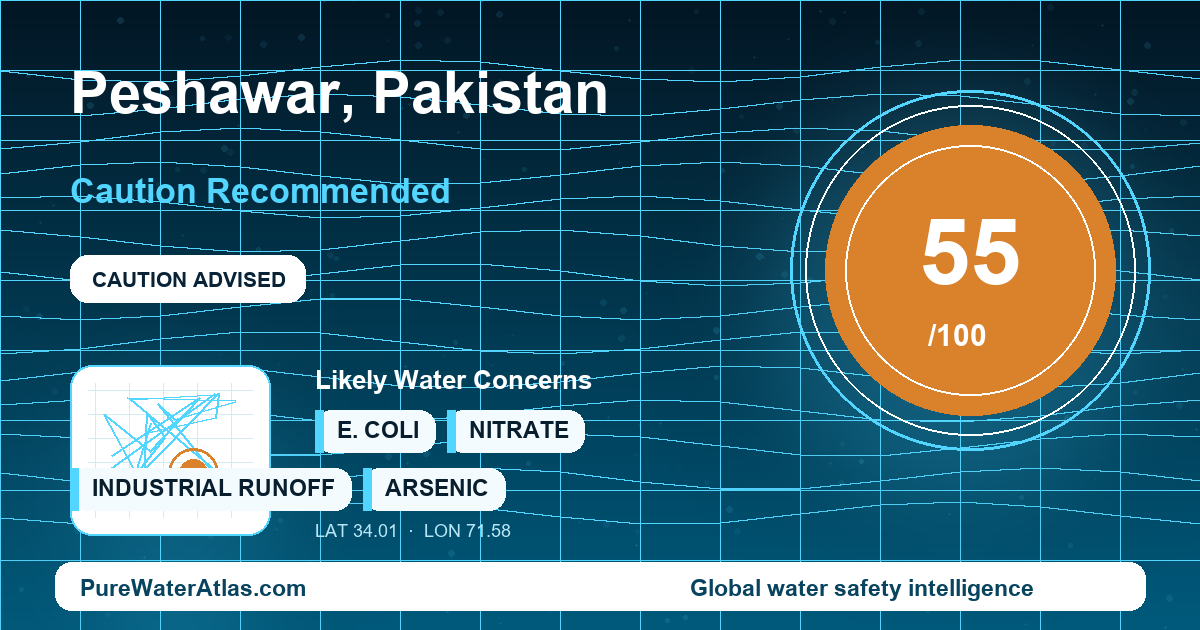
Peshawar, Pakistan: groundwater-based urban supply, intermittent distribution risk, household storage concerns, and practical drinking-water precautions for visitors and residents.
Quick Answer
| Overall safety status | Caution recommended. Peshawar tap water should not be treated as reliably safe for drinking without treatment, especially at the consumer tap. |
|---|---|
| Water safety score | 55 / 100 — risk level: Caution Recommended. |
| Traveler advice | Do not rely on untreated tap water. Use sealed bottled water, boiled water, or water treated by a reliable purifier. Be careful with ice and raw foods washed in tap water. |
| Resident advice | Treat municipal, bore, or stored water before drinking unless recent local testing confirms microbiological safety and acceptable chemistry at your kitchen tap. |
| Main water source | Primarily groundwater from the Peshawar Basin alluvial aquifer, abstracted through municipal tube wells and distributed through public water networks. |
| Main authority | Water and Sanitation Services Peshawar, commonly known as WSSP, is the main urban water and sanitation service provider for Peshawar’s notified service area. |
| Filter recommendation | At minimum, use a microbiological barrier such as UV or ultrafiltration with sediment prefiltration. Reverse osmosis is appropriate where testing shows high TDS, nitrate, arsenic, fluoride, or other dissolved contaminants. |
Why Peshawar Is Different
Peshawar is not best understood as a city with one continuously treated, centrally controlled surface-water supply reaching every household in the same condition. Its urban drinking-water supply is commonly understood to depend mainly on groundwater from the Peshawar Basin aquifer, pumped through tube wells and distributed through public networks. That makes local geology, bore depth, pipe condition, pumping reliability, and household plumbing more important than in cities where most drinking water passes through a single large treatment plant before continuous pressurized delivery.
The city sits in the Peshawar Valley of Khyber Pakhtunkhwa, within an alluvial groundwater basin influenced by the Kabul River system, the Bara River, canals, urban recharge, and surrounding agricultural and built-up land uses. Those regional water systems matter for recharge and basin hydrology, but most city tap water should not be described as a conventional continuously treated surface-water supply. This distinction matters because groundwater can vary by neighborhood, source, and depth, while the safety of delivered water also depends heavily on distribution and storage.
Peshawar’s practical risk is not only the aquifer. The more immediate household risk is the chain between source and glass: intermittent supply, low-pressure episodes, old or damaged pipes, nearby drains or sewers, household underground tanks, rooftop tanks, and private boreholes or suction pumps. When water lines depressurize, contaminated water can be drawn through leaks, cross-connections, or damaged joints. A household can therefore receive water that was acceptable at one point in the system but unsafe after distribution or storage.
Where Does Peshawar’s Tap Water Come From?
Peshawar’s urban drinking water is primarily groundwater from the Peshawar Basin alluvial aquifer, abstracted through municipal tube wells. From there, water moves through distribution mains, neighborhood supply lines, and, in some places, overhead or service reservoirs. At the property level, many buildings use underground or rooftop storage tanks because supply may not be continuous. Some households and peri-urban users also rely on private boreholes, hand pumps, tanker water, or stored water.
This mixed supply pattern is a major reason water quality can vary from one building to another. A municipal connection, a private borehole, and tanker-filled storage may each have different microbial and chemical risks. Even within the same neighborhood, a clean storage tank and a dirty uncovered tank can produce very different drinking-water quality. In older or high-density parts of the city, distribution lines and drains may run close together, increasing the importance of pressure management and pipe integrity.
Historically, Peshawar developed around river, canal, and groundwater resources in the Peshawar Valley. Today, those older water-use patterns overlap with formal public networks and private building-level systems. This is why a blanket claim that all Peshawar tap water is safe, or all of it is unsafe in the same way, would be misleading. The safer conclusion is that untreated tap or bore water should not be used for drinking unless recent testing at the point of use confirms safety.
Who Manages Drinking Water in Peshawar?
The main urban water and sanitation service provider for Peshawar’s notified service area is Water and Sanitation Services Peshawar. Other public bodies may be relevant depending on jurisdiction, especially for provincial, rural, peri-urban, or infrastructure schemes. These include Khyber Pakhtunkhwa local government institutions and the Khyber Pakhtunkhwa Public Health Engineering Department.
Drinking-water quality in Pakistan is framed by national standards and public-health guidance, while provincial and local agencies are responsible for implementation. The Pakistan Council of Research in Water Resources has carried out national and city water-quality monitoring, and the Pakistan Environmental Protection Agency is relevant to the national environmental standards context. International references such as the WHO Guidelines for Drinking-water Quality provide the public-health framework for interpreting microbial and chemical risks.
Data limitations are important. There is credible city-relevant information on Peshawar’s groundwater-based supply model, WSSP’s role, and common contamination pathways. However, publicly available data do not provide a current, comprehensive, independently audited neighborhood map of residual chlorine, E. coli, nitrate, arsenic, metals, TDS, and other parameters across all seasons and building types. Conditions can differ between municipal supply, private boreholes, tanker water, old buildings, and household storage tanks.
Main Local Water Concerns
The most important Peshawar concern is microbiological contamination at or near the consumer tap. Intermittent supply, pipe leaks, low pressure, sewer or drain intrusion, and unclean household tanks can allow fecal indicator organisms such as total coliforms and E. coli to appear in drinking water. This is the main short-term health risk for residents and the main reason short-term visitors should avoid untreated tap water.
Turbidity and sediment are also practical concerns. Water can become cloudy or discolored after pipe repairs, low-pressure events, maintenance, service interruptions, or disturbance of old distribution lines. High turbidity can reduce the effectiveness of disinfection and make UV treatment less reliable unless prefiltration is used. Sediment can also accumulate in household storage tanks and plumbing.
Residual disinfection may be variable in parts of the system. Adequate chlorine residual helps control microbial regrowth in distribution networks and storage, but inconsistent disinfection or long storage times can reduce protection by the time water reaches a kitchen tap.
Chemical concerns are more localized and should be confirmed by testing. Nitrate can be a risk where groundwater is influenced by sewage infiltration, drains, on-site sanitation, livestock areas, or agriculture. Groundwater may also vary in TDS, hardness, salinity, iron, or manganese depending on bore depth and neighborhood geology. Arsenic is a known groundwater concern in parts of Pakistan, but Peshawar-specific risk should be verified rather than assumed. Lead and other plumbing-related metals are best treated as building-specific risks, especially in older properties, not as confirmed citywide source-water conditions.
Season also matters. Monsoon rain and urban flooding can increase contamination risk by overwhelming drains and moving polluted water into shallow or damaged systems. Hot weather can increase bacterial regrowth in rooftop tanks and long household plumbing runs. Power outages or pump interruptions can create low-pressure conditions, increasing intrusion risk. After maintenance, pipe breaks, or long service interruptions, first-flush water may be turbid or discolored and should not be consumed without treatment.
For Travelers
Visitors should not drink untreated tap water in Peshawar as a default. Use sealed bottled water from a reputable source, water that has been brought to a rolling boil, or water treated by a reliable purifier. Check that bottled-water caps are intact. For hot drinks, boiling is useful only if the water was actually brought to a rolling boil before use. See the PureWaterAtlas Boiling Water Purification: Complete Guide for when boiling is appropriate.
Use bottled or boiled water for brushing teeth if you are a short-term visitor, immunocompromised, pregnant, elderly, or traveling with young children. Long-term residents may be more accustomed to local exposures, but that does not prove the water is safe.
Avoid ice unless a reputable hotel or restaurant can confirm it is made from treated or bottled water. Ice from street vendors or unknown sources should be considered unsafe. In small restaurants and street settings, choose sealed drinks and avoid raw foods that may have been washed in tap water if you are sensitive. Higher-end hotels may provide bottled water or in-house filtration, but travelers should still ask whether drinking water and ice are treated.
For longer stays, use a purifier that includes a microbiological barrier such as UV, ultrafiltration, or properly maintained reverse osmosis. UV can be effective for microbes when water is clear enough and the system is maintained; PureWaterAtlas explains this in the UV Water Purification: Complete Guide. If diarrhea occurs, use oral rehydration salts promptly and avoid further exposure to untreated water.
For Residents
For most Peshawar households, drinking-water treatment is usually needed. A practical setup for municipal water with acceptable chemistry is sediment prefiltration followed by UV or ultrafiltration to address microbial risk. Reverse osmosis is worth considering where testing shows high TDS, nitrate, arsenic, fluoride, or other dissolved contaminants. RO systems should be maintained carefully, and remineralization may be needed for taste.
Residents should test water at the actual kitchen tap, not only at the tube well, building inlet, or storage tank. Testing should include E. coli and total coliforms after pipe breaks, flooding, tank cleaning, long outages, or periodically for routine assurance. Basic measurements should include turbidity, pH, electrical conductivity, TDS, hardness, and residual chlorine. Nitrate testing is especially relevant for private bores, shallow groundwater, peri-urban supply, or areas near drains, septic systems, livestock, or agriculture.
Private borehole users should also consider testing for arsenic, fluoride, iron, manganese, and other metals, especially if water has staining, metallic taste, or unexplained changes. In older buildings, first-draw and flushed samples for lead and copper can help identify plumbing-related metals. Use an accredited laboratory where possible, such as a recognized public-health, university, PCRWR-associated, or certified private water-quality laboratory.
Storage tanks deserve special attention in Peshawar. Clean and disinfect underground and rooftop tanks regularly, keep lids sealed, prevent insects and dust from entering, and avoid direct cross-connections between tanker water, bore water, and municipal supply. Stored water should be treated again at the point of drinking if tank hygiene is uncertain. Older buildings can add risk through corroded pipes, old fittings, stagnant plumbing, cross-connections, and dirty underground tanks.
Relevant Contaminants and Water-Quality Issues
The most relevant contaminant profile for Peshawar is E. coli, because intermittent supply, sewage intrusion, and storage-tank contamination can create direct microbial health risk. Related background is available in PureWaterAtlas’s Water Microbiology guide.
For cloudy or dirty-looking water after outages, repairs, or tank disturbance, review turbidity and sediment. These are not just appearance issues; they can interfere with disinfection and indicate disturbance in the water system.
For private boreholes and shallow groundwater, nitrate deserves attention, particularly where drains, sewage, livestock, agriculture, or on-site sanitation may influence groundwater. PureWaterAtlas also provides a dedicated guide to nitrate testing and detection. For groundwater users who want to check regional chemical risks without assuming contamination, see Arsenic in Drinking Water: Testing and Detection Methods. For older buildings, the Lead in Drinking Water testing guide is relevant.
How to Verify Your Water Quality
The best next step in Peshawar is not a generic filter purchase; it is testing the water you actually drink. Start with the PureWaterAtlas Water Testing guide, then match the treatment method to the results. The broader Drinking Water Safety guide explains how to judge whether tap water is safe enough to drink, while the Water Purification guide compares boiling, filtration, UV, and RO.
Residents and travelers can also use the Global Water Quality Checker to compare Peshawar with other destinations and plan precautions. If your lab report lists a contaminant you do not recognize, use the Contaminants Search Engine. Relevant PureWaterAtlas categories include Drinking Water Safety, Water Testing, Water Microbiology, and Water Purification.
Official and Technical Sources
- Water and Sanitation Services Peshawar — official urban water and sanitation service provider for Peshawar’s notified service area.
- Khyber Pakhtunkhwa Public Health Engineering Department — provincial institution relevant to water-supply and sanitation infrastructure.
- Pakistan Council of Research in Water Resources — national research and monitoring authority for drinking-water and groundwater quality.
- Pakistan Environmental Protection Agency — national environmental authority connected with Pakistan’s standards framework.
- Asian Development Bank: Khyber Pakhtunkhwa Cities Improvement Project — project documentation relevant to urban infrastructure improvement needs.
- CDC Travelers’ Health: Pakistan — conservative food and water precautions for travelers.
- WHO Guidelines for Drinking-water Quality — international public-health reference for microbial and chemical drinking-water risks.
- UNICEF and WHO Joint Monitoring Programme: Pakistan country data — national WASH context, not neighborhood-level Peshawar compliance data.
Bottom Line
Peshawar tap water deserves caution because the city’s supply is largely groundwater-based and final water quality depends on tube wells, distribution pressure, pipe condition, disinfection, building plumbing, and household storage tanks. Untreated tap water is not a good default for visitors; use sealed bottled water, boiled water, or a verified purifier, and avoid unsafe ice. Residents should treat drinking water unless recent testing at the kitchen tap confirms microbial safety and acceptable chemistry. A sediment prefilter plus UV or ultrafiltration is a practical baseline for many homes, while reverse osmosis is appropriate when testing shows dissolved contaminants such as high TDS, nitrate, arsenic, or fluoride. Because neighborhood-level public compliance data are limited, household testing and tank hygiene are essential in Peshawar.
Read the full guide: Global Water Quality Guide
Explore more in this category: Global Water Quality Articles