Taipei’s municipal supply is generally well treated and supported by the Feitsui Reservoir system, but the practical drinking-water question often depends on the building: rooftop tanks, basement cisterns, old pipes, stagnant plumbing, and storm-related turbidity can change what reaches the tap.
Quick Answer
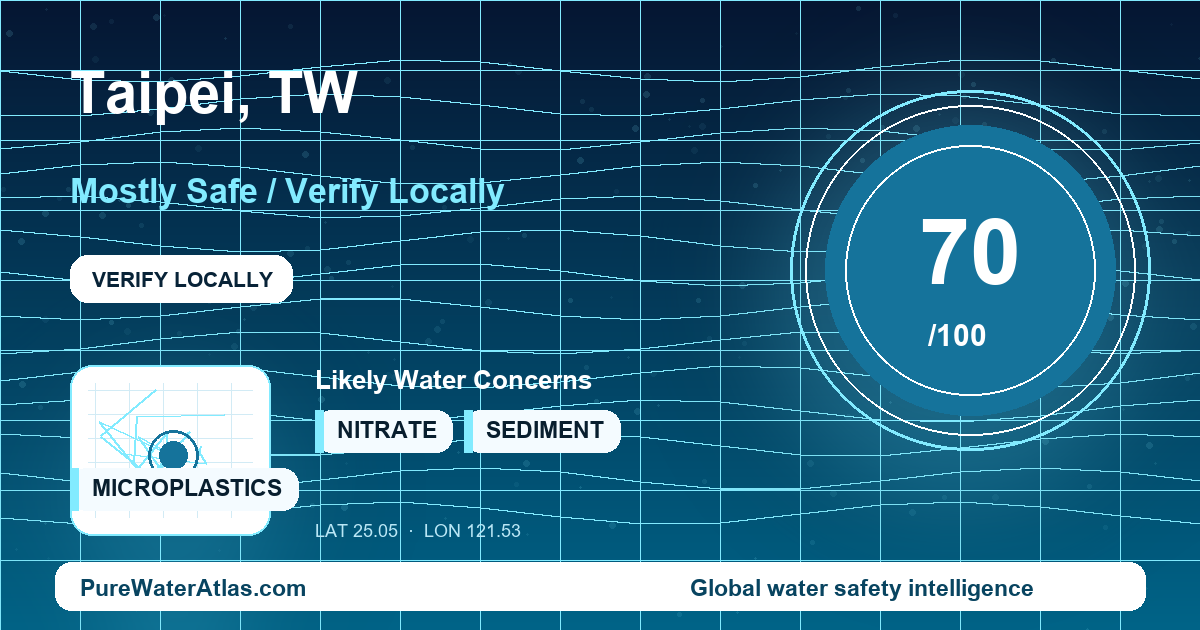
| Overall status | Mostly Safe / Verify Locally. PureWaterAtlas safety score: 70/100. |
|---|---|
| Can you drink it? | At the municipal utility level, Taipei tap water is generally treated to a high standard and is usually considered potable. At the household or hotel tap, safety depends on building plumbing, tanks, and maintenance. |
| Traveler advice | Use tap water for washing, brushing teeth, and boiling. For direct cold-water drinking, choose bottled water, boiled tap water, or hotel-filtered water unless the hotel confirms its tanks and internal plumbing are maintained for potable use. |
| Resident advice | Verify your building. Clean storage tanks, maintained pipes, periodic flushing, and tap-specific testing matter, especially in older apartments. |
| Main source | The Xindian River basin, especially water regulated by Feitsui Reservoir on the Beishi River, with the Beishi, Nanshi, and Xindian river system feeding Greater Taipei. |
| Water authority | Taipei Water Department, Taipei City Government; Feitsui Reservoir is managed by Taipei Feitsui Reservoir Administration. |
| Filter recommendation | Not automatically required for every home. Consider certified filtration if the building is old, tank maintenance is uncertain, water has sediment or metallic taste, or vulnerable residents live in the home. |
Why Taipei Is Different
Taipei is not a city where the main drinking-water concern is a known broad failure of the municipal source. The city benefits from a mountainous, inland source-water system centered on the Xindian River basin and the Feitsui Reservoir. That gives Taipei a stronger source-water identity than cities relying heavily on shallow groundwater, polluted urban rivers, coastal intakes, or desalination.
The reason Taipei still requires a cautious, local answer is that the water’s final journey is often through private building infrastructure. Many apartments, hotels, and commercial buildings use rooftop tanks, basement cisterns, booster pumps, and internal premise pipes. A clean municipal supply can be degraded after it enters a building if tanks are dirty, uncovered, cracked, poorly sealed, or rarely cleaned. Older pipes and stagnant branches can also add sediment, rust-colored water, metallic taste, or other building-level risks.
Taipei also sits in a humid basin downstream of steep mountain catchments. Protected mountain reservoir water is an advantage, but steep watersheds can produce rapid runoff during typhoons and intense rain. During such periods, raw-water turbidity can rise and treatment demand can increase. Consumers should pay attention to Taipei Water Department notices if discoloration, cloudy water, or service alerts occur.
Where Does Taipei’s Tap Water Come From?
Taipei’s main municipal raw-water system is the Xindian River basin, especially water regulated by the Feitsui Reservoir on the Beishi River in New Taipei City. The Beishi, Nanshi, and Xindian river system supports much of the Greater Taipei water supply. This is a mountainous inland catchment system, not a coastal salinity-prone or desalination-based system. Based on the available dataset, there is no strong evidence of a broad salinity problem in Taipei’s main municipal supply.
Feitsui Reservoir is the key upstream storage and source-water protection asset for Taipei. Before it became the central strategic source for Greater Taipei, the city was more dependent on river flows and smaller local sources, making drought resilience and high-turbidity storm events harder to manage. Feitsui Reservoir was built to stabilize both quantity and quality for the Taipei metropolitan area.
Major treatment infrastructure includes Taipei Water Department purification facilities connected to the Xindian River raw-water system, including facilities such as Zhitan and Gongguan treatment works. However, the public treatment system is only part of the safety chain. The distribution system includes public mains, but many final-use points depend on private storage tanks, booster pumps, and internal pipes that are outside the meaning of citywide source-water quality.
Who Manages Drinking Water in Taipei?
The local drinking-water utility is the Taipei Water Department, part of Taipei City Government. It supplies Taipei City and parts of New Taipei City, publishes service information, and is the primary local source for Taipei water-quality and service notices. The reservoir asset that underpins much of the city’s source water is managed by the Taipei Feitsui Reservoir Administration.
Drinking water in Taiwan is regulated nationally under the Drinking Water Management Act and related Drinking Water Quality Standards. National environmental policy and regulatory context are overseen by Taiwan’s Ministry of Environment, with local implementation and monitoring responsibilities.
A key limitation is important: utility-level compliance data should not be assumed to prove the safety of every kitchen faucet, apartment tank, hotel plumbing system, or rooftop cistern. Taipei has identifiable official sources and a well-defined municipal supply system, but citywide public data cannot fully describe the condition of each private building. PureWaterAtlas therefore treats Taipei as mostly safe at the municipal level, with building-specific verification recommended.
Main Local Water Concerns
Building tanks and internal plumbing are the central local concern. Rooftop and basement storage tanks should be treated as part of the drinking-water system. If lids, vents, overflow screens, pump rooms, or cleaning schedules are neglected, tanks can become pathways for insects, dust, rainwater intrusion, sediment, odor, and microbial contamination.
Older buildings can add uncertainty after the utility main. Aging internal pipes, old fixtures, solder, valves, corrosion, or stagnant branches can introduce metals, rust, sediment, and taste problems after water has already left the municipal system. Residents should not infer household metal levels from utility source-water data alone.
Typhoons and heavy rain can create short-term turbidity challenges. Taipei’s steep mountain catchments can send rapid runoff into the raw-water system during intense rainfall. This does not mean the municipal supply is broadly unsafe, but it does mean consumers should watch for official notices and avoid drinking visibly discolored water until it runs clear and no advisory is active.
Chlorine taste or odor can occur. Residual disinfectant helps protect water in the distribution network, but it may be noticeable, especially after operational adjustments or in some parts of the system. In many cases this is a palatability issue rather than proof of unsafe water.
Boiling is common, but it has limits. Boiling tap water can help address microbial uncertainty from tanks and building plumbing. It can also reduce chlorine taste after the boiled water cools in a clean, covered container. Boiling does not remove metals such as lead and does not remove many industrial chemicals.
For Travelers
For most short-stay visitors in Taipei, tap water is generally acceptable for washing, showering, and brushing teeth. In modern hotels, major restaurants, serviced apartments, and well-managed properties, the practical risk is lower because these places are more likely to maintain water storage, filtration, or drinking-water dispensers. Still, if you plan to drink cold tap water directly, ask whether the hotel’s potable-water tanks and internal plumbing are maintained and whether drinking water is filtered or boiled.
A conservative rule for visitors is: use tap water freely for washing and boiling, but drink cold water only from a reliable hotel tap, filtered-water station, boiled-water source, or sealed bottle. This is especially sensible in older guesthouses, unknown short-term apartments, or buildings where you see sediment, rust color, odor, or stagnant fixtures.
Brushing teeth with tap water is generally acceptable for most travelers in Taipei. People who are immunocompromised, traveling with infants, or highly risk-averse can use bottled or boiled water, particularly in older buildings. Hot drinks made with boiled tap water are a practical lower-risk option.
Ice in established hotels, chain cafes, and busy restaurants is usually lower risk. Avoid ice from street vendors or unknown sources if you have a sensitive stomach or cannot verify that the ice was made from treated water in sanitary equipment. If you arrive after a typhoon, flood, water-main work, or visible discoloration, do not drink the water until it runs clear and there is no official advisory in place.
For Residents
Residents can usually rely on the Taipei Water Department supply as the starting point, but household safety depends on the building. Ask your building manager how often potable-water tanks are cleaned, whether inspection records are available, whether tank lids and vents are sealed and screened, and whether potable-water tanks are separated from non-potable service systems.
A home filter is not automatically required in every Taipei household. It becomes more sensible when the building is old, pipe materials are unknown, tank maintenance is poorly documented, water has sediment or metallic taste, or vulnerable residents live in the home. Infants, pregnant people, elderly people, and immunocompromised residents justify a lower tolerance for uncertainty.
Choose treatment based on the problem. Activated carbon can improve chlorine taste and reduce many organic compounds. Systems certified for lead reduction, including NSF/ANSI 53-type or reverse-osmosis-style NSF/ANSI 58-type approaches, are more relevant when older plumbing or fixtures are the concern. UV can help with microbial inactivation only when the water is clear and turbidity or sediment is controlled first. Boiling is useful for microbial risk, but it is not a lead-removal strategy.
Testing should be performed at the kitchen tap, not only at the building inlet. Consider laboratory testing for lead and other metals where plumbing is old, water has been stagnant overnight, or you notice metallic taste or blue-green staining. After tank cleaning, pipe work, or unexplained discoloration, check turbidity, odor, color, and residual chlorine before resuming normal drinking use.
Relevant Contaminants and Water-Quality Issues
Several water-quality topics are especially relevant to Taipei’s local risk profile. Chlorine in drinking water matters because disinfectant residual can cause taste or odor complaints while helping protect the distribution system. Turbidity in drinking water is important during typhoons, heavy rainfall, and rapid runoff in the Xindian River and Feitsui watershed system.
Sediment in drinking water is relevant to internal pipe corrosion, apartment tanks, and temporary disturbance after water-main or building plumbing work. Lead in drinking water is a premise-plumbing issue: even when municipal source water is well treated, older internal pipes, solder, fixtures, or stagnant lines can affect the water at a kitchen tap. E. coli in drinking water is relevant where poorly maintained storage tanks, cisterns, or intrusion pathways create microbial risk after treatment.
How to Verify Your Water Quality
The best verification strategy in Taipei is to separate municipal-system questions from building-specific questions. For official supply, service, and local notices, consult the Taipei Water Department. For a home, apartment, or hotel, look at the tap itself: water should be clear, without persistent sediment, rust color, unusual odor, or metallic taste. Flush stagnant lines after long absences, holidays, or low-occupancy periods before using water for drinking or cooking.
PureWaterAtlas resources can help you choose the next step. Start with the Drinking Water Safety framework, then use the Water Testing guide if you need laboratory confirmation at your kitchen tap. For treatment choices, compare boiling, carbon, reverse osmosis, and UV in the Water Purification guide.
If your concern is microbial risk from a tank, read the Water Microbiology guide, the Boiling Water Purification guide, and the UV Water Purification guide. For older apartments, see Lead in Drinking Water: Testing and Detection Methods and Lead in Drinking Water: Best Filters, Systems and Solutions. You can also search specific substances in the PureWaterAtlas Contaminants Search Engine or compare destinations with the Global Water Quality Checker.
Official and Technical Sources
- Taipei Water Department official website — primary local utility source for Taipei water supply, water-quality information, service notices, and consumer guidance.
- Taipei Feitsui Reservoir Administration official website — official source for Feitsui Reservoir, the key source-water storage system supporting Taipei’s municipal supply.
- Drinking Water Management Act — Taiwan’s national legal framework for drinking-water management.
- Ministry of Environment, Taiwan — national environmental authority responsible for drinking-water regulatory policy and environmental protection context.
- CDC Yellow Book: Water Disinfection for Travelers — traveler guidance on boiling, filtration, disinfection, and risk reduction when premise plumbing is uncertain.
- WHO Guidelines for Drinking-water Quality — international reference for drinking-water risk management, microbial safety, chemical contaminants, and multiple-barrier protection.
Bottom Line
Taipei’s tap water is generally strong at the municipal level because it is supplied by a treated system supported by the Feitsui Reservoir and Xindian River basin. The main caution is the last leg: older building pipes, rooftop tanks, basement cisterns, pumps, and stagnant internal plumbing. Travelers can usually brush teeth and use tap water for boiling, but bottled, boiled, or hotel-filtered water is the conservative choice for cold drinking unless building maintenance is confirmed. Residents should verify tank cleaning, inspect for sediment or metallic taste, and test kitchen tap water in older apartments. During typhoons, heavy rain, discoloration, or water-main work, follow Taipei Water Department notices and avoid drinking visibly affected water.
Read the full guide: Global Water Quality Guide
Explore more in this category: Global Water Quality Articles