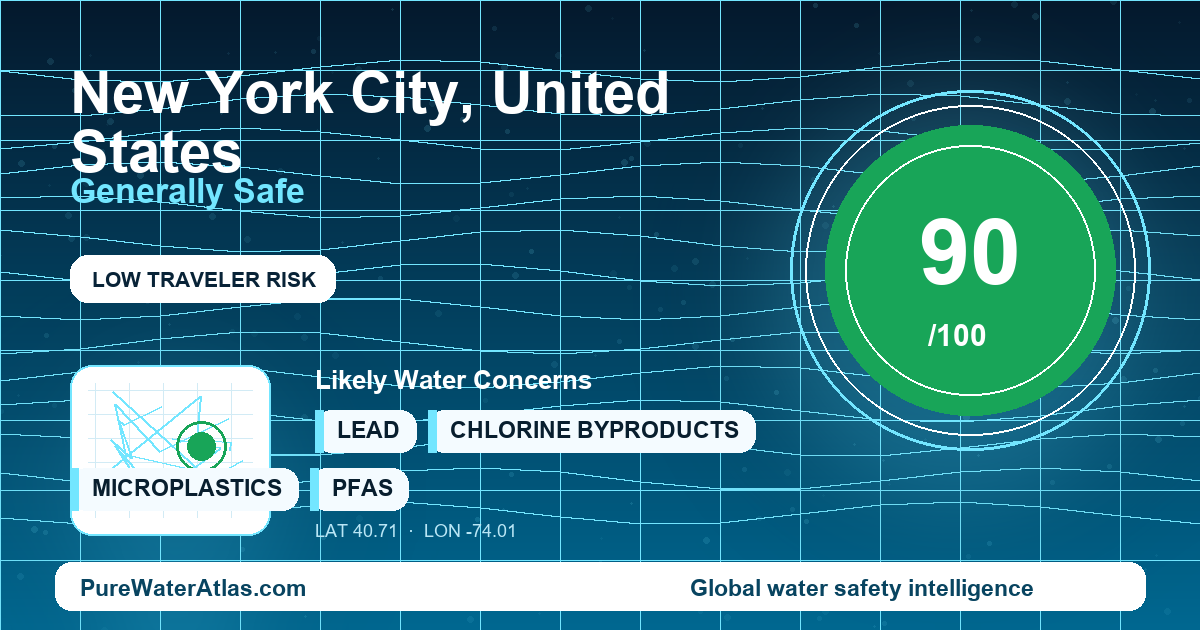
New York City tap water is generally safe to drink, with a strong protected upstate reservoir supply and well-documented public reporting; the most important safety questions are usually building-specific issues such as lead plumbing, stagnation, and rooftop water tanks.
Quick Answer
| Overall safety status | Generally safe. New York City tap water is among the better-documented large municipal supplies in the United States and is regulated under federal and state drinking-water rules. |
|---|---|
| Water safety score | 90 / 100 |
| Risk level | Generally Safe |
| Can travelers drink it? | Yes. Most visitors can drink NYC tap water, brush teeth with it, use it for coffee and tea, and accept ice in normal hotels, restaurants, bars, and cafes. |
| Resident advice | The citywide supply is strong, but individual tap quality can depend on service-line material, old building plumbing, rooftop tanks, stagnation, and maintenance. |
| Main water source | Protected upstate surface-water reservoirs in the Catskill, Delaware, and Croton watersheds; not the Hudson River, East River, harbor water, or seawater. |
| Water authority | New York City Department of Environmental Protection, commonly NYC DEP. |
| Is a home filter needed? | Not universally. A filter may be useful for taste or for lead risk in older buildings. For lead, use an NSF/ANSI 53-certified lead-reduction filter and maintain it as directed. |
Why New York City Is Different
New York City is unusual among global megacities because much of its drinking water comes by gravity from protected mountain watersheds far outside the city. The core city-specific fact is that the normal drinking-water source is not the Hudson River near Manhattan, the East River, New York Harbor, or desalinated seawater. It is primarily upstate surface water from the Catskill, Delaware, and Croton watershed systems.
The overall verdict is favorable: New York City tap water is generally safe to drink and is supported by extensive source-water protection, disinfection, ultraviolet treatment, corrosion control, monitoring, and annual public reporting. The most important caveat is the last stretch of the system. Once water enters old urban infrastructure, water quality can be affected by lead service lines, older internal plumbing, lead solder, brass fixtures, long stagnation periods, and building-level storage.
This distinction matters. NYC’s mountain-reservoir supply can meet drinking-water standards at the municipal level while an individual apartment faucet can still have a building-specific issue. This is why PureWaterAtlas treats New York City as a strong citywide supply with a practical household-level warning, especially for older homes, unknown service-line material, rooftop tank buildings, infants, pregnancy, and immunocompromised residents.
Where Does New York City’s Tap Water Come From?
New York City drinking water is supplied mainly by a large upstate surface-water system made up of the Catskill, Delaware, and Croton watersheds. In typical years, the Catskill and Delaware systems provide most of the city supply. These systems operate under a federal filtration avoidance framework rather than conventional filtration, supported by watershed protection, reservoir management, disinfection, ultraviolet treatment, and continuous monitoring. Croton water is treated at the Croton Water Filtration Plant.
Important pieces of the system include Catskill watershed reservoirs such as Ashokan and Schoharie, Delaware watershed reservoirs including Cannonsville, Pepacton, Neversink, and Rondout, and the Croton watershed reservoirs and controlled lakes. Water also passes through major infrastructure such as Kensico Reservoir in Westchester County, the Catskill-Delaware Ultraviolet Disinfection Facility, Hillview Reservoir in Yonkers, and a vast network of aqueducts, tunnels, shafts, water mains, service lines, building plumbing, and rooftop tanks in many taller buildings.
Historically, New York City expanded its water sources as the city grew: local wells and ponds came first, then the Croton system in the 19th century, followed by the Catskill and Delaware systems. Some areas of Queens once used local groundwater systems before full integration into the citywide surface-water supply. That history helps explain infrastructure complexity, but it does not describe the normal present-day source for most NYC taps.
Who Manages Drinking Water in New York City?
The municipal drinking-water system is operated by the New York City Department of Environmental Protection, commonly NYC DEP. DEP manages the source-water system, watershed protection program, treatment facilities, distribution system, monitoring program, and the annual Drinking Water Supply and Quality Report.
New York City drinking water is regulated under the federal Safe Drinking Water Act. Oversight involves the U.S. Environmental Protection Agency and the New York State Department of Health, with NYC DEP acting as the water supplier. The Catskill and Delaware systems have a federal filtration avoidance status, which is a formal regulatory framework with conditions; it is not simply “untreated” water. The Croton supply is filtered.
Building owners also matter. Internal plumbing and rooftop storage tanks are not the same as the upstate reservoir system. Many taller NYC buildings pump water to rooftop wooden or steel tanks and then distribute it by gravity to apartments. These tanks are privately maintained and subject to inspection and reporting requirements, so a resident’s tap can be influenced by building-level conditions even when water entering the building meets standards.
Main Local Water Concerns
Lead is the main household-level concern in New York City. Lead can enter tap water from lead service lines, old building plumbing, lead solder, brass fixtures, and stagnant water. The concern is property-specific rather than a sign that the protected reservoir source is broadly contaminated. Residents in older buildings or homes with unknown service-line material should take lead risk seriously, especially if there are young children, pregnancy, or medically vulnerable household members.
Turbidity is an important system-management issue. Because the Catskill and Delaware supplies are largely unfiltered under a filtration avoidance framework, turbidity is closely managed through watershed controls, reservoir operations, treatment, and monitoring. Heavy rain, snowmelt, and storms can increase runoff, natural organic matter, and turbidity pressure in source waters.
Rooftop tanks can create building-specific issues. In many buildings over roughly six stories, water is pumped to rooftop tanks before reaching apartments. If these tanks are not properly inspected, cleaned, covered, and maintained, they can contribute to microbial, sediment, taste, or odor complaints at the building level.
Chlorine taste or odor can be noticeable. NYC water is disinfected for distribution, and some residents or visitors notice a chlorine character. By itself, this is usually an aesthetic issue rather than a sign of unsafe water.
Discoloration and sediment can occur temporarily. Old mains, construction, hydrant use, or plumbing disturbances can cause brown, rusty, cloudy, or particle-containing water. If flushing cold water does not clear the problem, residents should report it through 311 or NYC DEP.
PFAS and emerging contaminants should be interpreted through current official reports. They are increasingly monitored across U.S. drinking-water systems, but neighborhood-level claims should not be assumed without current official data or properly collected samples.
For Travelers
Yes, travelers can generally drink New York City tap water. In normal hotels, restaurants, airports, cafes, bars, and public venues connected to the municipal system, tap water is appropriate for drinking, coffee, tea, fountain drinks, and brushing teeth. Ice made in regulated hotels, restaurants, bars, and cafes is generally acceptable.
Bottled water is not necessary for routine travel in New York City unless a person prefers it for taste, has a medical vulnerability, or is staying in a building with a posted water notice, visible plumbing problems, persistent discoloration, or other signs of poor building maintenance. Visitors staying in older apartment rentals can take simple precautions: run the cold tap briefly after overnight stagnation, use cold water for drinking, and avoid using hot tap water for drinking or formula preparation.
If taste is the only concern, chilling water or using a basic carbon filter can improve chlorine taste. Travelers should follow any official boil-water notice or building-specific advisory if one is posted, but routine boiling is not needed for typical NYC travel.
For Residents
For residents, the practical question is not just “Is NYC water safe?” but “Is my building’s tap safe?” Citywide documentation is strong, but lead, copper, sediment, stagnation, and rooftop-tank effects can vary by property, plumbing materials, maintenance, water age, and sampling method.
A home filter is not universally required for New York City tap water. It can be sensible for taste or as added protection where lead risk is plausible. If lead is the concern, choose a filter certified to NSF/ANSI 53 for lead reduction and replace cartridges on schedule. A generic pitcher that is not certified for lead should not be treated as lead protection.
Residents in older buildings, homes with unknown service-line material, or households with infants, pregnancy, or immunocompromised people should consider tap-level lead testing using proper first-draw and follow-up sampling. Testing at the tap is important because building entrance water does not prove the condition of apartment plumbing or fixtures.
Practical NYC-specific habits include using only cold tap water for drinking, cooking, and infant formula; flushing cold water after overnight stagnation or long absences; cleaning faucet aerators; and reporting persistent discoloration, sediment, or odor. In rooftop-tank buildings, residents with recurring quality complaints should ask building management about required inspection and cleaning records.
Relevant Contaminants and Water-Quality Issues
The most relevant contaminant profile for New York City households is Lead, because exposure risk is driven mainly by old service lines, building plumbing, solder, brass fixtures, and stagnation. For deeper resident guidance, see Lead in Drinking Water: Testing and Detection Methods, Lead in Drinking Water: Complete Guide, and Lead in Drinking Water: Best Filters, Systems and Solutions.
Turbidity is relevant because the Catskill and Delaware supplies operate under filtration avoidance, making source-water protection, reservoir operations, treatment, and monitoring especially important. Chlorine is relevant for taste and odor questions because NYC water is disinfected for distribution. Sediment helps explain temporary particles or discoloration from mains work, hydrant use, or plumbing disturbance.
PFAS is an emerging contaminant category that should be interpreted from current official NYC DEP monitoring reports rather than assumed at neighborhood level. E. coli is relevant for understanding disinfection, UV treatment, boil-water advisories, and why rooftop tank maintenance matters.
How to Verify Your Water Quality
Start with the official NYC DEP Drinking Water Supply and Quality Report, because it is the primary citywide source for monitoring results, treatment information, regulated contaminants, and consumer confidence reporting. Then narrow the question to your building. Citywide data can describe the municipal supply, but it cannot prove the condition of every apartment faucet.
If you are concerned about lead, copper, discoloration, sediment, stagnation, tank storage, taste, or odor, test at the tap using the correct sampling method for the issue. PureWaterAtlas resources that can help include the Water Testing guide, the Contaminants Search Engine, and the broader Drinking Water Safety framework.
For broader context, see Water Contamination and Water Treatment Systems. Travelers comparing destinations can also use the Global Water Quality Checker. If an official boil-water advisory is issued, follow local instructions; for background, see Boiling Water Purification: Complete Guide.
Official and Technical Sources
- NYC Department of Environmental Protection: Drinking Water Supply and Quality Report
- NYC Department of Environmental Protection: Drinking Water
- NYC Department of Environmental Protection: Watershed Protection
- U.S. Environmental Protection Agency: New York City Filtration Avoidance Determination
- NYC Department of Environmental Protection: Lead in Drinking Water
- NYC Department of Health and Mental Hygiene: Drinking Water Tank Inspection Reporting
- New York State Department of Health: Public Water Systems and Drinking Water Standards
- U.S. Environmental Protection Agency: Consumer Confidence Reports
Bottom Line
New York City tap water is generally safe to drink, with a strong protected upstate reservoir supply, documented treatment, UV disinfection, corrosion control, monitoring, and annual public reporting by NYC DEP. Travelers can normally drink the tap water, brush teeth with it, and accept ice in hotels and restaurants. For residents, the main risk is not the Catskill, Delaware, or Croton source water but the building-specific path to the faucet: lead service lines, older plumbing, stagnation, fixtures, and privately maintained rooftop tanks. Older buildings and vulnerable households should consider lead testing, cold-water flushing, certified lead-reduction filtration when needed, and rooftop-tank maintenance questions if quality problems persist.
Read the full guide: Global Water Quality Guide
Explore more in this category: Global Water Quality Articles