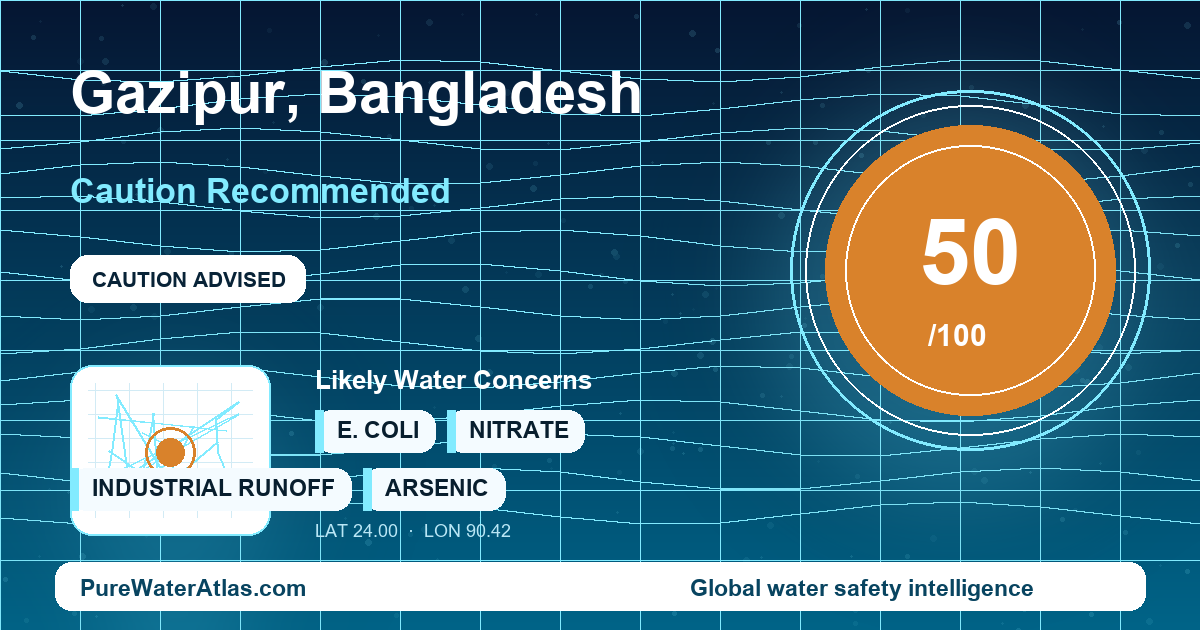
Gazipur, Bangladesh: caution recommended for tap, borehole, and stored building water unless it has been tested and properly treated.
Quick Answer
| Overall status | Caution recommended. Gazipur tap water should not be assumed safe to drink untreated, especially for visitors, children, pregnant people, immunocompromised people, or anyone using private borehole water, rooftop-tank water, or an intermittent municipal connection. |
|---|---|
| Water safety score | 50 / 100 — risk level: Caution Recommended. |
| Traveler advice | Most travelers should avoid untreated tap water. Use sealed bottled water, hotel-provided purified water, or water that has been boiled or passed through a maintained purifier. Be careful with ice and drinks diluted with tap water. |
| Resident advice | Residents should verify safety at the actual drinking tap, not only at the borehole or building connection. Test for microbial indicators, arsenic, iron, manganese, nitrate, TDS or conductivity, pH, turbidity, and residual chlorine where relevant. |
| Main water source | Primarily groundwater from deep and production tube wells, plus private tube wells, building pumps, underground reservoirs, rooftop tanks, and household or institutional point-of-use treatment. |
| Responsible bodies | Gazipur City Corporation is the relevant local government body for municipal services. The Department of Public Health Engineering is the national technical agency for water supply and sanitation outside WASA service areas. |
| Filter recommendation | A household treatment barrier is recommended for most homes unless recent laboratory testing confirms safety. The right system depends on test results; common components include sediment filtration, UV or boiling for microbes, activated carbon for taste, and RO or specialized media only where testing supports it. |
Why Gazipur Is Different
Gazipur is not a city where tap-water safety can be judged from a single central utility report. It is a fast-growing industrial urban area immediately north of Dhaka, located on the Madhupur Tract within the highly urbanized Dhaka industrial region. Its drinking-water risk profile is shaped less by coastal salinity and more by groundwater dependence, rapid urban growth, industrial land use, variable distribution coverage, and building-level storage.
The practical question in Gazipur is often not simply “Is the municipal source safe?” but “What happened to the water between the borehole, pump, pipe, underground reservoir, rooftop tank, purifier, and drinking glass?” Many households, apartment buildings, factories, schools, offices, hotels, and institutions use a mix of municipal groundwater, private tube wells, stored water, bottled water, and small RO, UV, carbon, or sediment purifier systems. That fragmented pattern makes local verification especially important.
Gazipur and Tongi are major industrial and garment-textile zones. This matters for drinking-water decisions because nearby surface waters, canals, and drainage channels are under industrial and urban pollution pressure. Those surface waters are not reliable direct drinking-water sources without full treatment, and shallow private wells in densely built or industrial settings should not be treated as automatically safe. At the same time, publicly accessible, recent, zone-by-zone drinking-water compliance data for Gazipur were not found, so this profile uses a cautious, evidence-based risk approach rather than making neighborhood-level safety claims.
Where Does Gazipur’s Tap Water Come From?
Gazipur drinking water is primarily groundwater-based. Municipal and institutional supplies in the Gazipur-Tongi urban area rely mainly on deep and production tube wells drawing from local aquifers. Many users also depend on private tube wells or motorized pumps, especially where piped supply is absent, intermittent, or considered unreliable.
Key infrastructure includes groundwater production tube wells and deep tube wells, local distribution pipelines with variable coverage and pressure, underground reservoirs, rooftop storage tanks, private pumps, and point-of-use treatment systems. In apartment buildings and commercial properties, the water reaching the kitchen or bathroom tap may have passed through several storage and plumbing stages before use.
Surface waters such as the Turag, Tongi Khal, Balu, Shitalakhya-linked waterways, and local canals are important to the urban environment, but they should not be considered dependable drinking-water sources without full treatment. The main household and municipal supply identity is groundwater plus storage, not a well-documented, fully centralized surface-water treatment system with consumer-facing water-quality dashboards.
This matters because source water and tap water can differ. A deep borehole may produce water with one quality profile, while the final water at the tap may pick up microbes, sediment, metals, or taste issues through storage tanks, pumps, premise plumbing, stagnant pipes, low pressure, suction, or repair disturbances.
Who Manages Drinking Water in Gazipur?
Gazipur City Corporation is the relevant local government body for municipal services in the city corporation area. Gazipur City Corporation was created by combining the former Gazipur and Tongi municipalities, and the water-supply pattern has developed in a fragmented urban form rather than as a long-established, fully centralized metropolitan system.
At the national level, the Department of Public Health Engineering, under the Local Government Division of the Ministry of Local Government, Rural Development and Cooperatives, is the technical agency for water supply and sanitation outside WASA service areas. DPHE is relevant for water-supply engineering, testing support, standards implementation, and arsenic-related public-health engineering functions. The Department of Environment is relevant to pollution control and environmental rules that affect the broader water-quality context.
Bangladesh drinking-water quality is governed through national drinking-water standards and public-health engineering oversight, with WHO guideline values often used as a reference point. However, Gazipur does not appear to publish a routine consumer confidence report comparable to those available in some North American or European utility systems. That lack of public tap-level reporting is a major reason residents and building managers should use their own testing records.
Main Local Water Concerns
- Microbial contamination: Intermittent supply, low pressure, suction pumps, pipe leaks, cross-connections, flooding, underground reservoirs, and rooftop tanks can allow contaminated water to enter after abstraction. This is the main reason short-term visitors should not drink untreated tap water.
- Storage-tank risk: Building tanks are a major control point in Gazipur. Even if the borehole or municipal connection is acceptable, dirty, uncovered, poorly screened, or flood-affected tanks can make drinking water unsafe.
- Turbidity and sediment: Cloudy water or visible particles may occur after pipe repairs, pump changes, monsoon runoff, disturbed tanks, or sediment buildup. Turbidity can reduce the effectiveness of UV disinfection and can indicate conditions that deserve retesting.
- Iron and manganese: Groundwater in many Bangladesh aquifers can contain iron and manganese. These may cause staining, taste problems, dark deposits, and filter fouling, and manganese can require specific treatment attention depending on concentration.
- Arsenic in private wells: Gazipur is not identified here as one of Bangladesh’s best-known highest arsenic hot spots, but any private tube well or borehole that has not been tested should be treated as uncertain.
- Nitrate and sanitation influence: Wells near septic tanks, drains, latrines, livestock areas, dense unsewered settlements, or agricultural runoff pathways should be checked for nitrate and microbial contamination.
- Industrial-area uncertainty: Properties near factories, dyeing units, polluted canals, waste disposal areas, fuel storage, or old industrial plots may need broader laboratory testing. Gazipur-specific public evidence is not sufficient to make precise claims about PFAS, solvents, or metals at individual addresses.
- Premise plumbing metals: Lead is not mainly a Gazipur source-water issue, but it can occur from building plumbing, brass fittings, old fixtures, solder, and stagnant premise plumbing.
Season also matters. Monsoon rains can increase turbidity, flooding, drain backflow, and contamination risk around wells, pump houses, and building reservoirs. Waterlogging or floodwater near wells or underground tanks should be treated as a boil-water or disinfect-water trigger until testing confirms safety. Dry-season demand can increase pumping stress and may worsen intermittent or low-pressure supply in some areas.
For Travelers
Do not drink untreated tap water in Gazipur as a default. Short-term visitors are more vulnerable to stomach illness because they are not used to local microbial conditions and usually do not know whether a hotel’s underground reservoir, rooftop tank, or purifier has been maintained.
Use sealed bottled water, hotel-provided purified water, or freshly boiled water. Check that bottle caps are intact. Hot tea or coffee is lower risk when it has just been boiled, but avoid drinks that may have been cooled, diluted, or served with uncertain ice.
For brushing teeth, visitors with sensitive stomachs, small children, immunocompromised travelers, and highly risk-averse travelers should use bottled, boiled, or purified water. Long-term residents may use treated household water if their storage tank and purifier are maintained, but that assumption is not safe for a short hotel stay.
Avoid ice in roadside drinks, juice stalls, informal restaurants, and tea stalls after cooling unless you know it was made from purified water. In better hotels, ask whether drinking water is RO-treated, UV-treated, boiled, or bottled, and whether the purifier is serviced. In small restaurants, assume jug water and ice may be tap or locally filtered water unless sealed bottles are provided.
During local travel in Gazipur’s industrial areas, markets, and hot weather, carry your own sealed water. If you are highly risk-averse, avoid raw salads and cut fruit that may have been washed with untreated water.
For Residents
Most Gazipur residents should use a treatment barrier unless recent testing shows that water is safe at the actual drinking tap. The correct system depends on the water. A practical approach is sediment prefiltration first, then targeted treatment: UV or boiling for microbial risk when turbidity is low, activated carbon for taste issues, and reverse osmosis or specialized media only where testing indicates arsenic, nitrate, high TDS, or other dissolved contaminants.
Filters must be maintained. An expired purifier, dirty cartridge, fouled RO membrane, unserviced UV lamp, or contaminated storage chamber can become a source of contamination. Do not choose RO simply because Gazipur is industrial, and do not rely on UV if the water is visibly cloudy or the prefilter is not maintained.
Test the actual drinking tap, not only the borehole or incoming line. For any private tube well or borehole, test at least for E. coli or thermotolerant coliforms, arsenic, iron, manganese, nitrate, pH, electrical conductivity or TDS, and turbidity. If connected to a piped network, residual chlorine is also useful. If water comes through old plumbing, brass fixtures, long-stagnant pipes, or renovated buildings, test first-draw and flushed samples for lead.
If the property is near industrial discharge channels, dyeing or textile units, fuel storage, waste dumps, or polluted canals, consider a broader laboratory panel for metals and relevant organic contaminants rather than relying only on basic field kits. Use a DPHE-recognized, university, accredited private, or otherwise reputable laboratory where possible, and keep written results with the date, sampling location, and whether the sample was taken before or after treatment.
Older buildings and mixed plumbing materials can contribute lead, copper, zinc, or bacterial regrowth. Let stagnant water run before collecting drinking water, but do not treat flushing as a substitute for testing and treatment. Underground reservoirs and rooftop tanks should be covered, screened against insects and animals, protected from drains and floodwater, cleaned and disinfected on a schedule, and inspected after monsoon flooding.
Relevant Contaminants and Water-Quality Issues
For Gazipur, the most important starting point is microbial safety. Learn more about E. coli in drinking water, especially if your supply is intermittent, stored in tanks, or affected by flooding. Cloudy water and particles should be interpreted with caution; see turbidity in drinking water and sediment in drinking water.
For private boreholes and tube wells, arsenic testing remains important in Bangladesh, even where a district is not the country’s best-known hot spot. Groundwater users should also understand iron and manganese, both of which can affect taste, staining, treatment performance, and household system design.
If wells are near sanitation sources, drains, dense settlements, or agricultural influence, review nitrate in drinking water. In older buildings or where water stagnates in premise plumbing, lead in drinking water is also relevant, even if the source aquifer is not the main issue.
How to Verify Your Water Quality
Because recent, public, ward-by-ward Gazipur drinking-water compliance data were not found, the most reliable answer for a household, school, factory, hotel, or apartment building is a current test at the actual drinking tap. Start with the PureWaterAtlas guide to water testing, then use the Contaminants Search Engine to interpret any contaminant names on your laboratory report.
For treatment planning, see Water Treatment Systems. For short-term microbial protection, review boiling water purification and UV water purification. UV can be useful only when the water is clear and the unit is maintained.
For specific test methods, residents using private wells may need arsenic testing and detection methods, nitrate testing, and, in older buildings, lead testing. Industrial-area due diligence may also justify reading about PFAS testing, while recognizing that Gazipur-specific PFAS results are not publicly established in the available dataset.
For broader context, see PureWaterAtlas resources on drinking water safety, water microbiology, and water contamination. Travelers comparing destinations can also use the Global Water Quality Checker.
Official and Technical Sources
- Gazipur City Corporation official website — municipal context for Gazipur City Corporation services.
- Department of Public Health Engineering — Bangladesh’s national technical agency for water supply and sanitation outside WASA systems.
- Local Government Division — parent government division for local water supply and sanitation institutions.
- Department of Environment — environmental regulation and pollution-control context.
- WHO Guidelines for Drinking-water Quality — international guidance on microbial and chemical drinking-water risk management.
- WHO/UNICEF Joint Monitoring Programme data for Bangladesh — country-level WASH service and sanitation context.
- UNICEF Bangladesh Water, Sanitation and Hygiene — Bangladesh WASH and public-health context, including safe water and arsenic concerns.
- Asian Development Bank City Region Development Project — urban infrastructure context for Bangladesh city regions, including the wider Dhaka-Gazipur growth area.
- World Bank Open Knowledge Repository — source for Bangladesh environmental analysis and urban pollution context.
- Bangladesh Bureau of Statistics — official demographic and district statistics relevant to Gazipur urbanization and population growth.
Data limitation: publicly accessible, recent, zone-by-zone Gazipur drinking-water compliance data were not found. This page does not claim that every neighborhood, ward, hotel, borehole, or apartment tank has the same risk. Water quality can vary sharply between buildings and even between taps in the same building.
Bottom Line
Gazipur tap water deserves a cautious approach. The city’s drinking-water supply is mainly groundwater-based, but many users depend on private tube wells, pumps, underground reservoirs, rooftop tanks, and household purifiers, so final tap quality can differ from source quality. Travelers should not drink untreated tap water and should use sealed bottled, boiled, or verified purified water, including for brushing teeth if risk-averse. Residents can often make water suitable for drinking, but only with testing and maintained treatment matched to the results. The most important checks are microbial indicators, arsenic, iron, manganese, nitrate, turbidity, pH, TDS or conductivity, and lead where old plumbing is present. Storage-tank maintenance is central to safe water in Gazipur.
Read the full guide: Global Water Quality Guide
Explore more in this category: Global Water Quality Articles