Saint Petersburg’s central tap water is mainly treated Neva River water from the Lake Ladoga–Neva system. The municipal supply is professionally operated, but the real safety question often depends on the building, pipes, stagnation, and recent local works.
Quick Answer
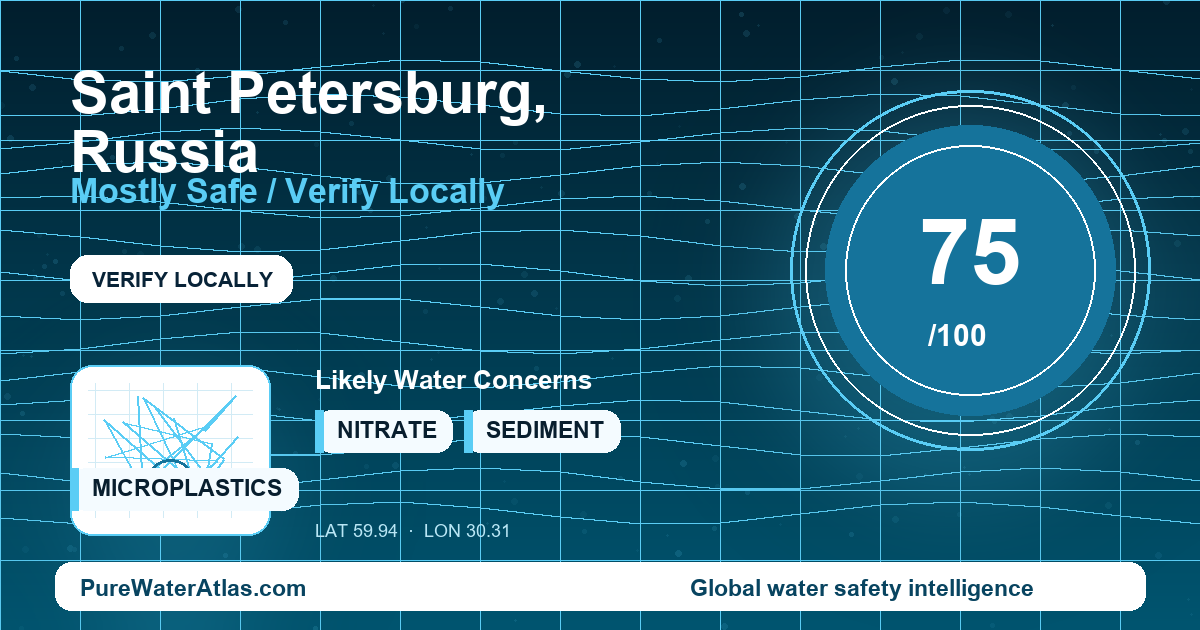
| Overall status | Mostly Safe / Verify Locally — PureWaterAtlas score: 75/100. |
|---|---|
| Can you drink it? | Healthy adults in reputable hotels or apartments connected to the central system usually face a lower-risk supply, but cautious visitors should use bottled or properly filtered water for direct drinking. |
| Traveler advice | Use tap water for brushing teeth if it is clear. Use boiled tap water for tea and coffee. Use bottled or filtered water if the building is old, water is discolored, or you have a sensitive stomach. |
| Resident advice | Central municipal water is generally usable, but old building plumbing can change quality at the tap. Test if there is discoloration, metallic taste, young children, pregnancy, or old internal pipes. |
| Main water source | The city supply is dominated by surface water from the Neva River, which drains Lake Ladoga and flows to the Gulf of Finland. |
| Water authority | SUE Vodokanal of Saint Petersburg, with public-health oversight associated with Rospotrebnadzor’s Saint Petersburg office. |
| Filter recommendation | A filter is not automatically required for every home, but carbon filtration can improve taste and disinfectant odor. If testing shows metals or other dissolved contaminants, choose a certified system based on the result. |
Why Saint Petersburg Is Different
Saint Petersburg is not a groundwater-dominated city in its urban core. Its drinking-water identity is tied to the Neva River delta at the eastern end of the Gulf of Finland. The Neva connects Lake Ladoga, a major freshwater lake, with the Baltic Sea basin, so the city’s water safety depends heavily on continuous treatment of a large northern surface-water source.
This local context explains why residents and visitors may hear mixed advice. It is possible for the central supply to be treated and monitored while many locals still prefer to boil or filter water. Those positions are not necessarily contradictory. Municipal treatment can reduce major source-water risks, while older apartment plumbing, sediment release, residual disinfectant taste, iron-colored water, or a recent pipe disturbance can still affect what reaches an individual kitchen tap.
The most important distinction in Saint Petersburg is therefore treated water entering the distribution system versus water after it has passed through a specific building. Historic buildings, Soviet-era apartment blocks, old risers, corroded valves, stagnant sections of pipe, or poorly maintained building equipment can all change tap water quality after municipal treatment.
Where Does Saint Petersburg’s Tap Water Come From?
Saint Petersburg’s central drinking-water supply is dominated by surface water from the Neva River. The Neva drains Lake Ladoga and flows through Saint Petersburg toward the Gulf of Finland, making the Neva–Lake Ladoga system the key raw-water source behind most municipal tap water in the city. Geographic references such as Encyclopaedia Britannica’s Neva River entry describe this Lake Ladoga-to-Gulf of Finland connection.
Historically, Saint Petersburg developed around the Neva delta and its canals. Older local wells and early centralized waterworks were gradually replaced by a large municipal surface-water system. Groundwater can still matter in some outlying or suburban service areas, but the urban core should not be judged as if every home used a private well. The relevant baseline for most city addresses is the centralized Vodokanal system.
The municipal system includes major city waterworks drawing from the Neva River, commonly referenced by the utility as central facilities such as the Main, Northern, Southern, and other waterworks serving different districts and pressure zones. Treatment uses multiple barriers, including conventional clarification and filtration, chemical disinfection, and ultraviolet disinfection as an important microbial control step. The citywide network then moves water through mains, pumping stations, pressure-control zones, and finally building-level plumbing.
That final stage matters. A good treatment plant result does not automatically prove identical quality at a specific faucet. Internal pipes, old fixtures, corrosion products, dead legs, sediment, and stagnation can influence color, taste, metals, and particles at the point of use.
Who Manages Drinking Water in Saint Petersburg?
The local water utility is SUE Vodokanal of Saint Petersburg, commonly called Vodokanal St. Petersburg. Its public materials identify it as the operator of the city’s water supply and wastewater system. The utility’s water supply information describes the municipal system, waterworks, and the Neva-centered supply. Its quality control information provides context on drinking-water monitoring and control processes.
Public-health oversight is associated with Rospotrebnadzor in Saint Petersburg, under Russian sanitary and consumer-health regulation. City-level utility governance context is also connected to the Government of Saint Petersburg Committee for Energy and Engineering Support.
For practical users, the regulatory point is simple: compliance at the treatment plant or in the municipal distribution system is not the same as a guarantee for every apartment, hotel room, school, restaurant, private storage system, or dacha supply. Publicly accessible citywide data does not provide verified tap-by-tap results for every Saint Petersburg building.
Main Local Water Concerns
- Old building plumbing: Saint Petersburg has many historic and older residential buildings. Corroded internal pipes, old risers, valves, fixtures, solder, and stagnant sections can contribute rust, sediment, metallic taste, and potentially metals in specific apartments.
- Discoloration after disturbances: Yellow, brown, cloudy, or particle-filled water can appear after nearby water-main repairs, pressure changes, hydrant flushing, or work inside apartment-building risers.
- Disinfectant taste or odor: Because the water is disinfected for network safety, some users may notice residual disinfectant taste or smell.
- Surface-water vulnerability: The Neva River source is exposed to urban runoff, shipping, wastewater-system pressures, and broader Lake Ladoga–Neva watershed influences. This does not mean the treated tap water is automatically unsafe, but it makes treatment reliability and monitoring essential.
- Lead and metals uncertainty: Lead should not be treated as a proven citywide finished-water problem from the dataset, but older plumbing components, brass fixtures, solder, and stagnation justify address-level testing in higher-risk apartments.
- Iron and manganese complaints: Rusty color, staining, metallic taste, or dark particles may be distribution- or building-related and should be investigated if persistent.
- Seasonal source-water changes: Spring snowmelt, river-flow changes, warm-season biological activity, heavy rain, and stormwater runoff can affect raw-water color, organic matter, turbidity, taste, odor, and treatment demand.
Private wells, dacha supplies, and noncentralized sources outside the main municipal network should not be judged by this central Saint Petersburg profile. They need their own testing.
For Travelers
For most short-stay visitors in reputable Saint Petersburg hotels, centrally supplied tap water is usually acceptable for brushing teeth and for hot drinks after boiling. For direct drinking, the conservative recommendation is to use bottled or properly filtered water unless the hotel confirms that the building tap water is suitable.
This is especially sensible for infants, pregnant travelers, immunocompromised people, and anyone with a sensitive stomach. The CDC Travelers’ Health page for Russia provides the general travel-health context for being cautious with food and water when traveling.
- Drinking: Bottled or filtered water is the safest default for cautious visitors. Healthy adults in good hotels may face low risk from central supply, but building-level plumbing is the unknown.
- Brushing teeth: Generally acceptable if the tap water is clear and the property is connected to the municipal system. Use bottled water if it is brown, has particles, smells unusual, or the building plumbing seems uncertain.
- Ice: Ice from established hotels, restaurants, and cafes is lower concern if made from treated water and handled hygienically. Avoid ice from informal venues if you are being cautious.
- Hotels and restaurants: Better hotels and restaurants often use additional filtration for taste, coffee, tea, and ice machines. Ask the hotel what it recommends for that building.
- Hot drinks: Boiling is a reliable extra barrier for microbial risk, but it does not remove metals or many dissolved chemicals. Do not drink hot tap water directly from the plumbing system.
If the water runs yellow or brown, let the cold tap run until clear and switch to bottled water until the issue passes.
For Residents
Residents connected to the central Vodokanal network can generally treat municipal tap water as usable, but should evaluate their own building. A home filter is not automatically required for everyone. However, it is practical for taste, residual disinfectant odor, sediment, and uncertainty from internal plumbing.
A carbon block or pitcher filter can improve taste and chlorine-like odor. If testing shows lead, copper, manganese, or other dissolved contaminants of concern, a certified under-sink system or reverse osmosis unit may be more appropriate. Filter choice should follow test results, not assumptions.
Testing is most important when the apartment is in an old building, young children or pregnant people live there, the water has metallic taste, staining, particles, or recurring discoloration, or there has been major plumbing work. Use both a first-draw sample after overnight stagnation and a flushed sample. That comparison helps distinguish building-plumbing contribution from incoming municipal water.
Priority household tests include lead, copper, iron, manganese, turbidity, color, odor, pH, and basic microbiological indicators if there is any storage tank, private supply, recurring pressure loss, or building reservoir. After pipe replacement or major repairs, flush cold taps and consider retesting before using the water for infant formula or as the primary drinking source.
Most ordinary urban apartments rely on pressurized municipal supply rather than a household storage tank, but any building-level tank, booster system, private reservoir, or poorly maintained filter can introduce stagnation and microbial risk. If such equipment is present, ask the building manager about cleaning, inspection, and maintenance records.
Relevant Contaminants and Water-Quality Issues
Saint Petersburg’s main practical issues are not best understood as one single contaminant. They involve source-water treatment, disinfection, pipe condition, stagnation, and building-level materials.
- Chlorine is relevant for disinfectant taste and odor in treated municipal water.
- Turbidity matters when spring runoff, pipe disturbance, or visible cloudiness appears.
- Sediment helps explain rust, particles, and post-repair discoloration.
- Lead is relevant for old plumbing and fixture-specific testing, not as a citywide claim.
- E. coli is important for microbiological safety, especially with storage tanks, pressure loss, private supplies, or noncentralized sources.
- Iron is relevant to rusty water, staining, metallic taste, and corrosion in distribution or building pipes.
- Manganese is relevant when dark particles, staining, or groundwater-influenced supplies are suspected.
For broader background, see PureWaterAtlas guides on boiling water purification, UV water purification, and water microbiology. UV is especially relevant because it is described as an important municipal disinfection barrier in Saint Petersburg’s system.
How to Verify Your Water Quality
The best answer for a specific Saint Petersburg apartment or hotel is address-level verification. Official utility and regulator information identifies the source, operator, treatment framework, and monitoring context, but it does not prove the condition inside every building, riser, apartment, restaurant, school, private well, or storage system.
- Use the PureWaterAtlas Water Testing guide to plan household sampling.
- If old plumbing is suspected, read Lead in Drinking Water: Testing and Detection Methods and compare first-draw and flushed samples.
- If a result shows lead or high-risk plumbing is present, review Lead in Drinking Water: Best Filters, Systems and Solutions.
- Use the Global Water Quality Checker to compare Saint Petersburg with other destinations.
- Search specific substances in the Contaminants Search Engine.
- For general decision-making, see Drinking Water Safety, Water Treatment Systems, and the PureWaterAtlas categories for Global Water Quality, Water Testing, and Water Contamination.
Official and Technical Sources
- SUE Vodokanal of Saint Petersburg — official local water utility identity for water supply and wastewater services.
- SUE Vodokanal of Saint Petersburg: Water Supply — municipal water-supply system, waterworks, and Neva River-centered supply context.
- SUE Vodokanal of Saint Petersburg: Quality Control — drinking-water monitoring and quality-control context.
- Rospotrebnadzor, Saint Petersburg regional office — regional sanitary and consumer-health oversight context.
- Government of Saint Petersburg Committee for Energy and Engineering Support — city engineering and utility governance context.
- Encyclopaedia Britannica: Neva River — geographic context for the Neva River’s Lake Ladoga-to-Gulf of Finland flow.
- World Health Organization: Guidelines for Drinking-water Quality — general public-health framework for microbial barriers, turbidity, source protection, and point-of-use caution.
- CDC Travelers’ Health: Russia — conservative travel-health framing for food and water precautions.
Bottom Line
Saint Petersburg’s tap water is best described as mostly safe but worth verifying locally. The central municipal supply is a large treated surface-water system dominated by the Neva River and operated by Vodokanal of Saint Petersburg, with treatment barriers including filtration, chemical disinfection, and ultraviolet disinfection. For healthy visitors in reputable hotels, tap water is generally reasonable for brushing teeth and hot drinks after boiling, while bottled or filtered water is the cautious choice for direct drinking. For residents, the main risk question is the building: old pipes, stagnation, sediment, discoloration, and fixtures can alter quality after city treatment. Test if the building is old, water is discolored, vulnerable people live there, or plumbing has recently been disturbed.
Read the full guide: Global Water Quality Guide
Explore more in this category: Global Water Quality Articles