Bangkok has a professionally treated Metropolitan Waterworks Authority supply, but drinking-water safety at the tap depends heavily on building plumbing, storage tanks, filtration, and temporary river-water conditions.
Quick Answer
| City | Bangkok, Thailand |
|---|---|
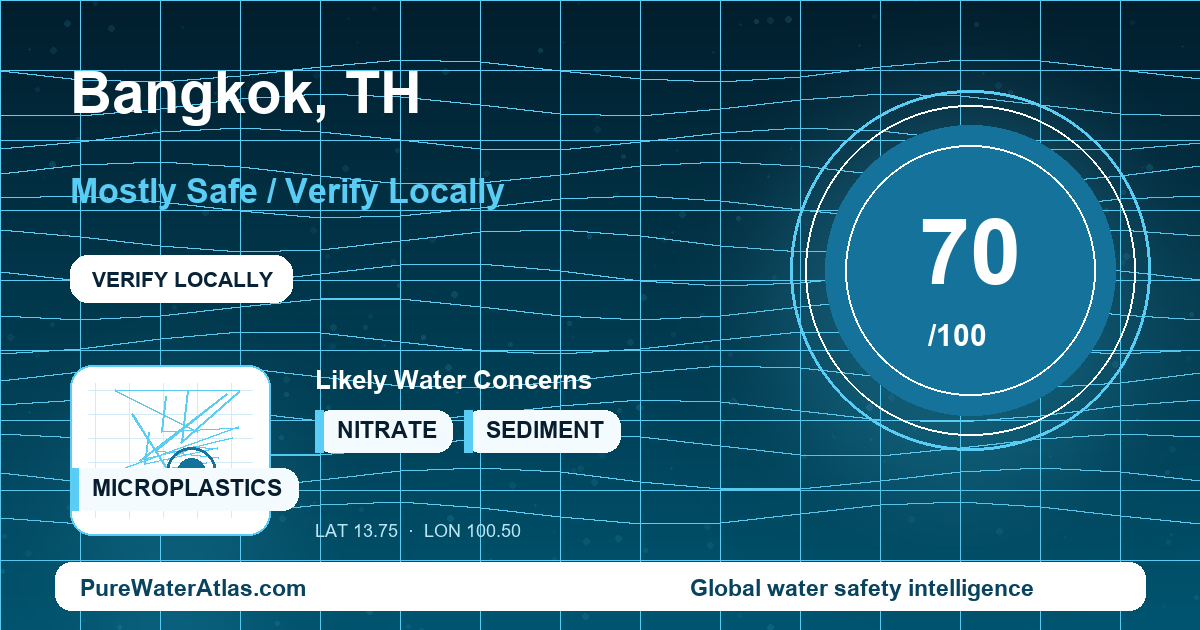
| Water safety score | 70 / 100 |
| Risk level | Mostly Safe / Verify Locally |
| Can tourists drink the tap water? | Not the risk-minimizing choice for short stays. Use sealed bottled water, hotel-provided filtered water, or a trusted point-of-use filter for drinking. |
| Resident advice | MWA-connected households can usually treat tap water as a usable municipal source, but many residents sensibly use carbon filtration, reverse osmosis, UV, or bottled water for drinking. |
| Main raw water source | Surface water from the Chao Phraya River system and Mae Klong River system, including the Sam Lae raw-water intake area in Pathum Thani. |
| Water authority | Metropolitan Waterworks Authority, commonly abbreviated MWA. |
| Filter recommendation | Activated carbon for chlorine taste and odor; reverse osmosis for salinity, dissolved solids, or broader uncertainty; UV only when microbial control is needed after filtration. |
Bangkok’s municipal water is treated and monitored before distribution, but that does not prove the quality of every hotel, condominium, shophouse, or household tap. The key safety question is often not only “Is MWA water treated?” but “What happens after it enters the local pipes, storage tank, and building plumbing?”
Why Bangkok Is Different
Bangkok sits on the low-lying Chao Phraya River delta near the Gulf of Thailand. That geography matters for drinking water because dry-season river flow can be low enough for tidal influence and salinity intrusion to become a real raw-water concern in the lower Chao Phraya system. During drought or strong tidal periods, chloride and salty taste can become more relevant than in inland cities that do not depend on a tidal river system.
The city also has a large, modern municipal water system operated by the Metropolitan Waterworks Authority. Water leaving treatment plants is disinfected and monitored, and the system serves Bangkok as well as parts of the surrounding metropolitan area. However, the final quality at a consumer’s tap may be affected by old pipes, pressure interruptions, building-level storage tanks, condominium plumbing, privately maintained filters, and stagnant internal pipework.
This is why Bangkok has a split verdict: the city has a treated municipal supply, but visitors should not assume that ordinary unfiltered tap water is the safest drinking option in every building. Local practice reflects that caution. Many Bangkok residents use bottled water, delivered water, refill machines, or home filtration, often because of taste, chlorine, tanks, old plumbing, and practical uncertainty rather than because the entire municipal system is untreated.
Where Does Bangkok’s Tap Water Come From?
Bangkok’s tap water is supplied primarily by the Metropolitan Waterworks Authority using treated surface water. The main raw-water systems are the Chao Phraya River system and the Mae Klong River system. A key Chao Phraya raw-water intake is at Sam Lae in Pathum Thani, where raw water is pumped and conveyed by canal toward major treatment works that serve Bangkok and nearby provinces.
Important parts of the Bangkok water infrastructure include the MWA service area covering Bangkok, Nonthaburi, and Samut Prakan; the Sam Lae intake area on the Chao Phraya River; raw-water canals and transmission routes; and major treatment plants such as Bang Khen, Samsen, Thon Buri, and Mahasawat. Mahasawat is associated with the western Mae Klong raw-water supply system.
Bangkok also has an older historical connection to groundwater. The metropolitan area has a long history of land subsidence linked to groundwater extraction. Modern municipal drinking-water supply for the city, however, is based mainly on treated surface water rather than household groundwater wells. For drinking-water decisions today, the more practical issues are river-water variability, treatment performance, distribution conditions, and what happens inside the building after MWA delivery.
Who Manages Drinking Water in Bangkok?
The public utility responsible for producing and distributing tap water in Bangkok is the Metropolitan Waterworks Authority. MWA is a Thai state enterprise under the Ministry of Interior and serves Bangkok plus parts of the surrounding metropolitan area. Its role includes water production, distribution, customer service, and public water-quality communications.
Drinking-water quality is assessed against Thai drinking-water quality criteria and utility monitoring practices, with references commonly made to Ministry of Public Health and WHO-style parameters. Relevant public-health institutions include the Ministry of Public Health Thailand and the Department of Health, Ministry of Public Health. River and environmental context can also involve the Pollution Control Department Thailand and basin water-management information from the Royal Irrigation Department.
Publicly available utility and agency information is useful for understanding the system, but it is not the same thing as a current laboratory certificate for an individual tap. A hotel room, condominium kitchen, older apartment, or shophouse may have different final water quality depending on private plumbing, storage-tank hygiene, pump systems, and maintenance.
Main Local Water Concerns
- Dry-season salinity: Bangkok’s delta location creates a real risk of salinity intrusion in the Chao Phraya raw-water system when upstream freshwater flow is low and tides push saline water inland. This can cause elevated chloride or salty taste issues during drought or strong tidal influence.
- Rainy-season turbidity: Rainy periods can increase turbidity, suspended sediment, runoff, and organic load in source rivers, creating a greater treatment challenge even when central treatment continues.
- Chlorine taste and odor: Disinfection is important, but visitors may notice chlorine taste or odor, especially if they are not used to chlorinated municipal supplies.
- Storage-tank hygiene: Many Bangkok properties use rooftop or basement storage tanks and pumps. Dirty, uncovered, cracked, or rarely cleaned tanks can compromise otherwise treated water.
- Building plumbing and sediment: Aged local pipes, local repairs, pressure changes, stagnant plumbing, and old fixtures can contribute to discoloration, iron-like particles, or sediment at the tap.
- Lead as a premise-plumbing issue: Lead is not presented here as a proven citywide source-water problem, but older fittings, solder, brass components, unknown plumbing materials, or imported fixtures can still matter at the household tap.
- Private filters and refill points: Unverified street-side refill stations, room dispensers, and private filters may be less reliable than sealed bottled water unless maintenance and filtration are documented.
For Travelers
For a short Bangkok stay, the cautious answer is simple: do not rely on ordinary tap water as your main drinking source unless the building provides credible filtration or the water has been boiled or otherwise treated. The municipal supply is treated, but visitor risk is driven by the last mile: building plumbing, storage tanks, and local maintenance.
Use sealed bottled water, hotel-provided filtered water, or a trusted point-of-use filter for drinking. Tap water is generally acceptable for handwashing. Brushing teeth with tap water is usually acceptable in reputable hotels and modern serviced apartments, but use bottled or filtered water if you have a sensitive stomach, are pregnant, are immunocompromised, are traveling with infants, or are staying in older or budget accommodation with uncertain plumbing.
Ice in established hotels, malls, chain restaurants, and busy restaurants is commonly made from commercial purified water and is usually low risk. If you are being conservative, avoid ice of uncertain origin from small street vendors. In hotels and restaurants, prefer sealed bottles, clearly filtered drinking stations, or dispensers with credible maintenance. Do not assume every pitcher, room dispenser, or refill machine is safe without knowing how it is maintained.
Boiling can help reduce microbial risk in an emergency, but it does not remove salinity, metals, or many chemical contaminants. For practical emergency guidance, see Boiling Water Purification: Complete Guide.
For Residents
For Bangkok residents connected to MWA supply, a home filter is not automatically required in every household, but it is a practical choice for drinking water. The best setup depends on the concern. Activated carbon can improve chlorine taste and odor. Certified carbon or reverse osmosis can provide broader chemical reduction. Reverse osmosis is especially relevant if salinity, dissolved solids, or uncertain contaminants are a concern. UV can be useful for microbial control, but it should normally be used after appropriate filtration rather than as a stand-alone fix for sediment or chemical issues.
Residents in older buildings should treat premise plumbing as part of the water system. Unknown internal pipe materials, corroded fixtures, dead legs, old brass fittings, and long stagnation times can add metals, sediment, taste problems, or microbial risk even when municipal water is properly treated. If you drink tap water regularly, test at the actual kitchen tap rather than only at the building inlet.
If your building stores water in a rooftop or basement tank, ask for tank-cleaning records. Tanks should be sealed against insects and debris and should be sanitized after flooding or repairs. If taste, odor, or illness concerns occur, or after tank cleaning, testing for E. coli or total coliform indicators is sensible. After pipe repairs, flooding, brown water, or pressure loss, flush taps and consider microbial testing before using the water for infants or medically vulnerable residents.
Filter maintenance matters. Replace cartridges on schedule and clean reservoirs. An expired filter or dirty storage reservoir can become worse than no filter. For point-of-use technology comparisons, see UV Water Purification: Complete Guide and Water Treatment Systems.
Relevant Contaminants and Water-Quality Issues
Bangkok’s most relevant water-quality topics are tied to treated river water, disinfection, distribution, and building-level conditions. Chlorine is relevant because residual disinfectant can affect taste and odor while helping control microbial risk. Turbidity matters during rainy-season river conditions when suspended sediment and runoff increase treatment challenge.
Sediment can appear after pipe repairs, local disturbances, stagnant plumbing, or old building systems. E. coli is most relevant as an indicator of microbial contamination from poor storage-tank hygiene or post-treatment contamination. Lead should be understood mainly as a premise-plumbing and fixture question in Bangkok, not as a confirmed citywide raw-water problem in this dataset.
If old plumbing or first-draw samples are a concern, PureWaterAtlas has deeper guidance on Lead in Drinking Water: Testing and Detection Methods and Lead in Drinking Water: Best Filters, Systems and Solutions.
How to Verify Your Water Quality
The most reliable way to assess your actual Bangkok tap is to test the water at the point of use. For routine household drinking, sample the kitchen tap. In older apartments or buildings with unknown plumbing, consider both first-draw and flushed samples for metals such as lead. If the building uses storage tanks, include microbial indicator testing such as E. coli or total coliform when hygiene is uncertain, after tank cleaning, or after flooding and repairs.
If the water tastes salty during the dry season, check current MWA salinity or chloride advisories and consider reverse osmosis for drinking water until the episode passes. If brown water or particles appear after local work or pressure loss, flush taps and avoid using the water for infants or medically vulnerable people until conditions are stable and, where appropriate, tested.
For broader guidance, use the PureWaterAtlas Water Testing guide, the Global Water Quality Checker, and the Contaminants Search Engine. For context on safe-water decision-making, see Drinking Water Safety, Global Water Quality, and Water Microbiology.
Data limitation: Bangkok has official utility and public-agency information, but publicly accessible data do not prove that every individual tap is safe to drink untreated at all times. Treatment-plant performance, distribution sampling, and raw-water conditions are system-level indicators; building plumbing, storage tanks, private filters, and temporary local disturbances vary widely.
Official and Technical Sources
- Metropolitan Waterworks Authority official website — primary authority for Bangkok metropolitan tap-water production, distribution, service area, and public communications.
- MWA water quality information and customer water-quality services — official utility information and advisories; check the current Thai-language site for latest notices.
- Ministry of Public Health Thailand — national public-health authority relevant to Thai drinking-water quality criteria and health guidance.
- Department of Health, Ministry of Public Health — environmental health and drinking-water quality guidance context.
- Pollution Control Department Thailand — river water quality, pollution status, and environmental monitoring context for source waters.
- Royal Irrigation Department Thailand — Chao Phraya and Mae Klong basin water management, drought conditions, reservoir releases, and salinity-control context.
- World Health Organization drinking-water fact sheet — global context for safe drinking-water and microbial contamination risk.
- WHO Guidelines for Drinking-water Quality — international framework for interpreting water-safety parameters.
- Climate Risk Country Profile: Thailand — climate context for heat, flooding, drought, and water-resource stress.
Bottom Line
Bangkok’s tap water comes from a large, treated MWA municipal system using surface water from the Chao Phraya and Mae Klong systems. At the treatment-plant and utility level, this is a managed urban water supply. At the consumer tap, however, risk can change because of old building plumbing, rooftop or basement storage tanks, private filters, pressure interruptions, sediment, and seasonal river conditions such as dry-season salinity or rainy-season turbidity. Tourists should use sealed bottled water, hotel-filtered water, or a trusted point-of-use filter for drinking, and cautious travelers should use bottled or filtered water for tooth brushing. Residents can use MWA water as a municipal source, but filtration, tank maintenance, and tap-level testing are the practical way to verify safety in a specific Bangkok building.
Read the full guide: Global Water Quality Guide
Explore more in this category: Global Water Quality Articles