Introduction
Freshwater is one of the planet’s most essential resources, yet it is unevenly distributed, increasingly stressed, and governed by a complex mix of local, national, and international rules. Understanding freshwater availability around the world regulations is important for policymakers, utilities, public health professionals, farmers, businesses, and households alike. Water availability is not only a question of how much water exists in rivers, lakes, aquifers, glaciers, and reservoirs. It is also shaped by legal standards, water allocation systems, environmental protections, infrastructure, contamination control, and public health guidance.
Across the world, freshwater systems are under pressure from population growth, urbanization, industrial development, agricultural demand, climate change, ecosystem degradation, and pollution. In many regions, there is enough annual rainfall in theory, but not enough safe, accessible, and affordable water in practice. This gap between physical supply and usable supply is where regulations and standards become critical. Water rules determine who can withdraw water, how much can be used, what quality is acceptable, how ecosystems are protected, and what level of treatment is required before water can be consumed or discharged.
Because freshwater management crosses public health, environmental law, engineering, and economics, the topic is best understood through both water quantity and water quality. A country may have large freshwater reserves, but weak compliance systems can undermine safety. Another country may have limited natural freshwater, yet maintain high water security through strong governance, treatment systems, reuse programs, and clear standards. For broader context on global water conditions, readers may also explore /category/global-water-quality/ and the overview at /freshwater-availability-around-the-world-complete-guide/.
This article explains what freshwater availability means, the main causes of scarcity or stress, the health and safety consequences of limited or contaminated supply, and how water is tested, protected, and regulated. It also reviews how freshwater availability around the world epa standards, freshwater availability around the world who guidelines, and other legal frameworks influence safe access, water allocation, and long-term sustainability.
What It Is
Freshwater availability refers to the amount of naturally occurring or managed water that can be accessed for human use, agriculture, industry, and ecosystem support. It includes surface water such as rivers, lakes, wetlands, and reservoirs, as well as groundwater stored in aquifers. In some countries, freshwater planning also includes desalinated water and highly treated reclaimed water because these sources reduce pressure on natural systems.
It is important to distinguish between total freshwater resources and available freshwater. Total resources may include water in remote locations, seasonal flows, deeply buried groundwater, or water too polluted for immediate use. Available freshwater is the share that can be reliably captured, treated, distributed, and protected under current technical, legal, and economic conditions.
Water availability is often discussed in several related ways:
- Physical availability: the actual volume of water present in a region.
- Seasonal availability: how supply rises or falls throughout the year.
- Per capita availability: the amount of freshwater available per person.
- Safe availability: water that meets public health and environmental quality requirements.
- Reliable availability: water that can be delivered consistently during drought, contamination events, or infrastructure failures.
Freshwater availability is therefore not only a hydrological measure. It is a governance issue. A river basin can be overallocated through permits, a groundwater aquifer can be depleted by weak enforcement, and a reservoir can become unusable if contamination exceeds treatment capacity. This is why discussions of freshwater availability around the world safe limits often combine water quantity thresholds with water quality standards and ecosystem flow requirements.
On a global scale, freshwater is distributed unevenly. Some countries have abundant renewable water but lack treatment and delivery infrastructure. Others have limited rainfall but strong institutions that recycle wastewater, regulate withdrawals, and maintain strict quality monitoring. Transboundary rivers and aquifers add another layer of complexity because neighboring states may share the same water source while applying different water rules.
The science behind this topic is closely linked to hydrology, watershed protection, pollution control, and environmental health. Readers interested in foundational concepts can find additional background at /category/water-science/.
Main Causes or Sources
Freshwater stress does not arise from a single cause. In most regions, it results from several overlapping pressures that reduce supply, degrade quality, or disrupt access. Understanding these drivers helps explain why regulations must address both use and protection.
Climate Variability and Climate Change
Changing precipitation patterns, higher temperatures, altered snowpack, glacier retreat, and more frequent droughts are affecting freshwater systems across continents. Some areas experience prolonged dry periods, while others face intense rainfall that causes runoff rather than groundwater recharge. Climate change can also worsen evaporation from reservoirs and soils, reducing the amount of water available for use.
Population Growth and Urbanization
As populations grow, demand for drinking water, sanitation, energy production, and food increases. Expanding cities place pressure on nearby rivers and aquifers, often requiring long-distance transfers, new reservoirs, or groundwater extraction. Urban growth can also increase pollution through stormwater runoff, sewage overflows, and industrial discharge if infrastructure does not keep pace.
Agricultural Demand
Agriculture is one of the largest users of freshwater worldwide. Irrigation supports crop yields, but inefficient systems can waste large volumes of water. In some regions, overpumping groundwater for irrigation causes falling water tables, land subsidence, and loss of river baseflow. Fertilizers, pesticides, and animal waste can also contaminate nearby water bodies, reducing safe supply.
Industrial Use and Energy Production
Manufacturing, mining, power generation, and resource extraction can require substantial water withdrawals. Industrial activity may also introduce heavy metals, solvents, salts, nutrients, hydrocarbons, and thermal pollution into freshwater systems. Regulations often focus on permits, treatment requirements, and discharge limits to prevent these uses from reducing public access to safe water.
Pollution and Source Water Degradation
Freshwater may become unavailable not because it disappears, but because contamination makes it unsafe or expensive to use. Common pollutants include:
- Pathogens from sewage and inadequate sanitation
- Nitrates and phosphates from fertilizer runoff
- Heavy metals such as lead, arsenic, and mercury
- Industrial chemicals and solvents
- PFAS and other persistent synthetic compounds
- Salinity from irrigation return flows or seawater intrusion
- Sediment from erosion and deforestation
More detail on the drivers behind freshwater stress can be found at /freshwater-availability-around-the-world-causes-and-sources/.
Overuse of Groundwater
Groundwater acts as a strategic reserve in many dry or highly populated regions. However, aquifers can be depleted when extraction exceeds recharge. This may reduce well yields, increase pumping costs, concentrate contaminants, and harm connected rivers and wetlands. In coastal areas, overpumping can lead to saltwater intrusion, making freshwater less suitable for drinking or irrigation.
Deforestation and Land Use Change
Watersheds depend on healthy landscapes. Forest removal, wetland drainage, and poorly managed development can reduce infiltration, increase erosion, and alter streamflow patterns. Such changes affect both quantity and quality, often increasing treatment needs downstream.
Weak Governance and Infrastructure Gaps
Even where water resources are significant, poor management can limit availability. Leaking distribution networks, unregulated wells, insufficient treatment plants, inadequate monitoring, and fragmented water authority structures all reduce the amount of water that is safely available. This is why freshwater availability around the world compliance issues are often as important as natural supply conditions.
Health and Safety Implications
When freshwater is scarce, polluted, or poorly regulated, the consequences extend far beyond inconvenience. Water insecurity affects drinking water safety, sanitation, food production, livelihoods, disease transmission, and social stability. Safe freshwater access is a public health necessity.
Waterborne Disease
Insufficient freshwater can force communities to use unsafe surface water or poorly protected wells. This increases exposure to pathogens such as bacteria, viruses, and parasites that cause diarrhea, cholera, typhoid, dysentery, hepatitis, and other illnesses. Areas with limited sanitation are especially vulnerable because wastewater may contaminate drinking sources.
Chemical Exposure
Freshwater contamination is not limited to microbes. Arsenic, fluoride, lead, nitrates, pesticides, and industrial chemicals can enter water supplies naturally or through human activity. Long-term exposure may contribute to neurological problems, developmental effects, kidney damage, cancers, reproductive issues, and cardiovascular disease. Nitrate contamination, for example, poses particular risks to infants.
Reduced Hygiene and Sanitation
When clean water is limited, handwashing, food preparation, cleaning, and sanitation become more difficult. This increases the spread of infectious disease and worsens school and workplace conditions. Health impacts are often greatest among children, older adults, pregnant women, and people with weakened immune systems.
Food Security and Nutrition
Freshwater scarcity affects irrigation, livestock production, and fisheries. Lower agricultural productivity can raise food prices, reduce dietary quality, and strain rural economies. Contaminated water used in farming can also affect crop safety and food supply chains.
Mental, Social, and Economic Stress
Water shortages can lead to household insecurity, displacement, conflict over local resources, and financial hardship. In some regions, people must spend significant time collecting water, reducing educational and economic opportunities. Utilities and governments may also face difficult trade-offs between residential, agricultural, industrial, and ecological needs.
For a focused discussion of health outcomes linked to water quality and scarcity, see /freshwater-availability-around-the-world-health-effects-and-risks/ and the broader resource hub at /category/drinking-water-safety/.
Safe Limits and Risk-Based Protection
Because contaminants and water shortages carry measurable risks, regulators and international organizations establish benchmarks, action levels, treatment targets, and operational safeguards. These benchmarks help define freshwater availability around the world safe limits for both microbiological and chemical hazards. Safe limits do not mean absolute zero risk in every setting. Rather, they reflect the best available science, feasibility of control, and public health protection goals.
Testing and Detection
Reliable data are essential for managing freshwater resources. Testing and detection help answer two basic questions: how much water is available, and is it safe to use? Effective monitoring systems combine hydrological measurements, laboratory analysis, field inspection, and regulatory reporting.
Quantity Monitoring
Water agencies track freshwater availability using stream gauges, reservoir levels, groundwater monitoring wells, snowpack surveys, rainfall records, and satellite data. These tools help estimate:
- River flow and seasonal variability
- Aquifer recharge and depletion
- Drought severity
- Reservoir storage trends
- Long-term changes linked to climate and land use
Water allocation decisions depend on this information. Without regular monitoring, permits may exceed sustainable yield and shortages may be recognized too late.
Water Quality Testing
Laboratories and utilities test freshwater for microbiological, chemical, and physical indicators. Common parameters include:
- Microbial indicators: E. coli, total coliforms, enterococci
- Nutrients: nitrate, nitrite, ammonia, phosphate
- Metals: lead, arsenic, cadmium, mercury
- General chemistry: pH, alkalinity, hardness, conductivity, total dissolved solids
- Disinfection and treatment indicators: chlorine residual, turbidity
- Organic contaminants: pesticides, solvents, PFAS, hydrocarbons
Source Water Assessments
Many regulatory systems require source water protection programs that identify contamination risks in watersheds and aquifer recharge zones. These assessments may examine nearby agriculture, septic systems, industrial sites, landfills, wastewater discharges, and stormwater pathways.
Real-Time and Risk-Based Monitoring
Advanced systems increasingly use online sensors, remote sensing, predictive models, and digital reporting. These tools improve early warning for algal blooms, salinity shifts, drought conditions, and treatment failures. Risk-based frameworks are especially valuable where water quality changes quickly or where resources for full laboratory testing are limited.
Compliance Monitoring
Testing is also central to enforcement. Public water systems, industrial facilities, and wastewater plants may be required to sample at specific frequencies, use approved methods, retain records, and report exceedances. Strong freshwater availability around the world compliance systems depend on transparent monitoring, accredited laboratories, and clear corrective action procedures.
Prevention and Treatment
Protecting freshwater availability requires a combination of conservation, source protection, infrastructure investment, and treatment. The most effective strategies address the entire water cycle, from watershed to tap and back to the environment.
Water Conservation and Demand Management
Reducing unnecessary use is one of the fastest ways to improve water security. Common measures include efficient irrigation, leak reduction, water-saving fixtures, tiered pricing, drought restrictions, and industrial recycling. Conservation helps preserve environmental flows and delays the need for expensive supply expansion.
Watershed and Aquifer Protection
Prevention is generally more cost-effective than treating heavily contaminated water. Protective actions may include:
- Buffer zones around rivers and lakes
- Wetland conservation
- Control of industrial and agricultural runoff
- Land use planning in recharge areas
- Septic system oversight
- Restrictions on hazardous discharges
Wastewater Treatment and Reuse
Modern wastewater treatment reduces pollution loads and can support water reuse for agriculture, landscaping, industry, and in some cases potable supply after advanced treatment. Reuse is especially important in water-stressed regions where freshwater sources are limited. However, reuse programs require strong standards, monitoring, and public communication.
Drinking Water Treatment
Treatment processes vary depending on source water quality but may include coagulation, sedimentation, filtration, disinfection, activated carbon adsorption, membrane systems, ion exchange, and advanced oxidation. No single process solves all water quality problems, so treatment must be matched to local risks.
Groundwater Management
Sustainable groundwater use often depends on well permitting, metering, extraction limits, recharge projects, and protection from contamination. Artificial recharge, managed aquifer recharge, and stormwater capture can improve long-term resilience where hydrogeology is suitable.
Emergency Preparedness
Utilities and governments should plan for droughts, floods, contamination events, infrastructure failures, and cyber or power disruptions. Emergency response may include boil water notices, alternate supplies, mobile treatment units, and rapid public notification systems.
Common Misconceptions
Public discussion about freshwater often includes oversimplifications. Correcting these misconceptions is important for understanding why regulations and standards matter.
“If a country has rivers and lakes, it has enough safe water.”
Visible water does not guarantee usable water. Seasonal shortages, pollution, treatment capacity limits, and legal allocation issues may still create insecurity.
“Water scarcity only affects arid regions.”
Even humid regions can experience freshwater stress because of contamination, infrastructure failures, overuse, drought variability, or rapid demand growth.
“Groundwater is always naturally clean.”
Groundwater is often protected from short-term surface contamination, but it can contain arsenic, fluoride, salinity, nitrates, and industrial pollutants. It can also be depleted by overpumping.
“Treatment plants can fix any water problem.”
Treatment is essential, but it has technical and financial limits. Severe contamination can be difficult or costly to remove, especially for small systems. Source protection remains critical.
“International guidelines are the same as enforceable law.”
Organizations such as the World Health Organization issue guidance based on public health evidence, but countries must adopt or adapt these recommendations into national law to make them enforceable.
“Water quality standards alone ensure water security.”
Quality standards are only part of the picture. Freshwater security also requires quantity management, infrastructure, ecosystem protection, financing, and institutional capacity.
Regulations and Standards
The regulatory landscape for freshwater is broad. It includes international guidance, national drinking water rules, water withdrawal permits, environmental discharge limits, watershed protections, and emergency response requirements. Together, these frameworks shape freshwater availability around the world water rules and determine how water is protected, allocated, and monitored.
International Guidance and Cooperation
At the global level, there is no single world water law that governs all freshwater resources. Instead, countries rely on a combination of treaties, basin agreements, human rights principles, and technical guidance. International frameworks support cooperation on shared waters, sustainable development, and access to safe drinking water and sanitation.
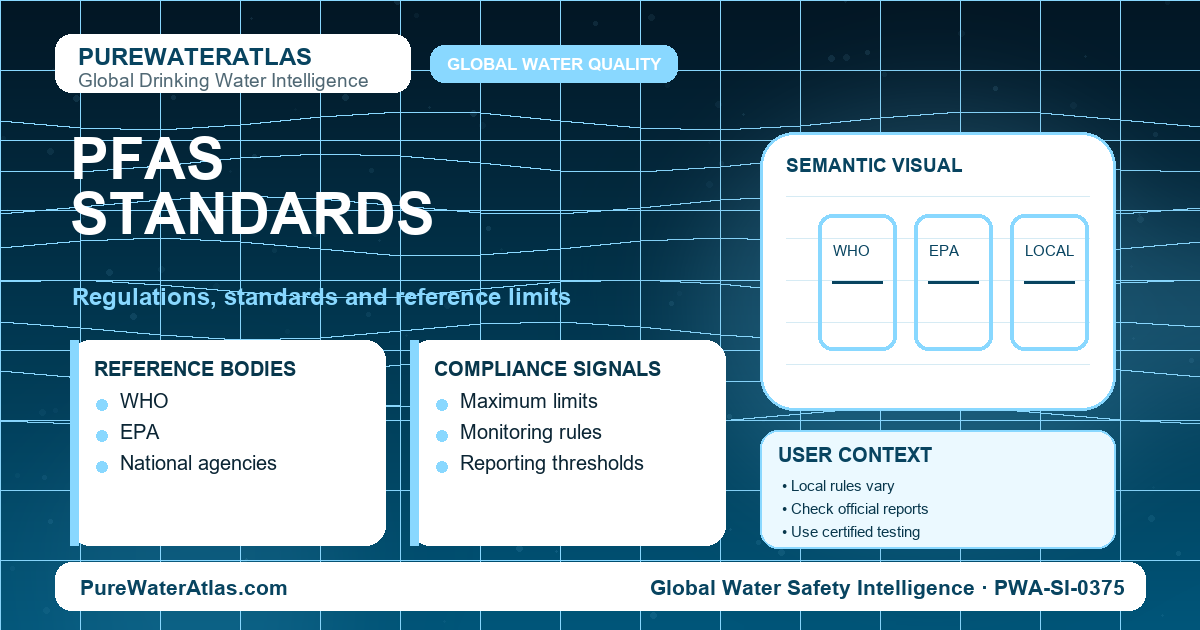
One of the most influential technical references is the WHO framework for drinking water quality. Discussions of freshwater availability around the world who guidelines usually refer to the World Health Organization’s guideline values and risk-management approach for microbial, chemical, and radiological hazards in drinking water. WHO guidance is widely used because it provides science-based reference points for governments developing national standards, especially where regulatory capacity is evolving.
The WHO approach emphasizes water safety plans, preventive risk management, source protection, treatment performance, and verification monitoring. Rather than relying only on end-product testing, it encourages control across the entire system.
National Standards and Regulatory Models
Countries vary significantly in how they regulate freshwater. Some have centralized national systems; others divide authority among federal, state, provincial, or municipal institutions. In general, regulations fall into several categories:
- Drinking water standards: define acceptable contaminant levels and treatment requirements.
- Water allocation laws: govern withdrawals from rivers, lakes, and aquifers.
- Source water protection rules: reduce pollution risks in watersheds and recharge areas.
- Wastewater and discharge permits: limit pollutants entering freshwater systems.
- Environmental flow and ecosystem rules: preserve water for aquatic habitats and wetlands.
- Drought and emergency measures: prioritize essential uses during shortages.
EPA Standards and the U.S. Example
When people search for freshwater availability around the world epa standards, they are often looking to the United States as an example of a mature regulatory framework. The U.S. Environmental Protection Agency establishes national drinking water regulations under the Safe Drinking Water Act and works with states on implementation and enforcement. These rules set maximum contaminant levels or treatment techniques for numerous substances and organisms relevant to public health.
The EPA also plays a major role in protecting freshwater sources through the Clean Water Act, which regulates pollutant discharges into surface waters, supports water quality criteria, and requires permits for many wastewater and industrial releases. While the EPA framework is specific to the United States, its structure influences water governance discussions globally because it links source protection, public health standards, monitoring, and enforcement.
However, EPA-style standards are not universal. Other countries may adopt stricter limits for certain contaminants, use different risk thresholds, or emphasize different treatment and reporting approaches. Standards also evolve over time as science improves.
WHO Guidelines Versus National Law
WHO guideline values are not automatically binding. National authorities review local conditions, laboratory capacity, treatment feasibility, exposure patterns, and economic constraints before converting guidance into law or policy. In some places, national standards are aligned closely with WHO recommendations. In others, standards differ because of regional geology, infrastructure, climate, or public health priorities.
This distinction is important when discussing freshwater availability around the world safe limits. A safe limit may be defined differently in law, guidance, or operational practice. For example, some contaminants may be regulated through mandatory maximum concentrations, while others are controlled through treatment techniques, risk plans, or advisory levels.
Water Allocation and Scarcity Rules
Regulation of freshwater availability is not only about contaminant limits. Many countries use permits, licenses, riparian rights, prior appropriation systems, or basin-level planning to determine who may use water and in what quantities. These systems become especially important during drought or in overdrawn basins.
Allocation frameworks may prioritize uses such as:
- Basic human consumption and sanitation
- Public health and emergency services
- Agriculture and food production
- Industrial and energy needs
- Ecosystem preservation and environmental flows
In practice, balancing these interests is politically and technically difficult. Strong regulation requires reliable data, equitable institutions, and the ability to adjust permits when conditions change.
Compliance, Enforcement, and Transparency
Rules are only meaningful when they are implemented. Freshwater availability around the world compliance depends on routine monitoring, inspections, laboratory capacity, operator training, legal authority, and public reporting. Common compliance tools include:
- Sampling and reporting requirements
- Permit conditions for withdrawals and discharges
- Operator certification and treatment process control
- Corrective action plans after exceedances
- Public notification of water safety issues
- Financial penalties or operational restrictions for noncompliance
Transparency is especially important because communities, researchers, and regulators need access to trustworthy data. Public confidence is strengthened when monitoring results, enforcement actions, and water shortage plans are clearly communicated.
Regional Differences in Water Rules
High-income countries often have more extensive infrastructure and formal monitoring systems, but they still face emerging contaminants, aging assets, and drought stress. Low- and middle-income countries may rely more heavily on international guidance, phased implementation, and risk-based prioritization due to resource constraints. Small island states, arid nations, and transboundary basin regions often adopt specialized rules addressing desalination, reuse, storage security, and shared water governance.
As climate pressures intensify, many legal systems are moving toward integrated water resources management, stronger watershed protection, water reuse standards, and adaptive drought planning. The overall trend is toward combining public health safeguards with ecosystem-based management and long-term resilience.
Conclusion
Freshwater availability is shaped by far more than rainfall and river flow. It is the result of hydrology, infrastructure, land use, pollution control, public health policy, and legal governance working together or, in some cases, failing to do so. Understanding freshwater availability around the world regulations means looking at both how much water exists and whether that water is safe, protected, fairly allocated, and sustainably managed.
Global freshwater challenges are increasing as climate change, population growth, agricultural demand, industrial development, and pollution place greater stress on rivers, lakes, and aquifers. In response, regulations and standards help define acceptable water quality, guide treatment, protect source waters, limit harmful discharges, and allocate scarce supplies. Frameworks associated with freshwater availability around the world epa standards and freshwater availability around the world who guidelines show how science-based limits and risk management can support safer and more reliable water systems.
Still, standards alone are not enough. Effective protection depends on enforcement, monitoring, transparent reporting, infrastructure investment, watershed stewardship, and adaptive planning. Whether the issue is contamination, drought, groundwater depletion, or weak institutional capacity, the goal remains the same: ensuring that freshwater is not only present, but safe, accessible, and sustainable for current and future generations.
As communities and governments refine freshwater availability around the world water rules, the most successful approaches will be those that integrate health protection, environmental sustainability, and practical freshwater availability around the world compliance systems. In a world of growing water stress, strong regulation is not a bureaucratic detail; it is one of the foundations of human well-being and long-term resilience.
Read the full guide: Global Water Quality Guide
Explore more in this category: Global Water Quality Articles