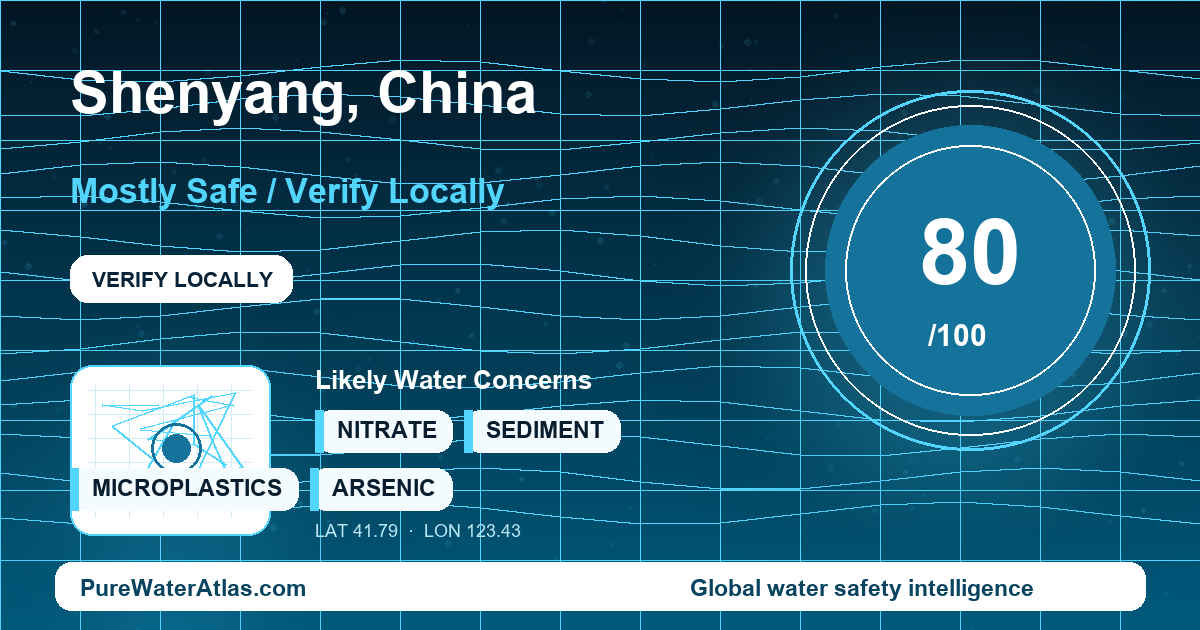
Shenyang, Liaoning: treated municipal water in a major northeast China city, with practical drinking safety depending heavily on building plumbing, secondary storage, and local verification.
Quick Answer
| Overall safety status | Mostly Safe / Verify Locally — PureWaterAtlas score: 80/100. Shenyang has a formal treated municipal water system, but tap-level safety can vary by building, district, pipe condition, and secondary storage. |
|---|---|
| Can tourists drink it? | Do not use unboiled tap water as your primary drinking water unless your hotel or host confirms that it is boiled, filtered, or otherwise treated at the point of use. Bottled water, boiled tap water, and properly filtered water are safer defaults. |
| Resident advice | Municipal water is generally suitable for household use, but residents should evaluate internal plumbing, high-rise tanks, discoloration, odor, pressure instability, and sediment. Testing is recommended for older buildings, unclear tank maintenance, infants, pregnant residents, or sensitive households. |
| Main water-source context | Shenyang is in the Liao River basin and is strongly associated with treated surface water from the Dahuofang Reservoir diversion system serving central Liaoning, along with municipal waterworks and historically used local surface-water and groundwater sources. |
| Water authority | Shenyang Water Group Co., Ltd. is the main urban water-supply operator, with oversight involving municipal, provincial, and national water, health, and environmental authorities. |
| Filter recommendation | A filter is not automatically required for every household, but a certified point-of-use filter can help with chlorine taste, sediment, turbidity, and older-building concerns. Choose filtration based on testing, not assumption. |
Why Shenyang Is Different
Shenyang is the capital of Liaoning Province and one of northeast China’s major urban and industrial centers. Its drinking-water profile is shaped by three local realities: a large municipal treatment and distribution system, a regional reservoir-transfer supply context, and a dense urban building stock where the final meters of plumbing can matter as much as the water leaving the plant.
The city sits in the Liao River basin, with the Hun River passing through the urban area. That basin setting makes watershed protection, reservoir management, storm runoff, seasonal turbidity, and industrial or urban pollution control relevant to drinking-water security. This does not mean finished tap water is known to be unsafe citywide. It means that Shenyang’s safety question should be asked locally: Which district, which water plant or pressure zone, which building, which tank, and which tap?
The practical verdict is therefore cautious but not alarmist. Shenyang’s municipal tap water is treated through a formal urban system and is expected to be suitable for normal domestic uses. For direct drinking, however, PureWaterAtlas recommends local verification. Many residents in China routinely boil tap water before drinking, and that habit is especially practical in a city where building-level plumbing, older apartment blocks, and high-rise secondary supply systems can influence water quality after treatment.
Where Does Shenyang’s Tap Water Come From?
Shenyang’s urban water supply is strongly associated with treated surface water from the Dahuofang Reservoir regional water-supply and diversion system, which supports central Liaoning cities including Shenyang. The World Bank: Liaoning Safe and Sustainable Urban Water Supply Project is an important technical reference for this regional supply context. The exact source mix can vary by district, treatment plant, season, and operating condition, so consumers should verify current information with Shenyang Water Group or local public notices.
Historically, Shenyang’s water security has also been tied to the Hun River system, local groundwater, and regional reservoirs. The Dahuofang Reservoir transfer system was developed to improve supply reliability for Shenyang and other central Liaoning cities, reducing dependence on more vulnerable local sources. This regional infrastructure is a key reason the city has a more robust supply identity than a community relying only on small local wells or a single local river intake.
After raw water is collected and treated, it moves through municipal treatment plants, transmission mains, neighborhood distribution pipes, pressure zones, and finally building-level plumbing. In high-rise residential and commercial buildings, water may pass through secondary supply systems such as pumps, rooftop or basement tanks, and internal pipes. For Shenyang households, that final stage is often the most important difference between “treated municipal water” and “safe water at my kitchen tap.”
Who Manages Drinking Water in Shenyang?
The main municipal water-supply operator for Shenyang’s urban system is Shenyang Water Group Co., Ltd.. For customer notices, service disruptions, and local supply operations, the utility is the first source residents should check.
Government oversight is shared across local and higher-level authorities. The Shenyang Water Affairs Bureau is relevant to municipal water affairs, water infrastructure, and public water management. The Shenyang Ecology and Environment Bureau is relevant to local surface-water quality and pollution-control information. At the provincial level, the Liaoning Provincial Department of Ecology and Environment provides regional context for river-basin water quality and source-water protection.
China’s urban drinking water is regulated under national drinking-water requirements, including the national Standard for Drinking Water Quality GB 5749-2022. The National Standard Information Public Service Platform is the official standards reference platform, and the Ministry of Ecology and Environment is the national authority for water pollution control and environmental policy. Internationally, the World Health Organization Guidelines for Drinking-water Quality provide useful health-based context for microbial and chemical risks.
A key limitation: public, address-level English data for every Shenyang apartment, hotel, secondary tank, and consumer tap is not readily available. City-level and regional institutions are identifiable, but tap-level conditions still require local verification.
Main Local Water Concerns
The main Shenyang water concerns are not primarily about whether a municipal treatment system exists. They are about what happens before and after treatment: source-water pressure in a large river basin, seasonal raw-water changes, old distribution infrastructure, and building-level storage or plumbing.
- Secondary supply in high-rise buildings: Tanks, pumps, and internal building pipes can become weak points if they are not cleaned, disinfected, and monitored. Residents should ask property management for tank-cleaning and testing records.
- Temporary turbidity and discoloration: Yellow or brown water, sediment, or cloudiness may appear after pipe repairs, pressure changes, service interruptions, hydrant flushing, or winter-related pipe work.
- Chlorine taste or odor: Municipal systems maintain disinfectant residuals through distribution. A noticeable chlorine smell can be unpleasant but is also part of microbial risk control.
- Older buildings and internal pipes: Older apartments, work-unit housing, corroded fixtures, or aging internal plumbing may affect iron, manganese, sediment, and potentially lead from premise plumbing components.
- Industrial and urban basin context: Shenyang’s wider metropolitan area has a heavy-industrial history. This does not prove finished water contamination, but it makes source-water protection and monitoring for metals and organic pollutants important.
- Seasonal runoff: Summer rainstorms, spring thaw, and snowmelt can increase turbidity and runoff loading. Warm-season reservoir or river conditions can also raise algae-related taste, odor, and treatment challenges.
For Travelers
For short-stay visitors to Shenyang, the safest practical answer is simple: drink sealed bottled water, boiled tap water, or properly filtered water. Do not rely on unboiled tap water as your primary drinking water unless your hotel, host, or restaurant can confirm that it has been boiled, filtered, or otherwise treated at the point of use.
Tap water is usually acceptable for showering and brushing teeth in major hotels and modern apartments. If you are highly cautious, traveling with young children, immunocompromised, pregnant, or prone to stomach sensitivity, use bottled water for brushing teeth as well.
Use the in-room kettle if bottled water is unavailable. Boiling is effective for microbial risk reduction, but it does not remove metals, salts, nitrate, or many industrial chemicals. For a practical overview, see PureWaterAtlas on boiling water purification.
Be careful with ice. Avoid ice from unknown street vendors or small restaurants unless you know it was made from commercially purified water. In higher-end hotels and chain restaurants, risk may be lower, but it still depends on handling. In restaurants, hot tea, boiled water, sealed bottled water, and factory-sealed drinks are safer choices than unverified cold tap water or ice.
For Residents
Residents connected to Shenyang’s central municipal system can usually rely on treated water for normal household use, but should evaluate their own building. The key questions are: Is the building old? Does it use rooftop or basement storage? Are tanks cleaned and documented? Is there rust-colored water after stagnation? Does the water become cloudy after maintenance or pressure changes?
A home filter is not automatically required for every household, but it is reasonable for taste, chlorine odor, sediment control, and added protection in older buildings. Many residents use a kettle plus a certified point-of-use filter. Reverse osmosis may be considered where dissolved contaminants are a specific concern, but filter selection should be based on testing rather than fear or marketing claims. For treatment selection, see Water Treatment Systems: Choosing the Right Solution.
Testing is especially important in older apartments, homes with infants or pregnant residents, buildings with unknown tank maintenance, or taps showing discoloration, odor, particles, staining, or pressure instability. Test both first-draw and flushed samples where internal plumbing is a concern. Useful parameters include lead, iron, manganese, turbidity, residual chlorine, pH, conductivity, hardness, total coliform, and E. coli. Nitrate testing is worth considering if there is any chance of non-municipal water, mixed sources, or local well use.
Use an accredited local laboratory or government-recognized testing service for health-critical decisions. Color strips can be useful for screening, but they should not be the only basis for decisions about infants, pregnancy, immunocompromised residents, or suspected microbial contamination.
Relevant Contaminants and Water-Quality Issues
Several water-quality topics are especially relevant to Shenyang’s local profile. Chlorine in drinking water is relevant because municipal systems maintain residual disinfectant in the network, sometimes producing a noticeable taste or odor. Turbidity and sediment are relevant after storms, repairs, pressure changes, or disturbance of older pipes.
Older buildings make premise-plumbing contaminants important. Lead in drinking water is a building-level concern where older internal components may contribute metals even when water leaving the plant is treated. For practical sampling guidance, see Lead in Drinking Water: Testing and Detection Methods. Manganese can be relevant to staining, discoloration, and certain groundwater or pipe-related conditions.
For high-rise buildings and storage tanks, microbial testing matters. E. coli in drinking water is an important indicator for fecal contamination and unsafe microbial conditions. UV treatment can be useful in some controlled systems, but only when paired with appropriate prefiltration and maintenance; see the PureWaterAtlas UV Water Purification Guide.
How to Verify Your Water Quality
The most reliable way to answer “is my Shenyang tap water safe?” is to verify at the point of use. Start with official utility or government notices, especially after maintenance, pipe repairs, pressure changes, or visible discoloration. For local operational information, check Shenyang Water Group and municipal water-affairs notices. For environmental context, consult city and provincial ecology and environment sources.
For households, arrange laboratory testing when there are old pipes, high-rise tanks, recurring odor, sediment, discoloration, or vulnerable residents. PureWaterAtlas recommends reading How to Test Drinking Water before choosing a test panel. For broader safety criteria, see Drinking Water Safety: How to Know If Your Tap Water Is Safe.
If you see brown water, particles, sudden cloudiness, or metallic taste, flush the tap, avoid drinking the affected water until it clears, document the issue, and contact property management or the utility. If the problem repeats, test for metals, turbidity, and microbial indicators. Use the PureWaterAtlas Contaminants Search Engine to look up individual parameters, and the Global Water Quality Checker to compare Shenyang with other city profiles. For background on contamination pathways, see Water Contamination in Drinking Water.
Official and Technical Sources
- Shenyang Water Group Co., Ltd. — local urban water-supply operator.
- Shenyang Water Affairs Bureau — municipal water affairs and infrastructure authority.
- Shenyang Ecology and Environment Bureau — local environmental and surface-water quality context.
- Liaoning Provincial Department of Ecology and Environment — provincial river-basin and source-water protection context.
- World Bank: Liaoning Safe and Sustainable Urban Water Supply Project — regional water-supply infrastructure reference.
- National Standard Information Public Service Platform — official Chinese national standards platform, including drinking-water standards.
- Ministry of Ecology and Environment of the People’s Republic of China — national environmental regulator.
- WHO Guidelines for Drinking-water Quality — international health reference for drinking-water risk interpretation.
Bottom Line
Shenyang’s tap water comes from a formal treated municipal system with important regional supply support from the Dahuofang Reservoir context, so it is generally suitable for normal domestic use. The main uncertainty is tap-level quality: older internal pipes, high-rise secondary tanks, repairs, pressure changes, and seasonal turbidity can affect what reaches a specific apartment, hotel, or office. Travelers should choose bottled, boiled, or properly filtered water for drinking and be cautious with ice. Residents should verify their own building conditions, ask about tank maintenance, test when discoloration or odor appears, and consider a certified point-of-use filter for taste, sediment, and added protection. The citywide verdict is mostly safe, but not a guarantee for every tap.
Read the full guide: Global Water Quality Guide
Explore more in this category: Global Water Quality Articles