
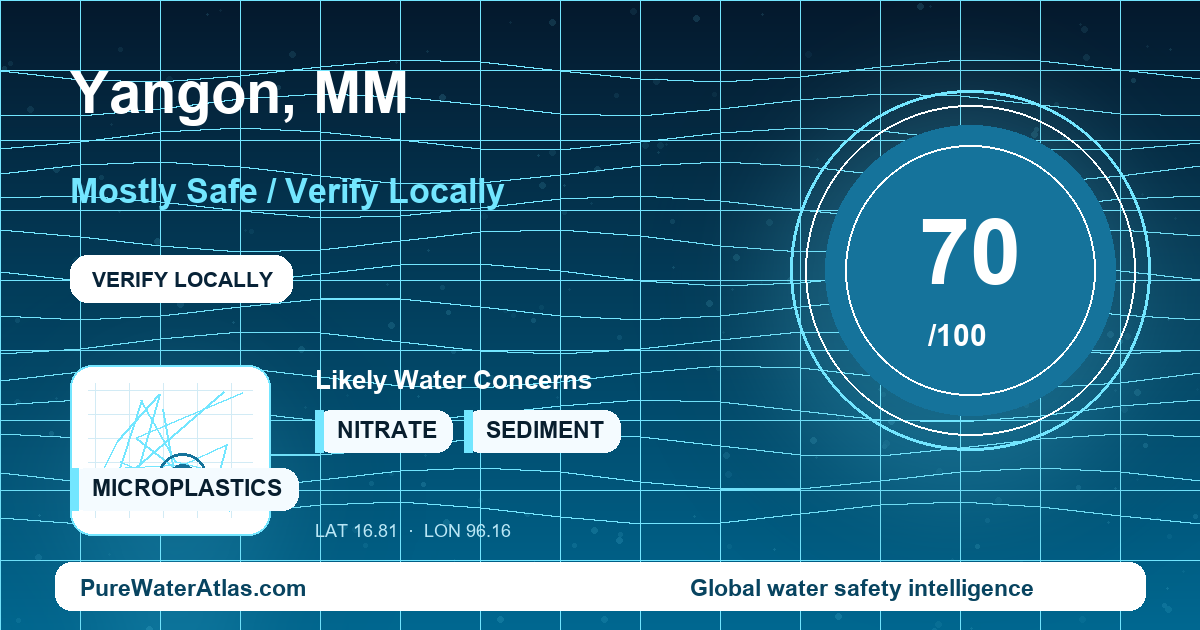
Yangon has an established YCDC municipal water system supplied mainly by reservoir sources, but final tap safety depends heavily on local pipes, pressure, storage tanks, and building plumbing.
Quick Answer
| Overall safety status | Mostly Safe / Verify Locally — PureWaterAtlas score: 70/100. Yangon has real municipal treatment and distribution infrastructure, but tap safety is not uniform across buildings or neighborhoods. |
|---|---|
| Can visitors drink the tap water? | No, not as a default. Travelers should use sealed bottled water, properly boiled water, or water treated by a trustworthy hotel, restaurant, or purifier. |
| Resident advice | Residents connected to YCDC supply should verify building tanks, old plumbing, and final tap quality. Stored water may need sediment filtration plus disinfection or a certified point-of-use drinking-water system. |
| Main water source | Primarily impounded surface-water reservoirs north and northeast of the city, including Hlawga, Gyobyu, Phugyi, and Ngamoeyeik systems, with supplementary groundwater tube wells in some areas. |
| Water authority | Yangon City Development Committee, commonly abbreviated YCDC. |
| Filter recommendation | For drinking water, use treatment that addresses both sediment and microbial risk. Sediment filtration alone is not reliable disinfection. Boiling, UV after adequate prefiltration, ultrafiltration, or reverse osmosis may be appropriate depending on the water source and test results. |
Why Yangon Is Different
Yangon is not a city where the main question is whether a municipal water system exists. It does. The city has a documented public water supply operated by the Yangon City Development Committee, with reservoir sources, treatment and transmission works, pumping infrastructure, distribution mains, and some groundwater supplementation. The practical safety question is what happens between the source system and the glass of water at a hotel, apartment, school, office, or restaurant.
Yangon sits in the low-lying Yangon River delta area, but the city’s core municipal supply should not be understood as simply untreated river water from the urban waterfront. The main supply is based on reservoir systems outside the densest urban core, including older lake and reservoir systems and later larger reservoir-linked expansions. This staged history matters because different parts of the network can have different pipe ages, pressure patterns, storage practices, and service reliability.
The most city-specific caution is the final-tap pathway. Development-agency assessments of Yangon have repeatedly identified aging pipes, leakage, intermittent supply or pressure-management challenges, and the need for major investment in treatment, transmission, and distribution. In a low-pressure or intermittently pressurized network, leaks and nearby drainage or sewage can become a contamination pathway. Even where treated municipal water enters a building, underground tanks, roof tanks, booster pumps, and internal plumbing can change the water before it reaches the kitchen tap.
Publicly accessible, recent, neighborhood-level tap-water compliance data are limited. That means it would be inaccurate to say that every Yangon tap is safe, or that every tap is unsafe. The better conclusion is more practical: Yangon’s municipal supply has real infrastructure behind it, but residents and visitors should verify the specific building and point of use.
Where Does Yangon’s Tap Water Come From?
Yangon’s municipal water supply is based mainly on impounded surface-water sources north and northeast of the city. Key systems include Hlawga, Gyobyu, Phugyi, and Ngamoeyeik reservoir systems. Ngamoeyeik water is associated with the Nyaunghnapin treatment and transmission system, while the older Hlawga and Gyobyu systems remain important parts of Yangon’s layered supply mix.
The city historically relied on lake and reservoir sources such as Hlawga and Gyobyu, then expanded to larger reservoir systems such as Phugyi and Ngamoeyeik as population and urban demand increased. This explains why Yangon water quality is not experienced as one single uniform condition. Service area, building elevation, distance from treatment and pumping points, local pipe age, pressure stability, and building storage can all affect what residents actually receive.
Important Yangon water infrastructure includes the Hlawga Lake or reservoir supply system, the Gyobyu Reservoir supply system, the Phugyi Reservoir supply system, the Ngamoeyeik Reservoir supply system, Nyaunghnapin water treatment and transmission facilities linked to Ngamoeyeik supply, YCDC distribution mains and pumping infrastructure, and supplementary municipal or local groundwater tube wells in some areas.
Many buildings also add an extra layer of infrastructure after the municipal connection. Water may be pumped into an underground tank, lifted to a roof tank, and then distributed through internal pipes. This is common in many urban buildings, and in Yangon it is a major reason why a clean source does not automatically guarantee clean water at the final tap. A tank that is open, cracked, poorly screened, rarely cleaned, or exposed to backflow can become the dominant water-quality risk.
Who Manages Drinking Water in Yangon?
The principal municipal authority responsible for Yangon urban water supply services is the Yangon City Development Committee, commonly abbreviated YCDC, through its water supply, sanitation, and engineering-related departments. YCDC is the relevant local body for municipal supply functions, including parts of source development, treatment, transmission, distribution, and service management.
Myanmar also has national drinking-water quality guidance and standards, including the Myanmar National Drinking Water Quality Standards 2014, influenced by public-health approaches consistent with the WHO Guidelines for Drinking-water Quality. These documents are important reference points for microbial safety, turbidity, disinfectant residual, and chemical parameters.
However, standards and infrastructure descriptions are not the same as tap-specific proof. Yangon consumers do not have the same level of easily accessible routine public tap-water reporting found in some countries. The available evidence supports identifying the city’s supply systems and risk mechanisms, but it does not justify precise claims about every township, hotel, apartment, or workplace. Local verification and testing are especially important when water is stored, mixed with private well water, or delivered through old building plumbing.
Main Local Water Concerns
The most important Yangon drinking-water concern is microbial contamination at the point of use. This can occur where pipes leak, pressure is intermittent, storage tanks are poorly maintained, or building plumbing allows contamination after the water leaves the utility system. If treated water loses disinfectant residual in a warm roof tank or after long storage, microbial regrowth becomes more plausible.
Turbidity and sediment are also practical concerns. Monsoon runoff can increase raw-water turbidity and organic load in catchments, making treatment and disinfection control more demanding. Sediment can also appear after pipe repairs, pressure changes, or disturbance of old mains and tanks. Visible particles are not just an aesthetic issue: high turbidity can interfere with disinfection and may signal disturbance in the system.
Variable chlorine residual is another concern, especially at distant taps or after long storage inside a building. Chlorine is used as a disinfectant in many municipal systems, but the useful residual must persist through pipes, tanks, and internal plumbing. If water sits too long in a tank, or if the tank is contaminated, the residual may be depleted before the water reaches the tap.
Iron and manganese may contribute to staining, color, or taste complaints where groundwater contributes to supply or where old pipes and tanks release deposits. These are often noticeable as aesthetic problems, but local testing is needed to understand concentrations and whether they have health relevance.
Private wells in and around Yangon should not be treated as equivalent to YCDC municipal water. They may have different risks, including salinity, iron, manganese, microbial contamination, nitrate from sanitation sources, and, in some Myanmar delta or groundwater settings, arsenic risk. These risks should be tested rather than assumed. Old buildings may also add metals from legacy internal plumbing, corroded fittings, solder, galvanized lines, or brass fixtures, making first-draw tap testing more useful than relying only on source-water information.
For Travelers
Visitors should not drink ordinary Yangon tap water unless the specific hotel, apartment, or restaurant confirms that the water is treated and maintained for drinking, or unless the traveler treats it personally. For short stays, the safer default is sealed bottled water, properly boiled water, or verified filtered water from a reputable system.
For brushing teeth, bottled or treated water is the cautious choice, especially for children, pregnant travelers, and anyone with a sensitive stomach. In higher-end hotels, tap water for brushing may be a lower-risk exposure, but it is still not the safest default because the condition of internal tanks and plumbing is building-specific.
Use ice only in reputable hotels, cafes, and restaurants that state they use purified water or commercial ice. Avoid unknown street ice, crushed ice from unclear sources, or ice stored in open containers. When ordering drinks, ask whether the ice and drinking water are made from purified water, not simply from municipal tap water.
Carry sealed bottled water for walking around the city, use bottled water for medications, and avoid swallowing shower water. For infant formula, use bottled water that is appropriate for that use or water that has been properly boiled and cooled. If treating uncertain water yourself, boiling to a rolling boil is a practical microbial safety method; see the PureWaterAtlas Boiling Water Purification: Complete Guide. Portable filters can help, but sediment removal alone does not reliably disinfect water.
Travel-health authorities such as the U.S. CDC Travelers’ Health page for Burma/Myanmar support conservative food and water precautions for visitors.
For Residents
Many Yangon households should consider point-of-use treatment, especially when water passes through underground or roof tanks, when the building has old plumbing, or when anyone drinks tap water without boiling. A practical setup is sediment prefiltration followed by a drinking-water treatment method that provides microbial protection. Options may include boiling, UV after adequate prefiltration and maintenance, ultrafiltration, or reverse osmosis where dissolved contaminants are a concern. The right system depends on the actual water source and test results.
Storage tanks deserve special attention in Yangon. Tanks should be covered, screened against insects and animals, protected from sewage or stormwater intrusion, cleaned on a schedule, and disinfected after cleaning or suspected contamination. A roof tank that is warm, open, cracked, or rarely cleaned can lose disinfectant residual and become a microbial growth point. An underground tank can also be vulnerable if it is poorly sealed or near contaminated drainage.
Residents should test stored tap water and kitchen tap water for E. coli or thermotolerant coliforms if anyone drinks it without boiling. It is also useful to check turbidity, color, odor, and residual chlorine after storage, especially at the farthest tap from the building inlet. Retest after floods, major pipe repairs, tank cleaning, pump replacement, or any change in taste, smell, color, or sediment.
If a household uses a private well or a mixed municipal and well supply, testing should include E. coli, nitrate, electrical conductivity or salinity, iron, manganese, arsenic, hardness, and basic chemistry. If the building is old or has unknown plumbing materials, test first-draw and flushed samples for lead and other metals. Older apartment blocks, colonial-era buildings, and buildings with poorly documented renovations may have corroded internal pipes, old solder, brass fixtures, galvanized lines, or storage systems that affect final water quality.
Relevant Contaminants and Water-Quality Issues
The most relevant Yangon contaminant profile is E. coli, because microbial contamination is the key concern where supply is intermittent, tanks are poorly maintained, or water is consumed without disinfection. Turbidity and sediment are also important because monsoon runoff, old mains, tank deposits, and pipe disturbance can affect clarity and treatment performance.
Chlorine is relevant because safe distribution depends partly on maintaining a disinfectant residual through pipes and building tanks. Low or absent residual at the tap does not automatically prove contamination, but it reduces the protective margin. For older buildings, lead is relevant as a tap-specific plumbing issue rather than a proven citywide source-water claim.
For private wells and groundwater use, Yangon households should pay attention to arsenic, nitrate, iron, and manganese. These should be verified with laboratory testing, especially for wells near sanitation sources, low-lying or peri-urban areas, or supplies with staining, salinity, odor, or taste changes.
How to Verify Your Water Quality
Because Yangon has limited public neighborhood-level tap-water reporting, the most reliable answer is to test the actual water you drink. Start by identifying whether the supply is YCDC municipal water, a private well, a tanker or other non-YCDC source, or a mixed system. Then sample the water at the kitchen tap and, if possible, before and after storage tanks.
For general decision-making, use the PureWaterAtlas Drinking Water Safety guide and the Water Testing guide. For microbial risk and household disinfection decisions, see Water Microbiology. For choosing between boiling, UV, filtration, ultrafiltration, and reverse osmosis, see Water Treatment Systems and the UV Water Purification: Complete Guide.
For old-building metals, use Lead in Drinking Water: Testing and Detection Methods. For private wells or groundwater, see Arsenic in Drinking Water: Testing and Detection Methods and Nitrate Contamination in Drinking Water: Testing and Detection Methods. You can also compare broader context with the Global Water Quality Checker, browse the Contaminants Search Engine, or explore Global Water Quality.
Official and Technical Sources
- Yangon City Development Committee — official municipal body responsible for Yangon city services, including water supply functions through its engineering and water-related departments.
- JICA open report library — technical reports on Yangon water supply, sewerage, drainage, reservoir sources, transmission infrastructure, leakage, and distribution challenges.
- JICA, The Project for the Strategic Urban Development Plan of the Greater Yangon — infrastructure context for Greater Yangon, including water supply development and population-growth pressure.
- WHO and UNICEF Joint Monitoring Programme, Myanmar household water data — national WASH background for Myanmar, not a substitute for Yangon tap-specific testing.
- WHO Guidelines for Drinking-water Quality — public-health reference for microbial safety, turbidity, disinfectant residual, chemicals, and household water safety principles.
- U.S. CDC Travelers’ Health, Burma/Myanmar — travel-health guidance supporting conservative food and water precautions for visitors.
- Myanmar National Drinking Water Quality Standards 2014 — national drinking-water parameter reference; not proof of current compliance at individual Yangon taps.
Bottom Line
Yangon’s tap water should be treated as mostly safe only when verified locally. The city has a genuine YCDC municipal system supplied mainly by reservoir sources such as Hlawga, Gyobyu, Phugyi, and Ngamoeyeik, with treatment, transmission, distribution mains, and some groundwater supplementation. The main risk is not the absence of a water system, but what can happen after treatment: aging pipes, intermittent pressure, leakage, storage tanks, old plumbing, and limited public tap-level reporting. Travelers should use bottled, boiled, or verified purified water. Residents should inspect tanks and plumbing, use appropriate point-of-use treatment, and test actual tap water, especially after floods, repairs, tank cleaning, or any change in water appearance, taste, odor, or sediment.
Read the full guide: Global Water Quality Guide
Explore more in this category: Global Water Quality Articles