
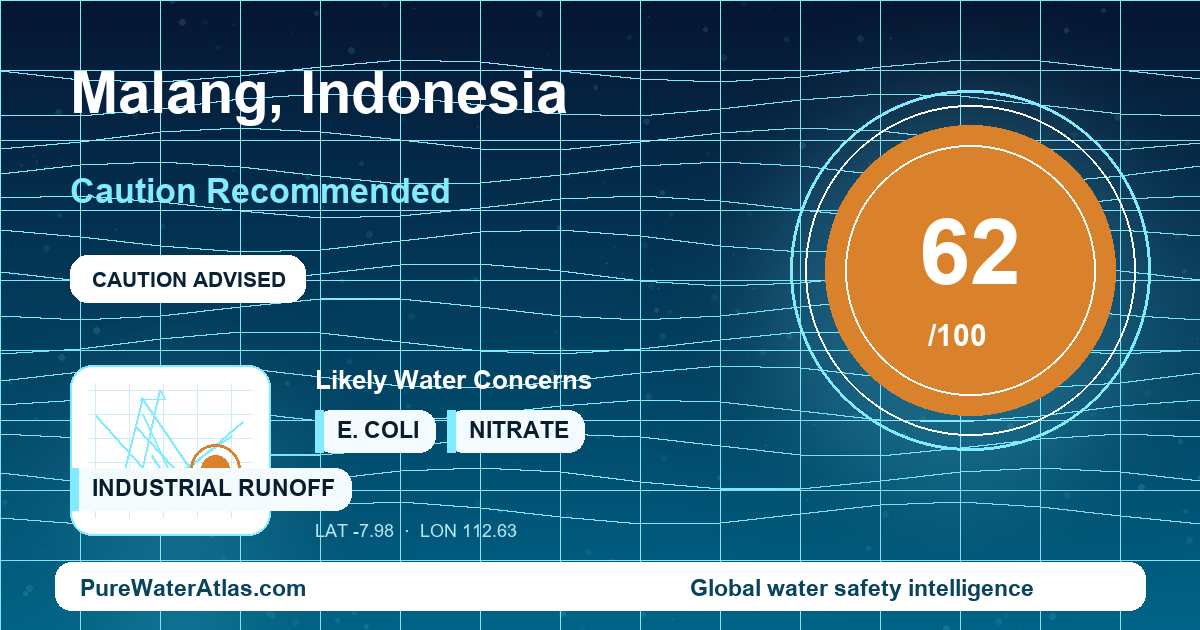
Malang, Indonesia: spring-fed municipal water in an inland highland city, with caution recommended at the tap because building plumbing, storage tanks, intermittent pressure, and limited public tap-level test data can affect final drinking-water safety.
Quick Answer
| Water safety score | 62 / 100 |
|---|---|
| Risk level | Caution Recommended |
| Can visitors drink the tap water? | No, not directly as a default practice. Visitors should use sealed bottled water, boiled water, or water treated by a reliable purifier. |
| Resident guidance | Municipal water from Perumda Air Minum Tugu Tirta can be treated as a managed source, but point-of-use treatment is recommended for drinking, especially where water is stored in roof or ground tanks. |
| Main water source | Primarily upland springs in the wider Malang Raya area, including the long-used Wendit spring system in Pakis, Kabupaten Malang, supplemented by other spring sources and reservoirs. |
| Water authority | Perumda Air Minum Tugu Tirta Kota Malang, with public-health oversight linked to Dinas Kesehatan Kota Malang and national Ministry of Health standards. |
| Home filter recommendation | Recommended for drinking water. A practical setup may include sediment prefiltration, activated carbon, and boiling, UV, or reverse osmosis depending on whether the home uses PDAM water, a private well, or mixed sources. |
Overall verdict: caution recommended. Malang has a formal municipal utility and a favorable upland spring-water setting, but recent, consolidated, public consumer-tap test results for the city are limited. The main question is not only what leaves the spring-fed system, but what reaches the actual tap after distribution pipes, pressure changes, household storage, pumps, and building plumbing.
Why Malang Is Different
Malang is not a coastal water-supply case. It is an inland highland city in East Java, surrounded by volcanic mountain systems and located well away from the sea. That geography matters: salinity intrusion and seawater contamination are not the leading drinking-water concern in Malang in the way they can be for some coastal Indonesian cities.
Malang’s water identity is closely tied to natural springs in the wider Malang Raya area. Historically, the city developed in a landscape with abundant spring water from the volcanic uplands. This gives Malang a more favorable raw-water setting than many dense lowland urban areas, but it does not automatically make every household tap safe for direct drinking.
The practical risk profile in Malang is more about spring protection, land-use pressure around catchments, distribution reliability across varied elevations, and what happens inside buildings. A clean spring source can still become a caution-level tap-water situation if pressure drops, pipes leak, storage tanks are unclean, or a building’s plumbing contributes sediment, rust, or other localized problems.
For that reason, PureWaterAtlas rates Malang as Caution Recommended rather than “drink freely from the tap.” The city has a managed municipal system, but the available public information does not support a blanket claim that every consumer tap consistently meets drinking-water standards at all times.
Where Does Malang’s Tap Water Come From?
Malang’s municipal supply is primarily a spring-fed upland system. The local utility, Perumda Air Minum Tugu Tirta Kota Malang, has historically relied on springs in the Malang Raya area. Wendit spring in Pakis, Kabupaten Malang is commonly identified as a major long-used source, with other spring sources and distribution reservoirs supporting the city’s service zones.
This source geography is important because several source areas are outside the city boundary. That means long-term source protection is not only a Kota Malang issue; it also depends on coordination across the wider Malang Raya landscape. Catchment protection, land-use change, and the condition of spring areas matter for future water security.
The main water infrastructure serving Malang includes spring intakes, transmission mains carrying raw or treated spring water toward the city, service reservoirs, pressure zones for different elevations, and the urban distribution network. Once water enters a property, the final quality depends heavily on customer-side conditions: pipes, pumps, roof tanks, ground tanks, fittings, and point-of-use treatment.
In practical terms, the biggest weak point for many users may not be the spring itself. It is often the path from source to tap. Pressure interruptions, pipe repairs, sediment deposits, and storage tanks can change the water that residents actually drink.
Who Manages Drinking Water in Malang?
Malang City’s municipal drinking-water utility is Perumda Air Minum Tugu Tirta Kota Malang. The utility is the official local water-service institution for the city and is the primary source to check for public notices, service updates, and utility-level information.
Local public-health oversight is associated with Dinas Kesehatan Kota Malang, while the national drinking-water quality framework is set by Indonesia’s Ministry of Health. A key national regulation is Permenkes No. 2 Tahun 2023, which covers environmental health standards, including drinking-water quality requirements.
For city context, official information is also available from Pemerintah Kota Malang and local statistics from BPS Kota Malang. These sources help confirm the administrative and geographic setting, but they do not replace household tap testing.
Data limitation: during this review, a recent consolidated public database of routine Malang consumer-tap results by parameter, sampling location, and date was not found. Therefore, this profile does not claim exact compliance rates, neighborhood-by-neighborhood safety, or universal potability at every tap.
Main Local Water Concerns
Malang’s main drinking-water concerns are practical and local to a spring-fed Indonesian city with urban distribution and household storage. The most important issue is microbial risk at the tap if water pressure drops, pipes leak, or household tanks are not cleaned. A managed municipal source can still become unsafe if contamination enters after treatment or during storage.
- Microbial contamination: risk can increase when distribution pressure is interrupted, pipes are damaged, or storage tanks allow insects, animals, dirt, or stagnant water to enter.
- Rainy-season turbidity: heavy rain can increase runoff, suspended sediment, turbidity, and microbial loading around catchments and poorly protected local systems.
- Sediment after outages or repairs: pipe work, pressure changes, or stored deposits can lead to cloudy, muddy, or particle-laden water at the tap.
- Chlorine residual loss: protection can decline before water reaches the tap, especially in stored water or distant parts of the network.
- Private well vulnerability: shallow groundwater in dense urban or peri-urban areas can be affected by septic leakage, runoff, and local contamination.
- Old building plumbing: corroded galvanized pipes, old fittings, rust, dead-end plumbing, and long stagnation can cause taste, color, sediment, or building-level metals concerns.
- Spring catchment pressure: urbanization and land-use change around Malang Raya source areas are relevant long-term concerns.
There is no verified evidence in this dataset of a citywide lead service-line contamination problem in Malang. Lead should be treated as a building-by-building plumbing issue, especially in older buildings or where water has a metallic taste after sitting in pipes.
For Travelers
Visitors should not drink Malang tap water straight from the tap unless it has been boiled, disinfected, or passed through a well-maintained purifier. This advice is precautionary and consistent with the broader traveler-health approach for Indonesia, including guidance from CDC Travelers’ Health: Indonesia.
Use sealed bottled water, boiled water, or a trusted hotel refill station for drinking. Better hotels and restaurants in Malang commonly provide bottled water, dispensers, or boiled water, but bathroom tap water should not be assumed potable unless the property specifically states that it is filtered and safe for drinking.
For brushing teeth, most healthy adults can usually use tap water without swallowing. More cautious travelers, young children, pregnant travelers, and immunocompromised people should use bottled or boiled water for brushing as well.
Avoid ice from street vendors or unknown sources. Ice in reputable hotels, cafes, or restaurants is usually lower risk when made from purified water or commercial ice, but it is reasonable to ask whether the ice is filtered or commercially supplied.
Carry safe water when walking around the city, use boiled water for infant formula, and consider oral rehydration salts if you develop diarrhea during travel. If you are highly sensitive to stomach illness, avoid swallowing water while showering.
For Residents
Residents connected to Perumda Air Minum Tugu Tirta can generally treat municipal water as a managed source, but drinking directly from the tap without any household control is not the most cautious choice. For drinking water, point-of-use treatment is recommended, especially where water is stored in tanks or where the building plumbing is old.
A practical Malang home setup often starts with sediment prefiltration to catch visible particles, followed by activated carbon for taste and some chlorine-related issues. Where microbial risk is a concern, boiling, UV, or another reliable disinfection step is important. Reverse osmosis may be appropriate where testing shows dissolved-contaminant concerns, but the correct system depends on whether the home uses PDAM water, a private well, or mixed sources.
Private wells require more caution. At a minimum, well users should test for E. coli or thermotolerant coliforms, nitrate, pH, electrical conductivity or total dissolved solids, turbidity, iron, and manganese. During heavy rain events, shallow groundwater and private wells are higher risk than properly managed piped water.
Older buildings should be evaluated building by building. Corroded galvanized pipes, old fittings, poorly maintained pumps, dead-end plumbing, and long stagnation can cause rust, particles, metallic taste, or localized metals exposure. If the water has black particles, red-brown staining, metallic taste, or has sat in pipes for a long time, first-draw and flushed samples can help identify whether plumbing is the source.
Storage tanks are one of the most important household risk points in Malang. Roof tanks and ground tanks should be covered, screened from insects and animals, cleaned on a routine schedule, and protected from cross-connections. Stored water can lose disinfectant residual and become unsafe even when the incoming municipal supply is acceptable.
Relevant Contaminants and Water-Quality Issues
The most relevant Malang concerns are not a single confirmed citywide contaminant, but a cluster of issues linked to microbial safety, storage, pressure, and plumbing. The key PureWaterAtlas profiles for Malang readers include E. coli, because microbial contamination is the most important practical health risk when tanks, private wells, or pressure losses are involved.
Turbidity is relevant during rainy-season cloudiness, after pipe repairs, or when sediment is resuspended in local plumbing. Related visible particles and pipe deposits are covered in the sediment guide.
Chlorine is relevant because disinfectant residual helps protect water in distribution, but it can decline before reaching the tap, especially in stored water. For private wells and peri-urban groundwater, nitrate is important because septic leakage and surface influence can be concerns in dense or mixed land-use areas.
Lead should be considered only as a building-plumbing concern in Malang, not as a verified citywide claim. Older buildings with metallic taste, old fittings, or long stagnation should use testing rather than assumptions.
How to Verify Your Water Quality
The best way to verify Malang tap water is to test the water that actually comes from your household tap, especially after it has passed through tanks, pumps, and building plumbing. General testing strategy is explained in the PureWaterAtlas Water Testing guide.
If you use a private well, prioritize microbial indicators, nitrate, turbidity, pH, conductivity or TDS, iron, and manganese. If your household includes infants, pregnant people, elderly people, or immunocompromised residents, use boiled or otherwise disinfected water until microbial safety is known.
For microbial control options, see the PureWaterAtlas guides to boiling water purification and UV water purification. For older buildings with suspected metal release, see lead testing and detection methods. For private-well users, the nitrate testing guide is especially relevant.
You can also compare this Malang profile with broader resources: Contaminants Search Engine, Global Water Quality Checker, Drinking Water Safety, Water Microbiology, and Water Purification.
Official and Technical Sources
- Perumda Air Minum Tugu Tirta Kota Malang — official municipal water utility for Malang City.
- Pemerintah Kota Malang — official city government source for Malang administrative and geographic context.
- BPS Kota Malang — official local statistics source for Malang city context.
- Permenkes No. 2 Tahun 2023 — Indonesian Ministry of Health regulation covering environmental health standards, including drinking-water quality.
- CDC Travelers’ Health: Indonesia — traveler health guidance supporting caution with food and water.
- WHO Drinking-water Fact Sheet — global reference for safe drinking-water principles and microbial contamination risks.
- UNICEF Indonesia: Water, Sanitation and Hygiene — broader Indonesia WASH context relevant to household water safety.
Bottom Line
Malang has a stronger raw-water identity than many urban areas because its municipal supply is closely tied to upland springs in the Malang Raya region, including the long-used Wendit spring system. However, spring-fed does not automatically mean safe at every tap. The final drinking-water risk in Malang depends on distribution pressure, pipe condition, household tanks, pumps, and building plumbing, and recent public consumer-tap data are not consolidated enough to support a universal potability claim. Travelers should use bottled, boiled, or reliably filtered water. Residents should treat PDAM water as a managed source but use point-of-use treatment for drinking, keep storage tanks clean and covered, and test private wells or older-building plumbing when warning signs appear.
Read the full guide: Global Water Quality Guide
Explore more in this category: Global Water Quality Articles