
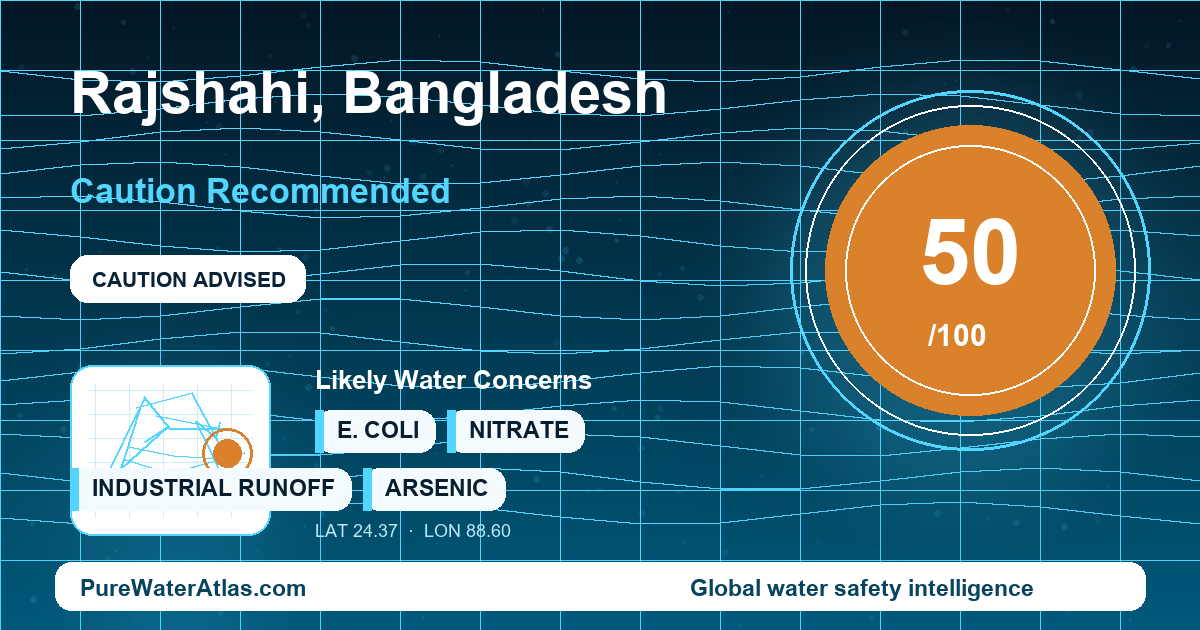
Rajshahi, Bangladesh: caution is recommended for untreated tap water because the city has a formal utility system, but household safety depends heavily on groundwater source confirmation, distribution pressure, storage tanks, and building-level testing.
Quick Answer
| City | Rajshahi, Bangladesh |
|---|---|
| Water safety score | 50 / 100 |
| Risk level | Caution Recommended |
| Is tap water safe to drink? | Do not assume untreated Rajshahi tap water is reliably safe to drink. Use bottled, boiled, or properly treated water unless you have recent reliable test results from the specific drinking tap. |
| Traveler advice | Use sealed bottled water, boiled water, or water treated by a maintained purifier. Be cautious with ice and with guesthouse or restaurant water if tank maintenance is unclear. |
| Resident advice | Confirm whether the home uses Rajshahi WASA piped supply or a private bore/tubewell, test the actual tap, maintain storage tanks, and choose treatment based on results. |
| Main water source context | Rajshahi’s urban supply has historically relied heavily on groundwater production deep tube wells, with official and donor discussions identifying a strategic shift toward treated Padma River surface water. |
| Local authority | Rajshahi Water Supply and Sewerage Authority, commonly Rajshahi WASA. |
| Filter recommendation | A household purifier is advisable for most users unless tap-specific testing and good storage hygiene confirm low risk. Use sediment filtration plus UV or boiling for microbial risk; use RO or certified arsenic-removal media only where testing shows dissolved contaminants such as arsenic are relevant. |
Why Rajshahi Is Different
Rajshahi is an inland northwestern Bangladesh city on the north bank of the Padma River near the Barind tract, a comparatively dry and groundwater-stressed region. That geography matters. Unlike coastal delta cities where salinity is often a central concern, Rajshahi’s practical drinking-water questions are more closely tied to groundwater dependence, dry-season source stress, distribution reliability, household storage, and whether microbial contamination can enter after pressure loss or through poorly maintained tanks.
The city has a dedicated urban water utility, but the water that reaches a drinking glass can differ from the water leaving a production point. Many buildings use rooftop or underground storage tanks, internal pumps, private plumbing, and local service connections. These building-level components are not minor details in Rajshahi: a dirty or poorly sealed tank can make otherwise treated water unsafe at the final tap.
Bangladesh’s national drinking-water history is also important. Groundwater development expanded access to water across the country, but it also revealed major chemical risks such as arsenic in many areas. Rajshahi city is not presented here as the country’s most cited arsenic hotspot, and this profile does not claim a citywide arsenic failure. The point is narrower and practical: private wells, borewells, and groundwater-derived supplies should be tested rather than judged by taste, smell, or clarity.
Where Does Rajshahi’s Tap Water Come From?
Rajshahi’s urban water supply has historically been dominated by groundwater abstraction through production deep tube wells operated for the piped system. The city’s location beside the Padma River does not mean every household is receiving treated river water. Groundwater has often been operationally attractive because it generally requires less conventional treatment than turbid river water, but long-term abstraction in the dry northwestern region has raised sustainability concerns.
Official development discussions and donor project material identify a strategic direction toward treated surface water from the Padma River. The purpose of that shift is to reduce pressure on groundwater and expand more reliable supply. For current household risk assessment, however, the cautious assumption is that much of the water supplied to a given home may still be groundwater-derived unless Rajshahi WASA or the local connection details confirm otherwise.
The infrastructure chain includes groundwater production wells, pumps, distribution mains, service lines, and household or building storage. At each step, different risks can appear. Pressure interruptions, leaks, repairs, illegal cross-connections, long residence time, and dirty tanks can create conditions for microbial intrusion or loss of disinfectant residual. Monsoon rainfall can add risk around broken pipes, low-lying infrastructure, wells, and unsealed tanks; hot dry periods can increase storage time and water stress.
Who Manages Drinking Water in Rajshahi?
Rajshahi Water Supply and Sewerage Authority, known as Rajshahi WASA, is the municipal utility responsible for urban water supply and sewerage functions in the city area. It operates within Bangladesh’s local government institutional framework. National-sector oversight and public-health engineering context involve institutions such as the Local Government Division and the Department of Public Health Engineering.
For consumers, the key issue is not only whether water meets a standard at the production source. It is whether disinfected, uncontaminated water is maintained through the distribution network, the service connection, the building’s storage tanks, and the final tap. Publicly accessible, routine, consumer-facing tap-level water-quality reporting for Rajshahi appears limited. Therefore, this profile does not claim that all Rajshahi tap water meets or fails any specific standard. The evidence-based position is caution: distinguish piped supply from private groundwater, treat drinking water when in doubt, and verify the water at the tap actually used for drinking.
Main Local Water Concerns
- Microbial contamination after pressure loss or storage: Intermittent pressure, leaks, pipe repairs, and dirty rooftop or underground tanks can allow contamination to enter water before it reaches the glass. This makes E. coli in drinking water and total coliform testing especially relevant.
- Groundwater chemical risks: Bangladesh-wide groundwater concerns include arsenic, and some groundwater may also have acceptability issues such as iron or manganese. These cannot be ruled out by clear appearance.
- Turbidity and sediment: Water may become cloudy or discolored after pump changes, seasonal disturbance, pipe repair, or flushing events. Turbidity can also interfere with disinfection and UV performance.
- Variable chlorine residual: Even if water is disinfected, chlorine residual may decline during long storage, long pipe residence time, or in building tanks.
- Dry-season and monsoon effects: Dry heat can increase storage time and groundwater stress. Monsoon rain can increase runoff, drainage overflow, and contamination risk around wells, tanks, broken pipes, and low-lying infrastructure.
- Limited public tap-level data: Some institutional information exists, but recent routine Rajshahi tap-level compliance data are not readily available in a transparent consumer format.
For Travelers
Visitors should treat Rajshahi tap water as caution-level rather than reliably potable. For drinking, use sealed bottled water from reputable brands, boiled water, or water treated by a properly maintained purifier. Clear water is not proof of safety because microbial contamination and arsenic are not reliably visible, smelled, or tasted.
For brushing teeth, healthy adults may tolerate brief exposure, but cautious travelers should use bottled or treated water, especially during monsoon season, after local flooding, or when staying in guesthouses with uncertain storage-tank maintenance. Children, pregnant travelers, older adults, and immunocompromised travelers should be more conservative.
Avoid ice unless a hotel or restaurant can confirm it is made from purified water. Ice made from untreated tap water can carry the same microbial risk as the source water, and travelers usually cannot verify how it was produced or stored. In higher-end hotels and restaurants, drinking water may come from bottled water, RO, UV, or filtered systems, but maintenance quality varies. Ask whether water and ice are purified, and prefer sealed bottles opened at the table.
If you must use tap water, bring it to a rolling boil and store it in a clean covered container. PureWaterAtlas has a practical guide to boiling water purification. Travel filters should address bacteria and protozoa, and additional disinfection is prudent for viruses.
For Residents
Rajshahi residents should start by identifying the household water source. A home on Rajshahi WASA piped supply has a different risk profile than a private borewell, tubewell, or mixed system. If water is stored in a rooftop or underground tank, test the actual drinking tap, not only the source point. Storage and internal plumbing can change water quality substantially.
A home filter or purifier is advisable for most households unless recent testing confirms that the specific tap is safe and the storage system is well maintained. The best setup depends on test results. Sediment prefiltration helps with particles and turbidity. Activated carbon can improve taste and odor, but it does not reliably remove arsenic. UV treatment or boiling can address microbial risk when the water is clear enough for treatment to work. Reverse osmosis can reduce many dissolved contaminants, including arsenic, nitrate, and salts, but it requires maintenance and reject-water management.
Testing priorities in Rajshahi should include E. coli and total coliform where tanks, pressure interruptions, or service interruptions are present. For private wells or uncertain groundwater sources, test arsenic using a competent laboratory or recognized screening program. Test iron and manganese if water has reddish, black, metallic, or staining characteristics, or if filters clog quickly. A useful baseline for piped water plus storage also includes turbidity, pH, electrical conductivity or TDS, residual chlorine, and nitrate.
Retest after flooding, major plumbing work, new borewell installation, persistent illness concerns, or any noticeable change in color, odor, taste, or sediment. Older buildings should also consider plumbing-related metals. Lead is not identified here as the main citywide Rajshahi hazard, but older pipes, brass fixtures, pumps, solder, and storage components can add metals after water leaves the utility network. For infants or pregnant people, consider first-draw and flushed samples for lead and other metals before relying on the tap.
Storage tank hygiene is essential. Keep rooftop and underground tanks covered, screened from insects and animals, routinely cleaned, and disinfected after flooding, contamination, long vacancy, or plumbing repair. A poorly maintained tank is one of the most important household-level ways safe water can become unsafe in Rajshahi.
Relevant Contaminants and Water-Quality Issues
The most practical short-term health concern in Rajshahi is microbial contamination, especially where water pressure is intermittent or tanks are poorly maintained. See PureWaterAtlas guidance on E. coli in drinking water and the broader water microbiology guide.
For groundwater-derived supply and private wells, arsenic deserves special attention because Bangladesh has a well-documented national arsenic history. Households can also review arsenic testing and detection methods and arsenic filter options. For staining, metallic taste, or filter clogging, review iron and manganese. For cloudy water or post-repair sediment, see turbidity. For disinfection and residual questions, see chlorine in drinking water.
How to Verify Your Water Quality
The most reliable answer for a Rajshahi household is a current test from the tap used for drinking. Start with the PureWaterAtlas complete guide to water testing and the general drinking water safety framework. If choosing treatment, match the system to the problem using the water treatment systems guide and the UV purification guide where microbial risk is the main concern.
Travelers comparing city-level risk can use the Global Water Quality Checker. Residents researching specific contaminants can use the PureWaterAtlas Contaminants Search Engine. Relevant topic areas include Global Water Quality, Water Testing, Water Microbiology, and Water Contamination.
Official and Technical Sources
- Rajshahi Water Supply and Sewerage Authority official portal — primary local authority source for Rajshahi WASA identity, service mandate, and official notices.
- Department of Public Health Engineering official portal — national public-health engineering context for drinking-water supply, testing, and sector standards in Bangladesh.
- Local Government Division official portal — government ministry context for urban water utilities and water-supply projects.
- Bangladesh National Drinking Water Quality Survey 2009 — national evidence on Bangladesh drinking-water quality problems, including microbial contamination and arsenic.
- UNICEF Bangladesh: Arsenic contamination in Bangladesh — public-health context on groundwater arsenic and the need for testing.
- World Health Organization drinking-water fact sheet — global health principles for safe drinking water and vulnerable populations.
- WHO Guidelines for Drinking-water Quality — international reference for interpreting water hazards and treatment barriers.
- Asian Development Bank Bangladesh water supply and sanitation sector assessment — sector context for Bangladesh urban water infrastructure and service challenges.
- JICA Bangladesh country and water-sector cooperation information — donor and infrastructure context for urban water and sanitation cooperation.
Bottom Line
Rajshahi tap water should be treated with caution rather than assumed safe untreated. The city has Rajshahi WASA and a formal piped system, but the local profile includes heavy historical groundwater dependence, possible transition toward treated Padma River surface water, pressure and distribution risks, and common household storage tanks. The most practical immediate concern is microbial contamination from tanks, leaks, pressure loss, or repairs; private wells and uncertain groundwater sources also need arsenic testing. Travelers should use sealed bottled, boiled, or properly purified water and avoid unverifiable ice. Residents should test the actual drinking tap, maintain tanks, and choose treatment based on results, not appearance.
Read the full guide: Global Water Quality Guide
Explore more in this category: Global Water Quality Articles