
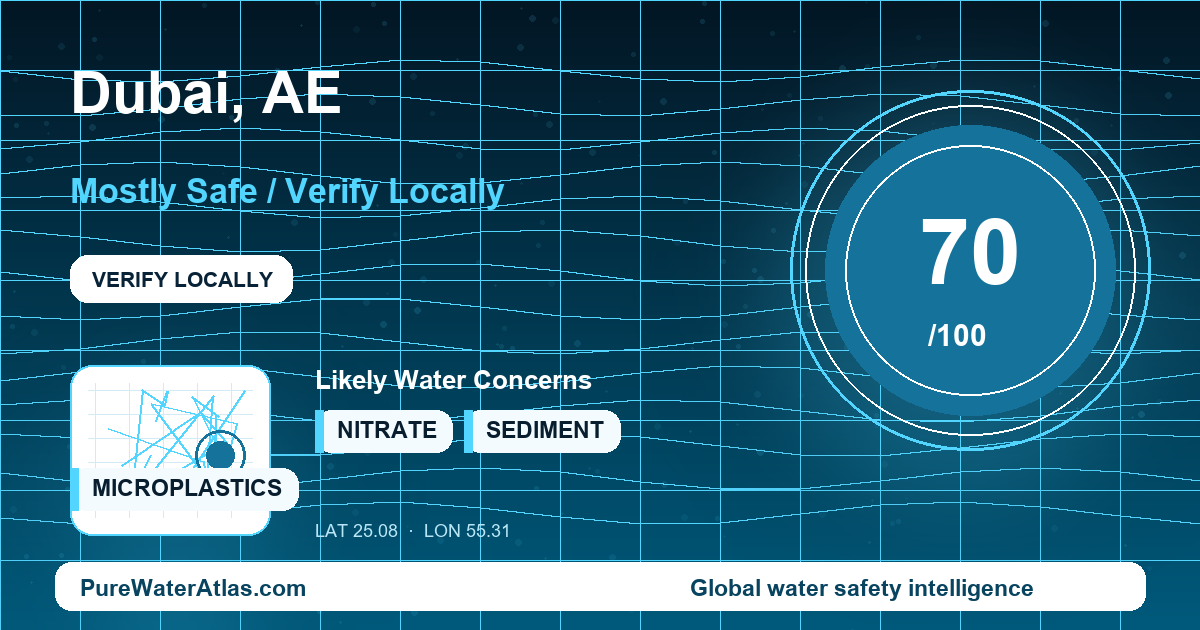
Dubai’s tap water starts as desalinated Arabian Gulf seawater supplied by DEWA, but the safety and taste at your faucet often depend on building storage tanks, internal plumbing, stagnation, and maintenance.
Quick Answer
| Overall safety status | Mostly Safe / Verify Locally. Dubai’s utility-supplied water is generally treated as potable, but the practical risk at the tap depends strongly on the building after the DEWA meter. |
|---|---|
| Water safety score | 70 / 100 for typical users, reflecting a strong desalinated utility supply but variable premise-side storage and plumbing conditions. |
| Main water source | Primarily desalinated Arabian Gulf seawater, produced through Dubai’s desalination infrastructure and distributed through the DEWA network. |
| Main authority | Dubai Electricity and Water Authority, commonly DEWA, is the main public utility for potable water production, transmission, and distribution. |
| Traveler advice | Tap water is usually acceptable for brushing teeth in modern hotels and serviced apartments. For primary drinking, many visitors use sealed bottled water or hotel-filtered water because of taste, warm tap water, chlorine odor, or uncertainty about building tanks. |
| Resident advice | Verify tank-cleaning records, flush stagnant taps after travel or low use, and test the kitchen tap if there are infants, pregnancy, immunocompromised residents, old plumbing, sediment, odor, or discoloration. |
| Filter recommendation | A filter is not automatically required solely because the city is Dubai. A certified carbon block filter can improve chlorine taste and odor; a maintained reverse-osmosis system may help with dissolved salts and some metals, but tank hygiene problems should be fixed at the source. |
Why Dubai Is Different
Dubai is an arid coastal city on the Arabian Gulf with no large local freshwater river. Its modern drinking-water system is therefore very different from cities that depend on rivers, lakes, or mountain reservoirs. Dubai’s urban water supply depends heavily on seawater desalination, not conventional freshwater catchments.
This matters for drinking-water safety because the main citywide question is not whether the raw water is a familiar river or aquifer. Instead, the central issue is how desalinated water is produced, disinfected, stored, distributed, and then handled inside private buildings. DEWA supplies treated potable water through its network, but many Dubai homes, hotels, offices, apartment towers, villas, and commercial buildings store water in roof, basement, or ground-level tanks before it reaches the tap.
That building handoff is one of the most important Dubai-specific water-quality issues. If a tank is cleaned, covered, disinfected, and maintained, the faucet risk is usually lower. If a tank is dirty, poorly sealed, stagnant, or connected to aging internal plumbing, water quality can change after it leaves the utility system. This is why a citywide answer such as “safe” or “unsafe” is not precise enough for Dubai.
Where Does Dubai’s Tap Water Come From?
Dubai’s modern municipal drinking water is based primarily on Arabian Gulf seawater desalination. DEWA produces and supplies desalinated water through large coastal power-and-water assets, historically centered on the Jebel Ali power and desalination complex. Dubai is also expanding seawater reverse-osmosis desalination capacity, including Hassyan-related projects referenced through DEWA project and news releases.
The key infrastructure chain is city-specific: Arabian Gulf seawater intakes feed desalination facilities; treated water is disinfected and moved through DEWA transmission mains, pumping systems, reservoirs, and distribution lines; after the utility meter, building-level tanks, booster pumps, and internal plumbing often become the final water system before the consumer’s glass.
Historically, Dubai and the wider UAE depended on scarce groundwater, wells, and traditional local sources. In today’s connected urban Dubai, groundwater is not the ordinary municipal drinking-water source for most users. UAE-level water-resource information notes national water scarcity, desalination dependence, and pressures on groundwater, which is consistent with Dubai’s reliance on desalinated seawater for modern supply. For this broader context, see the UAE Government’s page on water resources in the UAE.
Because desalination starts with coastal Gulf water, the source-water system must manage high salinity, warm seawater, marine pollution events, and occasional algal blooms. These source-water conditions are treatment-plant management issues and do not automatically mean unsafe tap water at the consumer tap. The more common everyday concern for residents and travelers is what happens after treated water enters private storage and internal building systems.
Who Manages Drinking Water in Dubai?
Dubai Electricity and Water Authority is the main public utility responsible for Dubai’s electricity and water services, including potable water production, transmission, and distribution. DEWA’s customer-facing water information is available through its official water services pages.
Dubai’s drinking-water safety context also includes public-health and municipal controls. Dubai Municipality is relevant to local public-health functions, building hygiene, and municipal controls that can affect premise-side water safety. Its public health and safety services provide official local-government context for hygiene-related regulatory functions.
At a technical level, drinking-water safety is best understood through water-safety-plan principles: safe source management, effective treatment, protected distribution, and verification at the point of use. The World Health Organization Guidelines for Drinking-water Quality provide the high-authority framework for interpreting microbial and chemical risks.
Data limitation: there is enough public information to identify Dubai’s main water source, utility, and desalination infrastructure. However, publicly accessible, current, neighborhood-level tap-water laboratory results are limited. Utility-level water quality does not prove the condition of every private storage tank, booster system, or internal pipe network. PureWaterAtlas therefore does not claim that every tap in Dubai is safe without building-specific evidence.
Main Local Water Concerns
The main Dubai water concern is not untreated municipal source water. It is premise-side water quality after treated desalinated water leaves the DEWA distribution network. In many buildings, water may pass through private tanks and pumps before reaching taps. If these systems are not cleaned, covered, disinfected, or inspected on schedule, they can introduce sediment, biofilm, insects, or microbial contamination.
- Storage tanks: Roof, basement, or ground tanks can become a weak point if access hatches, vents, covers, or cleaning schedules are poor.
- Heat and stagnation: Dubai’s very hot ambient temperatures can warm stored water, accelerate loss of disinfectant residual, and increase stagnation concerns in low-use lines.
- Sediment and particles: Rust-colored water, visible particles, or dirty water may come from internal tanks, pumps, or premise plumbing rather than from the desalination plant.
- Chlorine taste or odor: Disinfectant residual is needed to protect water through storage and distribution, and some users notice chlorine taste or smell.
- Old plumbing: Older fittings, unapproved materials, corroded components, or stagnant internal pipework can create premise-level risks. Dubai-specific public data on lead at household taps is limited, so testing is the appropriate verification step in older or unknown plumbing.
- Desalinated-water taste: Desalinated water can taste different from mineral-rich groundwater or bottled mineral water, which affects consumer perception even when the water has been treated.
Season also matters. Summer heat can make cold taps run warm and can worsen storage and stagnation concerns. Low occupancy during travel periods may leave water standing in apartment or villa plumbing. Dust and sand can affect poorly sealed tanks. Marine algal blooms or coastal pollution incidents are source-water management concerns for desalination operators, but they are not automatic evidence that the tap in a given hotel or apartment is unsafe.
For Travelers
For most short-stay visitors in modern Dubai hotels, tap water is generally suitable for brushing teeth and incidental consumption when the property is connected to the municipal system and there are no visible problems. However, bottled or hotel-filtered water is commonly used for drinking. The reasons are practical: taste preference, warm tap temperature, chlorine odor, uncertainty about internal tanks, and traveler stomach sensitivity.
If a hotel explicitly provides potable tap water or filtered drinking water, it is reasonable to use it. If the room has old plumbing, discolored water, visible particles, unusual odor, or no assurance about tank maintenance, use sealed bottled water. This is especially prudent for infants, immunocompromised travelers, or anyone with a sensitive stomach.
Ice in established hotels, malls, and reputable restaurants is usually low risk because it is normally made from treated or commercial water. Avoid ice from informal sources where water storage and handling are uncertain. In higher-end Dubai hotels and restaurants, water service is often bottled or filtered, but the safety of the room tap still depends on the property’s internal plumbing and tank maintenance.
Boiling can reduce microbial risk, but it is not a cure-all. It does not remove salts, metals, sediment, or chemical taste. If water is discolored, contains particles, or tastes strongly abnormal, switch to bottled or properly filtered water rather than relying on boiling. For the limits of boiling, see the PureWaterAtlas Boiling Water Purification Complete Guide. Travelers can also compare destination-level context with the Global Water Quality Checker and review general UAE travel-health precautions from the U.S. CDC traveler information for the United Arab Emirates.
For Residents
Residents should treat DEWA-supplied water as the starting point, then verify the building side. The most important household actions in Dubai are confirming tank-cleaning and disinfection records, checking that tanks are covered and screened, flushing stagnant water after travel or low use, and testing the actual kitchen tap when there are vulnerability factors or warning signs.
A home filter is not automatically required only because the address is in Dubai. Many residents still use one for taste, chlorine odor, sediment control, and confidence. A certified carbon block filter can improve chlorine taste and odor. A properly maintained reverse-osmosis system can reduce dissolved salts and many metals, but it requires maintenance and may need remineralization for taste. If microbial risk from a tank is suspected, the tank hygiene problem should be corrected; a countertop filter alone should not be treated as a substitute for a clean, protected building water system.
Residents should test water from the actual kitchen tap, not only the building inlet, when there is sediment, discoloration, odor, illness concern, infants, pregnancy, immunocompromised residents, or old plumbing. Useful checks include free chlorine residual, pH, conductivity or TDS, turbidity, and temperature. A certified laboratory should be used for microbiological indicators such as total coliform and E. coli if tank hygiene is uncertain or water has stood in private storage for long periods. Consider lead and copper testing when the building is old, plumbing materials are unknown, or the water has been stagnant in internal lines.
Older buildings and poorly maintained accommodations deserve extra caution. The utility may supply treated water, but old internal pipes, unapproved fittings, corroded pumps, dead-end plumbing, and long stagnation can change water quality before it reaches the glass. After travel or vacancy, flush taps until temperature stabilizes before using water for drinking or cooking, especially in summer.
Relevant Contaminants and Water-Quality Issues
Dubai-specific tap-water questions often involve water-quality indicators rather than a single citywide contaminant. For disinfectant taste and odor, see Chlorine in Drinking Water. Chlorine residual is relevant because disinfectant is needed to protect treated water through storage and distribution, but some users notice its taste or smell.
If the issue is cloudy water, visible particles, or dirty-looking tap water, review Turbidity in Drinking Water and Sediment in Drinking Water. These are especially relevant where building tanks, pumps, or internal plumbing may be contributing particles after water has left the DEWA network.
For storage-tank hygiene concerns, the microbial indicator to understand is E. coli in Drinking Water. E. coli is not a Dubai source-water claim here; it is a practical laboratory indicator when a tank or premise system may be contaminated. For older buildings or unknown plumbing, Lead in Drinking Water and Lead in Drinking Water: Testing and Detection Methods explain why tap-specific testing matters.
How to Verify Your Water Quality
The most reliable way to answer “Is my Dubai tap water safe?” is to test the water that actually comes from your drinking tap. Building-inlet data cannot fully represent roof tanks, basement tanks, booster pumps, internal pipe materials, or stagnant branch lines.
- Ask the building manager or hotel for recent tank-cleaning and disinfection records.
- Inspect for practical warning signs: discoloration, visible particles, unusual odor, dirty tank areas, damaged covers, or long periods of non-use.
- Flush stagnant lines after travel or low occupancy, especially during summer.
- Use a certified laboratory for microbial testing when tank hygiene is uncertain.
- Test metals such as lead and copper when the building is old or plumbing materials are unknown.
For a broader method, use the PureWaterAtlas guide to Water Testing. For general safety principles, see Drinking Water Safety, Water Microbiology, and Water Treatment Systems. You can also search specific issues through the Contaminants Search Engine or browse related categories such as Drinking Water Safety, Global Water Quality, Water Testing, and Water Microbiology. Residents considering microbial barriers after storage tanks may also want to review UV Water Purification, while remembering that UV systems require maintenance and appropriate prefiltration.
Official and Technical Sources
- Dubai Electricity and Water Authority official website — primary official source identifying DEWA as Dubai’s electricity and water utility.
- DEWA water services and customer information — official customer-facing water information for Dubai users.
- Jebel Ali power and desalination complex information — official DEWA context for major desalination-based production infrastructure.
- DEWA latest news — source for current DEWA announcements, including desalination expansion references.
- Water resources in the UAE — official UAE context on water scarcity, desalination, and national water-resource pressures.
- Dubai Municipality official website — local government authority relevant to public health and municipal controls.
- Dubai Municipality public health and safety services — official public-health context relevant to hygiene controls.
- WHO Guidelines for Drinking-water Quality — high-authority framework for drinking-water safety interpretation.
- CDC United Arab Emirates traveler health information — general traveler-health precautions for the UAE.
Bottom Line
Dubai tap water is generally treated as potable at the DEWA supply level and is based primarily on desalinated Arabian Gulf seawater. The practical drinking-water question is usually building-specific: storage tanks, pumps, internal plumbing, stagnation, sediment, chlorine taste, and summer heat can change water quality after it leaves the utility network. Travelers in modern hotels can usually brush teeth with tap water, but bottled or hotel-filtered water remains common for drinking. Residents should verify tank-cleaning records, flush after absences, and test the kitchen tap when water is discolored, odorous, particle-filled, stagnant, or used by infants or health-vulnerable people. Dubai is best described as mostly safe, but worth verifying locally.
Read the full guide: Global Water Quality Guide
Explore more in this category: Global Water Quality Articles