
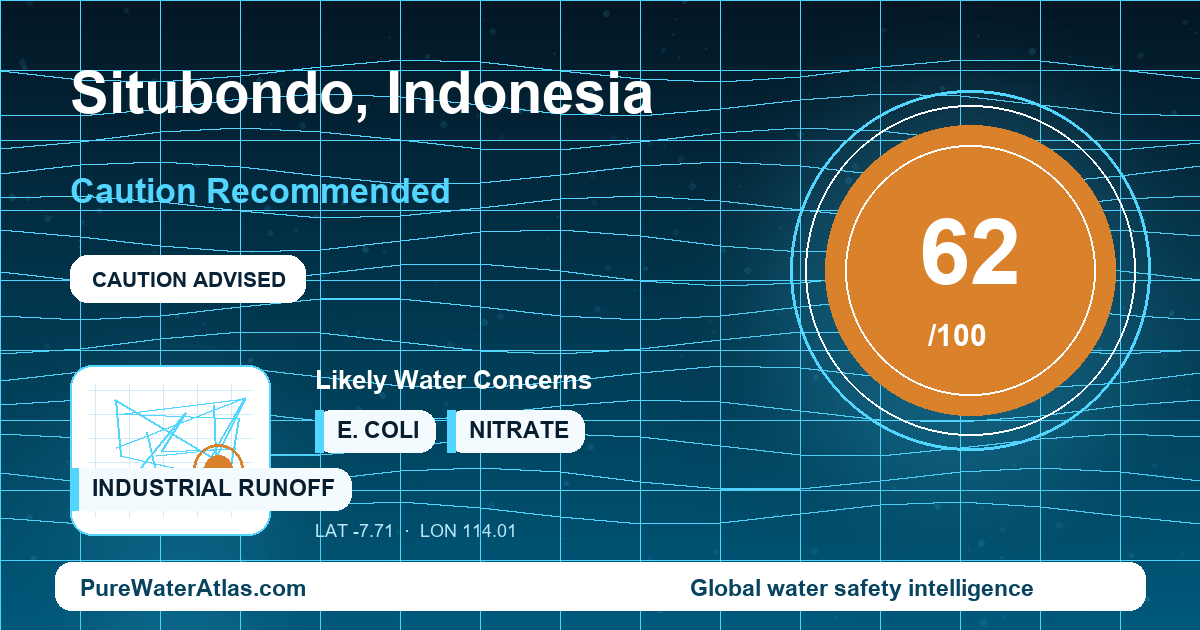
Situbondo, Indonesia: caution is recommended for drinking tap water because the regency has an organized local piped-water utility, but complete public tap-level laboratory reporting is limited and household storage, wells, refill water, and seasonal source stress can affect safety.
Quick Answer
| Water safety score | 62 / 100 |
|---|---|
| Risk level | Caution Recommended |
| Is tap water safe to drink? | Do not rely on untreated tap water as your main drinking water in Situbondo. Use sealed bottled water, boiled water, or water treated with a reliable purifier unless you have recent test results for your specific tap. |
| Traveler advice | Use sealed bottled, boiled, filtered, or professionally treated water for drinking. Be careful with ice, refilled jugs of uncertain origin, and drinks made with unboiled tap water. |
| Resident advice | Residents using Perumda/PDAM water should treat household tap water for drinking unless recent local testing confirms microbiological safety at the tap. Private wells and stored tank water should be tested. |
| Main water identity | A mixed small-city/regency system using local piped supply, likely including spring catchments, groundwater or bore wells, distribution reservoirs, private wells, refill stations, and packaged water. |
| Water authority | Perumda Air Minum Tirta Baluran Kabupaten Situbondo, commonly referred to as PDAM or Perumda Tirta Baluran, with public-health oversight associated with Dinas Kesehatan Kabupaten Situbondo. |
| Filter recommendation | For drinking water, use a maintained treatment barrier. Depending on source and test results, this may include sediment filtration, activated carbon, UV or disinfection, boiling, or reverse osmosis for high-TDS or salty groundwater. |
Why Situbondo Is Different
Situbondo is not a large metropolitan water system with extensive public online reporting for finished-water quality at every service zone. It is a north-coast East Java regency town where drinking-water safety depends on a practical mix of local piped water, household plumbing, roof tanks, private wells, refill-water depots, and packaged water. That makes the safest answer more specific than simply “tap water” or “bottled water.” In Situbondo, the better distinction is by end use: tap water is generally more appropriate for washing, bathing, and handwashing, while drinking water should normally be sealed, boiled, filtered and disinfected, or verified by recent testing.
The city’s geography matters. Situbondo sits on the Java Sea side of East Java, with lowland and coastal areas near alluvial zones and inland catchments toward the Baluran and Ijen-side landscape. This means both upland spring reliability and coastal groundwater quality are relevant. During dry periods, spring and well yields can decline, pressure can become less reliable, and households may rely more heavily on stored water, wells, refill stations, or delivered water. During the wet season, runoff, turbidity, and shallow-well contamination become more important.
The editorial verdict for Situbondo is therefore cautious: the local utility identity and the broad regional risk context are clear, but complete, recent, publicly accessible tap-level laboratory datasets for Situbondo were not found in open sources. This page does not claim that every tap is unsafe, nor does it claim that every tap meets drinking-water standards. It recommends a conservative drinking-water approach until a household, hotel, or business can show current test results for the water actually being consumed.
Where Does Situbondo’s Tap Water Come From?
Situbondo’s drinking-water picture is a mixed small-city and regency system. The piped supply is associated with Perumda Air Minum Tirta Baluran Kabupaten Situbondo. Based on the local water identity available for this profile, the system appears to rely on local raw-water sources typical of this part of East Java rather than a single large metropolitan surface-water plant. Those sources may include spring catchments from upland areas, groundwater or bore wells, and local distribution reservoirs.
Key infrastructure relevant to Situbondo includes spring intake or spring-capture facilities where available, groundwater wells or bore wells used by service units and private households, service reservoirs, storage tanks, booster or distribution pipelines, and local household roof tanks. These components matter because finished-water quality can change after water leaves the source. Even when water is treated or disinfected at a utility point, contamination can occur through damaged distribution lines, low pressure, private plumbing, or poorly maintained storage tanks.
Historically, many households in Indonesian regency towns, including coastal and semi-rural parts of Situbondo, have supplemented piped supply with dug wells, bore wells, springs, rainwater, refill-water depots, or delivered water. These alternatives can be useful, but they should not be assumed potable from taste, clarity, or local familiarity. A clear-looking private well can still contain E. coli, nitrate, salinity indicators, or metals. Refill water can be safe only when the depot’s filtration, UV or disinfection systems, gallon sanitation, and health-department inspection status are current and properly maintained.
Who Manages Drinking Water in Situbondo?
The local piped-water authority is Perumda Air Minum Tirta Baluran Kabupaten Situbondo, commonly referred to as PDAM or Perumda Tirta Baluran. Local public-health oversight is associated with Dinas Kesehatan Kabupaten Situbondo. National drinking-water and hygiene-related standards are set by the Indonesian Ministry of Health.
Indonesia’s current health-based drinking-water framework includes Peraturan Menteri Kesehatan Republik Indonesia No. 2 Tahun 2023, which covers environmental health quality requirements for water used for drinking and hygiene. Water-supply development and public water-system governance also sit within the broader context of national infrastructure programs, including the Kementerian Pekerjaan Umum dan Perumahan Rakyat, Direktorat Air Minum, local-government BUMD governance, and the Indonesian water-utility sector represented by PERPAMSI.
The important limitation for Situbondo is transparency at the consumer tap. Public sources confirm the local administrative and regulatory context, but this review did not locate a complete, recent, publicly posted Situbondo consumer confidence report listing routine microbiological results, chemical results, disinfectant residuals, and compliance rates by service zone. For that reason, PureWaterAtlas does not assign a blanket “safe to drink untreated” verdict for Situbondo tap water.
Main Local Water Concerns
The main concern for Situbondo drinking water is microbiological reliability at the point of use. Potential risk points include intermittent pressure, damaged pipes, unprotected wells, household roof tanks, storage containers, refill-water handling, and private plumbing. If water is contaminated with fecal indicators such as E. coli, it may cause gastrointestinal illness and is not suitable for drinking without treatment.
Wet-season conditions can increase turbidity, sediment, and runoff-related contamination, especially where raw water is influenced by shallow sources, hillside erosion, drains, or stormwater. After heavy rain, pipe repairs, outages, or flooding, Situbondo households should be more cautious: flush taps, avoid drinking cloudy water, and use boiled or disinfected water until clarity and odor return to normal.
Dry-season water stress is also relevant. Situbondo is in a relatively dry part of East Java and has recurring dry-season water-stress context at the regency level. Dry periods can reduce spring yield, lower distribution pressure, increase reliance on stored water or alternative sources, and concentrate dissolved minerals in groundwater. In low-lying coastal areas, private wells may be more vulnerable to salinity or elevated total dissolved solids, particularly if wells are close to the coast or heavily pumped.
Groundwater in and around Situbondo may also present nuisance-quality issues such as iron and manganese, which can cause metallic taste, staining, brown or black particles, and treatment problems. Agricultural runoff is a concern for private wells near farms, septic tanks, livestock areas, or dense settlements, especially for nitrate. Older buildings may require testing for metals such as lead, although no Situbondo-wide lead problem was verified from public sources.
For Travelers
Visitors should not rely on untreated tap water as their main drinking water in Situbondo. Use sealed bottled water, boiled water, or water treated by a reliable purifier. This advice is especially important for short-term travelers, children, pregnant people, immunocompromised travelers, and anyone prone to stomach illness. Tap water is usually acceptable for bathing and handwashing, but bathroom tap water should not be assumed potable.
For brushing teeth, the lower-risk choice is bottled, boiled, or filtered water. Many healthy adults may use tap water for brushing in practice, but travelers have less time to adapt to local microbes and less knowledge of a building’s plumbing or tank maintenance. If the hotel provides a dispenser, ask whether it is maintained and whether the water is sealed, boiled, filtered, or otherwise treated.
Ice deserves special caution. Avoid ice unless it is made from commercial ice or purified water. In small stalls, ask whether the ice is factory-made; avoid shaved or loose ice of uncertain origin. Drinks made with unboiled tap water, uncertain refill water, or poorly handled ice are higher-risk than hot drinks prepared with boiled water.
If traveling between Situbondo, Panarukan, Besuki, Baluran National Park, and nearby coastal or rural areas, carry sealed bottled water. Availability and water handling can vary outside central urban areas. For longer stays, consider a purifier capable of addressing bacteria and viruses, or use boiling as the practical baseline. PureWaterAtlas has a detailed guide to boiling water purification for situations where microbial safety is the priority.
For Residents
For Situbondo residents, the best approach is source-specific. If your home is connected to Perumda/PDAM supply, treat tap water for drinking unless recent local results confirm microbiological safety at your tap. A maintained system using sediment filtration, activated carbon, and UV or another proper disinfection barrier can reduce practical risk. Activated carbon can improve taste and odor, including some issues related to chlorine, but carbon alone is not a reliable disinfectant and must not be treated as a complete barrier to microbes.
If your household uses a private well, test before choosing treatment. At minimum, test E. coli or thermotolerant coliforms at least annually and after flooding, pipe repairs, tank-cleaning failures, or illness clusters. Also test turbidity, pH, TDS or electrical conductivity, salinity or chloride, hardness, iron, and manganese when there is taste, color, staining, sediment, or coastal-well concern. Test nitrate if the well is near farms, septic tanks, livestock areas, or dense settlements, especially where infants or pregnant people may drink the water.
High-TDS or salty groundwater may require reverse osmosis or another treatment selected from test results. Iron and manganese may require oxidation, aeration, sediment filtration, or other site-specific treatment. For daily refill-water use, choose depots that display current health-department inspection or lab results and visibly maintain filtration, UV or disinfection, and gallon sanitation procedures.
Older buildings require extra attention. Corroded internal pipes, old solder, brass fixtures, and long stagnation times can change water quality at the tap even when source water is acceptable. Flush taps after overnight stagnation and test first-draw and flushed samples for lead and other metals if water is used for infants, children, pregnancy, or long-term drinking. Roof tanks and household storage containers should be covered, screened from insects and animals, cleaned on a schedule, protected from backflow, and disinfected after repairs or contamination.
Relevant Contaminants and Water-Quality Issues
The most relevant Situbondo drinking-water issue is microbial contamination, especially E. coli, because distribution lines, private wells, storage tanks, and refill-water handling can all introduce bacteria. Turbidity and sediment are also important because cloudy or particle-laden water can indicate disturbed distribution pipes, storm runoff influence, or a source that needs filtration before disinfection.
For wells and coastal or rural households, nitrate should be checked when agriculture, septic systems, livestock, or dense settlement may affect groundwater. Iron and manganese are common groundwater concerns that can cause staining, metallic taste, and brown or black particles. Lead is not verified as a Situbondo-wide issue, but it is still relevant for older internal plumbing and first-draw tap testing. Chlorine is relevant where utility disinfection is used, because residual disinfectant can affect taste while also helping protect water in distribution.
How to Verify Your Water Quality
The safest way to answer “Is my Situbondo water safe?” is to test the water you actually drink. Ask the local utility, building manager, hotel, depot operator, or landlord for recent results if they claim the water is potable. For household taps, collect samples after normal use and, if checking old plumbing, collect both first-draw and flushed samples. For wells, test after heavy rain, flooding, repairs, or any change in taste, odor, color, sediment, or household illness patterns.
Useful PureWaterAtlas resources include the complete guide to water testing, the drinking water safety guide, the water microbiology guide, and the water purification methods guide. For specific concerns, see the guide to nitrate testing and detection, the guide to lead testing and detection, and the FAQ on agricultural runoff in drinking water.
You can also compare Situbondo with other destinations using the Global Water Quality Checker, browse city and country context in Global Water Quality, or research individual substances in the Contaminants Search Engine.
Official and Technical Sources
- Pemerintah Kabupaten Situbondo — official local government source used for local administrative context and public-service responsibility in Situbondo Regency.
- BPS Kabupaten Situbondo — official statistics source used for geographic and demographic context, including Situbondo’s regency context on the north coast of East Java.
- Permenkes No. 2 Tahun 2023 — national drinking-water and environmental health quality reference for Indonesia.
- Kementerian Kesehatan Republik Indonesia — national public-health authority for drinking-water quality and hygiene standards.
- Kementerian PUPR, Direktorat Air Minum — national water-supply infrastructure authority for SPAM development and drinking-water system context.
- PERPAMSI — Indonesian drinking-water utility association, used for PDAM and Perumda air minum institutional context.
- BMKG — official meteorology and climate authority used for seasonal rainfall, dry-season, and drought-risk context.
- BNPB Data Informasi Bencana Indonesia — official disaster database used for flood, drought, and disaster context affecting raw water, wells, and distribution reliability.
- CDC Travelers’ Health: Indonesia — high-authority traveler health guidance used for conservative food and water precautions.
- WHO Drinking-water Fact Sheet — global public-health reference for microbial contamination, safe management, and health risks from unsafe drinking water.
Bottom Line
Situbondo has an organized local piped-water utility, Perumda Air Minum Tirta Baluran Kabupaten Situbondo, but publicly accessible city-specific finished-water testing data are limited. The safest practical approach is caution: use tap water mainly for washing, and use sealed bottled, boiled, filtered and disinfected, or professionally treated water for drinking. Travelers should avoid untreated tap water, uncertain ice, and refilled water of unknown handling. Residents should test private wells and stored tank water for E. coli, nitrate, salinity or TDS, iron, manganese, turbidity, pH, and relevant metals in older buildings. Seasonal conditions matter: wet-season runoff can raise microbial and turbidity risk, while dry-season stress can increase reliance on wells and stored water.
Read the full guide: Global Water Quality Guide
Explore more in this category: Global Water Quality Articles