
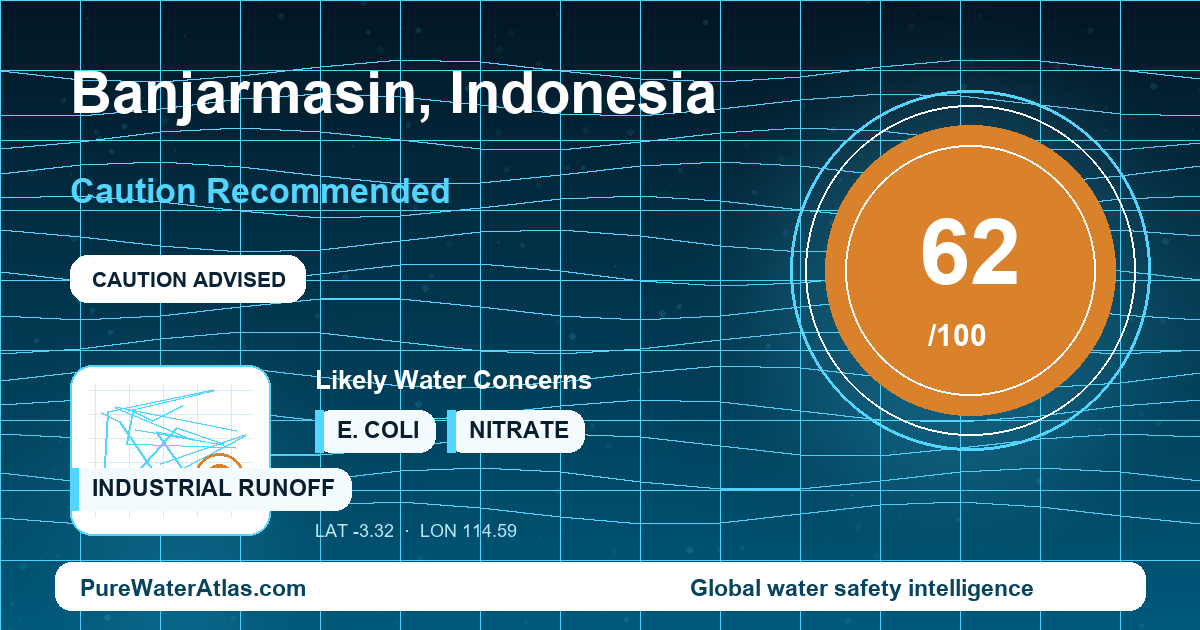
Banjarmasin’s drinking-water safety depends on a river-based municipal supply, tidal delta conditions, dry-season salinity pressure, high-turbidity events, and the condition of household storage and plumbing after water leaves the utility.
Quick Answer
| Overall safety status | Caution recommended. Banjarmasin has an organized municipal piped-water system, but direct drinking from the tap is not the conservative choice for visitors or sensitive residents. |
|---|---|
| Water safety score | 62 / 100 — risk level: Caution Recommended. |
| Traveler advice | Use sealed bottled water, reputable gallon water, or water that has been properly filtered and disinfected. Be cautious with ice, refill stations, and water from hotel tanks unless treatment and hygiene are clear. |
| Resident advice | Follow PT Air Minum Bandarmasih advisories, maintain storage tanks, and consider point-of-use treatment for drinking water, especially where taste, sediment, odor, intermittent pressure, or old plumbing is present. |
| Main water source | Primarily surface water from the Martapura River system and connected Barito delta raw-water corridors. |
| Local authority | PT Air Minum Bandarmasih, formerly commonly referred to as PDAM Bandarmasih. |
| Filter recommendation | A practical household setup is sediment filtration before activated carbon, followed by boiling, UV, or another verified disinfection step. Reverse osmosis may help where dissolved salts are a problem, but it requires maintenance. |
Why Banjarmasin Is Different
Banjarmasin is not an upland reservoir-supplied city. It is a low-elevation delta and river city in South Kalimantan, located where the Martapura River meets the larger Barito River system. Its river network, canals, tidal influence, and urban drainage conditions make raw-water quality more variable than in cities supplied mainly by protected highland reservoirs or deep groundwater.
The city’s identity as Kota Seribu Sungai, the city of a thousand rivers, is directly relevant to drinking water. Rivers are culturally, economically, and historically central to Banjarmasin, including settlement patterns, transportation, markets, and household water use. But this river identity should not be confused with drinking-water safety. Urban river and canal water are not safe drinking water without treatment, and shallow wells, direct river collection, or poorly handled refill water can carry higher microbial and sediment risk.
The most Banjarmasin-specific caution is dry-season saltwater influence in the Barito-Martapura tidal system. When river flow is lower, tidal saltwater intrusion can move upstream and make raw water more brackish. This can affect taste and household acceptability. Importantly, boiling does not remove salt; it can concentrate dissolved salts as water evaporates. During rainy periods, the concern shifts more toward runoff, turbidity, color, organic matter, and microbial loading in river-derived raw water.
Where Does Banjarmasin’s Tap Water Come From?
Banjarmasin’s municipal supply is primarily river-based. PT Air Minum Bandarmasih has historically relied on surface-water intakes and treatment plants drawing from the Martapura River system and connected upstream sources. Raw-water quality can vary with tides, river flow, rainfall, turbidity, and dry-season salinity pressure.
The core water infrastructure includes surface-water intakes, conventional treatment plants, and distribution mains serving dense neighborhoods across a low-lying city crossed by canals. Treatment for surface water typically involves multiple steps such as coagulation, sedimentation, filtration, and chlorination. These barriers are important because the raw water can contain suspended sediment, organic material, microbial contamination, and taste or odor compounds.
Because the supply depends on river water, treatment performance is strongly tied to intake quality. High suspended sediment after heavy rain, organic color in tropical surface water, or salinity episodes during dry periods can stress conventional treatment and may produce taste, odor, or aesthetic complaints even when the utility continues to treat and disinfect the water. After water leaves the treatment plant, final water quality can also be affected by distribution conditions, building plumbing, and household or rooftop storage tanks.
Who Manages Drinking Water in Banjarmasin?
The municipal drinking-water utility for Banjarmasin is PT Air Minum Bandarmasih. It is the main local water-supply institution serving the city and is the key source to follow for utility service information and local advisories.
Drinking-water quality in Indonesia is regulated nationally by the Ministry of Health, including environmental health standards for drinking water under Permenkes No. 2 Tahun 2023. Local implementation and public-health oversight involve city and provincial health authorities, while broader drinking-water supply infrastructure sits within Indonesia’s SPAM framework overseen by public works and local government agencies, including the Kementerian PUPR.
Publicly available city-level information supports the basic water-system identity, river setting, and known raw-water pressures in Banjarmasin. However, recent public, tap-level compliance data by parameter, treatment plant, neighborhood, and season are not consistently available in one accessible citywide report. For that reason, this guide does not claim that all Banjarmasin tap water is either compliant or unsafe at all times. The safer practical verdict is caution, especially for direct drinking.
Main Local Water Concerns
- Dry-season salinity and brackish taste: Lower river flow can allow saltwater influence to move farther into the Barito-Martapura tidal system. If water tastes salty, boiling, ordinary carbon filters, and UV will not remove the dissolved salt.
- Turbidity and sediment: Heavy rain, runoff, river disturbance, and catchment conditions can increase suspended particles in raw water. Turbid water can reduce treatment effectiveness and clog household filters.
- Microbial risk outside the protected supply chain: Untreated river water, canal water, shallow wells, contaminated storage tanks, and poorly handled refill water are more vulnerable to E. coli and other microbial contamination.
- Taste and odor variability: Organic-rich tropical surface water and chlorination can create noticeable taste or odor changes, even where disinfection is being applied.
- Household storage-tank contamination: Tanks that are open, uncovered, rarely cleaned, affected by insects, or exposed to floodwater can contaminate water after utility treatment.
- Iron, manganese, color, or staining: These issues may occur in some non-municipal groundwater, local storage systems, or building-level conditions.
- Building plumbing risk: Older buildings can add risk through corroded pipes, brass fixtures, solder, rooftop tanks, or long stagnation. Citywide lead data are not publicly established, so lead should be treated as a building-specific testing issue rather than a proven citywide source-water problem.
For Travelers
Most short-term visitors should not drink Banjarmasin tap water directly. The lower-risk choice is sealed bottled water, reputable gallon water, or water that has been filtered and disinfected. This is especially important for children, pregnant travelers, older adults, and anyone with a sensitive stomach or weakened immune system.
For brushing teeth, bottled or treated water is the conservative option. Some travelers may brush with tap water in better hotels without problems, but avoiding swallowing tap water is still prudent if gastrointestinal illness would disrupt the trip.
Ice deserves extra attention. Avoid ice from street stalls or informal vendors unless you know it was made from treated commercial water. Ice in higher-end hotels and established restaurants is usually lower risk, but it is still a judgment call. Ask whether drinking water and ice come from sealed commercial water, a maintained dispenser, or in-house filtration.
Hotel tap water is generally more appropriate for showering and handwashing than for direct drinking. In Banjarmasin, building tanks and local plumbing can matter, so a hotel connection to the municipal system does not automatically mean the water at the bathroom tap is drinkable. Carry bottled water during boat trips, floating-market visits, and hot-weather outings. If using a travel purifier, choose one that handles microbes and turbidity. For salty or brackish water, use another source because ordinary carbon filters, boiling, and UV do not remove salt.
For Residents
For many Banjarmasin households, a point-of-use treatment system is advisable for drinking water. This is especially true where residents notice sediment, color, chlorine taste, odor, intermittent pressure, old pipes, or reliance on household storage tanks. A practical approach is a sediment prefilter before activated carbon, followed by a reliable disinfection step such as boiling, UV, or another verified purifier. Learn the limits of each method: boiling helps with many microbial risks but does not remove salt or metals, while UV purification requires sufficiently clear water to work properly.
If water tastes salty in the dry season, consider testing electrical conductivity, total dissolved solids, chloride, or salinity. Reverse osmosis can help with dissolved salts and some metals, but it requires maintenance and produces reject water. If the municipal supply is affected by brackish raw water, boiling will not solve the problem.
Storage tanks are a major final-mile control point. Keep tanks covered, clean them periodically, prevent insects and floodwater entry, and disinfect after repairs or suspected contamination. A clean municipal supply can become unsafe if stored in a dirty or open tank. After periods of low pressure, repairs, flooding, or unusual water appearance, residents should be more cautious and consider additional treatment or testing.
Older buildings need special attention. Flush stagnant taps before using water for drinking or cooking, especially after long periods without use. If infants, pregnant people, or children will drink the water regularly, consider testing both first-draw and flushed samples for lead and other metals. If lead is detected, use targeted guidance such as lead testing methods and lead filter solutions.
Relevant Contaminants and Water-Quality Issues
Banjarmasin’s most relevant water-quality topics are tied to river-derived supply, seasonal turbidity, microbial risk, disinfection, and building-level issues.
- Turbidity in drinking water is highly relevant because river water can become cloudy after rainfall, runoff, or river disturbance.
- Sediment in drinking water helps explain visible particles, discoloration, and filter clogging in a river-supply context.
- E. coli in drinking water is important for untreated river or canal water, shallow wells, storage tanks, and poorly handled refill water.
- Chlorine in drinking water matters because chlorination is a key disinfection barrier in municipal surface-water treatment and may affect taste.
- Lead in drinking water should be considered a building-plumbing risk, especially in older or unknown plumbing systems.
- Iron in drinking water and manganese in drinking water are relevant where residents observe staining, discoloration, black particles, or taste issues in non-municipal groundwater or storage-related systems.
How to Verify Your Water Quality
The best way to verify drinking-water safety in Banjarmasin is to combine official utility information with household-level testing. Follow announcements from PT Air Minum Bandarmasih and local government channels, including the Pemerintah Kota Banjarmasin. For city context and demographic information, BPS Kota Banjarmasin is the official statistics source.
Residents using wells, river water, refill water, or storage tanks should test for E. coli or total coliform. If municipal water changes noticeably after heavy rain or distribution interruptions, check turbidity, color, odor, and residual chlorine. If water tastes salty during the dry season, test conductivity, TDS, chloride, or salinity. For older buildings, test first-draw and flushed samples for lead and other metals.
For broader guidance, see PureWaterAtlas resources on water testing, drinking water safety, water microbiology, and water treatment systems. Travelers comparing destinations can use the Global Water Quality Checker, and residents researching a specific issue can search the Contaminants Search Engine.
Official and Technical Sources
- PT Air Minum Bandarmasih — local municipal drinking-water utility for Banjarmasin.
- Pemerintah Kota Banjarmasin — official city government source for municipal context and announcements.
- BPS Kota Banjarmasin — official statistics agency for Banjarmasin.
- Kementerian Kesehatan Republik Indonesia, Permenkes No. 2 Tahun 2023 — national drinking-water and environmental health quality standards.
- Kementerian PUPR — national public works authority for SPAM drinking-water supply infrastructure policy.
- World Health Organization drinking-water fact sheet — public-health background on safe drinking water and microbial risk.
- WHO Guidelines for Drinking-water Quality — international reference for risk-based drinking-water management and multiple-barrier protection.
Bottom Line
Banjarmasin tap water should be treated with caution for direct drinking. The city has a formal municipal utility, PT Air Minum Bandarmasih, and a river-based treatment system, but its low-lying Barito-Martapura delta setting creates practical challenges: dry-season salinity intrusion, rainy-season turbidity, organic surface-water taste and odor, and final-mile risks from tanks, plumbing, and refill handling. Visitors should choose sealed bottled water or reliably treated water and be careful with ice. Residents should maintain storage tanks, follow utility advisories, and consider sediment filtration, activated carbon, and a verified disinfection step for drinking water. If water tastes salty, test for salinity or TDS because boiling will not remove dissolved salts.
Read the full guide: Global Water Quality Guide
Explore more in this category: Global Water Quality Articles