
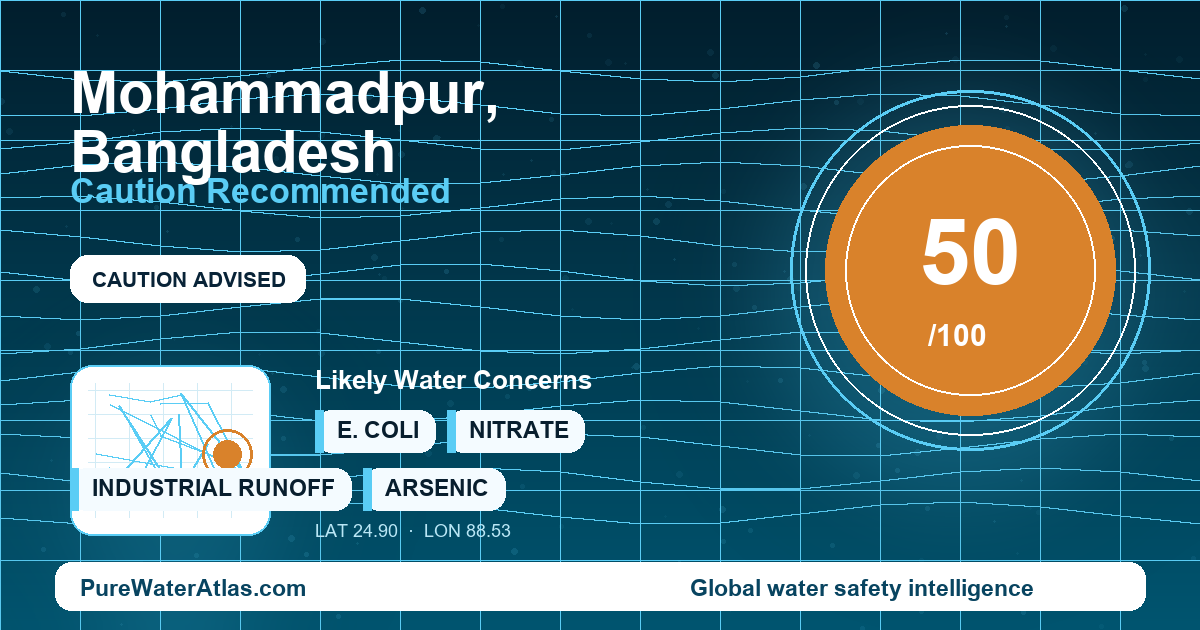
Mohammadpur, Bangladesh: tap water safety score 50/100, with caution recommended because final water quality can change after Dhaka WASA water enters neighborhood pipes, building reservoirs, rooftop tanks, pumps, and apartment plumbing.
Quick Answer
| Overall status | Caution recommended. Mohammadpur is served through the Dhaka WASA metropolitan system, but safety at the tap can vary by building, storage tank condition, plumbing age, pressure conditions, and recent flooding or pipe work. |
|---|---|
| Can visitors drink untreated tap water? | No. Short-term visitors should use sealed bottled water or water that has been reliably boiled, filtered, or treated by a reputable hotel or restaurant. |
| Resident guidance | Residents should treat tap water as conditionally usable only after household controls: maintained treatment, clean storage tanks, and periodic testing for microbial indicators and basic chemistry. |
| Main water source | Mohammadpur receives water as part of Dhaka’s mixed public supply network, historically dominated by deep groundwater wells with an increasing share from treated surface-water projects. |
| Water authority | Dhaka Water Supply and Sewerage Authority, commonly known as Dhaka WASA. |
| Filter recommendation | A home treatment system is strongly advisable for drinking water. Choose it based on testing; common setups include sediment pre-filtration, activated carbon, UV, or RO depending on actual results and maintenance capacity. |
Why Mohammadpur Is Different
Mohammadpur is not a standalone water-utility city. It is a dense residential and commercial area in western-central Dhaka, so its tap-water profile is tied to the wider Dhaka WASA supply system and to very local building-level conditions. That distinction matters: a household’s drinking water may pass through utility mains, a service connection, an underground reservoir, booster pumps, a rooftop tank, and then apartment plumbing before it reaches the glass.
The main concern in Mohammadpur is not that every tap is automatically unsafe. The concern is variability after water leaves the utility system. Distribution-pipe leakage, intermittent pressure, construction disturbance, older plumbing, poorly sealed storage tanks, and monsoon-related contamination pathways can all affect final tap quality. In many apartment buildings, underground reservoirs and rooftop tanks are as important to drinking-water safety as the citywide source.
Publicly accessible, recent, tap-by-tap laboratory data for Mohammadpur buildings is limited. This profile therefore does not claim that all Mohammadpur tap water is safe or unsafe. The appropriate verdict is caution recommended, with more confidence when a specific building’s water has been tested and its storage and treatment systems are maintained.
Where Does Mohammadpur’s Tap Water Come From?
Mohammadpur is supplied through the Dhaka WASA metropolitan network. Dhaka’s public supply has historically relied heavily on groundwater abstracted from deep production wells. Over time, this dependence on groundwater created long-term concerns about groundwater-level decline and aquifer pressure, leading Dhaka WASA and development partners to expand surface-water treatment and transmission capacity.
For Mohammadpur, this means the tap supply should be understood as part of a mixed Dhaka network rather than one neighborhood well or a separate municipal source. Relevant Dhaka infrastructure includes deep groundwater production wells, the Saidabad surface-water treatment infrastructure serving parts of Dhaka, and the Padma-Jashaldia water treatment and transmission infrastructure developed to increase the city’s surface-water share. Surface-water infrastructure for Dhaka includes treatment and transmission linked to regional river systems, including the Shitalakhya River system and the Padma-Jashaldia project.
After treated water enters the local distribution network, building-level infrastructure becomes critical. Many households and apartment buildings in Mohammadpur depend on underground reservoirs, rooftop tanks, booster pumps, and internal plumbing. Even when incoming utility water has been treated, contamination can occur if tanks are not sealed, are cleaned infrequently, contain sediment or slime, or are affected by cross-connections and nearby drain or sewer exposure.
Who Manages Drinking Water in Mohammadpur?
Public water supply and sewerage services in Dhaka are managed by Dhaka Water Supply and Sewerage Authority, commonly known as Dhaka WASA. Mohammadpur falls within this metropolitan service context rather than being managed by a separate neighborhood water department.
Dhaka WASA operates under Bangladesh’s local government water-supply framework. Drinking-water quality is generally referenced against Bangladesh national drinking-water standards and public-health guidance. National institutions such as the Local Government Division, Department of Public Health Engineering, Department of Environment, and health authorities have roles in water, sanitation, standards, and environmental oversight.
For a Mohammadpur household, however, official utility responsibility and actual tap safety are not identical. Dhaka-wide utility and project information can describe the network, sources, and improvement programs, but the water that reaches a specific kitchen tap may be affected by a private building’s reservoir, rooftop tank, booster pump, and plumbing materials. Because publicly accessible routine results at Mohammadpur tap level are not consistently available, residents should verify their own building water where drinking safety is important.
Main Local Water Concerns
The most important local concern is microbial contamination after water moves through vulnerable pipes, low-pressure areas, illegal or poor-quality connections, or contaminated storage. Microbial risk is especially relevant where water sits in underground or rooftop tanks, where tank covers are broken, or where flooding and drain overflow create exposure pathways.
Mohammadpur residents may also see turbidity, sediment, color, or odor episodes after pipe work, pressure changes, nearby construction, or tank disturbance. Cloudy or dirty water should not be treated as merely cosmetic, because turbidity and sediment can interfere with disinfection reliability and can indicate disturbed deposits in tanks or pipes.
Chlorine residual can decline by the time water reaches household taps, particularly after storage in tanks. This does not prove contamination, but it reduces the margin of protection if storage conditions are poor. Old building plumbing and fittings may also contribute taste issues or metals; lead risk should be evaluated by testing rather than assumed. Iron and manganese staining or metallic taste may occur in some groundwater-influenced supplies or building plumbing, but building-specific testing is needed.
Arsenic is a nationally important groundwater contaminant in Bangladesh. That national context should not be misread as proof of a Mohammadpur tap-water arsenic problem. Arsenic testing is especially important if a household uses a private borewell, an unknown groundwater source, or any non-Dhaka-WASA source, because taste and appearance cannot confirm safety.
Season also matters. Monsoon rainfall can increase urban flooding and sewer-drain overflow pathways, raising contamination risk where water mains, service pipes, or building reservoirs are vulnerable. After heavy rain, waterlogging, construction, or plumbing repairs, residents should be more cautious about sudden changes in smell, color, turbidity, or gastrointestinal illness patterns.
For Travelers
Visitors should not drink untreated tap water in Mohammadpur. Use sealed bottled water or water that has been boiled or treated by a trustworthy filtration and disinfection system. This is especially important for short-term travelers, children, pregnant travelers, and anyone with a sensitive stomach or compromised immune system.
For brushing teeth, use bottled or boiled water if you are a visitor or staying in a building with unknown tank hygiene. Avoid swallowing shower water. For oral rehydration, medicines, infant formula decisions, or sensitive health situations, use water from a sealed reputable bottle or a reliably treated source.
Avoid ice from street vendors or informal shops unless you know it was made from treated water. In higher-end hotels and reputable restaurants, ask whether ice is made from filtered or purified water. Better hotels and restaurants may use RO, UV, or bottled-water systems, but travelers should not assume this automatically. Check bottle seals and prefer hot drinks made with fully boiled water.
If boiling water yourself, bring it to a rolling boil and store it in a clean, covered container. Boiling is useful for microbial risk, but it does not remove metals, arsenic, nitrate, salinity, or other chemical contaminants. Travelers who want a backup option can carry a travel bottle that combines filtration and disinfection.
For Residents
For Mohammadpur residents, a home treatment system is strongly advisable for drinking water, but it should be selected based on test results rather than guesswork. A common practical setup is sediment pre-filtration followed by activated carbon and UV or RO, depending on microbial results, turbidity, taste, TDS, metals, and household health needs. RO should not be installed blindly without considering maintenance, wastewater, mineral balance, and the actual contaminant profile.
Testing should focus first on the point of use—the kitchen tap or the water outlet used for drinking. Test for E. coli or thermotolerant coliforms, especially after tank cleaning, flooding, plumbing repairs, or illness clusters. Basic screening should include turbidity, color, odor, pH, TDS, and residual chlorine. If there is staining, metallic taste, black particles, or discoloration, test for iron and manganese. If the building is old, plumbing is corroded, fixtures are unknown, or children and pregnant people live in the home, testing for lead is prudent.
Older Mohammadpur buildings may have aging service lines, corroded internal pipes, old valves, solder, brass fixtures, or poorly designed cross-connections. Let stagnant water run briefly before collecting water, but do not rely on flushing alone for safety. Laboratory testing is the more reliable way to understand microbial and metals risk.
Storage tanks deserve special attention. Underground and rooftop tanks should be sealed against insects, rodents, dust, and drain backflow; cleaned and disinfected on a schedule; and inspected after flooding or plumbing work. If a rooftop tank has slime, sediment, broken covers, foul odor, or nearby sewer or drain exposure, do not drink the water without treatment and testing.
Relevant Contaminants and Water-Quality Issues
The most relevant Mohammadpur concern is microbial contamination, especially where building storage or pressure conditions are weak. PureWaterAtlas has a dedicated guide to E. coli, which is one of the key indicators used to assess fecal contamination risk in drinking water. For broader microbial context, see the Water Microbiology pillar.
Visible cloudiness, dirty water, or particles should be taken seriously. The PureWaterAtlas pages on turbidity and sediment explain why disturbed tanks and pipes can affect treatment reliability and consumer confidence. Declining disinfectant protection is also relevant after storage; see chlorine for background on residual disinfectant.
For old buildings or unknown plumbing materials, residents should review lead and the guide to Lead in Drinking Water: Testing and Detection Methods. For staining, black particles, or metallic taste, see iron and manganese. If any private borewell or uncertain groundwater source is used, review arsenic and Arsenic in Drinking Water: Testing and Detection Methods.
How to Verify Your Water Quality
The best way to verify drinking-water safety in Mohammadpur is to test the water actually used for drinking, after it has passed through the building’s tanks, pumps, plumbing, and purifier. A utility-level source description is useful, but it cannot confirm the condition of one apartment tap.
Start with microbial testing for E. coli or thermotolerant coliforms, then add turbidity, color, odor, pH, TDS, and residual chlorine. Choose additional tests based on the building: lead for older or corroded plumbing, iron and manganese for staining or taste, and arsenic for private or uncertain groundwater sources. Retest after installing a purifier and after cartridge, membrane, or UV-lamp changes.
For step-by-step guidance, use the PureWaterAtlas Water Testing guide. For treatment choices, see Water Treatment Systems, Water Purification, Boiling Water Purification, and UV Water Purification. You can also compare risks using the Global Water Quality Checker and search specific issues in the Contaminants Search Engine.
Official and Technical Sources
- Dhaka Water Supply and Sewerage Authority official website — primary utility source for Dhaka’s water-supply authority, service structure, projects, and public notices.
- Dhaka Water Supply Network Improvement Project, Asian Development Bank — documentation on Dhaka distribution-network rehabilitation, nonrevenue water, and system improvement needs.
- Dhaka Environmentally Sustainable Water Supply Project, Asian Development Bank — information on Dhaka’s shift toward more sustainable surface-water supply and reduced groundwater dependence.
- Bangladesh: Dhaka Water Supply and Sanitation Project, World Bank — project source on Dhaka water and sanitation infrastructure investment and service challenges.
- WHO/UNICEF Joint Monitoring Programme country files for Bangladesh — national drinking water, sanitation, and hygiene context; not Mohammadpur-specific.
- WHO Guidelines for Drinking-water Quality — international reference for interpreting microbial and chemical drinking-water risks.
- Department of Public Health Engineering, Government of Bangladesh — national institution involved in water supply, sanitation, and water-quality programs.
- Department of Environment, Government of Bangladesh — national environmental regulator relevant to water-quality standards and pollution context.
Bottom Line
Mohammadpur tap water should be treated with caution, not automatic rejection and not blind trust. The area is served by Dhaka WASA’s wider mixed supply system, but the water at a specific tap can be affected by local mains, pressure changes, underground reservoirs, rooftop tanks, pumps, and old building plumbing. Visitors should avoid untreated tap water and use sealed bottled, boiled, or reliably treated water. Residents should maintain tanks, use a properly selected purifier, and test at the point of use for microbial indicators and relevant chemistry. Because public Mohammadpur-specific tap sampling data is limited, the safest approach is building-specific verification rather than relying only on Dhaka-wide information.
Read the full guide: Global Water Quality Guide
Explore more in this category: Global Water Quality Articles