
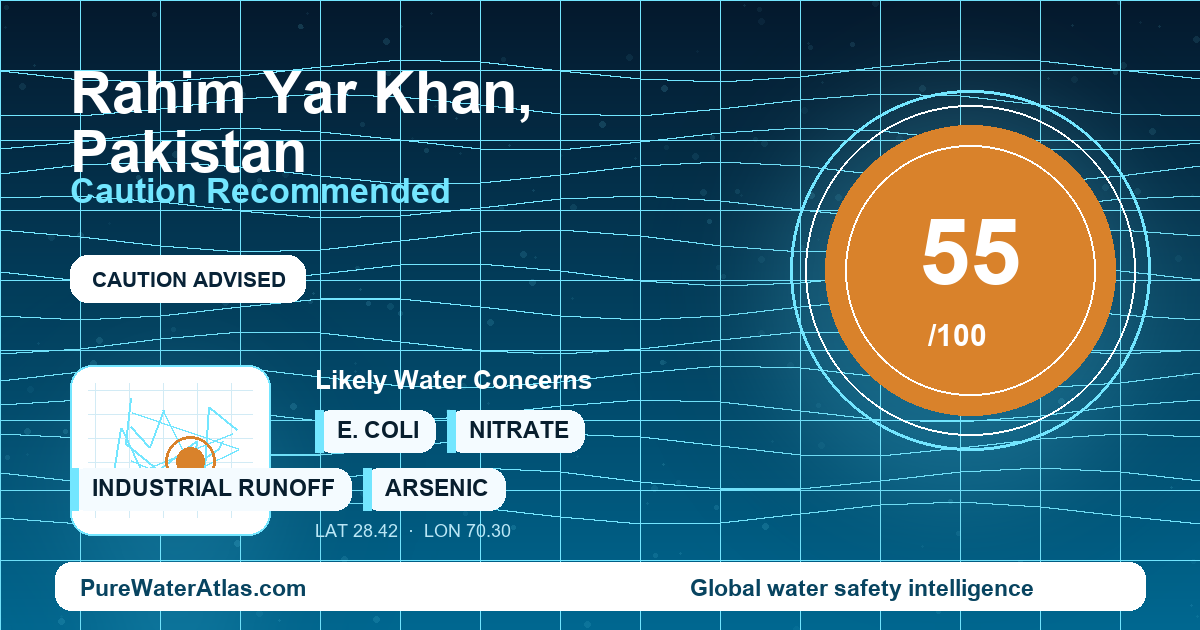
Rahim Yar Khan, Pakistan: groundwater-based urban supply, salinity and hardness pressure, household storage risks, and limited public tap-water compliance data.
Quick Answer
| Water safety score | 55 / 100 |
|---|---|
| Risk level | Caution Recommended |
| Can you drink the tap water? | Caution recommended. Ordinary tap water in Rahim Yar Khan should not be treated as reliably safe without boiling, verified filtration, or recent testing. |
| Traveler advice | Short-term visitors should use sealed bottled water, freshly boiled water, or water from a verified hotel or restaurant treatment system for drinking, brushing teeth, and medicines. |
| Resident advice | Residents should periodically test municipal water, private bore water, public filtration plant water, and stored tank water for microbial and chemical indicators before choosing treatment. |
| Main water source | Rahim Yar Khan is best characterized as a groundwater-dependent city, with municipal tube wells, private bores, hand pumps in some areas, public filtration points, and purchased bottled or 19-liter can water. |
| Water authority context | Local water service is associated with the Municipal Corporation or local government system under Punjab Local Government and Community Development Department; Punjab Public Health Engineering Department is also relevant for water-supply schemes. |
| Filter recommendation | A home treatment system is often advisable, but it should be selected from test results. Boiling, chlorination, or UV may address microbial risk; RO or other certified technology may be needed for elevated TDS, salinity, arsenic, or nitrate. |
The overall verdict for Rahim Yar Khan is not that one confirmed contaminant makes every tap unsafe. The issue is uncertainty plus a realistic local risk profile: groundwater chemical variability in the Indus Basin, salinity and hardness pressure in southern Punjab, intermittent urban distribution risks, and household storage tanks that can contaminate water after it leaves a tube well or supply line.
Why Rahim Yar Khan Is Different
Rahim Yar Khan sits in southern Punjab, in the Indus Basin agricultural plain near the Cholistan desert edge. This hot, arid to semi-arid setting matters for drinking water because groundwater quality can vary sharply by depth, location, canal influence, irrigation return flow, and nearby urban sanitation conditions. A glass of water may look clear and still contain high total dissolved solids, hardness, nitrate, arsenic, or microbes introduced after pumping.
The city’s drinking-water picture is therefore different from a large metropolitan system with a single, consistently reported surface-water treatment plant and a transparent consumer dashboard. Publicly accessible data do not provide a current ward-by-ward tap-water compliance record for Rahim Yar Khan. Confidence is medium-low for precise present-day tap safety at an individual address, but higher for the broad system identity: groundwater-based supply, local-government responsibility, hot climate, salinity pressure, and Pakistan-wide evidence that microbial and chemical drinking-water risks require verification.
Another important local factor is household storage. In Rahim Yar Khan, the final water quality at the tap can depend as much on rooftop or underground tanks as on the municipal source. A tube well or incoming line may deliver acceptable water, but a dirty, uncovered, or rarely cleaned tank can introduce sediment, insects, bird or rodent contamination, and coliform bacteria.
Where Does Rahim Yar Khan’s Tap Water Come From?
Rahim Yar Khan’s urban drinking water is best described as a groundwater-based supply. Public and municipal schemes in southern Punjab commonly abstract groundwater through tube wells and distribute it through local pipe networks where service is available. Many households and premises also use private boreholes, hand pumps, public filtration plants, RO-style water outlets, bottled water, or 19-liter can water.
The wider district is part of the canal-irrigated Indus Basin plain. Canals strongly influence irrigation, recharge, shallow groundwater behavior, and salinity patterns. However, no evidence in the available dataset identifies a single large conventional surface-water drinking treatment plant as the dominant potable source for the city. For practical household decisions, Rahim Yar Khan should be treated as a mixed local groundwater environment rather than a uniform citywide source.
Key infrastructure elements include municipal groundwater abstraction through tube wells and pumping stations, distribution mains and household service lines, public and private filtration points, household tanks, and private bores or hand pumps in some properties. Each point can change water quality. A bore may have a chemical problem even if it is microbiologically clean. A municipal supply may be acceptable at the pumping point but contaminated through leakage, intermittent pressure, cross-connections, or storage. A public filtration plant or RO outlet may improve water only if the system is maintained, cartridges are replaced, and the storage vessel is sanitary.
Rahim Yar Khan also has an older water-use history typical of canal-irrigated southern Punjab: shallow wells, hand pumps, tube wells, and later municipal piped schemes. That history matters because shallow groundwater and private bores can differ greatly from deeper municipal tube wells or treated filtration-plant water.
Who Manages Drinking Water in Rahim Yar Khan?
The relevant local water-service body is the Municipal Corporation or local government system for Rahim Yar Khan under the Punjab Local Government and Community Development Department. The Punjab Public Health Engineering Department is also relevant for water-supply and sanitation schemes, especially public health engineering works outside major WASA cities.
No dedicated WASA for Rahim Yar Khan was identified in the same way that Lahore, Faisalabad, Gujranwala, Multan, and Rawalpindi have WASA agencies. This matters because secondary-city water systems often have less accessible public compliance reporting than major metropolitan utilities. Residents should not assume that appearance, taste, or a general claim of municipal supply proves safety at the tap.
Drinking-water quality in Pakistan is referenced through Pakistan Standards for Drinking Water Quality and national or provincial public health institutions, including PSQCA, PCRWR, Punjab health and local-government agencies, and Punjab environmental authorities. In practice, the available public reporting for a city like Rahim Yar Khan is not enough to confirm current safety at every neighborhood or building. Local testing remains essential.
Main Local Water Concerns
- Microbial contamination such as E. coli or total coliform: This is the highest-priority practical risk for travelers and households using intermittent supply, leaky pipes, stored tank water, or private bores near drains, latrines, septic pits, or sewer lines. Pakistan water-quality monitoring and WHO-type public health guidance consistently treat fecal contamination as a major drinking-water risk.
- High TDS, salinity, hardness, and taste problems: Southern Punjab groundwater is vulnerable to salinity and hardness because of arid climate, irrigation return flows, evaporation, waterlogging, and drainage pressures in the broader Indus Basin. High TDS may not always cause immediate illness, but it can make water unpleasant, increase scaling, damage appliances, and push households toward RO water or bottled water.
- Arsenic in groundwater: Peer-reviewed mapping and Pakistan water-quality literature show arsenic-risk zones in parts of the Indus alluvial aquifer system. This does not prove every Rahim Yar Khan tap contains arsenic, but it makes arsenic testing prudent for private bores, hand pumps, and long-term household tube-well use.
- Nitrate: Rahim Yar Khan is surrounded by intensive agriculture, and peri-urban groundwater can also be affected by drains, septic systems, and sewer leakage. Nitrate is especially important for infants, pregnant people, and households using shallow or poorly protected bores.
- Turbidity, sediment, and dirty storage tanks: Sediment can enter through old pipes, repairs, low-pressure events, and unclean tanks. Turbidity can reduce the effectiveness of UV and chlorine disinfection and may signal intrusion or storage contamination.
- Inconsistent residual chlorine: A detectable free-chlorine residual can help protect piped water, but chlorine does not remove arsenic, nitrate, salinity, or dissolved solids. If residual chlorine is absent at the tap, microbial regrowth or contamination becomes more likely; if chlorine taste is very strong, households may avoid the supply.
Season also matters. Extreme summer heat increases demand, speeds chlorine decay, and makes stored water more vulnerable. Monsoon rain and drainage overflows can increase fecal intrusion risks. Electricity outages and pump interruptions can create intermittent pressure, allowing contaminated water to enter cracked or poorly sealed pipes.
For Travelers
Visitors should not drink untreated tap water in Rahim Yar Khan. Use sealed bottled water from reliable shops, freshly boiled water, or water from a verified RO or UV-treated system that is actually maintained. A visible filter on a counter does not prove safe drinking water.
Use bottled, boiled, or verified filtered water for brushing teeth, especially for children, pregnant travelers, older adults, and anyone with a sensitive stomach or weakened immune system. Avoid ice unless the hotel or restaurant can confirm that it is made from treated water. Ice made with ordinary tap water carries the same microbial concern as the original water.
In hotels and restaurants, ask directly whether drinking water is bottled, boiled, RO-treated, or UV-treated. Prefer sealed bottles opened in front of you, hot tea or coffee made with boiling water, and cooked foods served hot. Be cautious with fresh juices diluted with water and salads washed in untreated water. During hot months, carry oral rehydration salts, check bottle seals, and avoid refilled bottles. Boiling is useful for bacteria, viruses, and protozoa when done properly, but it does not remove arsenic, nitrate, salinity, or dissolved solids.
For Residents
Rahim Yar Khan residents should base treatment on testing rather than brand claims or taste alone. If the main confirmed issue is microbial contamination and turbidity is low, boiling, chlorination, or UV can be effective when used correctly. If test results show elevated TDS, salinity, arsenic, or nitrate, a properly maintained RO system or another certified technology may be needed. Activated carbon alone should not be relied on for arsenic, nitrate, or salinity.
Test any private bore, hand pump, or tube-well water before using it as the primary drinking source. At minimum, test for E. coli or total coliform, TDS, electrical conductivity, pH, turbidity, hardness, nitrate, arsenic, iron, and manganese. If using municipal water, test both the incoming supply point and water after the household storage tank. That comparison helps identify whether contamination is entering inside the property.
Where chlorinated municipal supply is claimed, check free residual chlorine at the tap, especially during hot weather and after interruptions. Retest after floods, sewer overflows, pipe repairs, new bore installation, major changes in taste or color, or unexplained gastrointestinal illness in the household.
Older buildings need special attention. There is no public evidence supporting a citywide lead claim for Rahim Yar Khan, but older internal plumbing, brass fittings, galvanized pipes, solder, pumps, and corrosion can add metals or sediment after water leaves the municipal line or bore. For older or recently renovated buildings, test first-draw and flushed samples for metals rather than assuming the supply result applies at the kitchen tap.
Storage tanks are one of the most important local control points. Clean rooftop and underground tanks on a fixed schedule, keep lids tight, prevent bird, rodent, insect, and dust entry, remove sludge, disinfect after cleaning, and keep vents and overflows away from drains. If tank water tests positive for coliforms while incoming water is clean, the building storage system is probably the problem.
Relevant Contaminants and Water-Quality Issues
The most important microbial indicator for Rahim Yar Khan households and travelers is E. coli, because it signals fecal contamination and potential diarrheal-disease risk. Turbidity and sediment are also relevant because dirty tanks, old pipes, and low-pressure events can introduce particles that interfere with disinfection.
For groundwater users, arsenic and nitrate deserve specific testing attention. Arsenic is a regional Indus alluvial aquifer concern, while nitrate can reflect agricultural or sewage influence and is especially important for infants and pregnant people. Chlorine is relevant for understanding residual disinfectant, taste complaints, and microbial protection limits. Lead is not identified here as a citywide Rahim Yar Khan problem, but it remains relevant for old-building plumbing assessment.
How to Verify Your Water Quality
The best next step in Rahim Yar Khan is structured testing. Start with the PureWaterAtlas guide to water testing, then match treatment to the result using the guide to water purification methods. For general safety decisions, see Drinking Water Safety and the background guide on Water Contamination.
If a lab report shows specific chemicals, use the Contaminants Search Engine to interpret individual parameters. Residents using tube wells or private bores should review arsenic testing methods and nitrate testing methods. For microbial risk, the Water Microbiology guide explains bacteria, viruses, and contamination pathways. Travelers comparing destinations can use the Global Water Quality Checker.
Treatment choices should not be one-size-fits-all. Boiling is practical for short-term microbial protection and emergencies, while UV purification can work when turbidity is controlled and the unit is maintained. RO may be appropriate for high TDS, salinity, arsenic, or nitrate, but only if the system is correctly specified, serviced, and periodically tested.
Official and Technical Sources
- Pakistan Council of Research in Water Resources — national water research and monitoring authority used as a federal reference for drinking-water research, monitoring, and laboratory context in Pakistan.
- Punjab Public Health Engineering Department — Government of Punjab authority relevant to public health engineering, water-supply, and sanitation schemes.
Data limitation: no continuously updated Rahim Yar Khan consumer tap-water dashboard or recent ward-level compliance dataset was identified in accessible public sources. This profile therefore emphasizes verified system context, regional groundwater risk factors, and practical testing-based decisions rather than unsupported claims about every tap in the city.
Bottom Line
Tap water in Rahim Yar Khan should be approached with caution. The city is best understood as a groundwater-dependent southern Punjab system where safety can vary by supply zone, private bore, pipe condition, tank hygiene, and treatment maintenance. Visitors should avoid untreated tap water and use sealed bottled, boiled, or verified treated water. Residents should not rely on taste or clarity: test for E. coli or total coliform, TDS, hardness, nitrate, arsenic, turbidity, pH, and residual chlorine where relevant. Boiling or UV may handle microbial risk, but they do not remove arsenic, nitrate, salinity, or dissolved solids. For long-term use, testing and tank maintenance are the key safeguards.
Read the full guide: Global Water Quality Guide
Explore more in this category: Global Water Quality Articles