
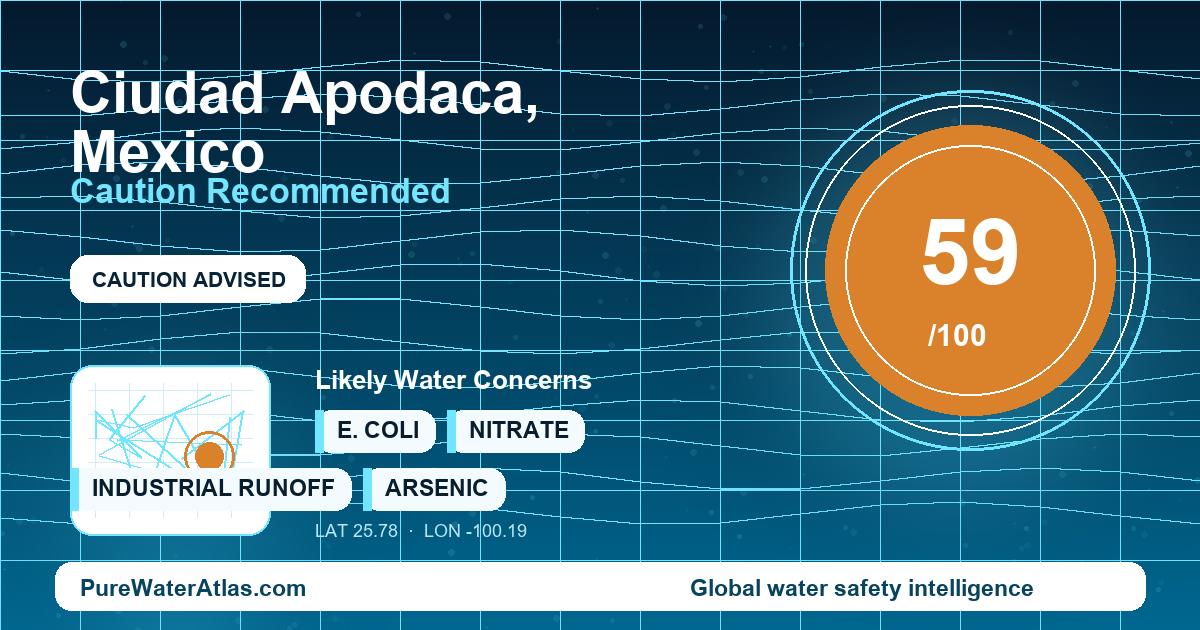
Ciudad Apodaca, Nuevo León: treated Monterrey metropolitan water with caution recommended at the household tap because drought, pressure changes, storage tanks and limited city-specific public data can affect real-world safety.
Quick Answer
| Overall safety status | Caution recommended. Ciudad Apodaca is served by the Monterrey metropolitan water system. The water is generally treated and chlorinated, but Apodaca-specific tap-water data are limited and household conditions can change water quality. |
|---|---|
| Water safety score | 59 / 100 — managed municipal supply, but not a “drink freely without local precautions” profile. |
| Traveler advice | Use sealed bottled water, hotel-provided purified water, or properly filtered water for drinking. Tap water is usually acceptable for showering and handwashing, but direct drinking is not the conservative traveler choice. |
| Resident advice | Use a maintained point-of-use filter for daily drinking water. Test water from the actual kitchen tap if you use a cistern, tinaco, older plumbing, private well, tanker water or backup source. |
| Main water source | A mixed Monterrey metropolitan supply: surface reservoirs such as El Cuchillo, Cerro Prieto, La Boca and Libertad, combined with groundwater wells and well fields. |
| Water authority | Servicios de Agua y Drenaje de Monterrey, I.P.D. — commonly known as SADM or Agua y Drenaje de Monterrey. |
| Filter recommendation | Certified activated carbon is a reasonable minimum for chlorine taste and odor. Reverse osmosis is stronger where dissolved minerals, metals, arsenic/nitrate uncertainty, industrial-area concerns or private sources are relevant. |
Why Ciudad Apodaca Is Different
Ciudad Apodaca is not a separate water-supply island with its own stand-alone municipal drinking-water utility. It is an industrial and residential municipality in the northeastern part of the Monterrey metropolitan area, and its drinking water is supplied through the same regional system that serves Monterrey and surrounding municipalities. That matters because the safety question in Apodaca is not simply “does the city treat water?” but “what happens to treated metropolitan water before it reaches a specific apartment, house, hotel, workshop or restaurant?”
The overall verdict for Ciudad Apodaca is caution recommended. Servicios de Agua y Drenaje de Monterrey treats and chlorinates water for the metropolitan system, but publicly accessible, recent, Apodaca-by-neighborhood tap-water compliance data are not consistently available in an easy-to-verify format. Local risk depends heavily on drought-driven source changes, distribution pressure, maintenance events, building plumbing, and the condition of household cisterns and rooftop tinacos.
Apodaca’s industrial parks, logistics zones and airport-related development are also relevant context. This does not prove that industrial contaminants are present in the public tap water. It does mean that residents using private wells, tanker-delivered water, stored water, or older plumbing have a stronger reason to verify water quality with testing rather than relying only on regional assurances.
Where Does Ciudad Apodaca’s Tap Water Come From?
Ciudad Apodaca receives drinking water through the Monterrey metropolitan system operated by SADM. The raw-water portfolio is mixed. It includes major surface reservoirs such as El Cuchillo, Cerro Prieto, La Boca and the newer Libertad supply, along with groundwater wells and well fields used to support metropolitan demand, especially during drought and high-demand periods.
This blended-source reality is important for daily tap quality. The water at a given building in Apodaca may reflect reservoir water, groundwater, and local distribution hydraulics. When the source blend changes, residents may notice differences in taste, odor, hardness or dissolved-mineral character. During low-pressure events, repairs, scheduled or unexpected interruptions, and service restoration, the risk of sediment release, turbidity, and microbial intrusion can increase even if water leaving a treatment facility is properly disinfected.
The region’s recent history also matters. Nuevo León experienced a severe water-supply crisis in 2022, when reservoir levels fell sharply and many metropolitan neighborhoods faced scheduled or unexpected service interruptions. That event is relevant to Apodaca because intermittent supply often increases household reliance on storage tanks and can change chlorine residual, sediment behavior and taste at the tap.
Key infrastructure connected to the broader supply picture includes the El Cuchillo reservoir and aqueduct system, the El Cuchillo II aqueduct, Cerro Prieto reservoir, La Boca reservoir, Libertad dam, metropolitan treatment and pumping facilities, storage and distribution networks, and groundwater wells used as part of the wider Nuevo León water portfolio.
Who Manages Drinking Water in Ciudad Apodaca?
Drinking water and sewerage service for Ciudad Apodaca is managed by Servicios de Agua y Drenaje de Monterrey, I.P.D., commonly called SADM or Agua y Drenaje de Monterrey. It is the state public utility responsible for potable water and sewerage service across the Monterrey metropolitan area, including Ciudad Apodaca.
Mexico’s drinking-water quality framework is federal. Potable water for human use and consumption is regulated principally under NOM-127-SSA1-2021, with oversight roles involving the Secretaría de Salud, COFEPRIS and CONAGUA. CONAGUA manages national water resources and publishes hydrologic and water-quality information, including reservoir and water-quality context. In practice, however, public reporting is stronger at the regional and system level than at the individual Apodaca tap or neighborhood level.
That data limitation is central to this profile. Public sources document the regional utility, the major reservoirs and Nuevo León’s water-supply pressures. They do not provide a complete, current, neighborhood-level tap-water dataset for Apodaca. A kitchen tap can differ from treated utility water because of pressure events, distribution disturbances, cisterns, tinacos, building plumbing and filter maintenance.
Main Local Water Concerns
- Drought and source-water stress: The Monterrey metropolitan supply is vulnerable to dry periods. Drought can lower reservoir levels, concentrate minerals, and increase dependence on alternative sources.
- Intermittent service and low pressure: During shortages, maintenance or high-demand periods, low pressure and service interruptions can increase the chance of sediment movement and microbial vulnerability in the distribution system.
- Sediment and turbidity: Pipe repairs, storm runoff into reservoirs, pressure changes and post-outage flushing can cause discolored or particle-laden water at the tap.
- Chlorine residual variability: Treated water is chlorinated, but residual disinfectant can decline in poorly maintained cisterns or rooftop tinacos, especially when water is stored for long periods.
- Household storage risks: Dirty, uncovered or poorly screened tanks can make otherwise treated municipal water unsafe by the time it reaches the kitchen faucet.
- Older internal plumbing: Municipal treatment does not remove metals that enter after water reaches a building. Older fixtures, solder or undocumented plumbing repairs can create building-specific metal risk.
- Industrial-area uncertainty: Apodaca’s industrial setting does not prove contamination of public tap water, but it supports targeted testing for private wells, stored water and households wanting evidence beyond utility-level assurance.
- Emerging contaminant data gaps: Publicly available Apodaca-specific data for contaminants such as PFAS and microplastics are limited.
Season also matters. Late spring and summer heat can increase water demand and worsen pressure problems in dry years. Heavy rain and tropical-storm remnants can raise raw-water turbidity and disturb distribution sediments. After an outage, the first water from taps may be discolored or contain sediment; it should be flushed before use.
For Travelers
For short-term visitors, the conservative answer is: do not rely on unfiltered tap water as your main drinking water in Ciudad Apodaca. Use sealed bottled water, hotel-provided purified water, or water from a well-maintained purifier. This is especially important for travelers with sensitive stomachs, pregnant travelers, immunocompromised people, infants and young children.
Tap water is generally a reasonable choice for showering and handwashing. Most healthy adults can brush teeth with tap water, but cautious travelers should use bottled or purified water for brushing, particularly during or after water outages, low-pressure periods, or visible discoloration.
For ice, use it only in established hotels, restaurants and chains that state they use purified water or commercial ice. Avoid informal ice of unknown origin. Large hotels, airport-area restaurants and major chains commonly use purified water systems or bottled water for drinking service, but visitors should still ask if uncertain. Do not assume that every small restaurant, rental property, street vendor or informal beverage stand uses purified water for drinks and ice.
Practical Apodaca travel habits are simple: carry bottled water during hot months, avoid drinking from bathroom taps in rentals, flush taps after service interruptions, and treat brown water, strong odor, unusual taste or low pressure as a reason to switch fully to bottled or purified water until the system is clear and stable.
For Residents
Residents should treat Apodaca’s municipal supply as managed and treated, but not fully transparent at the household level. A home filter is advisable for regular drinking-water use. At minimum, use a certified activated carbon filter for chlorine taste, odor and some organic compounds, and replace cartridges on schedule. For broader protection against dissolved salts, metals, nitrate, arsenic uncertainty, or industrial-area concerns, a certified reverse osmosis system is the stronger point-of-use option.
UV can be useful for microbial control only when water is visually clear and after sediment filtration. UV is not a substitute for tank cleaning, and it does not remove metals, dissolved minerals or chemical contaminants. If water is cloudy or sediment-laden, address turbidity and particulate matter before relying on UV.
Testing should focus on the water people actually drink. If your building uses a cistern or rooftop tinaco, test from the kitchen tap, not only from the municipal inlet. After repeated outages, flooding, tank-cleaning failures or illness concerns, test for total coliform and E. coli through a qualified laboratory. For older buildings or unexplained metallic taste, test both first-draw and flushed samples for lead and other metals.
If you use a private well, tanker-delivered water or a non-municipal backup source, test for E. coli, nitrate, arsenic, total dissolved solids, hardness and basic metals. If the home is near industrial activity or uses private groundwater, consider a broader laboratory panel that includes volatile organic compounds and, where available, PFAS screening. Households that store water for long periods should also check free chlorine residual, because loss of residual in a cistern or tinaco can allow microbial regrowth.
Cisterns and rooftop tinacos are a major household-level risk in Apodaca. Tanks should be sealed, screened against insects, cleaned and disinfected periodically, and inspected after outages or nearby construction. A dirty tank can make treated municipal water unsafe at the tap.
Relevant Contaminants and Water-Quality Issues
Several PureWaterAtlas contaminant guides are especially relevant to Ciudad Apodaca’s real-world water profile. Chlorine in drinking water is relevant because SADM-treated water is chlorinated, while storage in cisterns and tinacos can reduce residual disinfectant. Turbidity and sediment are relevant after outages, repairs, storm runoff and distribution disturbances.
For microbial risk, especially in stored water or private sources, see E. coli in drinking water. For older buildings, lead in drinking water is relevant as a plumbing-specific concern, not as a proven citywide Apodaca contaminant. For private wells or broader northern Mexico groundwater screening, review arsenic and nitrate. For emerging-contaminant uncertainty in industrialized settings, see PFAS in drinking water, while noting that Apodaca-specific PFAS data are limited.
For broader background, PureWaterAtlas also provides guides to drinking water safety, water microbiology, and water treatment systems.
How to Verify Your Water Quality
The most reliable answer for a specific Apodaca home is testing the water that comes from the actual drinking tap. Start with basic sensory checks: unusual odor, strong chlorine loss, brown color, visible sediment, sudden taste changes or low pressure after an outage should trigger caution. Flush affected taps and use bottled or purified water until water is clear and stable.
For laboratory decisions, use the PureWaterAtlas complete guide to water testing and analysis. Residents concerned about old plumbing can review lead testing and detection methods. Households using private or backup groundwater sources should consider arsenic testing and nitrate testing, especially where infants are present. If industrial-area emerging contaminants are a concern, review PFAS testing methods.
For treatment decisions, boiling water can be useful as a short-term microbial precaution after outages, but it does not remove metals, dissolved salts or many chemical contaminants. UV purification can help with microbes only when the water is clear and prefiltered. To compare issues, use the PureWaterAtlas Contaminants Search Engine and the Global Water Quality Checker.
Official and Technical Sources
- Servicios de Agua y Drenaje de Monterrey, official utility website — official metropolitan water and sewer utility information.
- Agua y Drenaje de Monterrey, Gobierno de Nuevo León service information — state-government information on the public utility serving the metropolitan area.
- Plan Hídrico Nuevo León 2050 — state planning document describing water-supply stress, infrastructure needs and long-term strategy.
- Presa Libertad, Nuevo León project information — federal information on the Libertad dam.
- Sistema Nacional de Información del Agua, Presas — CONAGUA reservoir monitoring for major dams such as El Cuchillo, Cerro Prieto and La Boca.
- CONAGUA Calidad del Agua — federal water-quality monitoring context.
- NOM-127-SSA1-2021 — official Mexican drinking-water quality standard for water for human use and consumption.
- Gobierno Municipal de Apodaca — local municipal context for Ciudad Apodaca.
- CDC Mexico travel health information — traveler-health guidance supporting conservative use of safe bottled or treated water when visiting Mexico.
Bottom Line
Ciudad Apodaca’s tap water comes from the treated Monterrey metropolitan system, not a separate Apodaca-only utility. That system is managed by SADM and draws from a mixed portfolio of reservoirs and groundwater, but local tap safety depends on pressure stability, drought conditions, distribution events, household cisterns, tinacos and plumbing. Visitors should use sealed bottled or verified purified water for drinking and be cautious with ice of unknown origin. Residents should use a maintained point-of-use filter, clean and protect storage tanks, and test kitchen-tap water when using older plumbing, private wells, tanker water or backup storage. Because public Apodaca-specific tap data are limited, the safest practical verdict is caution recommended rather than unconditional tap-water confidence.
Read the full guide: Global Water Quality Guide
Explore more in this category: Global Water Quality Articles