
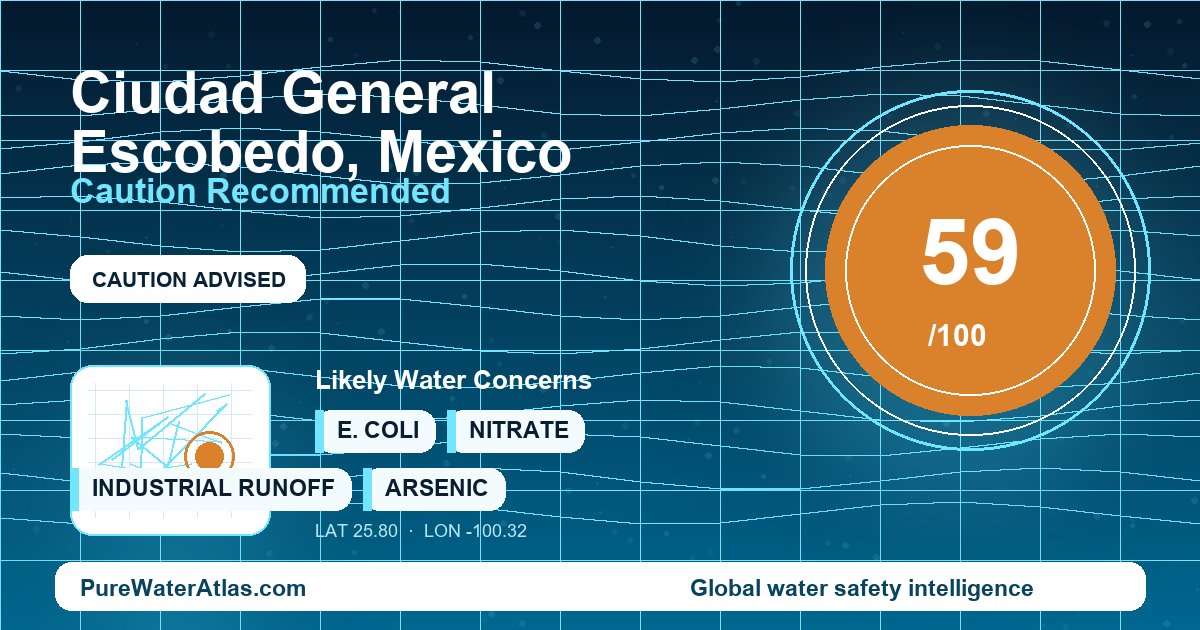
Ciudad General Escobedo, Nuevo León: tap water is supplied through the Monterrey metropolitan system, with caution recommended because household storage, intermittent service history, sediment, and limited neighborhood-level reporting can affect what reaches your tap.
Quick Answer
| Overall safety status | Caution recommended. PureWaterAtlas score: 59/100. The city is served by a formal metropolitan utility, but tap-level safety can vary by building plumbing, storage tanks, outages, and local distribution conditions. |
|---|---|
| Can travelers drink the tap water? | Not recommended for most short-term travelers. Use sealed bottled water, hotel-provided purified water, boiled water, or a properly maintained purifier. |
| Resident advice | Treat the supply as utility-managed but verify conditions at the kitchen tap. Use a maintained filter if sediment, chlorine taste, storage tanks, or vulnerable household members are involved. |
| Main water source | Monterrey metropolitan supply mix: major reservoirs including El Cuchillo, Cerro Prieto, and La Boca, plus groundwater wells and resilience projects such as El Cuchillo II and the Libertad Dam program. |
| Water authority | Servicios de Agua y Drenaje de Monterrey, also known as SADM or Agua y Drenaje de Monterrey. |
| Filter recommendation | A sediment prefilter plus activated carbon is reasonable for many homes. Add UV, ultrafiltration, boiling, or another microbial barrier if cistern or rooftop tank hygiene is uncertain. Consider reverse osmosis only when testing shows a dissolved-contaminant problem. |
Why Ciudad General Escobedo Is Different
Ciudad General Escobedo is not a standalone small-city water system with one local wellfield or one municipal treatment plant. It is a northern municipality within the Monterrey metropolitan area in Nuevo León, and its tap-water situation is tied to metropolitan-scale supply decisions, aqueduct capacity, reservoir storage, drought response, and pressure management.
That distinction matters. The most important water-safety concern in Ciudad General Escobedo is not a confirmed citywide toxic contaminant in the available public record. The more practical concern is the chain between regional treatment and the glass of water in a home, apartment, hotel, restaurant, or workplace. Pressure reductions, outages, repairs, household cisterns, rooftop tanks, stagnant plumbing, and sediment disturbance can all change water quality at the point of use.
Nuevo León’s 2022 urban water crisis is important local context. Low reservoir levels and high demand produced restrictions across the Monterrey metropolitan area. For Escobedo, that history reinforces a simple point: even where utility-treated water is part of a formal system, intermittent service and household storage can become major risk factors. A clean, sealed, disinfected tank can reduce risk; a neglected tank can make otherwise treated municipal water unsafe at the tap.
PureWaterAtlas rates Ciudad General Escobedo as Caution Recommended with medium confidence. The regional system and utility are well documented, but publicly accessible, routinely summarized water-quality data by Escobedo neighborhood, distribution sector, and individual building tap is limited. This profile therefore avoids claiming exact contaminant concentrations or uniform safety conditions across the municipality.
Where Does Ciudad General Escobedo’s Tap Water Come From?
Ciudad General Escobedo is supplied through the Monterrey metropolitan distribution network operated by Servicios de Agua y Drenaje de Monterrey. The regional raw-water portfolio includes large surface-water reservoirs, imported surface-water infrastructure, and groundwater wells. Key sources and infrastructure include the El Cuchillo Reservoir and aqueduct system in the Río San Juan basin, Cerro Prieto Reservoir, La Boca Reservoir, groundwater wells, and major resilience projects such as the El Cuchillo II aqueduct and the Libertad Dam program.
Escobedo does not appear, based on the available information, to have a separate municipal drinking-water source independent of this metropolitan grid. In practical terms, residents and visitors are affected by the same broad regional supply stresses that affect the Monterrey area: reservoir variability, drought years, summer demand, source blending, and pressure-management decisions.
Surface-water reservoirs can be affected by seasonal runoff and turbidity, while groundwater can influence mineral taste, hardness, or dissolved solids in parts of a mixed system. The dataset for this profile does not provide Escobedo-specific measurements for those parameters, so they should be treated as practical possibilities rather than confirmed neighborhood-wide conditions.
The final part of the “source” is often inside the property. In many homes, apartments, commercial buildings, and rental properties, water may pass through a cistern, rooftop tank, or internal plumbing before reaching the tap. That building-level system can accumulate sediment, biofilm, insects, or microbial contamination if it is not covered, screened, cleaned, and disinfected. For many Escobedo households, this is the most important water-quality control point.
Who Manages Drinking Water in Ciudad General Escobedo?
Drinking water service in Ciudad General Escobedo is managed through Servicios de Agua y Drenaje de Monterrey, the state water and sewerage utility serving the Monterrey metropolitan area. The system is regional, not purely municipal, so Escobedo’s supply depends on utility operations and state-level water planning across Nuevo León.
Mexico’s drinking-water quality framework includes national health standards, especially NOM-127-SSA1-2021, the official standard for water for human use and consumption. Health oversight involves Mexican authorities such as Secretaría de Salud and COFEPRIS. National water-resource and reservoir information is associated with CONAGUA, including information relevant to major projects such as El Cuchillo II and reservoir conditions.
For residents, the regulatory framework is important but not sufficient by itself. Compliance at a system level does not automatically prove that water is safe at every kitchen tap after it has moved through distribution pipes, intermittent pressure conditions, property tanks, or older internal plumbing. This is why tap-level observation, storage-tank maintenance, and periodic testing are central to the local guidance for Ciudad General Escobedo.
Main Local Water Concerns
The main documented concerns for Ciudad General Escobedo are practical and infrastructure-related rather than a single verified contaminant affecting the entire municipality. The most relevant issues are:
- Regional drought pressure and reservoir variability: late spring and summer heat can raise demand, while drought years can shift the source-water blend and increase dependence on wells or emergency supply measures.
- Intermittent service and pressure changes: outages, pressure reductions, or restoration of service can disturb sediments and may increase intrusion risk in vulnerable parts of a distribution network.
- Sediment and discolored water: brown, sandy, or cloudy water may occur after pipe repairs, hydrant activity, outages, or service restoration. Residents should flush until clear before using water for drinking.
- Chlorine taste and odor: chlorine can be noticeable in disinfected municipal water. Taste and odor can be unpleasant, but an appropriate residual is also part of microbial control.
- Cisterns and rooftop tanks: poorly sealed or neglected storage can accumulate sediment, biofilm, insects, or microbial contamination.
- Mineral taste or dissolved solids: parts of the regional supply mix may have hardness, mineral taste, or elevated dissolved solids, especially when groundwater contributes more heavily, but household testing is needed to confirm conditions.
- Older premise plumbing: older or unverified pipes, solder, and fixtures can contribute metals at the tap even if utility-treated water is managed correctly.
Heavy rains and tropical storm remnants can also increase runoff and raw-water turbidity in reservoirs and drainage basins. After any outage, repair, or visible discoloration event, first-draw water should not be assumed safe for drinking until it runs clear and, where risk is higher, has been tested or boiled.
For Travelers
Short-stay visitors in Ciudad General Escobedo should not rely on tap water for drinking. Use sealed bottled water, water identified by the hotel as purified, boiled water, or water passed through a properly maintained purifier. This is a conservative traveler recommendation, not a claim that every municipal tap in Escobedo is unsafe.
For brushing teeth, cautious travelers, children, and anyone with a sensitive stomach should use bottled or purified water. If tap water is used, avoid swallowing it and do not use water that is cloudy, discolored, metallic-tasting, or drawn after a known outage.
Use ice only when it is commercially bagged or the restaurant confirms that it is made from purified water. In established hotels and restaurants in the Monterrey area, purified water and commercial ice are commonly used, but visitors should still ask. Street vendors and informal settings deserve more caution.
Hotels, serviced apartments, and rental homes can differ significantly. Ask whether drinking water and ice are purified. Many properties provide garrafón water, bottled water, or filtered dispensers. Do not assume the bathroom tap is intended for drinking unless the property specifically states that it is treated and safe for that use.
Escobedo can be hot, and travelers moving through suburban or industrial areas may not always find convenient refill points. Carry sealed bottled water, especially during late spring and summer. For broader traveler comparisons, use the PureWaterAtlas Global Water Quality Checker and follow conservative food, water, and ice practices consistent with CDC Travelers Health guidance for Mexico.
For Residents
Residents of Ciudad General Escobedo should treat the municipal supply as part of a formal managed system, but should verify conditions at their own tap. A home filter is reasonable, especially for households that use stored water, notice sediment, dislike chlorine taste, or include infants, pregnant people, elderly residents, or immunocompromised people.
At minimum, many homes can benefit from a sediment prefilter followed by activated carbon. The sediment stage helps with particles released from tanks, plumbing, or post-repair disturbance. Activated carbon can reduce chlorine taste and odor. If microbial risk from cisterns or rooftop tanks is a concern, add a certified UV unit, ultrafiltration, boiling, or another appropriate barrier. A reverse-osmosis system may be appropriate if testing shows high dissolved solids, salinity, nitrate, arsenic, or another dissolved contaminant, but it should not be installed blindly without testing and maintenance planning.
Testing should be done at the kitchen tap, not only at a utility meter or building entry point, because internal plumbing and storage tanks can change water quality. After repeated outages or pressure drops, test for total coliform and E. coli, or use boiled water until water is clear and safe handling is restored. If water is cloudy, brown, sandy, or metallic-tasting, test turbidity, iron, manganese, total dissolved solids, and basic chemistry.
Older buildings and renovated properties deserve extra care. Unknown plumbing materials can create tap-specific metal risks from pipes, solder, fixtures, or stagnant water. Flush water after long stagnation, avoid using hot tap water for cooking or infant formula, and test first-draw and flushed samples for lead if plumbing materials are uncertain.
Cisterns and rooftop tanks are a major practical risk point in Escobedo. Keep tanks covered and screened, prevent animal and insect entry, remove accumulated sediment, clean and disinfect routinely, and inspect after outages, construction, or flooding. If tank maintenance is unknown, use boiled, bottled, or properly filtered water for drinking.
Relevant Contaminants and Water-Quality Issues
The most relevant PureWaterAtlas topics for Ciudad General Escobedo are tied to disinfection, sediment, storage, and building plumbing. Chlorine is relevant because disinfected municipal water may have noticeable taste or odor, while residual disinfectant helps protect against microbial regrowth. Turbidity and sediment are important after outages, repairs, reservoir runoff, or tank disturbance.
Microbial risk is especially relevant when water is stored in cisterns or rooftop tanks, or when pressure losses occur. Review the PureWaterAtlas profile on E. coli if coliform testing is positive or if tank hygiene is uncertain. Lead is included here as a premise-plumbing risk in older or unverified buildings, not as a confirmed citywide source-water issue.
Nitrate is also worth including in broader household laboratory screening where groundwater influence, vulnerable occupants, or infant formula preparation make dissolved-contaminant testing prudent. For treatment selection, see Boiling Water Purification, UV Water Purification, and the guide to Water Treatment Systems.
How to Verify Your Water Quality
The best way to verify drinking-water safety in Ciudad General Escobedo is to test the water you actually drink. Start with observations: color, odor, sediment, chlorine taste, pressure changes, recent outages, and whether water passes through a cistern or rooftop tank. Then use a certified laboratory or appropriate field screening for the conditions you observe.
For routine resident testing, prioritize total coliform and E. coli, turbidity, total dissolved solids, basic chemistry, nitrate, and metals where plumbing is older or unknown. If using reverse osmosis, periodically test product water and replace cartridges and membranes on schedule. If water is drawn after long stagnation, collect both first-draw and flushed samples when evaluating metals.
PureWaterAtlas resources that support Escobedo residents include the complete Water Testing guide, the Drinking Water Safety decision guide, the Water Microbiology guide, and the Contaminants Search Engine. For specific metals and nutrients, see Lead in Drinking Water: Testing and Detection Methods and Nitrate Contamination in Drinking Water: Testing and Detection Methods.
Official and Technical Sources
- Servicios de Agua y Drenaje de Monterrey official website — local utility serving the Monterrey metropolitan area, including Ciudad General Escobedo.
- Gobierno de Nuevo León — state-level information on water policy, drought response, and infrastructure announcements affecting the metropolitan supply.
- CONAGUA National Water Information System reservoir information — official reservoir information relevant to regional storage conditions.
- CONAGUA official website — federal authority associated with national water resources and major supply infrastructure such as El Cuchillo II.
- Diario Oficial de la Federación: NOM-127-SSA1-2021 — Mexican drinking-water quality standard for human use and consumption.
- COFEPRIS official website — federal health-protection authority relevant to sanitary control and drinking-water oversight.
- CDC Travelers Health: Mexico — traveler guidance supporting conservative food, water, and ice practices.
Bottom Line
Ciudad General Escobedo’s tap water should be approached with caution, especially for drinking. The city is part of the Monterrey metropolitan system managed by Servicios de Agua y Drenaje de Monterrey, with water drawn from a stressed regional mix of reservoirs, aqueducts, and groundwater. The key risk is not a documented citywide contaminant in the available public data; it is reliability, intermittent service history, sediment after outages or repairs, chlorine taste, household cisterns, rooftop tanks, older plumbing, and limited neighborhood-level reporting. Travelers should use bottled, purified, boiled, or properly filtered water. Residents should maintain storage tanks, use appropriate filtration, flush after outages, and test the kitchen tap when sediment, vulnerable occupants, or old plumbing are present.
Read the full guide: Global Water Quality Guide
Explore more in this category: Global Water Quality Articles