
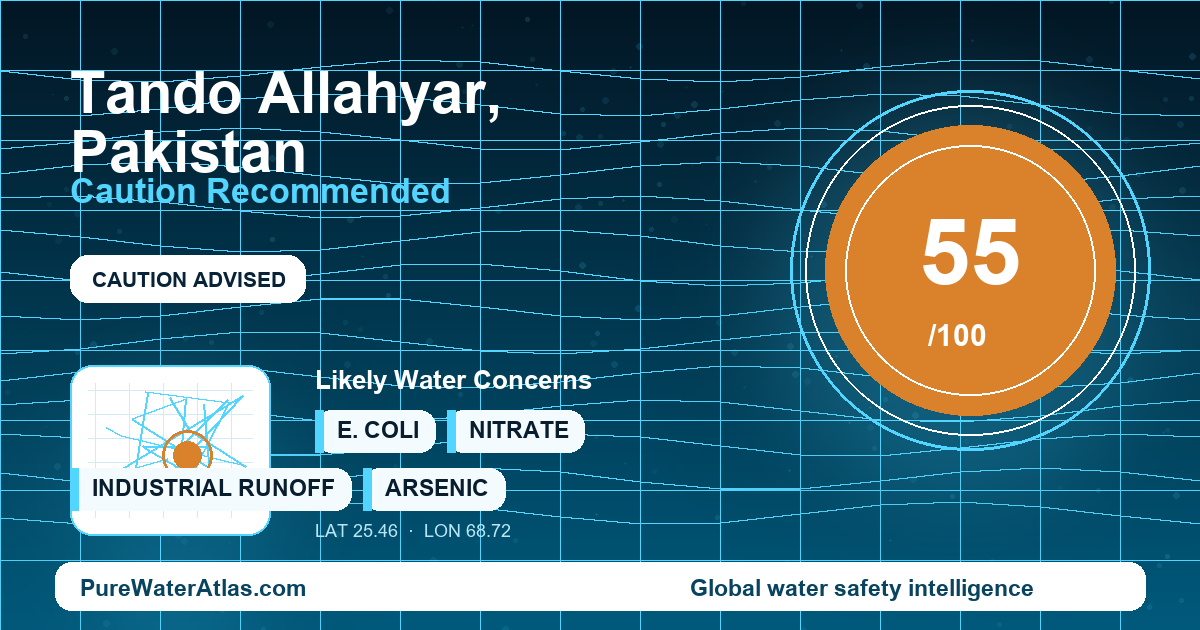
Tando Allahyar, Sindh: caution recommended for untreated tap water because the city relies on a mixed canal, municipal, groundwater, and household-storage system with limited public city-level testing disclosure.
Quick Answer
| Overall safety status | Caution recommended. Tando Allahyar tap water should not be assumed safe to drink without treatment, especially for visitors, infants, pregnant people, immunocompromised people, and households using private boreholes or poorly maintained storage tanks. |
|---|---|
| Water safety score | 55 / 100 — caution recommended due to microbial, storage, intermittent-supply, groundwater-salinity, and limited public-data concerns. |
| Traveler advice | Most travelers should use sealed bottled water or water that has been boiled, disinfected, or passed through a properly maintained purifier suitable for microbial risks. Avoid untreated tap water and be cautious with ice. |
| Resident advice | Treat drinking and cooking water unless recent laboratory results from the actual household tap confirm safety after storage. Test private boreholes for microbes and key chemicals. |
| Main local water system | A mixed lower-Indus system: canal-linked surface water and municipal waterworks where available, supplemented by groundwater from tube wells, hand pumps, private boreholes, and household storage. |
| Responsible institutions | Municipal Committee Tando Allahyar under Sindh local government, with Public Health Engineering Department involvement in water-supply and sanitation schemes. |
| Filter recommendation | Sediment pre-filtration plus reliable disinfection for municipal or canal-influenced water; reverse osmosis may be needed where groundwater is saline or testing shows arsenic, nitrate, or high TDS. |
Why Tando Allahyar Is Different
Tando Allahyar is an agricultural district town in Sindh, east of Hyderabad, on the lower Indus alluvial plain. That setting matters for drinking water. The surrounding land is heavily canal-irrigated, so drinking-water risk is shaped not only by municipal supply, but also by canal water, shallow groundwater, irrigation return flows, drains, and household storage practices.
The practical safety question in Tando Allahyar is not simply “is there a tap?” The delivery chain is central. Intermittent pumping, low pressure, ageing distribution lines, proximity of drains or sewers, and rooftop or underground storage tanks can allow contamination after water leaves a treatment point or source. Clear-looking water is therefore not proof of safety: canal-derived water can become more turbid after rains or operational changes; groundwater can be salty while still appearing clear; and stored water can become unsafe if tanks are uncovered, cracked, biofilm-coated, or rarely cleaned.
Public, current, city-specific municipal test reports for Tando Allahyar are not readily available. This profile therefore does not claim exact compliance percentages, neighborhood-level safety, daily chlorine residuals, or a verified production split between canal water and groundwater. The recommendation is based on the city’s local water identity, Sindh infrastructure context, Pakistan water-quality evidence, and public-health guidance from national and international sources.
Where Does Tando Allahyar’s Tap Water Come From?
Tando Allahyar’s urban supply is best understood as a mixed local system. The city sits in the canal-irrigated lower Indus plain, where canal-fed surface water from the Indus irrigation network and municipal waterworks may serve parts of the urban area. Where municipal supply is unavailable, unreliable, or not preferred for drinking, households may rely on groundwater from tube wells, hand pumps, private boreholes, small local filtration points, reverse-osmosis points, or stored water.
Important infrastructure elements include the Municipal Committee Tando Allahyar water-supply network, canal-linked surface-water supply and local waterworks where functioning, Public Health Engineering Department schemes, ground storage reservoirs, overhead tanks, pumping stations, household underground and rooftop storage tanks, and private boreholes or hand pumps. Open drains, ageing sewers, and street-level distribution lines are also relevant because they can create contamination risk when water pressure is low.
Historically, like many towns in interior Sindh, older and peripheral households have relied on shallow groundwater, hand pumps, and private boreholes when piped supply is intermittent. In lower Sindh, groundwater commonly faces salinity and total dissolved solids problems, while canal water can carry turbidity and microbial load if settling, filtration, and residual chlorination are inadequate.
Who Manages Drinking Water in Tando Allahyar?
Local urban service responsibility sits with Municipal Committee Tando Allahyar under the Government of Sindh local-government system. The Local Government Department, Government of Sindh provides the relevant local governance context for municipal services. The Public Health Engineering Department, Government of Sindh is also a key implementing agency for water-supply and sanitation schemes in Sindh districts, especially outside major metropolitan utility systems.
Water-quality research and testing context may involve the Pakistan Council of Research in Water Resources, while standards and environmental regulation are framed by Pakistan and Sindh authorities, including the Pakistan Environmental Protection Agency and the Sindh Environmental Protection Agency. Pakistan has National Standards for Drinking Water Quality, but Tando Allahyar does not have publicly available routine consumer confidence reporting comparable to some high-income country systems.
For residents, this means safety should not be inferred from the existence of a municipal tap alone. Actual safety depends on source condition, treatment performance, residual chlorination, pipe integrity, pumping pressure, household storage hygiene, and recent testing at the tap used for drinking.
Main Local Water Concerns
- Microbial contamination: The main immediate health risk is contamination by organisms such as E. coli or faecal coliforms. Intermittent supply, leaking pipes, drain proximity, low pressure, insufficient chlorine, and household storage tanks can all contribute.
- Turbidity and sediment: Canal-influenced water can carry turbidity and sediment, especially during monsoon runoff, canal disturbance, or poor settling and filtration. High turbidity can also reduce the reliability of disinfection.
- Low or absent residual chlorine: Chlorine residual is a key protective indicator in piped systems, but it can decay during intermittent supply, long storage, high summer heat, or movement through compromised pipes.
- Salinity and high TDS: Groundwater or private boreholes in parts of lower Sindh may have high total dissolved solids, hardness, chloride, sulfate, or unpleasant salty taste.
- Nitrate: Nitrate is relevant for shallow groundwater influenced by sanitation leakage, animal waste, fertilizer use, or agricultural return flows.
- Arsenic: Arsenic is a recognized concern in parts of Pakistan’s Indus alluvial aquifers, including Sindh. It should be tested in private groundwater rather than assumed absent or present at a specific address.
- Seasonal stress: Monsoon rains can increase drain overflow, sewage intrusion, turbidity, and shallow groundwater contamination risk. Summer heat can accelerate chlorine loss and microbial regrowth in rooftop tanks. Canal closures, desilting, low-flow periods, and power outages can reduce reliability and push households toward sources of variable quality.
For Travelers
Do not drink untreated tap water in Tando Allahyar. For most short-term visitors, sealed bottled water from a reputable source is the simplest option. If bottled water is not available, use water that has been boiled, disinfected, or passed through a maintained purifier suitable for microbial contamination. The CDC Travelers’ Health guidance for Pakistan supports conservative food and water precautions for travelers.
Use bottled, boiled, or properly filtered water for brushing teeth, especially if you are new to the area, have a sensitive stomach, or are visiting during monsoon conditions or after a power or supply outage. Avoid rinsing toothbrushes with untreated tap water when the water has visible sediment, odor, or uncertain storage conditions.
Avoid ice unless you know it was made from treated water. In small restaurants, roadside stalls, and private events, assume ice may have been made from municipal or borehole water of uncertain quality. Better hotels may provide bottled or filtered water, but do not assume kitchen water, unsealed jugs, or ice are treated. Ask for sealed bottles, check seals, and choose hot tea or boiled beverages when bottled water is not available.
During hot weather, carry oral rehydration salts. Use treated water for babies’ formula, medications, and oral care. If you are a short-term visitor, be cautious with raw foods washed in untreated water.
For Residents
For Tando Allahyar households, treatment is advisable for drinking and cooking water unless recent laboratory testing confirms safety at the tap after household storage. For municipal or canal-influenced water, a practical approach is sediment pre-filtration followed by reliable disinfection: boiling, UV with pre-filtration, chlorination, or a properly maintained purifier. PureWaterAtlas guides on boiling water purification and UV water purification explain where these methods help and where they do not.
For salty groundwater, high TDS, or testing that confirms arsenic or nitrate, disinfection alone is not enough. A certified reverse-osmosis system may be needed, with maintenance and periodic testing. Residents using private boreholes or hand pumps should test for E. coli or thermotolerant coliforms, total coliforms, turbidity, residual chlorine if chlorinated supply is used, pH, electrical conductivity, total dissolved solids, hardness, arsenic, nitrate, chloride, sulfate, iron, manganese, and salinity indicators.
Test the actual drinking tap after water has passed through rooftop or underground storage, not only the municipal source or borehole head. Retest after monsoon flooding, drain overflow, pipe repairs, new borehole installation, or any change in taste, odor, color, or sediment. If infants, pregnant people, elderly residents, or immunocompromised people use the water, prioritize bacteriological testing and nitrate testing.
Older buildings can add risk after water reaches the street main. Lead service-line inventories are not the main framing issue here, but lead-bearing brass fittings, solder, galvanized pipes, corroded plumbing, and dirty building tanks can affect water. Flush stagnant water before use and test if plumbing materials are unknown. Keep household tanks covered, screened from insects and dust, separated from sewer or drain leakage, and cleaned and disinfected periodically.
Relevant Contaminants and Water-Quality Issues
The most relevant PureWaterAtlas contaminant profiles for Tando Allahyar are microbial indicators, turbidity, disinfectant residual, groundwater chemicals, and sediment. Start with E. coli because it is the most important immediate sign of faecal contamination in a system affected by intermittent supply, drains, and storage. Review turbidity and sediment if your water becomes cloudy, gritty, or visibly affected after rain or supply interruptions.
For piped water, chlorine matters because residual chlorine helps protect water during distribution, but it may be absent at the household tap after long storage or pressure problems. For private boreholes and hand pumps, see arsenic and nitrate. The detailed PureWaterAtlas guides on arsenic testing, nitrate testing, and agricultural runoff are especially relevant in an agricultural district on the lower Indus plain.
How to Verify Your Water Quality
The only way to confirm safety for a Tando Allahyar household is to test the water actually used for drinking. Prefer a recognized laboratory where possible, such as PCRWR-linked testing facilities, a government laboratory, university laboratory, or accredited private lab. A single clear glass test is not enough: microbial contamination, nitrate, arsenic, residual chlorine loss, and high TDS may not be obvious by sight.
Use the PureWaterAtlas Water Testing guide to choose parameters and understand results. The broader Drinking Water Safety guide explains how to decide whether tap water is safe, while Water Microbiology covers bacteria, viruses, and microbial risks. For treatment planning, see Water Purification Methods.
You can also compare practical city guidance using the Global Water Quality Checker and look up individual lab-result terms in the Contaminants Search Engine. Relevant PureWaterAtlas categories include Drinking Water Safety, Water Testing, Water Microbiology, and Water Purification.
Official and Technical Sources
- Pakistan Council of Research in Water Resources — national water research and testing authority used for Pakistan and Sindh water-quality context.
- Public Health Engineering Department, Government of Sindh — provincial water-supply and sanitation implementing department relevant to Sindh district schemes.
- Local Government Department, Government of Sindh — local-government framework for Municipal Committee Tando Allahyar.
- Sindh Environmental Protection Agency — provincial environmental regulation and pollution-control context.
- Pakistan Environmental Protection Agency — national environmental and standards context.
- WHO/UNICEF Joint Monitoring Programme — Pakistan WASH context and distinction between improved sources and safely managed water.
- World Health Organization Guidelines for Drinking-water Quality — public-health basis for microbial safety, turbidity, disinfection, and risk management.
- CDC Travelers’ Health: Pakistan — traveler food and water precautions.
- Pakistan Bureau of Statistics — administrative and geographic context.
- World Bank: Pakistan, Getting More from Water — Pakistan water-sector context on service reliability, irrigation dependence, and water-quality pressures.
Bottom Line
Tando Allahyar tap water deserves caution, not automatic trust. The city’s lower-Indus setting, canal-influenced supply, groundwater use, intermittent delivery, drain proximity, and household storage tanks create practical risks that can change by season and by address. Travelers should use sealed bottled water or properly treated water for drinking, brushing teeth, and baby formula, and should avoid uncertain ice. Residents should test the actual household tap after storage and treat drinking water unless recent results confirm safety. Sediment filtration plus disinfection is a sensible baseline for municipal or canal-influenced water; reverse osmosis may be needed for salty groundwater or confirmed arsenic, nitrate, or high TDS. Because current public Tando Allahyar test data are limited, local laboratory testing is the most reliable decision tool.
Read the full guide: Global Water Quality Guide
Explore more in this category: Global Water Quality Articles