
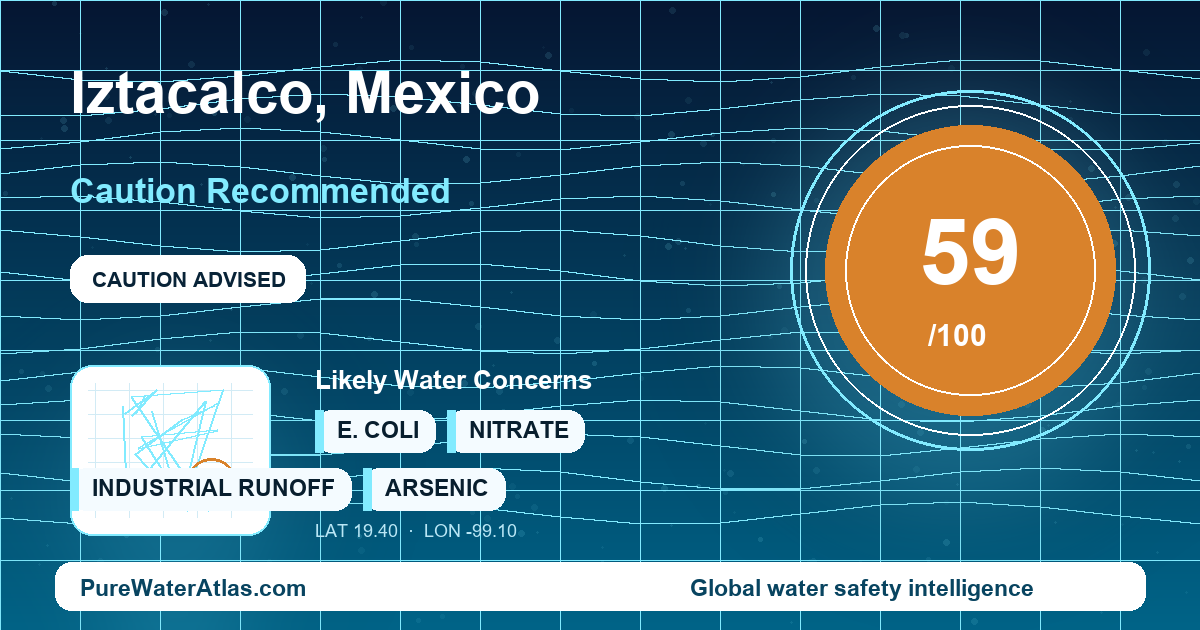
Iztacalco tap water is part of the Mexico City public system: treated and chlorinated before distribution, but faucet safety depends heavily on local pipes, pressure stability, building cisterns, rooftop tanks, and household filtration.
Quick Answer
| Water safety score | 59 / 100 |
|---|---|
| Risk level | Caution Recommended |
| Is tap water safe to drink? | Caution recommended. Iztacalco receives treated water through the Mexico City system, but untreated tap water should not be assumed safe at the faucet unless the building plumbing, cistern, tinaco, and tap water quality have been verified. |
| Traveler advice | Most short-term visitors should drink sealed bottled water or water from a verified hotel, restaurant, garrafón, or purification system. Avoid street drinks and ice of unknown origin. |
| Resident advice | Treat water safety as building-specific. Test at the kitchen tap, maintain cisterns and rooftop tanks, and use certified point-of-use treatment for drinking and cooking. |
| Main water source | Mexico City’s mixed supply: Valley of Mexico groundwater, imported Cutzamala System water, and other regional infrastructure such as Lerma depending on operations. |
| Water authority | Sistema de Aguas de la Ciudad de México, SACMEX. |
| Filter recommendation | Recommended for drinking and cooking unless recent tap testing and building maintenance confirm acceptable quality. Consider sediment prefiltration plus activated carbon, or reverse osmosis where dissolved solids, salinity, metals, or extra caution are concerns. |
Why Iztacalco Is Different
Iztacalco is not a separate water-utility city with one simple source and one simple distribution story. It is a dense central-eastern borough inside Mexico City, supplied as part of the capital’s larger hydraulic network. That matters because the water may be treated before it reaches the borough, but the condition at a kitchen tap can be shaped by the final stretch of distribution pipes, pressure history, building plumbing, cisterns, and rooftop storage tanks.
The borough’s setting is also important. Iztacalco sits on former lakebed terrain in the Valley of Mexico. This low-lying lacustrine context differs from hillier western parts of Mexico City. Soft soils, urban subsidence, buried infrastructure stress, flooding exposure, and pipe movement can all increase the practical importance of local maintenance. The key issue is not a single named contaminant unique to Iztacalco; it is the interaction of treated municipal water with an aging, complex urban distribution and storage environment.
For this reason, the safest interpretation is cautious: the municipal system is managed and chlorinated, but untreated tap water in Iztacalco should not be treated as automatically potable at every faucet. Building-level conditions can change the risk substantially from one apartment, school, small hotel, or business to the next.
Where Does Iztacalco’s Tap Water Come From?
Iztacalco is supplied within the Mexico City metropolitan drinking-water network operated by SACMEX. Publicly available information does not support a claim that every Iztacalco tap receives one fixed water source at all times. Mexico City’s supply generally includes groundwater pumped from the Valley of Mexico aquifer system and imported surface water from the Cutzamala System, with contributions from other regional infrastructure such as the Lerma system depending on operating conditions.
This mixed-source reality is important for residents and travelers. Groundwater in parts of the Mexico City basin can present mineralization, salinity, hardness, or other geochemical concerns, while imported surface water availability can be affected by drought and storage conditions. The dataset available for this profile does not prove that all of these issues appear at every Iztacalco tap. Instead, it shows why citywide statements should be combined with tap-level testing and building inspection.
The final infrastructure before water reaches many homes is especially important in Iztacalco. Local building cisterns and rooftop tanks, known as cisternas and tinacos, may store water before it enters indoor plumbing. If these tanks are dirty, uncovered, poorly sealed, or not disinfected, they can reduce water safety even when incoming municipal water has been treated.
Who Manages Drinking Water in Iztacalco?
Drinking-water service in Iztacalco is managed as part of the Mexico City system, not by an independent borough water utility. The responsible water authority is Sistema de Aguas de la Ciudad de México, SACMEX, which is responsible for drinking-water service, drainage, and hydraulic operation in Mexico City boroughs including Iztacalco.
Federal water policy and national water information are under CONAGUA, whose publications such as Estadísticas del Agua en México provide broader context for Mexican water resources, infrastructure, and regional water stress. Drinking-water quality requirements are set through national sanitary standards, including NOM-127-SSA1-2021, which establishes permissible quality limits and treatment requirements for water for human use and consumption.
The most important limitation for Iztacalco is data granularity. Public information is stronger for Mexico City as a whole, SACMEX operations, Cutzamala supply, national standards, and risk mapping than for continuously updated Iztacalco neighborhood-by-neighborhood tap samples. The Portal de Datos Abiertos de la Ciudad de México is a useful official place to check for updated local datasets, but household decisions should still account for building-specific plumbing and storage conditions.
Main Local Water Concerns
The main water concerns in Iztacalco are practical and infrastructure-related. Intermittent supply, pressure drops, pipe repairs, and low-pressure periods can increase the chance of intrusion through leaks or cross-connections in aging networks. After outages or flow changes, residents may notice sediment, turbidity, discoloration, or unusual taste. These events are especially important because pressure variation can also affect disinfectant residuals and the cleanliness of water entering storage tanks.
Residual chlorine is a key protective factor in a large urban system, but it can decline inside private cisterns, rooftop tanks, and long internal plumbing runs. For background on this disinfectant issue, see PureWaterAtlas on chlorine in drinking water. If storage tanks are open, dusty, contaminated by insects, or not cleaned after flooding or service interruptions, microbial risk can increase before water reaches the kitchen tap.
Older buildings in Iztacalco require extra caution. Municipal treatment data cannot rule out problems created inside a property. Legacy plumbing components, old valves, solder, brass fixtures, or internal corrosion can contribute metals under some circumstances, including building-specific lead risk. This cannot be confirmed or dismissed without proper sampling.
Seasonal and operational conditions also matter. During the dry season and drought periods, reduced availability of imported water such as Cutzamala supply can affect operating arrangements. During the rainy season, turbidity episodes, drainage stress, localized flooding, and compromised storage tanks can increase risk. The Atlas de Riesgos de la Ciudad de México is relevant for understanding broader risks such as subsidence, flooding, soil conditions, and infrastructure vulnerability.
For Travelers
Most visitors to Iztacalco should not drink untreated tap water. The practical recommendation is to use sealed bottled water, professionally purified water, or water that has been boiled or treated with a reliable purifier. Check bottle seals, especially when buying water from small shops or informal sources.
For brushing teeth, risk-tolerant travelers may use tap water in modern hotels that confirm filtration or purified water systems. More cautious travelers, children, pregnant travelers, and people with sensitive stomachs should use bottled or purified water for brushing. For medications, infant formula, oral rehydration, and wound cleaning, use bottled or otherwise verified safe water.
Ice should be treated as a separate risk. Use ice only when it is commercially made or served by a reputable hotel, café, or restaurant that can confirm purified water use. Avoid ice from informal vendors or places that cannot explain the source. The same caution applies to aguas frescas, street beverages, smoothies, and drinks diluted with unknown tap water.
Higher-end hotels and established restaurants in Mexico City commonly provide purified water, garrafón water, or in-house filtration, but visitors should still ask. In short-term rentals in Iztacalco, do not assume the kitchen tap is potable. Ask whether the building uses a cistern or tinaco, whether the tanks are maintained, and whether drinking water is filtered.
For general travel health context, the U.S. CDC’s Travelers’ Health guidance for Mexico supports conservative food and water precautions.
For Residents
For Iztacalco residents, the safest approach is to manage water quality at the building and tap level. A home filter is recommended for drinking and cooking unless the household has recent test results and a well-maintained internal water system. A practical setup may include sediment prefiltration to reduce particles, activated carbon for taste, chlorine, and some organic compounds, and reverse osmosis where dissolved solids, salinity, metals, or extra caution are concerns. Filters should be certified for the target contaminant and maintained on schedule.
Testing should be done at the kitchen tap, not only by relying on citywide information. Useful tests include total coliforms and E. coli, turbidity, residual chlorine, pH, conductivity or total dissolved solids, hardness, nitrate, iron, manganese, and metals such as lead and arsenic where concern exists. If testing for lead, use proper first-draw and flushed samples so results can distinguish building plumbing contributions from incoming supply.
Retest after major plumbing work, cistern cleaning, flooding, long outages, visible discoloration, unusual taste, or recurring stomach illness in the household. If a building has recurring microbial concerns, checking residual chlorine at the tap and after storage tanks can help identify where protection is being lost.
Cisterns and tinacos should be covered, sealed against insects and dust, cleaned and disinfected periodically, and inspected after flooding or water outages. In Iztacalco, these storage systems are often the practical last barrier before the faucet. A dirty or open tank can make treated incoming water unsafe before anyone drinks it.
Relevant Contaminants and Water-Quality Issues
The most relevant Iztacalco issues are linked to distribution, storage, and building plumbing rather than one confirmed borough-wide contaminant. After repairs, outages, or pressure changes, turbidity and sediment may appear. These are not just aesthetic issues: cloudy or particle-laden water can indicate disturbed pipes, storage-tank problems, or conditions that make disinfection less reliable.
Microbial indicators are especially important when cisterns, rooftop tanks, or pressure losses are involved. Testing for total coliforms and E. coli helps assess whether fecal or environmental contamination may be present. For deeper background, see PureWaterAtlas on water microbiology.
Metals are more building-specific. Lead risk in Iztacalco cannot be ruled out from municipal treatment statements alone, especially in older buildings with legacy plumbing components. Helpful resources include lead testing methods and lead filter solutions. Where arsenic is a concern, see arsenic testing methods.
How to Verify Your Water Quality
The best verification step in Iztacalco is a kitchen-tap test combined with an inspection of the building’s water storage. Use an accredited laboratory where possible, especially for microbiological indicators and metals. Household test strips may be useful for screening residual chlorine or general chemistry, but they should not replace lab testing when health decisions depend on the result.
If water is visibly cloudy, rusty, discolored, or has an unusual odor after a service cut or repair, flush the tap and avoid using it untreated for drinking until it clears and has been treated. Boiling can reduce microbial risk, but it does not remove dissolved metals, salts, or many chemicals. For method guidance, see PureWaterAtlas on boiling water purification and UV water purification.
For broader decision-making, use the PureWaterAtlas Drinking Water Safety guide, the Water Testing guide, the Water Treatment Systems guide, the Global Water Quality resource, the Contaminants Search Engine, and the Global Water Quality Checker.
Official and Technical Sources
- Sistema de Aguas de la Ciudad de México, SACMEX — Mexico City water authority responsible for drinking-water service and hydraulic operation.
- Portal de Datos Abiertos de la Ciudad de México — official open-data portal for checking updated city datasets.
- Sistema Cutzamala, CONAGUA — official description of a major imported supply for Mexico City and the metropolitan area.
- Estadísticas del Agua en México, CONAGUA — national water resources and infrastructure reference.
- NOM-127-SSA1-2021 — Mexican drinking-water quality standard for water for human use and consumption.
- Atlas de Riesgos de la Ciudad de México — official risk mapping relevant to flooding, subsidence, soils, and infrastructure vulnerability.
- CDC Travelers’ Health: Mexico — travel health guidance supporting conservative food and water precautions.
- World Health Organization drinking-water fact sheet — general public-health reference on safe drinking water and contamination risks.
Bottom Line
Iztacalco tap water should be approached with caution. The borough is served by Mexico City’s treated and chlorinated public water system, managed by SACMEX, but public data are not detailed enough to guarantee safety at every neighborhood, block, building, or faucet. Local risk is shaped by the former lakebed setting, subsidence-related infrastructure stress, pressure interruptions, repairs, sediment, declining chlorine residual, older internal plumbing, cisterns, and rooftop tinacos. Visitors should use sealed bottled or verified purified water, especially for drinking, ice, and sensitive uses. Residents should test at the kitchen tap, maintain storage tanks, and use certified filtration for drinking and cooking unless recent results and building conditions confirm acceptable water quality.
Read the full guide: Global Water Quality Guide
Explore more in this category: Global Water Quality Articles