
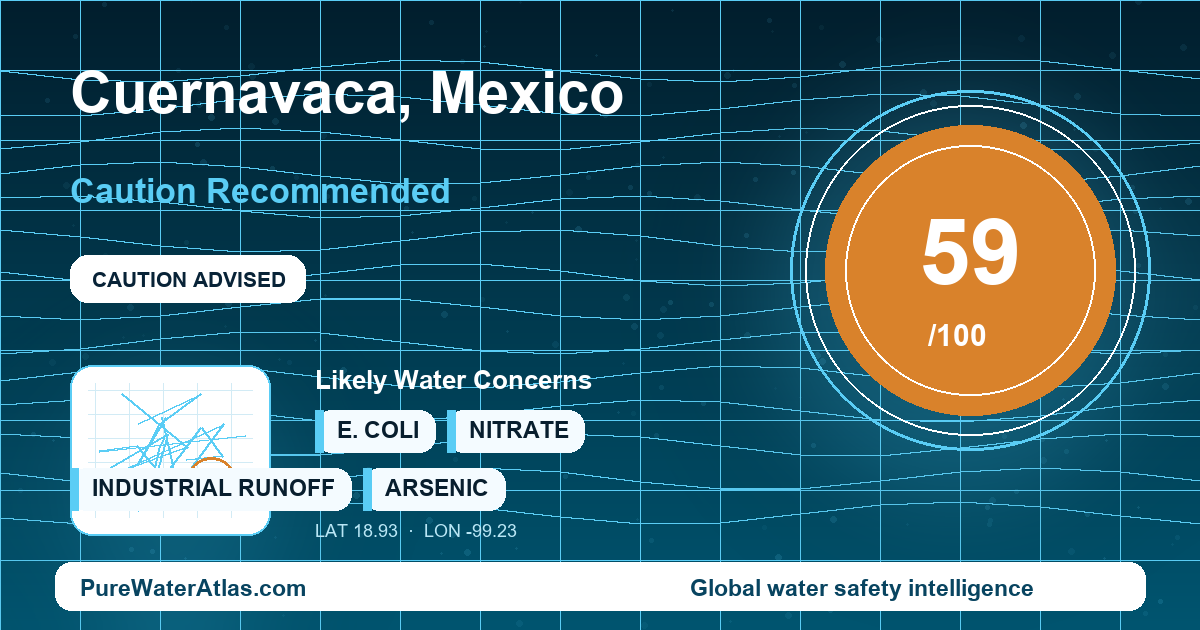
Cuernavaca, Morelos has a groundwater-based municipal system managed by SAPAC, but intermittent service, aging distribution lines, private cisterns, rooftop tinacos, and limited public neighborhood-level test data mean caution is recommended at the tap.
Quick Answer
| Water safety score | 59 / 100 |
|---|---|
| Risk level | Caution Recommended |
| Can travelers drink the tap water? | Generally no. Visitors should use sealed bottled water, garrafón water, boiled water, or water from a clearly maintained purification system. |
| Resident guidance | Treat tap water as potentially usable after point-of-use treatment rather than automatically potable from every tap. |
| Main water source | Primarily municipal groundwater wells in the Cuernavaca aquifer area, with local spring or manantial contributions historically important in parts of the system. |
| Water authority | SAPAC, the Sistema de Agua Potable y Alcantarillado del Municipio de Cuernavaca, with broader water-resource oversight by CONAGUA and national drinking-water standards under NOM-127-SSA1-2021. |
| Recommended home treatment | Sediment filtration plus activated carbon as a baseline; add UV disinfection or reverse osmosis where storage-tank conditions, microbial risk, nitrate, metals, dissolved solids, or taste issues warrant it. |
Overall verdict: Caution is recommended. Cuernavaca has an organized municipal water system, but the practical drinking-water risk is increased by intermittent service, household storage tanks, older plumbing, pipe disturbances, and limited public access to recent Cuernavaca-specific finished-water compliance results.
Why Cuernavaca Is Different
Cuernavaca is not a city whose drinking-water profile can be understood only by asking whether a treatment plant meets a standard. The city sits on the southern flank of the Sierra de Chichinautzin in Morelos, in a landscape of ravines, recharge zones, springs, and groundwater discharge areas connected to the Apatlaco River basin. That geography makes aquifer condition, urban runoff, wastewater management, and storm-season movement of sediment directly relevant to local water security.
The city has long been associated with springs and abundant water, but the modern drinking-water situation is more complex. Urban growth, paved surfaces, higher water demand, and pressure on wells have made groundwater management and infrastructure maintenance more important than Cuernavaca’s historical image as a naturally water-rich city might suggest.
For many homes, apartments, rentals, and small businesses, the decisive risk is the final segment of the water system: building plumbing, cisterns, rooftop tinacos, pumps, filters, and tap-level maintenance. One hotel or apartment may provide safe filtered drinking water at a kitchen dispenser while another tap in the same building is supplied through an older, poorly maintained tank. This local “last-meter” factor is a key reason PureWaterAtlas rates Cuernavaca as Caution Recommended rather than simply safe or unsafe.
Where Does Cuernavaca’s Tap Water Come From?
Cuernavaca’s public supply is primarily a groundwater system. The city draws heavily from municipal wells in the Cuernavaca aquifer area, with local springs or manantiales historically important in the city and surrounding ravines. The raw-water setting is a mountain-front groundwater recharge system associated with the Sierra de Chichinautzin and the Apatlaco River basin, not a large reservoir-fed surface-water system.
Key infrastructure includes municipal wells and pumping stations, spring or manantial sources in parts of the local system, chlorination points at wells, tanks, or distribution infrastructure, municipal storage tanks, and distribution mains. Because supply can be intermittent, many Cuernavaca households also use private cisterns and rooftop tinacos. These building-level tanks are not a minor detail: they can strongly influence the water that actually reaches a glass, kettle, bathroom sink, or restaurant ice machine.
Intermittent service can create pressure drops in distribution lines. In an aging network, pressure changes may increase intrusion risk, especially after pipe disturbances, main repairs, or pump restarts. Rainy-season runoff and sediment movement can also affect turbidity around ravines, springs, and poorly protected storage systems. After outages or repairs, first-flush water may appear cloudy, sandy, yellow, brown, or sediment-heavy. That water should not be used for drinking until it clears and is treated appropriately.
Who Manages Drinking Water in Cuernavaca?
The municipal water operator is SAPAC, Sistema de Agua Potable y Alcantarillado del Municipio de Cuernavaca. SAPAC is the city utility responsible for local public water and sewer service, including user-facing supply information and infrastructure operations.
At the broader water-resource level, Mexico’s national water authority, CONAGUA, oversees national water resources and water-quality programs. CONAGUA’s official aquifer documentation for the Cuernavaca aquifer 1701 supports the conclusion that the city’s supply depends strongly on groundwater resources.
Drinking-water quality in Mexico is governed nationally by NOM-127-SSA1-2021, which sets requirements for water for human use and consumption. Public-health surveillance involves health authorities, and state-level water planning and infrastructure context are also relevant through the Comisión Estatal del Agua Morelos.
Data limitation: city-level information is available for the utility identity, aquifer context, and regulatory framework. However, recent, comprehensive, publicly searchable Cuernavaca finished-water results by contaminant, date, and neighborhood are limited. For that reason, this profile does not claim universal compliance or universal noncompliance. It focuses on documented system characteristics and practical risk factors.
Main Local Water Concerns
- Intermittent service: Pressure drops can increase intrusion risk in older distribution lines, especially after outages, repairs, or pump restarts.
- Private cisterns and tinacos: Household storage can introduce microbial contamination if tanks are uncovered, cracked, poorly cleaned, or supplied after dirty-water events.
- Turbidity and sediment: Cloudiness, sand, yellow or brown color, and visible particles can occur after main repairs, pipe disturbances, pump restarts, or heavy rain periods.
- Storm-season influence: Rainy season can increase runoff, sediment movement, and contamination risk around ravines, springs, and poorly protected storage systems.
- Dry-season supply pressure: Dry periods can intensify pumping dependence and intermittent service in some areas.
- Wastewater and runoff context: Urban runoff, sewage leakage, and wastewater management in the Apatlaco basin are relevant to environmental water quality and may matter for springs, shallow groundwater influence, or vulnerable local sources.
- Nitrate as a site-specific concern: Nitrate should be considered in testing where wells, septic influence, agriculture, or wastewater impacts are possible, but a citywide exceedance should not be assumed without site-specific data.
- Lead as a building-specific concern: Lead is not identified here as a documented citywide crisis, but older plumbing, brass fixtures, solder, and stagnant water in old buildings can justify testing.
For Travelers
Most travelers should not drink untreated tap water in Cuernavaca. The water may be chlorinated within the municipal system, but visitors should not assume every tap is potable because the final water quality can be affected by intermittent distribution, building storage tanks, and unknown maintenance practices.
Use sealed bottled water, garrafón water from a reliable source, water from a clearly maintained purification system, or water that has been boiled or disinfected appropriately. This is especially important for short-stay travelers, children, pregnant travelers, older adults, and immunocompromised people. For hot drinks, make sure the water has reached a full boil; see the PureWaterAtlas Boiling Water Purification Guide for practical details.
For brushing teeth, many healthy adults brush with tap water without incident, but cautious travelers should use bottled or purified water, particularly after outages, during dirty-water events, or in older rentals where tank maintenance is unknown. Avoid drinking from bathroom taps, garden taps, rooftop-tank-fed taps, or any tap producing cloudy, colored, earthy-smelling, or sediment-heavy water.
Use ice only if it is commercially produced or supplied by a reputable hotel or restaurant using purified water. In better hotels and established restaurants, purified water is commonly used for drinking and ice, but it is still sensible to ask whether the water and ice come from garrafón, bottled water, or a maintained purification system. The CDC Mexico traveler guidance supports cautious use of safe bottled, disinfected, or properly treated water while traveling.
For Residents
Cuernavaca residents should treat tap water as potentially usable after point-of-use treatment rather than automatically potable from every tap. A practical household setup begins with a sediment prefilter to reduce particles and an activated carbon filter to improve taste, odor, and chlorine-related issues. Where water passes through a cistern or rooftop tinaco, a microbiological barrier such as UV disinfection should be considered. Reverse osmosis is appropriate where testing shows nitrate, elevated dissolved solids, metals, or persistent taste problems.
Testing should be done at the actual kitchen tap used for drinking. Test for total coliform and E. coli, especially if water comes through a cistern or rooftop tank. Check free chlorine residual at the tap during normal supply and after outages; lack of residual can indicate higher microbial vulnerability. If water becomes cloudy, sandy, yellow, or brown after repairs or pump restarts, test turbidity and basic physical parameters before relying on it for drinking.
Residents should test nitrate where a private well is used, where septic or wastewater influence is possible, or where infants or pregnant residents will consume the water. In older buildings, test lead and other metals after long stagnation, where older fixtures are present, or where plumbing materials are unknown. First-draw and flushed samples are both useful because they can distinguish building-plumbing effects from incoming water quality.
Cisterns and rooftop tinacos should be covered, screened, structurally sound, and cleaned at least once or twice per year, and sooner after dirty-water events. A dirty or uncovered tank can defeat municipal chlorination and become the main contamination source inside the home.
Relevant Contaminants and Water-Quality Issues
The most relevant Cuernavaca water-quality issues are practical and system-specific rather than based on a single publicly documented citywide contaminant exceedance. Chlorine matters because residual disinfectant helps control microbial risk, but residual can decline during storage, stagnation, or long distribution times. Turbidity and sediment are important after pipe work, pump restarts, outages, or heavy rains because particles can interfere with disinfection and indicate system disturbance.
E. coli is a key indicator for fecal contamination and should be included in testing where cisterns, rooftop tanks, private wells, or unknown storage conditions are involved. Nitrate should be considered in site-specific testing where wastewater, septic influence, agriculture, or well vulnerability may be relevant; PureWaterAtlas also has a detailed guide to nitrate testing and detection methods. Lead is mainly a building-specific concern in Cuernavaca, so older homes, older plumbing, brass fixtures, solder, and stagnant lines justify targeted testing; see the guide to lead testing and detection methods.
How to Verify Your Water Quality
The most reliable way to know whether water is safe in a specific Cuernavaca home, rental, hotel, school, or business is to test the water at the point of use. Start with microbial testing, free chlorine residual, turbidity, and basic chemistry. Add nitrate testing where well or wastewater influence is plausible, and add metals testing in older buildings or after long stagnation.
PureWaterAtlas resources that are especially relevant for Cuernavaca include the Water Testing Guide, the Drinking Water Safety Guide, the Water Microbiology Guide, and the Water Treatment Systems Guide. For disinfection, review the UV Water Purification Guide.
You can also explore the Contaminants Search Engine and compare city-level safety context using the Global Water Quality Checker. Category hubs for further reading include Drinking Water Safety, Water Testing, Water Microbiology, and Water Purification.
Official and Technical Sources
- SAPAC Cuernavaca official site — municipal water and sewer utility responsible for Cuernavaca public water service.
- CONAGUA: Cuernavaca aquifer 1701 availability document — official aquifer context for groundwater dependence.
- NOM-127-SSA1-2021 — Mexico’s national standard for water for human use and consumption.
- CONAGUA water quality program information — federal water-quality monitoring and oversight context.
- Comisión Estatal del Agua Morelos — state-level water institution for Morelos.
- INEGI Cuernavaca municipal information — official geographic and municipal reference.
- CDC Mexico traveler health guidance — traveler advice supporting safe bottled, disinfected, or properly treated water.
Bottom Line
Cuernavaca’s tap water deserves a cautious, location-specific approach. The city has a municipal groundwater-based system managed by SAPAC and operates under Mexico’s national drinking-water framework, but the final water reaching a tap can be affected by intermittent service, distribution pressure changes, older pipes, cisterns, rooftop tinacos, and building plumbing. Visitors should generally avoid untreated tap water and use sealed bottled, garrafón, boiled, disinfected, or verified purified water. Residents should combine practical treatment with periodic testing, especially for microbial indicators, chlorine residual, turbidity, nitrate where relevant, and lead in older buildings. Because recent neighborhood-level public test data are limited, household verification is the safest path.
Read the full guide: Global Water Quality Guide
Explore more in this category: Global Water Quality Articles